


world
Among the Latin American countries that could increase their future share in the supply mentioned Venezuela, Guyana, Brazil and Argentina.
The managing partner of Plata Energy warned that global consumption remains at high levels while there is uncertainty about the investments needed to sustain future supply. During the XXIII Peruvian Congress of Geology, he said that global reserves would be around 1.7 trillion barrels.
Proven oil reserves in the world would last for approximately 42 years if the current level of consumption is maintained, Max Torres, managing partner of Plata Energy, said during his participation in the XXIII Peruvian Congress of Geology.
In his keynote lecture, “Future and potential of the hydrocarbons industry in Peru in the current economic and political context,” Torres focused his presentation on global energy security, the evolution of consumption, and the investment challenges facing the hydrocarbons industry.
Based on the figures presented, global reserves are around 1.7 billion barrels. When related to current consumption levels, Torres estimated an availability equivalent to about 42 years.
Global consumption reaches 105 million barrels per day
Torres said, citing OPEC figures, that global consumption and production are around 105 million barrels per day.
The specialist used these figures to put into perspective the number of new fields, projects, and investments that would be needed to maintain global energy supply in the coming decades.
He also stated that over the past 25 years, oil consumption increased by around 40%, while gas also recorded significant growth.
The energy mix would still rely 85% on fossil fuels
According to the figures shown during the conference, approximately 85% of the world’s energy mix currently comes from fossil fuels, while the remaining 15% comprises other sources, including renewables and nuclear energy.
Torres linked this composition to population growth and emerging economies, especially due to the increase in energy demand recorded in recent decades.
China was one of the central examples of his presentation. According to the data presented, the Asian country currently consumes around 55% of the world’s coal, while this source would account for about 50% of its energy mix.
Projections show wide uncertainty toward 2050
One of the main challenges identified by Torres is the large difference between projections for future oil demand.
As he explained, different scenarios developed by international organizations and energy companies show that by 2050 there could be a spread of approximately 80 million barrels per day between the highest and lowest estimates.
In his view, this uncertainty makes investment decisions difficult because hydrocarbon projects are typically developed over 20- or 30-year horizons.
Torres stressed that the International Energy Agency and OPEC maintain important differences in their long-term scenarios, particularly regarding how oil consumption would evolve.
Torres warns of lower investment in new projects
The representative from Plata Energy stated that a gap is also observed between the projects currently approved and the production levels that might be required in the coming years.
According to his presentation, by 2030 difficulties related to financing and developing new oil and gas projects could begin to show up.
He also said that the figures presented show a recent reduction in hydrocarbon investments in different regions, although he highlighted Latin America as an exception within that trend.
Among the Latin American countries that could increase their future share in supply, he mentioned Venezuela, Guyana, Brazil, and Argentina, along with other international producers such as Canada and Qatar.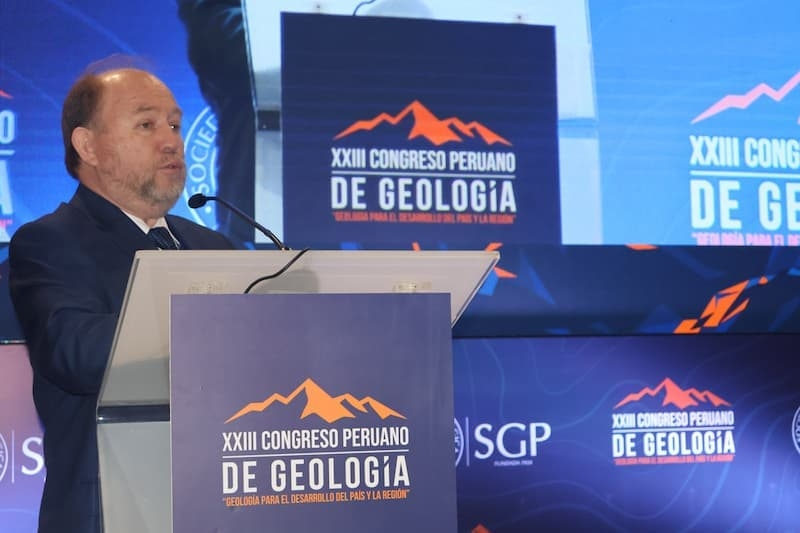
You can also read: Peru: domestic production would cover only 16% of the internal demand for hydrocarbons
Energy security returns to the center of the debate
Torres concluded that high consumption, uncertainty about demand projections, and reduced investment in new projects force the industry to discuss—more deeply—the long-term energy supply security.
In that context, he considered it necessary to analyze not only how many reserves exist, but also whether there will be enough investment and infrastructure to turn those resources into production.
For the specialist, theoretically having oil equivalent to 42 years of consumption does not eliminate supply risk if the investments needed to develop new projects do not move forward at the required pace.