

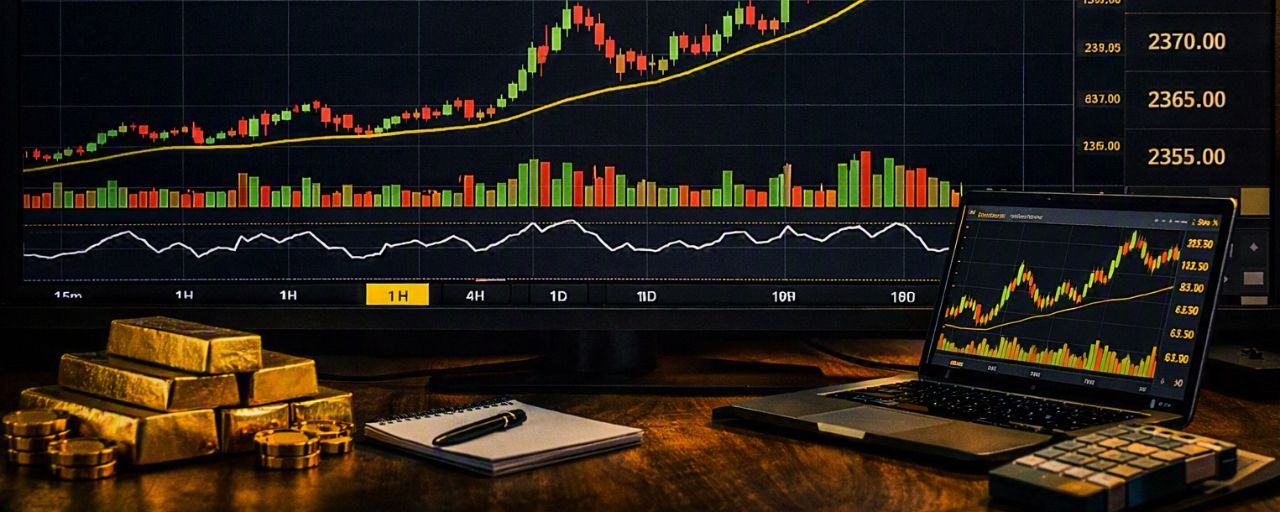

There are things that seem uninteresting for a long time until, suddenly, everyone around starts talking about them at the same time. For me, gold is exactly that kind of story. A year ago it was an asset “for conservative uncle types with bonds,” and now people who were previously interested exclusively in crypto are talking about it too.
What’s happening to the price right now
Gold this year has hit record highs, and most major investment banks, from Goldman Sachs to UBS, are revising their forecasts upward throughout the year rather than downward. The numbers in different forecasts vary—some talk about a level around five thousand dollars per ounce by year-end, while others set even higher targets—but the analysts’ overall view is basically the same: demand is being supported, not fading.
The reasons for this trend are fairly well known: central banks keep increasing their gold reserves, diversifying their holdings; uncertainty around the Fed’s interest-rate policy hasn’t gone away; and geopolitical developments in recent months also haven’t brought the market any peace. All of this pushes investors toward safe-haven assets, and gold remains the main candidate for that role, as it has for decades.
Why I’m choosing a contract right now instead of physical metal or an ETF
My earlier logic was simple: if you want gold, buy an ETF or physical metal, hold it long-term, and don’t overthink it. But the current market is exactly the case where the speed of reaction matters—not only the direction of the long-term trend. Important macroeconomic inflation data or interest-rate decisions often come out at a time when the classic gold market is already closed, and with a contract on Binance I can react immediately, without waiting for the next business day.
Second, the current high volatility itself creates opportunities for shorter trades, not just long-term holding. When the price in a day can move as much as it used to take weeks, round-the-clock access to the contract isn’t just convenient—it’s a practical advantage for those who want to trade these swings actively.
What not to forget in a market like this
High volatility is a double-edged sword, especially if you add leverage. When an asset can swing sharply in both directions over a short time, a leveraged position can just as quickly turn negative as it can turn positive. Personally, right now I’m holding smaller position sizes than I would in a calmer period, precisely because the movement amplitude is higher than usual.
The funding rate during periods of increased interest in the asset often becomes more noticeable because the imbalance between longs and shorts in the market also grows. This isn’t a reason to avoid the instrument, but a reason to look at it more carefully before holding a position for longer than a few days.
The current market backdrop is one of those rare periods when gold is back in the spotlight—not because of panic, but because of a steady, analyst-confirmed trend. For me, this means that an instrument like TradFi is more appropriate now than it would have been a year ago, precisely due to the combination of high volatility and the need to act quickly on news that doesn’t wait for the opening of the classic exchange. But that doesn’t mean acting recklessly—the speed of reaction only makes sense when the position size and leverage match the market’s real amplitude, not your desired one.