
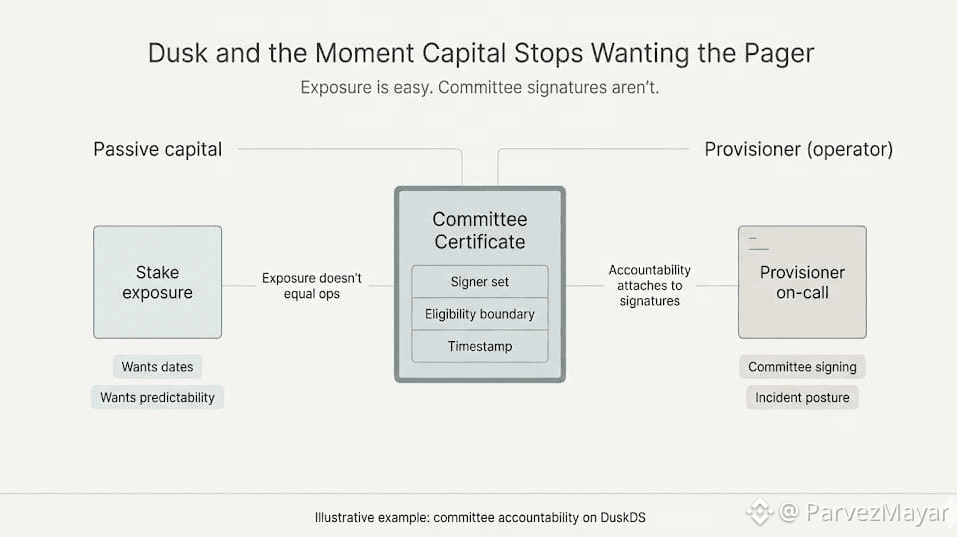


On DuskDS, not everyone who puts capital at risk wants to be the person inside the committee round when something goes weird at 3 a.m.
Not philosophy. Staffing. And liability.
Bunch of networks blur the roles because it's convenient on paper... stake shows up, 'validators' happen, rewards flow and everyone pretends the same actor is both money and ops. Then a bad night lands. Uptime slips. A compliance posture gets questioned. A committee window doesn't clear cleanly inside the attestation window... and now you have got a DuskDS-final state you can't narrate cleanly to the people waiting for the close.
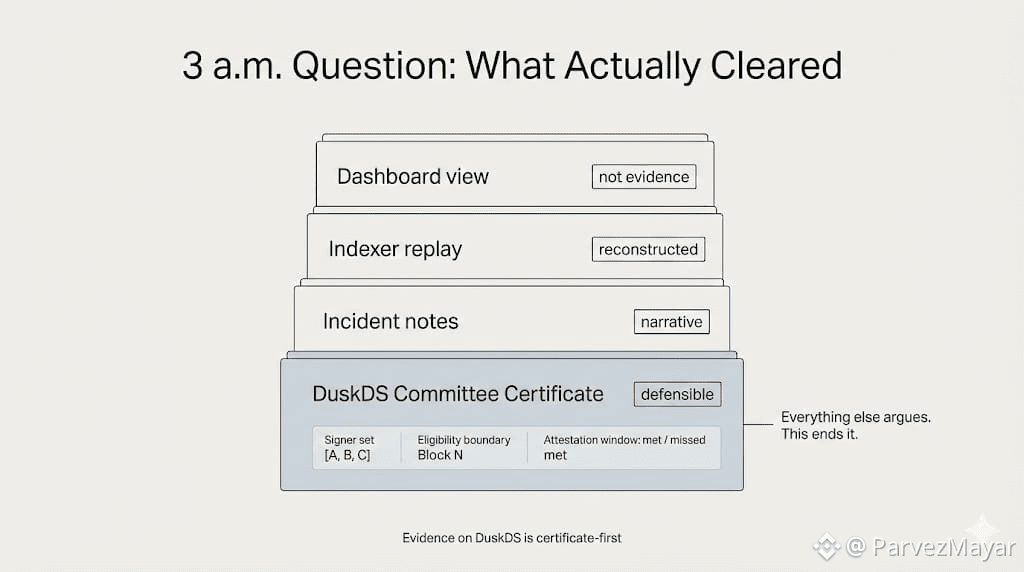
You can feel the room change right there. Somebody's phone buzzes again. The incident channel goes quiet for a beat too long. Someone posts: "Need signer list for the close". Nobody reacts for a minute.
Because now the only question that matters is boring and sharp... which Dusk's committee signatures landed and under what eligibility boundary did they become 'real' on DuskDS?
"Provisioner" is already an operator word on Dusk. If you're a Provisioner, you're running the node. You are inside Dusk ( @Dusk ) committee selection and committee signing. You're part of the machinery that finalizes state though, not a passive balance hoping the system sorts itself out.
So the split that is cherry on top is not "Provisioners vs validators" It's Provisioners versus the capital that wants exposure without being on-call. Different risk. And the blame shows up at different times. Usually the worst time.
That capital still exists. It wants dates. Maturity windows it can plan around. Reward distribution it can forecast without writing a memo about variance. And it wants the uncomfortable clause written plainly... if something breaks at finality, whose signature set made it real and can that answer be said inside scope, without widening it just to calm a room?
Dusk's Provisioners can't dodge that. Their rewards aren't 'yield' in the soft way people use the word. It's payment for being reachable, being correct, and being boring when the network is stressed and nobody has time to interpret intent. When a decision lands at the protocol layer, the blame surface isn't vibes. It is the operator set that attested under policy, or didn't.
That's when incentives stop pretending.
Passive capital stops chasing the loudest number and starts screening operators like counterparties... process, uptime discipline, incident posture, who actually shows up when deadlines hit. Provisioners stop optimizing for "more stake" as a vanity metric and start optimizing for not being the next committee headache on Dusk, because the questions come from listing desks, compliance, internal audit. People who don't accept "we meant well."
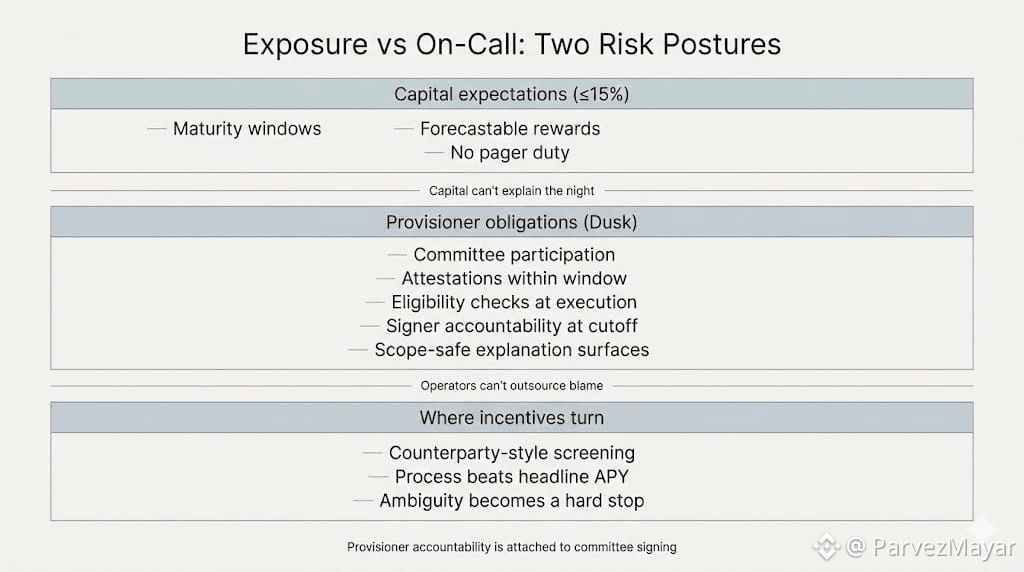
I've watched a risk desk pass on staking entirely over one line that implied accountability was fuzzy. Not returns. Not slashing. Just ambiguity: "If something goes wrong, are we expected to explain it?" Hard stop. Meeting over.
Dusk doesn't make the night safer. It just makes the alibi harder.
If you're only supplying capital, you shouldn't be forced to pretend you ran the incident. If you're operating as a Provisioner, you don't get to pretend you were "just infrastructure."
Next cutoff, same committee logic. Same incentives rubbing. Someone's drafting the sentence they'll wish they had at 3 a.m. #Dusk $DUSK