
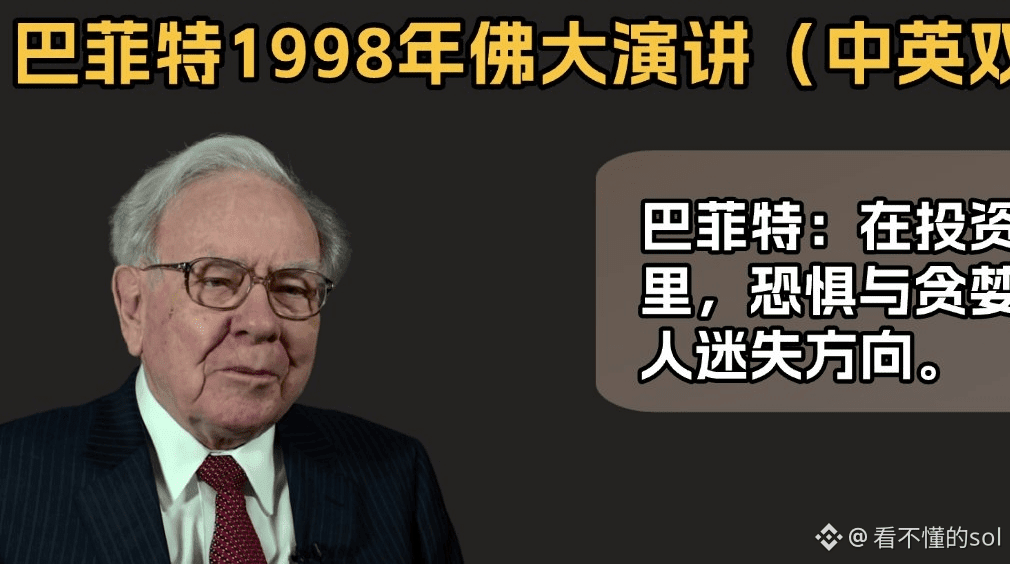

This article took 17 hours to compile, and this is Buffett's most classic speech. It is widely said that investment mogul Duan Yongping once suggested, 'I recommend you watch Buffett's speech at Florida University in 1998. You can watch it multiple times until you understand it. I have listened to this speech no less than 10 times, and it is very worth listening to carefully.' Although I couldn't find the exact original text, there is indeed a flavor of Duan Yongping's remarks on Xueqiu.
During this speech, Buffett shared his experiences in investment and life with the MBA students at the University of Florida in a simple, humorous, and even somewhat mocking tone, which is definitely worth a listen.
01 Buffett's experience and wisdom
Be with people and companies you recognize, maintain a long-term perspective, and time will yield rich rewards.
Put what you like and love at the forefront when deciding whether to do something; do not sacrifice yourself in pursuit of so-called success.
Recognize your capacity limits, do not invest in companies you do not understand, focus on companies with core competitiveness.
Do not try to understand all companies; even understanding just a part of companies can yield substantial returns.
For those who have investment capabilities, discovering a few recognized companies is enough; do not blindly diversify your investments.
Investment businesses can be understood; management must be upright and capable, and companies should be able to foresee their development over the next decade.
Distinguish between truly important and unimportant factors; company-level factors are more important and more knowable than macro-level factors.
The best investments are often not calculated but emotionally driven, when you have strong confidence in the company's products.
Whether a company is a large-cap or small-cap stock is not important; what matters is whether you recognize the company.
When the stock market falls, study the companies you might have bought more closely, as this may present buying opportunities.
Stay calm in a restless market, set aside some time and space for yourself to think.
Do not be greedy; there is always a possibility of failure in anything, leave room for error.
Learning from mistakes is inevitable, but try to learn as much as possible from others' errors.
02 Bilingual speech transcript
I would like to say a few words primarily, and then the highlight for me will be getting your questions. I want to talk about what is on your mind.
I want to start with a few words, and then for me, the most exciting part will be answering your questions. I want to talk about what you care about.
I would like to talk for just one minute to the students about your future when you leave here. Because you will learn a tremendous amount about investments, you all have the ability to do well; you all have the IQ to do well. You all have the energy and initiative to do well, or you wouldn't be here. Most of you will succeed in meeting your aspirations.
I want to spend a minute talking with you about your future after graduation. Because you will learn a lot about investments here, you all have the ability to do well; you all have enough IQ to do this. You all have the energy and initiative to do well; otherwise, you wouldn't be sitting here. Most of you will achieve your aspirations.
But in determining whether you succeed, there is more to it than intellect and energy. I would like to talk just a second about that. In fact, there was a guy, Pete Kiewit in Omaha, who used to say, he looked for three things in hiring people: integrity, intelligence, and energy. And he said if the person did not have the first two, the later two would kill him because if they don't have integrity, you want them dumb and lazy.
But in determining whether you succeed, there is more to it than intellect and energy. I would like to talk just a second about that. In fact, there was a guy, Pete Kiewit in Omaha, who used to say, he looked for three things in hiring people: integrity, intelligence, and energy. And he said if the person did not have the first two, the later two would kill him because if they don't have integrity, you want them dumb and lazy.
We want to talk about the first two because we know you have the last two. You are all second-year MBA students, so you have gotten to know your classmates. Think for a moment that I granted you the right—you can buy 10% of one of your classmate’s earnings for the rest of their lifetime. You can't pick someone with a rich father; you have to pick someone who is going to do it on his or her own merit. And I gave you an hour to think about it.
We want to talk about the first two points because we know you possess the last two. You are all MBA second-year students, so you have gotten to know your classmates quite well. Now imagine that I grant you a right—you can buy 10% of a classmate’s earnings for the rest of their lives. But you cannot choose someone with a rich father; you must select someone who will achieve success on their own merit. I give you an hour to think about this.
Will you give them an IQ test and pick the one with the highest IQ? I doubt it. Will you pick the one with the best grades? The most energetic? You will start looking for qualitative factors in addition to the quantitative because everyone has enough brains and energy. You would probably pick the one you responded the best to, the one who has the leadership qualities, the one who is able to get other people to carry out their interests. That would be the person who is generous, honest, and who gave credit to other people for their own ideas. All types of qualities. Whomever you admire the most in the class. Then I would throw in a hooker. In addition to this person, you had to go short one of your classmates.
Will you give them an IQ test and pick the one with the highest IQ? I doubt it. Will you pick the one with the best grades? The most energetic? You will start looking for qualitative factors, in addition to (the quantitative), because everyone has enough brains and energy. You would probably pick the one you responded the best to, the one who has the leadership qualities, the one who is able to get other people to carry out their interests. That would be the person who is generous, honest, and who gave credit to other people for their own ideas. All types of qualities. Whomever you admire the most in the class. Then I would throw in a hooker. In addition to this person, you had to go short one of your classmates.
That is more fun. Who do I want to go short? You wouldn't pick the person with the lowest IQ; you would think about the person who turned you off, the person who is egotistical, who is greedy, who cuts corners, and who is slightly dishonest.
This is more interesting. Who would you choose to short? You wouldn’t pick the person with the lowest IQ, but rather the one you find off-putting; that arrogant, greedy, corner-cutting, slightly dishonest person.
As you look at those qualities on the left and right-hand side, there is one interesting thing about them; it is not the ability to throw a football 60 yards, it is not the ability to run the 100-yard dash in 9.3 seconds, and it is not being the best looking person in the class. They are all qualities that if you really want to have the ones on the left-hand side, you can have them.
When you examine the qualities on both sides, you will find an interesting phenomenon: these qualities are not the ability to throw a football 60 yards, nor the ability to run 100 yards in 9.3 seconds, nor are they the best-looking person in the class. If you really want to possess the qualities on the left, you can achieve that.
They are qualities of behavior, temperament, character that are achievable; they are not forbidden to anybody in this group. And if you look at the qualities on the right-hand side, the ones that turn you off in other people, there is not a quality there that you have to have. You can get rid of it. You can get rid of it a lot easier at your age than at my age because most behaviors are habitual. The chains of habit are too light to be felt until they are too heavy to be broken. There is no question about it. I see people with these self-destructive behavior patterns at my age or even twenty years younger and they really are entrapped by them.
These are qualities of behavior, temperament, and character that can be cultivated; everyone here has the opportunity to possess them. Looking at the qualities on the right side that you dislike in others, none of them is something you must have. You can get rid of these qualities. It is much easier to discard them at your age than at my age because most behaviors are habits. The chains of habit are light enough that you don’t notice them until they become too heavy to break. There is no doubt about it. I have seen people my age or even twenty years younger trapped by these self-destructive behavior patterns.
They go around and do things that turn off other people right and left. They don't need to be that way but by a certain point, they get so they can hardly change it. But at your age, you can have any habits, any patterns of behavior that you wish. It is simply a question of which you decide.
They act in ways that always turn off the people around them. They don’t have to be this way, but at a certain point, it becomes hard to change. But at your age, you can develop any habits and behavior patterns you want; it simply depends on your choices.
If you did this… Ben Graham looked around at the people he admired and Ben Franklin did this before him. Ben Graham did this in his low teens and he looked around at the people he admired and he said, "I want to be admired, so why don't I behave like them?" And he found out that there was nothing impossible about behaving like them. Similarly, he did the same thing on the reverse side in terms of getting rid of those qualities. I would suggest is that if you write those qualities down and think about them a while and make them habitual, you will be the one you want to buy 10% of when you are all through. And the beauty of it is that you already own 100% of yourself and you are stuck with it. So you might as well be that person, that somebody else.
If you did this… Ben Graham would observe the people he admired around him, and before him, Ben Franklin did the same. Ben Graham did this in his teens; he looked around at those he admired and said, "I want to be admired, so why don’t I act like them?" He found that behaving like them was not impossible. Similarly, he applied the same principles to discard bad qualities. I suggest you write down these qualities, think about them for a while, and make them habits, so that when you finish your studies, you will become the person whose 10% future income you would want to buy. The wonderful part is that you already fully belong to yourself and can't change that. So, you might as well become that person, the one that others admire.
Well, that is a short little sermon. So let's get on with what you are interested in. Let's start with questions…
Alright, this is a brief lesson. Now, let’s talk about what you are interested in. Start asking questions…
Question: What about Japan? Your thoughts about Japan?
Question: What is the situation in Japan? What are your thoughts about Japan?
Buffett: My thoughts about Japan? I am not a macro guy. Now I say to myself Berkshire Hathaway can borrow mon