



Key metrics (Hong Kong time: 4:00 PM July 20 to 4:00 PM July 27):
BTC/USD: +1.9% ($64,150 → $65,350)
ETH/USD: +5.9% ($1,860 → $1,970)
BTC/USD Spot Technical Outlook
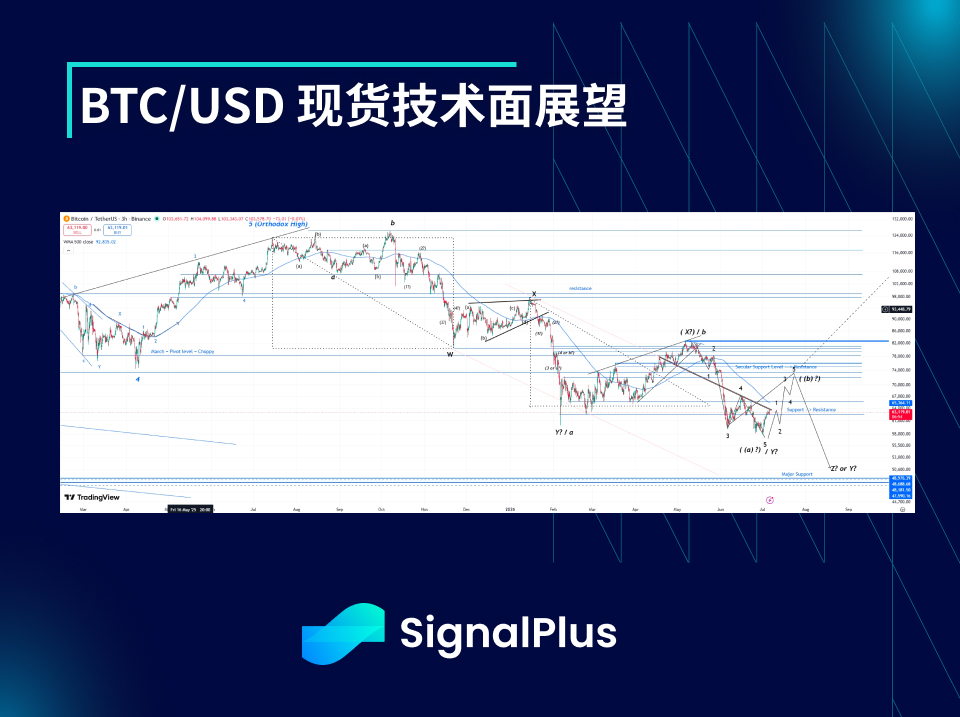
Last week, BTC (and ETH) spot prices continued to show relatively steady performance, consistent with the overall technical setup we have been tracking for the past several weeks. The market initially rebounded to $67k, but as hopes for progress on the CLARITY Act were tempered during the U.S. Congress’s summer recess, this rally was ultimately suppressed. Despite risk-off sentiment across the broader market after the escalation of the Iran-Iraq war over the weekend, BTC ultimately found support above $63.7k. Since the weekend situation did not further deteriorate, prices rebounded again today (Monday).
Our current base case is that the market will remain in a broad, sideways range and, within that, grind gradually higher. As the height of summer approaches, trading volumes continue to generally decline. Prices have been forming progressively higher lows and higher highs, outlining a relatively constructive short-term technical setup that could eventually drive price to test the first resistance around $67–68k. If the (CLARITY Act) gains traction, BTC could rise further toward a more important trend resistance at $74k. On the downside, we are watching the first support area at $62.5–63k; if that level breaks, price could retest $60k and then $58k, and may ultimately form a sub-wave dipping to $50–55k to complete the bear-market correction adjustment.
Market themes
Despite major companies such as Google and Intel reporting broadly solid earnings, last week’s market still generally showed a risk-off sentiment. Concerns that capital expenditures may rise further resurfaced and intensified again, and investors still do not seem to believe that these investments will ultimately generate enough output and drive revenue growth. The situation involving Iran and the U.S. has continued to fluctuate, keeping upward pressure on oil prices; Brent crude briefly broke above $100 per barrel and rose more than 30% from the recent lows. However, because neither side launched attacks over the weekend, oil prices subsequently retreated nearly 10% from a local high. The market still expects Trump to make concessions ahead of the midterm elections.
Last week, overall sentiment in the cryptocurrency market improved again. Initial optimism around the(CLARITY Act) fueled gains in spot prices, with BTC briefly rising to $67k and ETH touching $2k. Although the bill ultimately did not make substantive progress last week—Democrats continued to oppose the revised draft’s moral provisions—its prospects of passage within the next two weeks should not be ignored, with probability on Polymarket holding steady around 35%–37%. Given that this favorable tail scenario still exists in the market’s probability distribution, and because after massive outflows from ETFs in late May through late June, there are few remaining sellers in the market, the near-term supply-demand balance is gradually tilting toward the demand side. Overall, we believe that if the outcome is disappointing—if the (CLARITY Act) is not passed before the summer recess—spot prices could fall back to $62–63k. If there is an upside surprise, spot prices could break above $70k again. The worst near-term scenario would be an escalation of the Iran–U.S. conflict alongside failure of the (CLARITY Act), which could push BTC back into the $58–60k range.
BTC USD ATM implied volatility
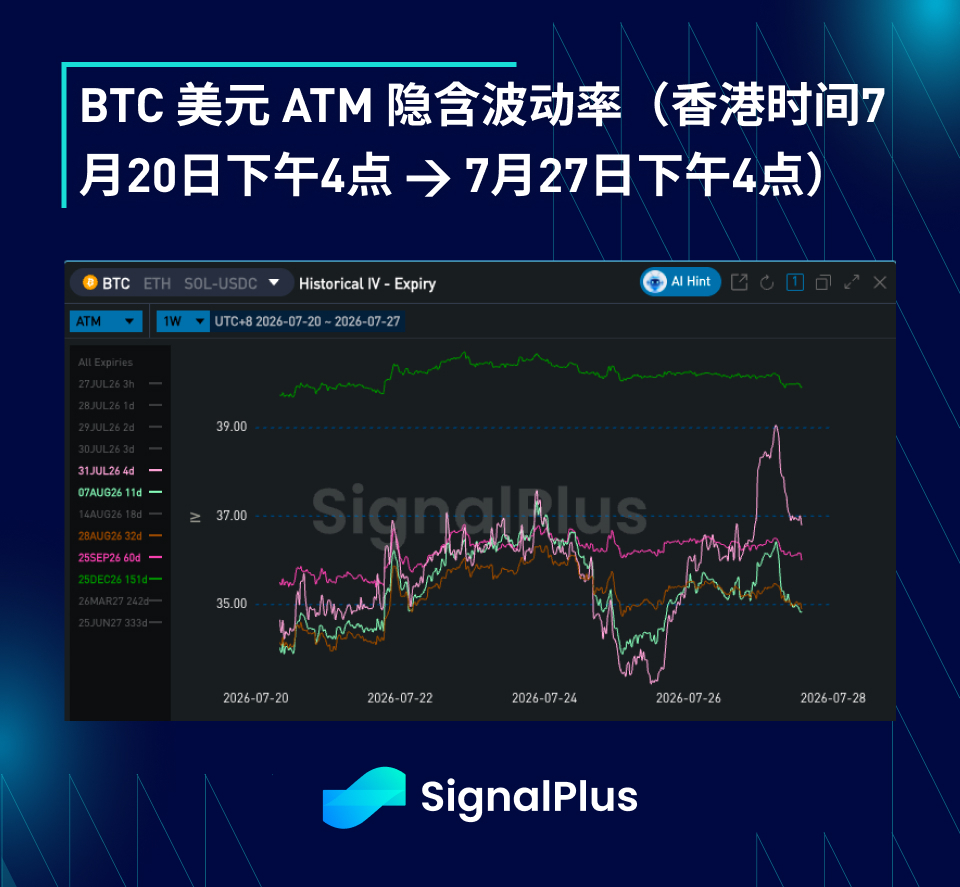
Last week, implied volatility generally edged up slowly, mainly driven by increased uncertainty at the very front of the volatility curve (expiries before mid-August). Ahead of the potential event window around the congressional summer recess for the (CLARITY Act), the market saw heavy demand for upside options. However, this is still a highly concentrated short-term bet. Because realized volatility remains low—largely due to subdued overall trading activity, with BTC ETF volumes falling to the lowest level since October 2024—an increase in short-dated volatility has not led to a more meaningful rebound in implied volatility at longer-dated points on the curve. At present, there is still no sign of structural demand for upside options. On the other hand, since market cash positions have clearly thinned, we are not seeing strong demand for downside hedging. Meanwhile, in the current range-bound environment, covered-call sellers continue to sell options on both sides of spot prices to enhance position carry returns.
Last week, the overall term structure of volatility moved toward a flatter shape, mainly because uncertainty driven by the (CLARITY Act) pushed up short-dated volatility. We still expect realized volatility to pick up again starting in September, especially considering the midterm elections and the macro backdrop—market expectations for the Fed’s first rate cut have already shifted from July/August to September/October. Moreover, even if the (CLARITY Act) misses the deadline before the summer recess, September still offers some time for congressional review, which could allow it to pass before the midterm election phase heats up. However, because we are currently approaching mid-summer, the market is not yet willing to price in this scenario early. This has further pushed the far-end forward volatility valuation on the vol curve down into the low end of the past two years’ range, gradually approaching levels that we think have value for positioning and could support accumulating positions.
BTC USD skew / kurtosis
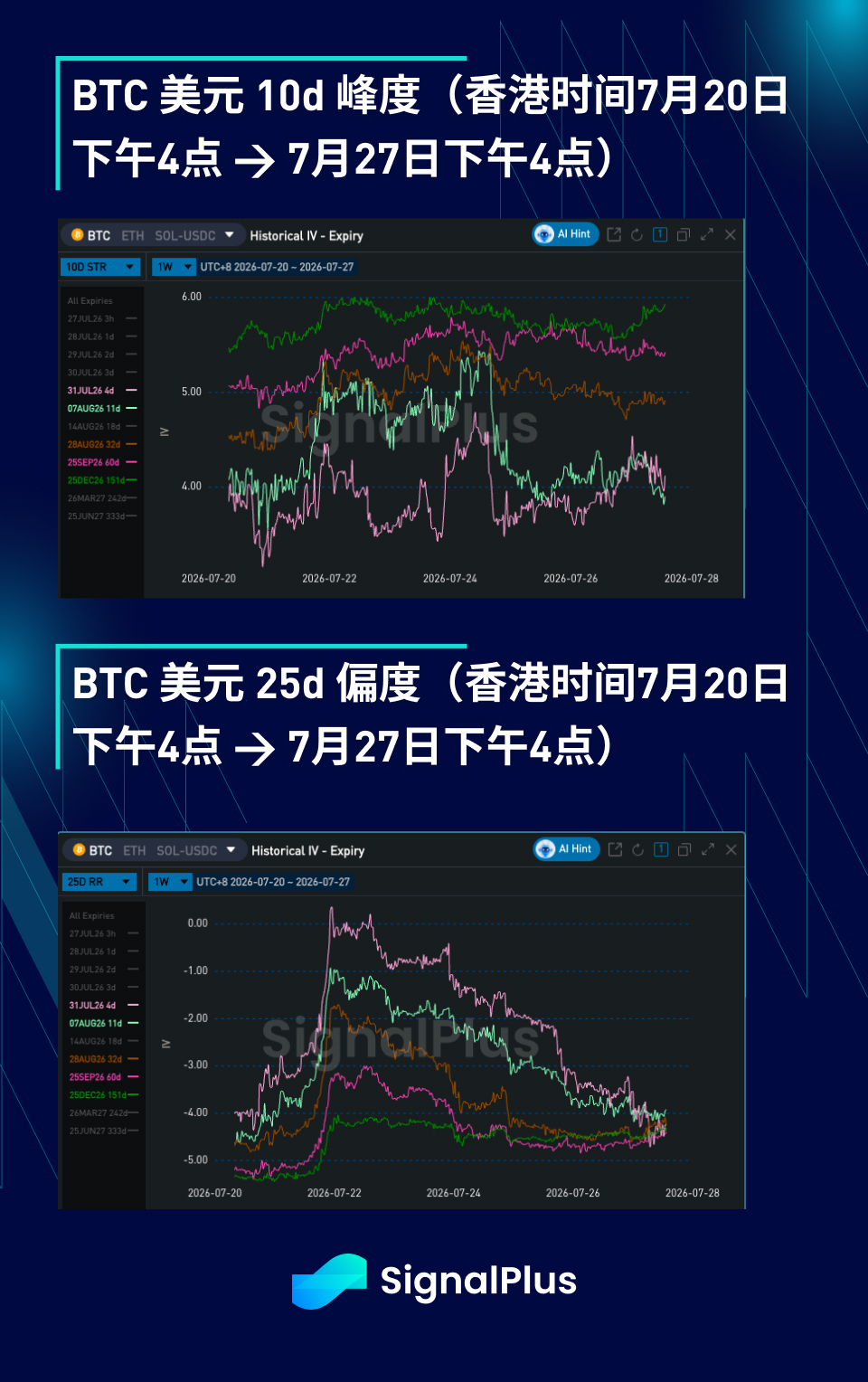
Last week, skew pricing experienced fairly extreme fluctuations. Driven by market optimism about the (CLARITY Act), BTC rose to around $67k, and demand for upside options surged, causing short-dated skew to briefly turn back toward calls being more expensive for the first time since January. However, this move was short-lived: as optimism rapidly cooled, external markets’ risk-off sentiment began to weigh on spot prices, giving the market reason to increase pricing for downside tail variance—namely the risk that the (CLARITY Act) would fail to pass along with a war escalation happening at the same time.
Convexity pricing has generally moved higher, especially at longer-dated tenors. Volatility of volatility (vol-of-vol) for short-dated options, as well as short-dated riskie-gamma, have shown extreme behavior—meaning that as the spot price rises, skew shifts strongly toward call options; when the spot price falls, the trend reverses quickly. This gives the market reason to increase the premium on further-out butterfly spreads. Given today’s skew pricing, the market is now more cautious about being overly short call-side volatility at deeply discounted levels. This is already reflected in higher kurtosis, and this premium is likely to remain elevated over the coming weeks.
Wishing everyone a smooth and successful trading week!
