
In financial markets, the most dangerous thing an investor can do is believe that the past is over. History does not return in the same form, but it leaves its mark on every new cycle. While billions of people are busy following the 2026 World Cup, investors are watching another event that is quieter yet may be more impactful: how will Bitcoin behave after the tournament?
At first glance, linking a football tournament to the crypto market may seem strange, but markets don’t move on news alone. They are also influenced by economic cycles, liquidity flows, and investors’ psychological state. And when we look at historical data, we find that the World Cup coinciding with pivotal phases in the Bitcoin cycle is not just a passing detail.
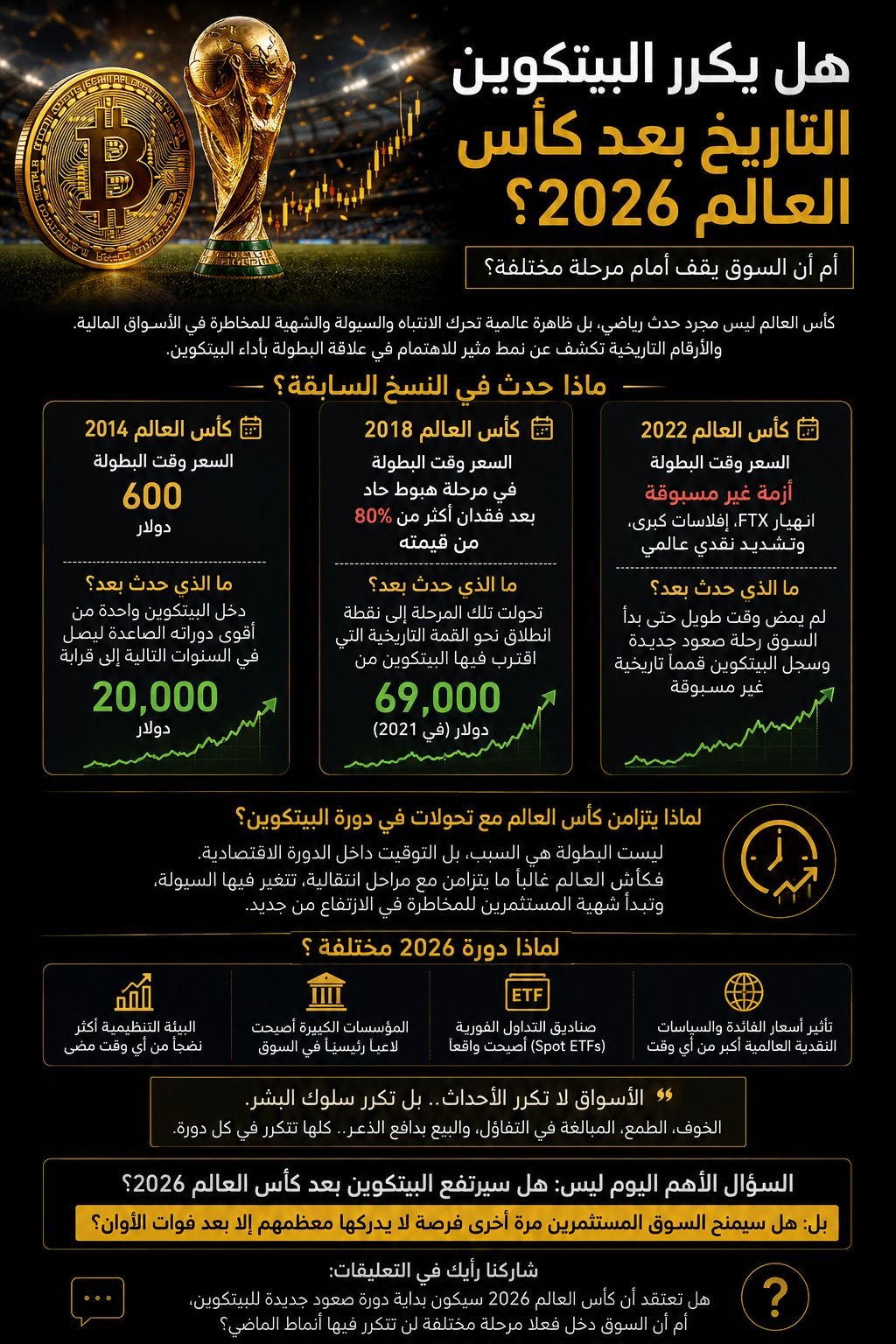
After the 2014 World Cup, Bitcoin was trading near $600 amid widespread doubt following the collapse of the Mt. Gox platform. Many thought the story was over, but the market was quietly preparing for one of the strongest upswings in its history, which ended with the price reaching roughly $20,000 by the end of 2017.
Then came the 2018 version. At that time, cryptocurrencies were going through one of the harshest periods after Bitcoin lost more than 80% of its value compared with its previous peak. Confidence seemed to be missing, and a large number of investors left the market, but that same phase was the beginning of the base from which the next bull cycle took off—taking Bitcoin to nearly $69,000 in 2021.
As for the 2022 World Cup, it arrived while the market was living through an unprecedented crisis. The collapse of FTX, the bankruptcy of major companies, and tighter monetary policies—all pushed many people to believe the crypto market had entered a long phase of contraction. But markets, as they always do, were writing a different story. What seemed like an ending for many later turned into a springboard toward new all-time highs.
And here comes the question worth thinking about: were these just coincidences, or is there a recurring pattern?
The answer isn’t that simple.
The World Cup doesn’t push Bitcoin up or down, but it coincides more than once with transitional stages within the economic cycle. During those periods, liquidity changes, investors’ appetite for risk shifts, and markets begin repricing their expectations for the future. So the sporting event may be just a point on the timeline, while the real story lies in the economic phase it occurs during.
But the 2026 cycle is different from everything that came before it.
For the first time, Bitcoin enters the World Cup as a financial asset that major institutions compete for, after the launch of spot Bitcoin ETFs, increased participation from asset managers, and higher levels of regulation in many markets. This means Bitcoin’s movement no longer relies only on the individual investor; it has also become tied to institutional capital flows, central bank decisions, interest rates, and global economic policies.
So, repeating the past word for word is unlikely.
But ignoring the past entirely could be an even bigger mistake.
Markets don’t repeat events… they repeat human behavior. Fear, greed, overconfidence, and panic selling—all of these feelings appear in every cycle, no matter how the tools and conditions change. That’s why analysts don’t study history to find an exact copy of the future; they look for patterns that recur when investors face the same conditions.
Maybe Bitcoin won’t repeat the same scenario after the 2026 World Cup, and maybe it will surprise everyone with a completely different path. But what’s certain is that the next phase will be among the most sensitive periods in the market’s history, because it will reveal whether crypto is still moving according to its traditional cycles—or whether a new era led by institutions and massive investments has already begun.
The question that the market will answer, not speculation:
Will the 2026 World Cup be the start of a new chapter in Bitcoin’s journey, or just another stop in a larger cycle whose chapters are not finished yet?
Share your opinion in the comments: do you believe history tends to repeat itself, or is this time truly different?