
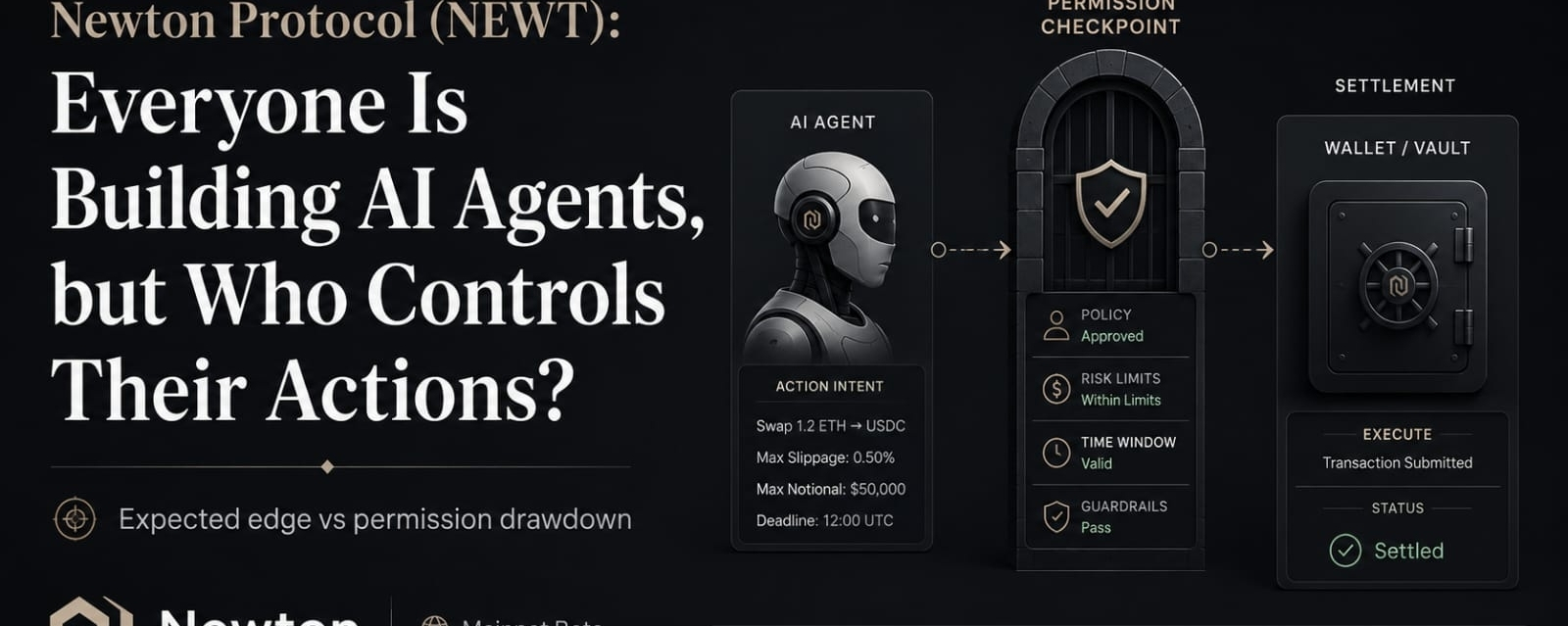
I keep noticing the same mistake whenever I review an AI trading product: I spend twenty minutes studying the strategy and maybe two minutes studying the authority behind it. The model might rebalance well, route efficiently, or react faster than I can. But if it has broad wallet access, one poisoned signal, faulty oracle, or badly written instruction can turn a clever system into a fast moving liability. That risk comes before the upside.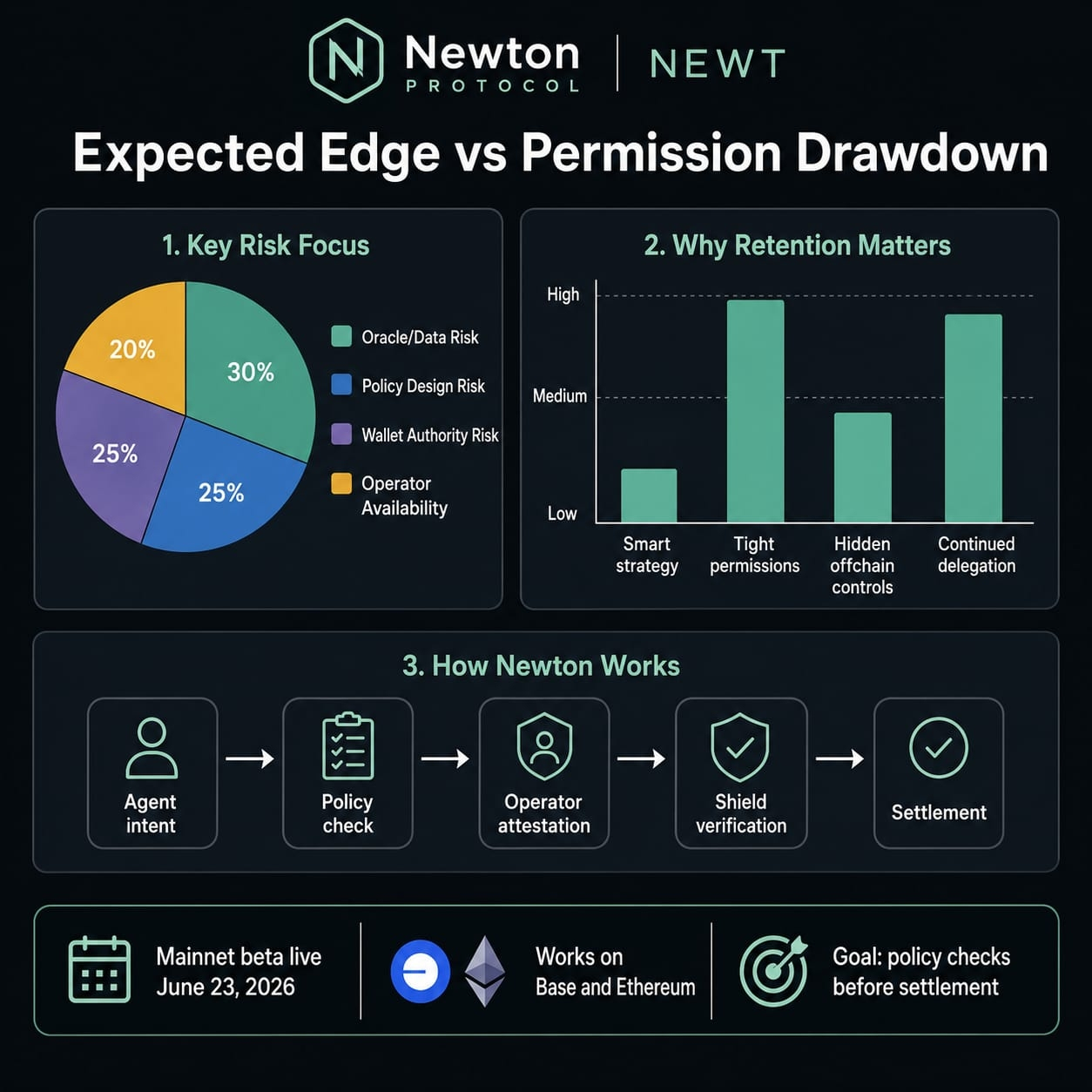
My framework is simple: expected edge versus permission drawdown. Expected edge measures what the agent might earn. Permission drawdown measures how much damage its authority can cause before something stops it. Traders already cap position size because even a good thesis can fail. We should treat machine permissions the same way. A strategy with modest edge and tightly bounded authority may be investable. A brilliant agent with an unlimited mandate probably isn’t.
That’s where Newton Protocol becomes relevant. Its mainnet beta went live on Base and Ethereum on June 23, 2026, placing a policy check between transaction intent and settlement. Before an action reaches the vault, operators evaluate it against rules chosen in advance. If the action passes, Newton produces an attestation tied to the exact sender, destination, chain, value, calldata, policy, and expiration. The onchain Shield checks that approval and rejects expired or replayed instructions before forwarding anything. Think of it like giving an agent a single use boarding pass for one specific transaction rather than handing it the airport keys.
Why does this matter? Because the Retention Problem in agent finance isn’t mainly about getting people to try automation. Incentives can do that. The harder question is whether users keep capital delegated after the first ugly market day. People stay when they understand the boundaries of failure. They leave when an agent’s mandate is vague, controls are hidden offchain, or accountability begins only after funds move. Newton’s real opportunity is not making agents look smarter. It’s making continued delegation feel less reckless.
The timing is sensible. Newton says curated DeFi vault TVL has grown more than 350% over the past year, while many vault managers still operate through powerful keys and offchain procedures. VaultKit wraps existing curator workflows, so actions such as reallocating capital, enabling markets, or changing caps must satisfy policy before execution. That’s operationally cleaner than asking users to migrate into a new vault product. It also matters for retention because controls can become part of the normal workflow instead of another dashboard everyone ignores.
Still, I don’t think an attestation magically removes risk. It relocates some of it. A bad policy can be enforced perfectly. A stale data source can block a sensible trade or approve a dangerous one. Fail-closed design is safer for capital, but during a sharp market move it can also freeze an action when speed matters most. Operator availability, data freshness, policy authorship, and override design become the new attack surface. The receipt proves the stated rules were followed. It doesn’t prove the rules were intelligent.
The NEWT market also needs sober reading. Etherscan’s July 11 snapshot lists 215 million circulating from a one billion maximum supply, about 13,027 holders, around 240 transfers over twenty-four hours, a circulating market value near $10.3 million, and roughly $4.6 million in daily volume. That level of turnover can attract traders, but it isn’t evidence that recurring authorization demand is established. Token activity and protocol retention are different datasets. Mixing them is how a promising infrastructure thesis becomes a weak trade. That distinction is the entire trade.
If you’re eyeing NEWT, watch behavior rather than announcements. I’d get more bullish if policy-backed transaction volume grows, vaults keep using Newton after incentives fade, operator diversity improves, and third-party curators publish evidence that controls prevented real losses without creating constant false blocks. I’d turn bearish if the explorer stays thin, integrations remain mostly promotional, overrides become routine, or a small group of data providers becomes an invisible control point.
Put Newton on your watchlist, then track whether capital stays after the novelty wears off. In autonomous finance, the winner won’t be the agent that acts most often. It’ll be the system that can prove when the agent was not allowed to act.