
One conversation changed how I think about evaluating infrastructure projects.
A friend of mine manages treasury operations for a mid-sized DAO. His work isn't glamorous, but it's essential. Every week he deals with repetitive treasury tasks, multisig approvals, asset allocation, and governance execution. Most of these processes follow clear rules, so naturally his first thought was, "Why can't AI handle this?"
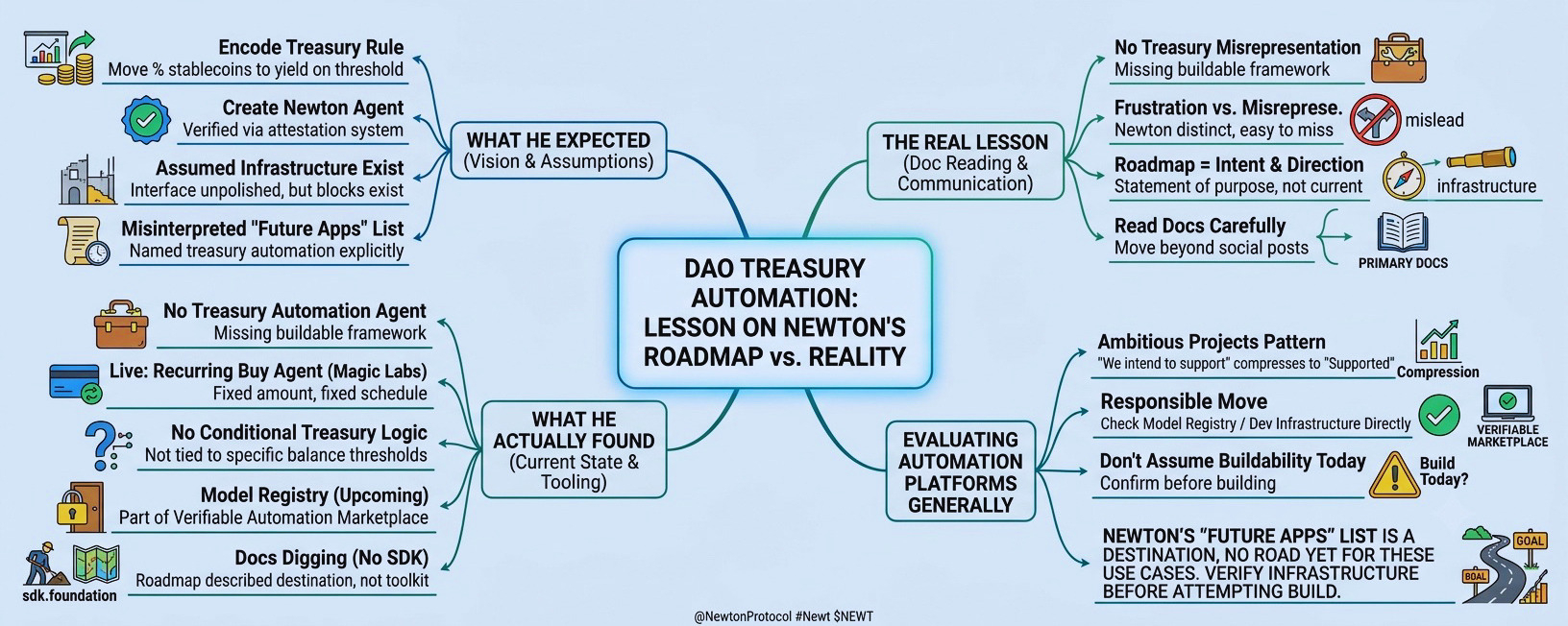
When he started reading about @NewtonProtocol , it immediately caught his attention. The vision of AI agents executing financial actions under verifiable rules sounded like exactly the direction treasury management should move toward. Instead of relying on manual coordination, he imagined creating an intelligent agent that could automatically rebalance stablecoin reserves whenever idle funds exceeded a predefined threshold, then allocate capital into yield-generating strategies while remaining fully transparent and verifiable.
The idea seemed realistic because Newton's long-term vision openly mentions treasury automation, DAO operations, liquidity management, and other autonomous financial workflows.
Confident he had found the right platform, he spent hours exploring the documentation.
That's when reality set in.
The feature he wanted wasn't actually available yet.
The infrastructure currently available focused on the Recurring Buy Agent developed by Magic Labs, which automates scheduled purchases. It worked well for recurring transactions, but it wasn't designed for conditional treasury decisions based on DAO-specific rules.
Even more importantly, the developer infrastructure required to publish custom automation models the Model Registry and the broader Verifiable Automation Marketplace was still part of the roadmap rather than something developers could actively build on.
At first, he felt disappointed.
But after carefully rereading the documentation, he realized Newton hadn't promised otherwise.
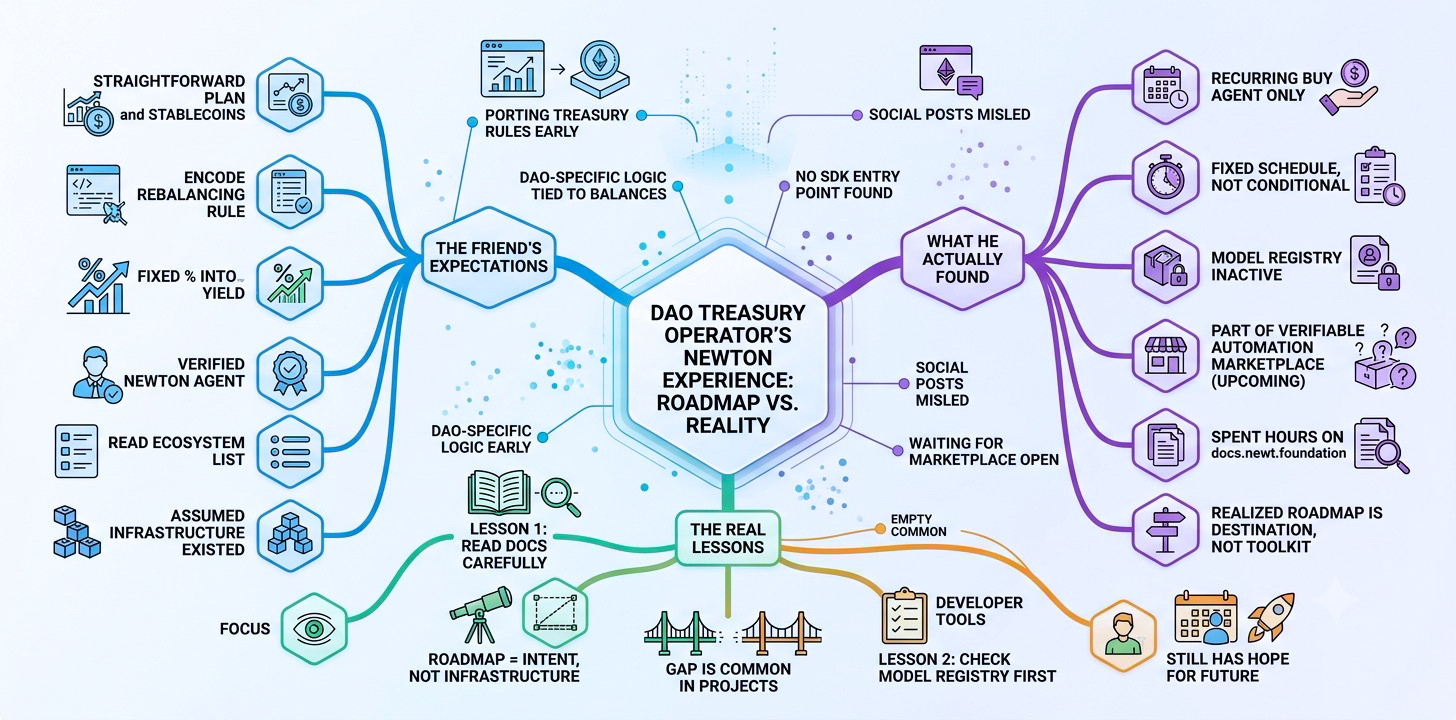
The roadmap clearly separated today's products from tomorrow's ecosystem. The misunderstanding happened because discussions on social media naturally emphasized the future vision, making it easy to assume every highlighted use case was already supported.
That experience taught him something valuable that now applies to every infrastructure project he researches.
A roadmap explains where a protocol wants to go. Documentation explains where it is today.
Those are two very different things.
Since then, before getting excited about any new protocol, he follows a simple habit. Instead of asking whether a project plans to support a feature, he asks whether developers can actually build it today. He looks for SDKs, APIs, developer documentation, deployment examples, and production-ready tooling before investing significant time.
Ironically, the experience didn't reduce his confidence in Newton.
If anything, it made his expectations healthier.
The vision remains compelling, especially as AI agents become increasingly involved in on-chain finance. But successful infrastructure isn't measured only by ambitious ideas it is measured by the gradual delivery of usable building blocks that developers can adopt with confidence.
For now, he's still watching Newton closely.
Not because the destination changed, but because he's waiting for the infrastructure to finally catch up with the vision.