
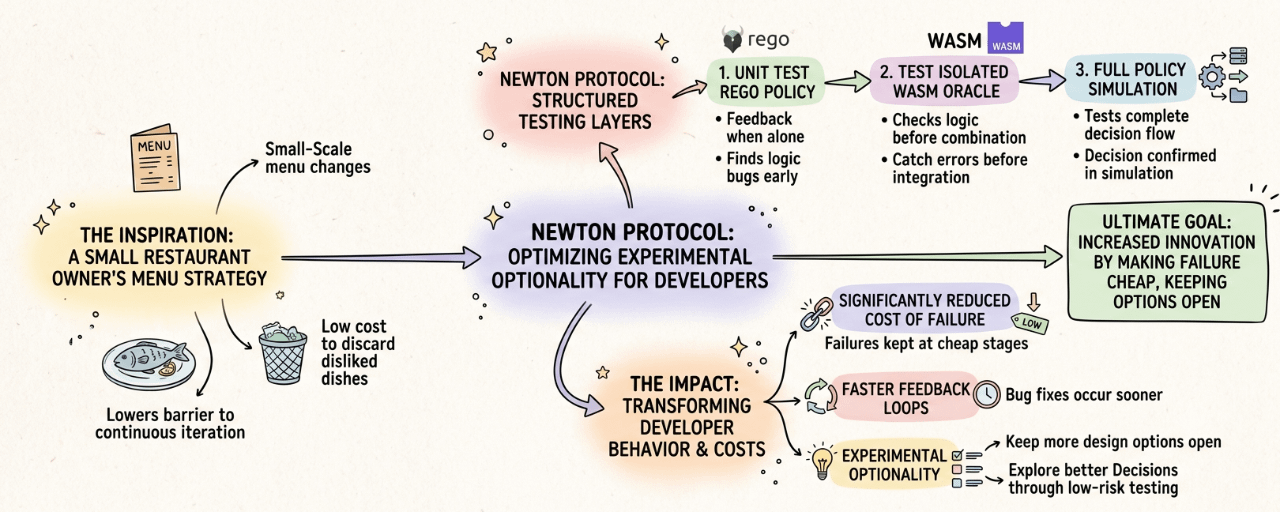
Last night, I had dinner with Oanh—a wealthy lady who was running a seafood restaurant. Oanh told me that they changed a few dishes on the menu every week.
I’m quite surprised.
"Doesn’t this frequency of changes worry customers and make it hard for them to follow?"
Oanh shook her head.
"I don’t change the whole menu. I just try one new dish each time. If the customer doesn’t like it, then we just get rid of it. The cost of trying once is small enough that I have no reason to be afraid to try again."
That statement makes me think of the Testing Policies & Oracles section in the Newton Protocol docs.
At first, I only thought this was a testing process that was more detailed than usual. Instead of saying vaguely “test before you deploy,” breaking it down into many very clear steps: unit tests for the Rego Policy, testing each WASM Oracle separately, and then simulating the whole policy before putting it out on the network.
But the more I read, the more I feel they aren’t just reorganizing their testing process.
Each testing layer delivers feedback a bit earlier. Errors in a Rego Policy are caught while the policy is still standalone. Errors in a WASM Oracle are detected before the Oracle is combined with other components. Only once each piece is working correctly is the entire Decision checked in the Simulation step.
This makes the cost of each attempt change completely.
If a Decision is wrong, the developer doesn’t need to wait until the deployment to find out. Most mistakes are caught at the testing layer, which is much cheaper. A small change no longer triggers an entire deployment cycle just to learn that the original idea wasn’t correct.
As the cost of each attempt drops, developer behavior starts to change too.
If every new idea required a long deployment cycle, people would tend to choose only the options they trust the most. But when feedback shows up almost immediately after each change, trying out another way of writing a Rego Policy or a different Decision becomes far less risky. Not because the chances of success are higher, but because the cost of failure has gone down.
That’s when I realized what Newton Protocol is creating isn’t just a better testing process.
They’re creating more Experimental Optionality for developers.
Each short feedback loop doesn’t just help fix bugs faster. It also preserves more options throughout the development process. One idea can be ruled out very early at very small cost, while another can be tried right after with almost no slowing of the project.
Maybe this is what I find interesting about Newton Protocol.
Most of us usually evaluate a testing process by its ability to detect bugs. I find the bigger value lies in the number of choices that process helps developers keep. When each attempt becomes cheaper, the system doesn’t just develop faster—it also opens up more opportunities to discover better Decisions. Viewed this way, Experimental Optionality is probably what Newton Protocol is quietly optimizing for, not merely the number of test cases or the speed of deployment.
$EVAA $NEWT #Newt