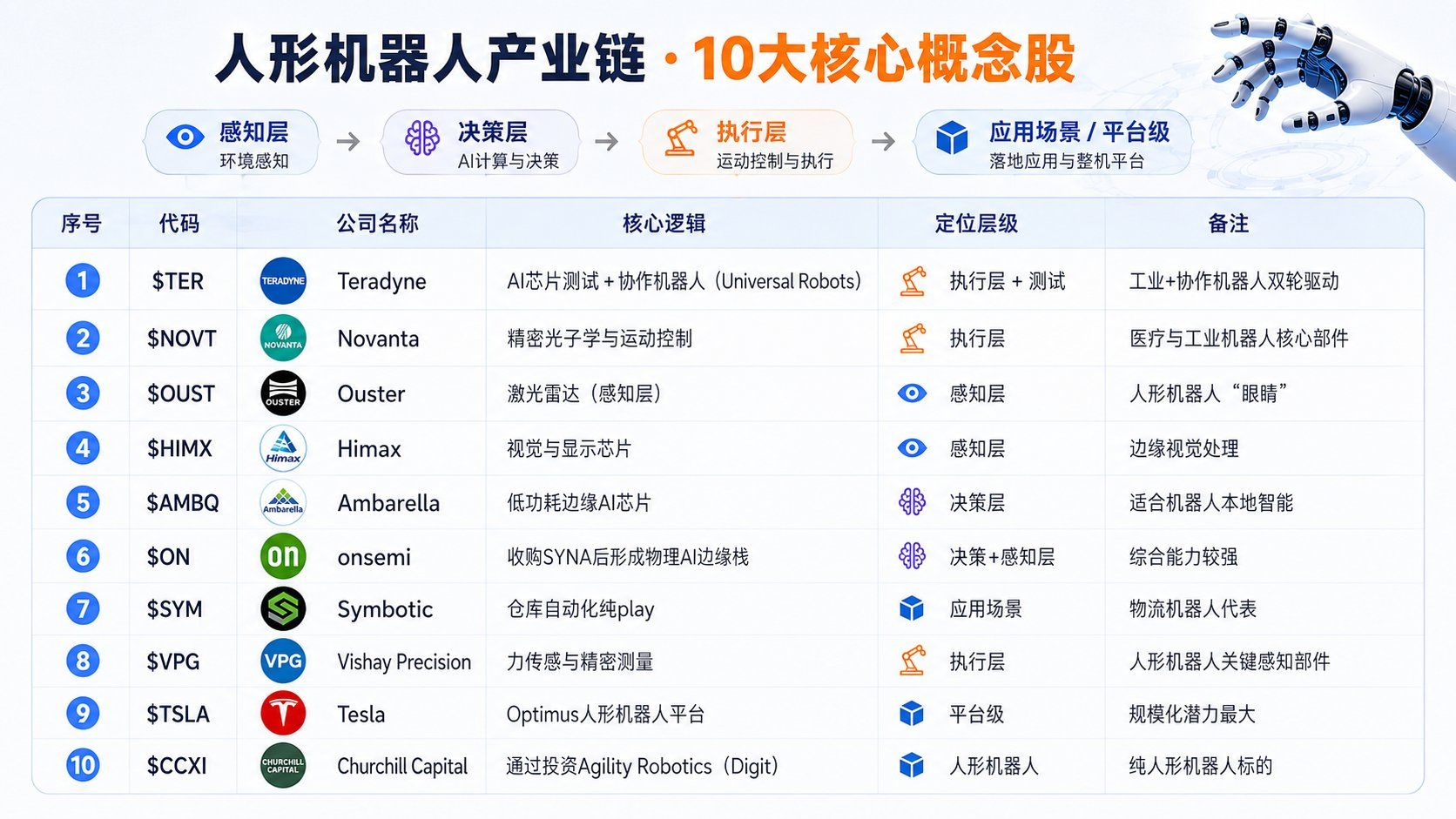
1. $TER (Teradyne)
Key strengths: In addition to the semiconductor testing business, it has also entered the collaborative robotics field through Universal Robots, with real products and a customer base in industrial automation.
Current highlights: Collaborative robots (cobots) are a fast-growing segment within industrial robots, and future order potential is worth watching.
Risk warning: The robotics business currently has a low share; the overall business is still mainly semiconductor testing, with a relatively slower growth rate.
Suitable for: Investors who want a relatively steady allocation within the robotics theme and whose cash flow is supported.
2. $NOVT (Novanta)
Core advantages: Deep accumulation in precision motion control and photonics technology. Products are widely used in industrial and medical robotics, with strong fit for scenarios requiring high precision.
Current highlights: With rising demand for precision control from industrial and medical robots, it is expected to continue benefiting.
Risk warning: Robotics-related business makes up a relatively low share; it relies more on overall demand in industrial and medical sectors.
Suitable for: Investors who believe in the application of precision manufacturing and motion control in robotics.
$OUST (Ouster)
Core advantages: Laser radar technology leads the pack. It has clear advantages in robot spatial sensing and environmental mapping, and is an important component of the humanoid robot perception layer.
Current highlights: Laser radar penetration in the robotics field is still in the early stage, with substantial room for future growth.
Risk warning: Competition in the laser radar industry is fierce, and downward pressure on product pricing is evident. In the short term, the proportion of robotics revenue is still not high.
Suitable for: Investors who are optimistic about the long-term development of the robot perception layer.
$HIMX (Himax)
Core advantages: Technology accumulation in vision chips and display driver areas, suitable for robot image processing and edge vision computing scenarios.
Current highlights: As robots become more intelligent, demand for edge vision processing is increasing.
Risk warning: The robotics business currently represents a relatively low proportion; it relies more on other applications such as consumer electronics and automobiles.
Suitable for: Investors focusing on robot vision and edge computing.
$AMBQ (Ambarella)
Core advantages: Focused on low-power edge AI chips. It is well positioned for applications where robots need local intelligent decision-making and power consumption is sensitive.
Current highlights: Localized edge AI is an important future trend, and it fits robot real-time decision-making scenarios.
Risk warning: There are still relatively few real-world implementation cases in the robotics field at present; most are in the validation stage.
Suitable for: Investors who are optimistic about long-term investments in edge AI applications in robotics.
$ON (onsemi)
Core advantages: After acquiring SYNA, it formed a relatively complete solution across perception, connectivity, and edge AI. Its products can cover the robot “perception + decision-making” workflow.
Current highlights: The direction of physical AI edge computing is clear, and the overall completeness of its solutions is relatively high compared with peers.
Risk warning: Robotics-related businesses are still in the early stage, with limited contribution to revenue, and it faces competition from NVIDIA, AMD, and others.
Suitable for: Investors who want to allocate based on both edge AI and robotics logic.
7. $SYM (Symbotic)
Core advantages: A warehouse automation pure-play company with mature commercialization cases and ongoing orders. It is one of the fastest-moving targets for implementation among current robotics application plays.
Current highlights: Order conversion and revenue growth are relatively clear, and cash flow is relatively stable.
Risk warning: The valuation already includes relatively high growth expectations; near-term volatility may be significant, and the company also faces competition from in-house systems such as Amazon.
Suitable for: Investors who want to allocate to a comparatively stable robotics-related target with faster commercialization progress.
$VPG (Vishay Precision Group)
Core advantages: Force sensing and precision measurement technologies are key components enabling fine manipulation in humanoid robots, with mature applications already in industrial and medical fields.
Current highlights: It belongs to a relatively undervalued sub-sector within the perception layer. Once humanoid robots enter mass production, demand could increase rapidly.
Risk warning: The company is relatively small in scale, liquidity is average, and its robotics business currently represents a low proportion.
Suitable for: Investors willing to dig for opportunities in niche sub-sectors.
9. $TSLA (Tesla)
Core advantages: Optimus humanoid robots adopt a full-stack in-house development model, with clear strengths across hardware, AI inference, software, and manufacturing scale.
Current highlights: 2026–2027 is the key window period for Optimus to transition from prototypes to small-scale mass production, and market expectations are still in the early stage.
Risk warning: The company is still in the R&D validation stage; in the short term it is unlikely to generate significant revenue, and the valuation already reflects many long-term optimistic expectations.
Suitable for: Investors willing to take on higher volatility and seeking long-term theme flexibility.
$CCXI (Churchill Capital III)
Core advantages: Indirectly lays out Agility Robotics (Digit robots) through SPAC investments, making it one of the few publicly traded vehicles that provide access to pure humanoid robotics companies.
Current highlights: If humanoid robot commercialization achieves a breakthrough, it could bring significant upside optionality.
Risk warning: Participating through a SPAC carries certain uncertainty, and commercialization is still in the early stage.
Suitable for: Investors willing to take on higher risk and focused on the humanoid robotics theme.
Summary recommendation (by priority of attention):
The top focus recommended for now is $SYM and $TSLA. The former is the most mature in terms of commercialization, while the latter offers the greatest long-term optionality. The perception-layer plays $OUST and $VPG are also worth ongoing tracking; the other names are suitable as satellite allocations or portfolio supplements. The above is only an analysis of the industry chain and personal observations, and does not constitute investment advice.