
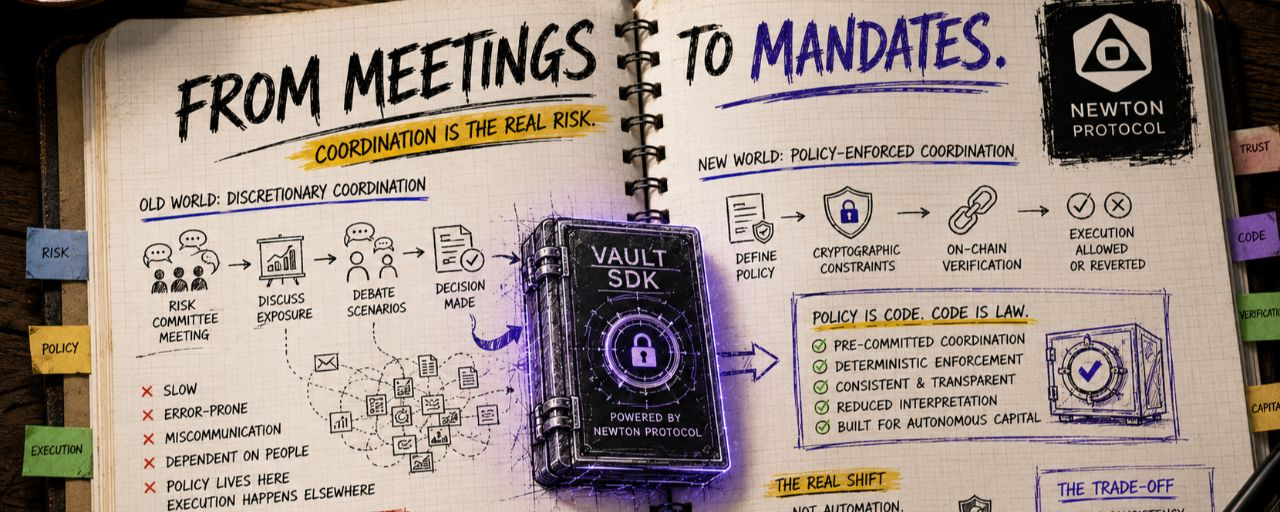
The more I think about treasury management in crypto, the less it feels like a capital allocation problem and the more it feels like a coordination problem.
Not the kind of coordination you get from consensus protocols or distributed systems. I mean coordination between people, which is messier and slower and, honestly, probably the part that still matters most.
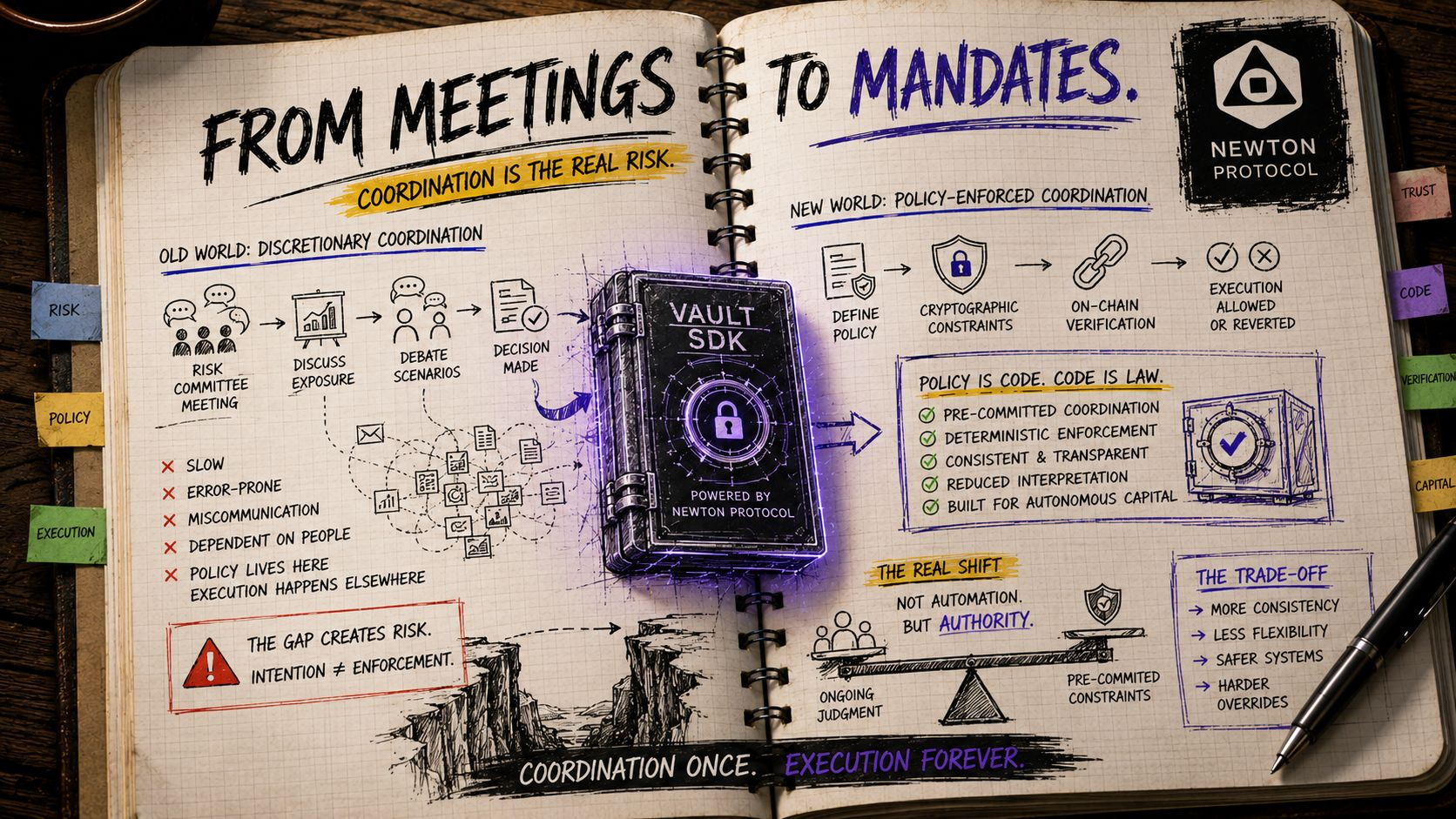
That’s what makes this whole area a little strange to me. Crypto was supposed to reduce dependence on human intermediaries, yet some of the biggest pools of capital in the space are still managed through workflows that look almost old-fashioned. A risk committee meets, someone walks through exposure, another person suggests changing a limit, a few people debate scenarios, a decision gets made, then someone else carries it out, and finally somebody checks whether it was done correctly. It works, more or less, but it also feels like a lot of manual effort for something that is supposed to be programmable.
Maybe that sounds unfair. Risk management is hard, and human judgment is not some outdated flaw that can simply be removed. Markets move, assumptions break, and edge cases show up when you least want them to. Still, I keep wondering whether a lot of treasury workflows are actually doing risk management, or whether they are mostly doing coordination and calling it risk management. Those are close, but they are not the same thing.
If you strip this down, a lot of institutional process exists because organizations struggle to turn intention into action without ambiguity. Meetings exist because different people need to agree on what is true. Approvals exist because authority is split across roles. Procedures exist because trust is incomplete. A treasury policy might say a vault should never allocate more than a certain percentage into one strategy, and everyone can agree with that in principle. But agreement does not enforce anything by itself. The policy lives in one place, the execution happens somewhere else, and in between sits this whole layer of people, spreadsheets, dashboards, messages, and assumptions.
That gap is what keeps bothering me.
The wider that gap gets, the more room there is for mistakes, delays, miscommunication, or just different interpretations of the same rule. Something feels off when an organization spends weeks defining risk parameters and then relies on human workflows to make sure those parameters are actually followed. The policy is deterministic on paper. The implementation usually isn’t.
And that’s where Newton Protocol starts to look more interesting than it first appears.
A lot of people will probably see the Vault SDK and think about automation, which is fair enough. But automation feels like the surface-level story. The deeper shift, at least to me, is about coordination itself. Normally, risk policies are organizational agreements. Newton seems to push those agreements closer to cryptographic constraints. That sounds subtle, but it changes the shape of the system.
A corporate meeting produces consensus among people. A cryptographic policy produces conditions for execution. They sound related, but they behave very differently. One creates shared understanding. The other creates enforceable boundaries. And that tension is hard to ignore.
Human coordination is flexible because it stays reversible. New information comes in, people change their minds, exceptions get made, edge cases appear, and the organization can adapt because the rule can still be interpreted. Cryptographic enforcement moves in the opposite direction. The value comes from removing interpretation. The policy either passes or it doesn’t. The vault either satisfies the conditions or it doesn’t. Execution either happens or it stops.
Actually, that might be too clean.
Interpretation never really disappears. Someone still defines the policy. Someone still decides what level of risk is acceptable. Someone still chooses the parameters. The difference is that interpretation gets pushed earlier in the process. Instead of arguing about whether a transaction should happen after the fact, the argument shifts to what conditions must be true before anything can happen at all.
Which means the real change is not from manual management to automated management. It’s from discretionary coordination to pre-committed coordination.
That feels like the more important distinction.
A risk committee meeting asks, “What should we do right now?” A policy-enforced vault asks, “What has to be true before anything can happen?” The first model depends on ongoing judgment. The second depends on prior commitment. Neither one is obviously better. In fact, there’s a real trade-off here.
The more authority gets embedded into cryptographic enforcement, the less room there is for human intervention. Organizations gain consistency, but they lose flexibility. Processes become harder to bypass, which is good, but also harder to override when the situation genuinely changes. That’s not a small trade-off. It’s the kind of thing that sounds efficient until you actually need discretion.
This keeps bringing me back to coordination. Not trust, not automation, coordination. Because a lot of what organizations call governance is really just a way of synchronizing human beliefs before action happens. Newton seems to be asking a different question: what if coordination happened once, at the policy-definition stage, and execution simply followed those commitments automatically after that? What if meetings mattered less because verification mattered more?
At first glance, that sounds like progress. But efficiency and resilience are not always the same thing. There is still something useful about human discretion, even if it creates friction. At the same time, a lot of treasury failures seem to come from exactly the kind of ambiguity that discretion introduces. The same flexibility that lets people adapt also opens the door to inconsistency. The same judgment that prevents rigid mistakes can also create subjective ones.
Maybe that’s why this topic feels more philosophical than technical.
The Vault SDK itself is just a mechanism. The more interesting question is where authority should actually live. Inside ongoing conversations between people, or inside conditions that have already been cryptographically committed to. Neither answer feels completely satisfying.
And yet, as more capital gets managed by autonomous agents, algorithmic strategies, and increasingly complex vault structures, it becomes harder to imagine coordination scaling forever through meetings, approvals, and manual checks alone. Then again, maybe replacing human coordination with cryptographic enforcement just moves the problem earlier in the process instead of solving it.
I’m not sure what to make of that yet, but it does make me wonder whether the future of treasury management is really about better automation, or whether it’s about deciding how much discretion organizations are willing to give up before coordination itself starts to look like software.
@NewtonProtocol $NEWT #Newt