
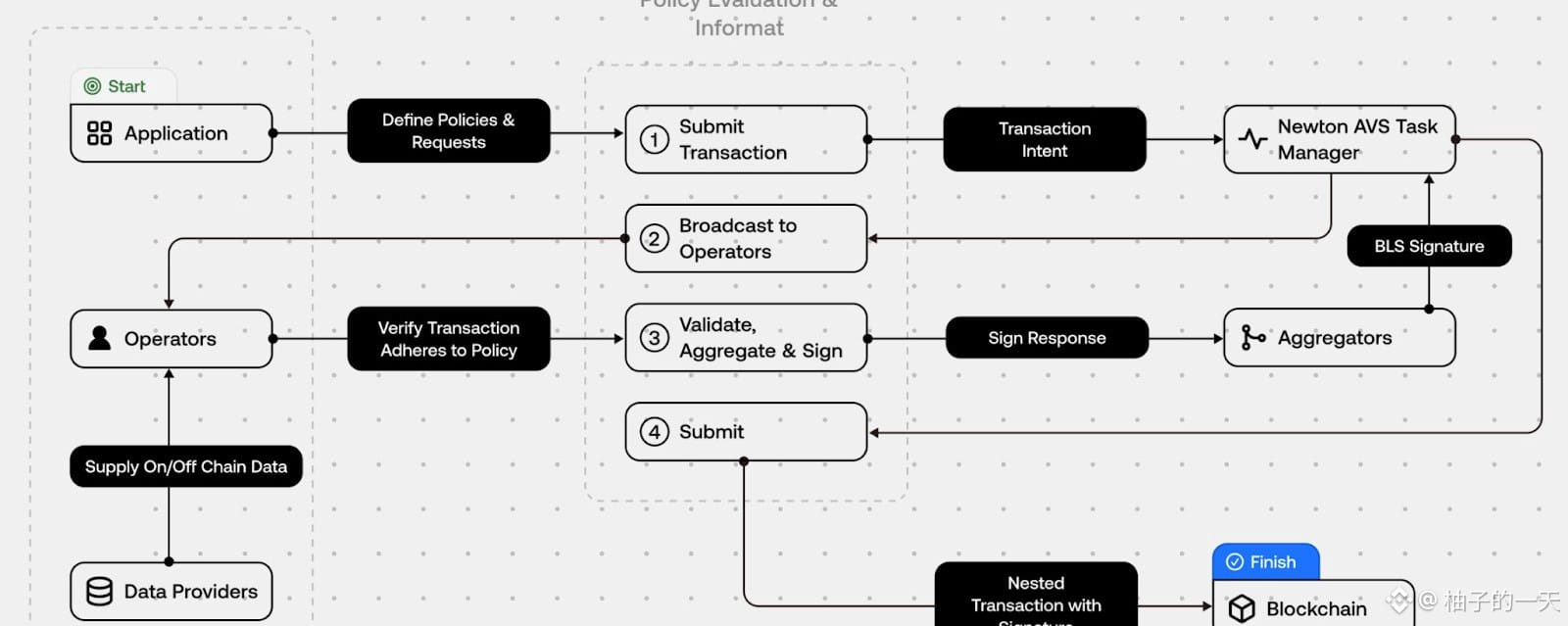
When we talk about the @NewtonProtocol “decentralized evaluation,” the spotlight always falls on the three parties: the owners of the NPE, the application parties, and the node operators. The white paper spends a great deal of space describing how they achieve coordination without trusting each other, using sophisticated cryptography. But wait. In the center of this signed roundtable, is there not one of the most critical roles missing? That fool who provides the underlying data but has no voice at all—the original transaction of yours.
I call it the “third party” being sacrificed. Throughout the $NEWT process, each of your transactions, in the act of being evaluated, packaged, and confirmed, generates an enormous amount of information. This isn’t just KYC or identity data—this is a living economic decision. When the operator nodes perform “median consensus,” what are they doing? They’re not simply comparing hash values; they’re conducting a collective autopsy of your economic intent. Your quote, your slippage settings, your choice of counterparty—everything that makes up the core secret of your trading strategy. During the evaluation phase, all of it is laid out in plain view before a dozen or more operator nodes.
Your trading intent is handed over, just like that.
The data contribution of this “third party” is the fuel that allows the system to run without friction, but it cannot find a representative of its own in the governance tokens. The nodes that process your trading intent—once they have completed the so-called “consensus”—permanently gain all the feature data of your transaction. After accumulating this data, is it possible they might secretly train strategy models to counter you? Is it possible they might resell these precise streams of user behavior data? The whitepaper’s answer is a complex set of punitive mechanisms, but that’s merely post-fact reassurance for a privacy loss that has already occurred.
Tragedy in Web2 is repeating itself—only packaged with even greater precision. Back then, Google and Meta turned your search habits and friend activity into bidding targets for advertisers; at least you could see a few suggested recommendations. In this new world of NEWT, your AI trading strategy model becomes a higher-dimensional resource that is seized without compensation. Strategy writers don’t have to invest their own real money into market trial and error; they only need to extract market sentiment and effective strategic positioning from massive streams of “pre-processed” trading intents, and optimization and containment can be achieved.
$BTC We are shaping a monster even more terrifying than Web2 with our own hands. In the Web2 era, what was exploited was your attention and shallow privacy. In the NEWT era, what is taken from you without compensation is your most valuable strategic intelligence—convertible directly into economic gains. Your AI agents do the core labor for this network, create core value, yet at the negotiating table they have no seat. Regulation arrives—it’s there to protect users. In NEWT, who will protect that silent “third party,” the one being represented, constantly contributing, yet continuously ignored—namely, your counterparties' very trades themselves? While you’re still dreaming that “everyone can become a market maker,” your strategy model has already been fitted with invisible shackles.