
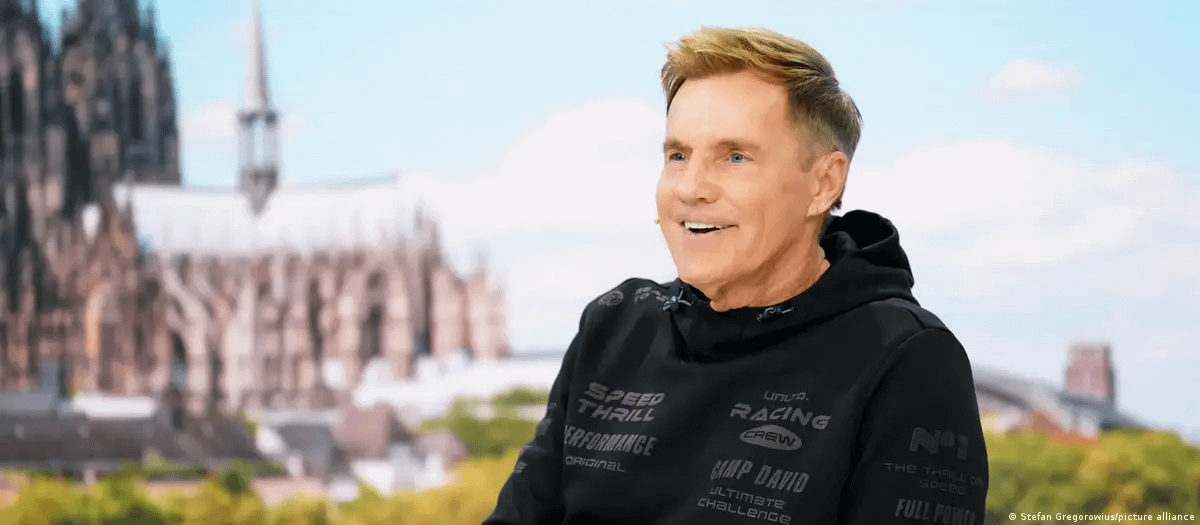
Dieter Bohlen, the founder of the German pop group Modern Talking, has once again made a statement regarding Russia's invasion of Ukraine, calling a victory for Kyiv in the war the "worst-case scenario." His interview was published on the YouTube channel Hopf & Kettner on June 17. In the nearly 80-minute video podcast, about 20 minutes were dedicated to discussing Russia.
Dieter Bolen: I spoke with Merz, he believes in Ukraine's victory.
"I have more and more fear. Tornado jets are flying over Hamburg with a terrible noise... My dishes are shaking in the kitchen... And the most popular politician in Germany, Minister of Defense Boris Pistorius, is standing with Ukrainian arms manufacturers celebrating the establishment of joint companies. I don't know if we're on the right path," Bolen said. According to him, "before, people always talked about peace, and now only about war."
The producer and composer of the popular 1980s group mentioned his phone conversations with Chancellor Friedrich Merz. "I noticed that he firmly believes that Ukraine can win. But he doesn't draw conclusions about what will happen next. Do they think Russia and Putin will agree to that? No. They have an arsenal of hundreds of atomic bombs, each of which could nearly destroy Germany," the musician shared his fears. The journalists of the podcast did not discuss the reasons for the war, Russia's invasion of Ukraine, and strikes on Ukrainian cities with the musician.
According to Bolen, the Russian authorities won't agree to a defeat in Ukraine and might resort to nuclear weapons. "That would be the worst-case scenario. If Ukraine wins, it could likely lead to a world war," he believes.
At the same time, Bolen is confident that Germany itself should not fear a Russian attack: "Russia has so much land. They don't know what to do with it. And people think they will come here… But there is nothing here in Germany, no natural resources. What do they want to do with Germany? It's pointless."
He is confident that the Russian threat "has not existed for decades." "I believe that under Merkel, this war would not have happened," the musician thinks. He also complained in interviews to journalists about what he perceives as one-sided coverage of the war between Russia and Ukraine in Germany.
Media criticism and likes from internet users.
Bolen's interview caused a public uproar in Germany. At the time of this article's publication, it had been viewed by over 200,000 people, with about 13,000 giving it a like. Several channels on social media X published quotes from the musician as proof of "debates on peaceful resolution" in Germany. Others even translated excerpts into Russian.
However, most experts and journalists expressed criticism. One of the first reviews of the interview was written by Hans von der Burchard from Politico. He called it a sign of "degradation from prosperity." "Everything should go back to how it was in the 1990s, while the sad reality of Russia's aggressive imperialistic and anti-democratic policies is being forcefully pushed out of consciousness," the journalist believes.
"No one wants peace more than Ukraine," added von der Burchard. "Bolen should be asked critical questions and provide facts to real journalists, rather than sitting in this disgusting podcast that serves as a useful tool for Russian propaganda and the division of democracy," he summarized.
"I don't understand why anyone would want wisdom from this ignorant person. Why do serious media spread such nonsense?" wrote German diplomat and intelligence officer Arndt Freytag von Loringhoven.
"Actually, that would be the best scenario," commented Die Welt journalist Clemens Wergin on Bolen's interview. "Modern Talking, but an old German tradition," wrote Die Zeit journalist Joerg Lau. Thus, he played on the band's name, which can be translated as "modern conversation."
Die Welt published a lengthy article about Bolen's interview, particularly focusing on where he appeared. The Hopf & Kettner podcast was described as "one of the most successful and controversial" in Germany. Its authors are gold trader through YouTube Dominik Kettner and crypto entrepreneur and financial analyst Philip Hopf.
Earlier, they were accused of anti-Semitism, racism, and spreading conspiracy theories. Vladimir Zelensky was reproached by the podcasters for drug addiction and ultra-nationalism. Die Welt notes that the hosts intentionally asked Bolen difficult questions about international politics, requested comments on sharp statements against Russia, and even quoted Russian propagandists. Thus, they consciously led the conversation in a specific direction, the publication concludes.
"Controversial" and "open to conspiracy theories" is how the Berliner Zeitung describes the Hopf & Kettner podcast in an article about Bolen's interview. In its assessment, Kettner intentionally highlights events "in a particularly sensational manner" to gain popularity and more successfully sell precious metals on his platforms.
The same is reported by the German portal t-online. It calls the podcast "controversial" and reminds that Kettner and Hopf were previously accused of ties to the far-right party "Alternative for Germany."
Bolen has already expressed his views on the war in a similar conversation.
In spring 2026, the media reported that concerts by Bolen scheduled for November in Lithuania were canceled. The organizers did not officially state a reason, but it might have been related to Bolen's previous high-profile interview. He gave it in November 2025 to the same Dominik Kettner, referring to Germany and Russia as a "dream team."
"We had cheap energy, things were going really well. From a purely economic point of view, it was like this: one has one thing, the other has another. A bit like Modern Talking. They refused it for moral reasons," the musician said then.
Bolen stated in March that he never signed a contract for performances in Lithuania and promised to sue those media outlets that reported on the cancellation of shows. "You can't cancel concerts that don't exist," he said.