
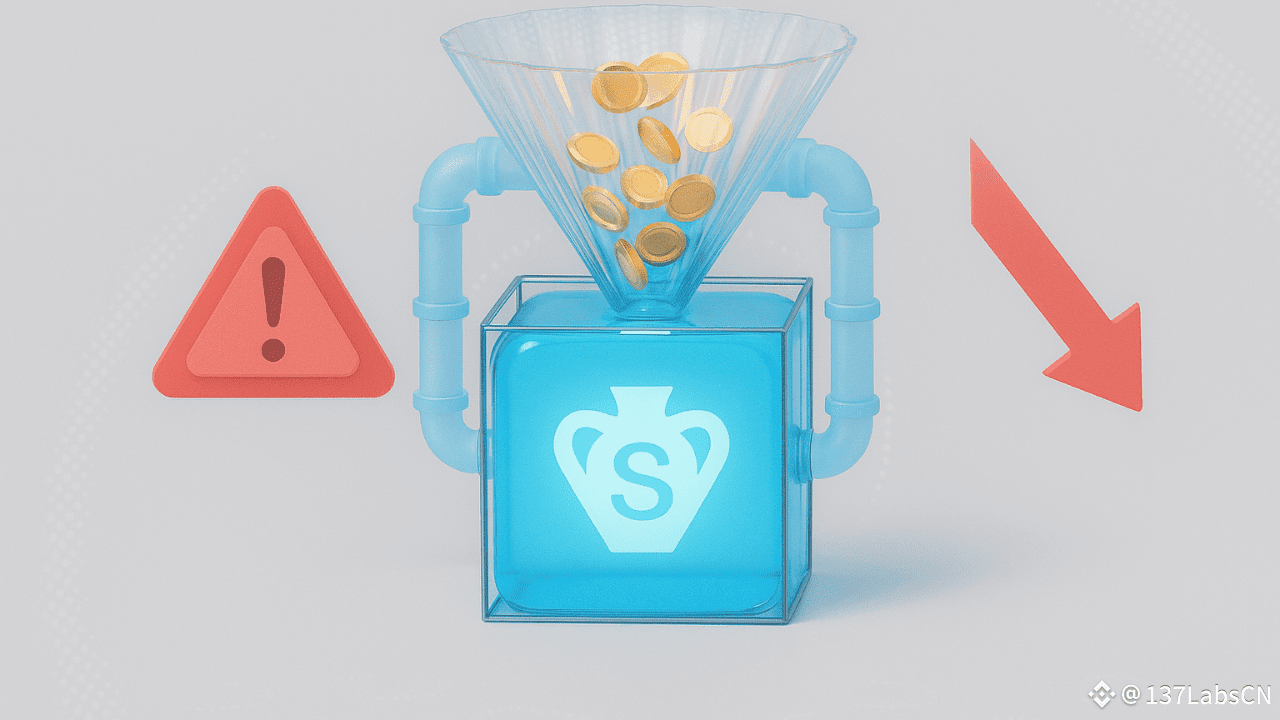

On November 3rd, Stream Finance suddenly announced that its delta-neutral strategy synthetic asset xUSD incurred a loss of $93M in trading and froze deposit and withdrawal functions.
Once the news broke, the price of xUSD plummeted from $1 and is now close to zero.
More seriously, xUSD attracted many DeFi Curators with 'up to 18% APY in U-pegged returns', incorporating it as collateral into loop loan strategies: collateralize xUSD ➡ borrow USDT/USDC ➡ mint new xUSD ➡ re-collateralize
With the collapse of xUSD, all these loop loan positions turned into actual bad debts.
However, this incident exposed not only the problems with xUSD but also the systemic risks of the entire Curator model.
1) What exactly is the Curator model?
Curator is essentially the liquidity fund manager in the DeFi world.
They mainly operate in permissionless lending protocols (such as Euler, Morpho), designing, deploying, and managing funds pools Vault with strategic logic, allowing ordinary users to 'deposit with one click' to gain complex strategy yields.
But all risk judgments, leverage management, asset allocation… are decided by the Curator.
This means the entire system is a huge trust game:
Your money, the Curator drives; he profits you get dividends, he crashes you pay the bill.
2) Stream disaster exposes the structural issues of the Curator industry
1) It's not that risks are invisible, but rather no one reminds you of the pitfalls
On-chain transparency ≠ risk transparency.
The structure of the Vault, collateral ratios, etc., can be checked on-chain, but the real risks lie in the underlying assets, like this time's xUSD.
The problem is:
Stream FinanceHas never disclosed complete reserve proofs
NoneFund custody mechanism
NoneIndependent audit report
Many Curators are aware of the doubts but still include xUSD in the circulating loan strategy, packaging high-risk assets as 'safe yield products'.
Once the underlying assets collapse, the entire circulating loan system is a domino effect.
2) Mechanism misalignment: returns and risks are severely asymmetric
Curator income sources:
Management fee
Performance fee (usually 5% - 10%)
This leads to a naturally misaligned structure:
Curators are motivated to pursue short-term high returns, but the real risks are borne by users.
Profited from Curator dividends; lost users paid the bill.
Under this incentive structure, Curators are naturally more inclined to take risks.
3) Cap: Institutional evolution of the Curator model
Many people say Cap is just a stablecoin protocol, but essentially it is an institutional reconstruction of the Curator model.
It is not about 'reinventing the wheel', but rather adding to DeFi's racing car:
Seatbelt
Braking system
Automatic shut-off mechanism
Cap adopts a tripartite structure:
1) Operator = Curator
Responsible for executing strategies, but must:
Submit deposit
Can only operate by borrowing money from Cap reserves
This means the Operator cannot act recklessly.
2) Restaker = Risk Control Department
Responsible for endorsing the actions of the Operator.
If the Operator incurs losses:
Restaker's deposits will be forfeited.
Therefore, Restakers will closely monitor Operators, preventing them from taking excessive risks.
3) Liquidator = Auditor/Security
When the Operator exceeds risk limits or lacks collateral, liquidation will automatically trigger, recovering funds through Dutch auctions to avoid systemic collapse.
4) How does Cap fix the structural defects of the Curator model?
1) Risk-sharing system
Operators and Restakers must bear losses; risks cannot be shifted to users.
2) Automated liquidation mechanism
Do not rely on 'human conscience'; risk control is written into code.
3) Incentive alignment
Operators must bear risks to make money; Restakers must supervise Operators to earn returns.
Compared to 'blindly trusting Curators', Cap writes 'trust into the system', leading DeFi from 'experimental finance' to 'sustainable finance'.
5) However, Cap is still not perfect
Currently, the system has:
The same participant is both the Operator and the Restaker
—— just like 'competing while being the referee'.
This will undermine the original checks and balances of the system, requiring the Cap team to continuously optimize the mechanism.
6) Summary: Lessons from Stream and the direction of Cap
The failure of Stream:
Underlying assets are opaque
Curator is unsecured, unliquidated, and unsupervised
High returns are disguised as low risk
In the end, 'everyone loses, no one is responsible'
The evolution of Cap:
Tripartite separation of powers
Risks are accountable
Automated liquidation
Incentives are deeply tied to risks
Cap is not perfect, but it is currently the closest design to the 'institutional Curator model', changing risk control from 'person-dependent' to 'mechanism-dependent', and building a truly sustainable security framework for DeFi.