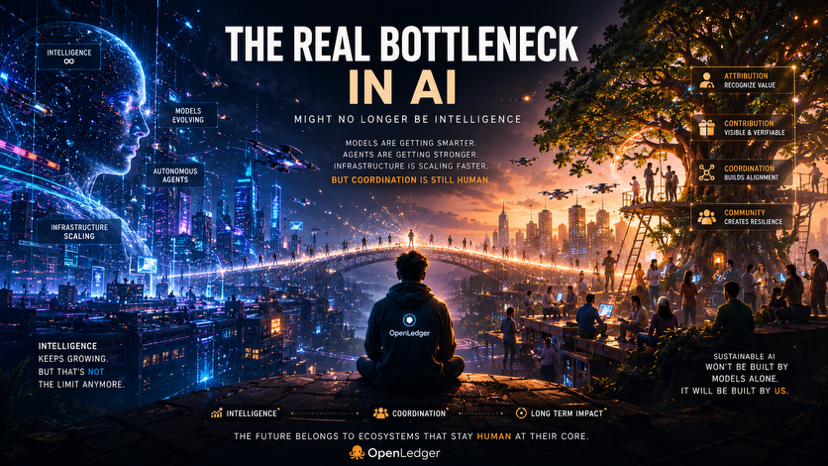
The real bottleneck in AI might no longer be intelligence.
And honestly, I think the industry still hasn’t fully processed that yet.
Models keep getting smarter.
Agents keep becoming more autonomous.
Infrastructure keeps scaling at an insane pace.
But underneath all that progress, something else feels like it’s quietly starting to break:
human coordination.
That realization hit me harder the deeper I explored ecosystems like @OpenLedger .
Because the strange part is that many AI systems already look technologically impressive…
while the ecosystems around them feel increasingly fragmented underneath.
Contributors become invisible.
Communities lose alignment.
Participation turns temporary.
Everything starts optimizing for expansion instead of coherence.
The infrastructure keeps scaling.
The social layer inside it slowly weakens.
And honestly, I’m starting to think that disconnect may become more dangerous than model limitations themselves.
Because intelligence alone doesn’t automatically create sustainable ecosystems.
Humans still need to:
coordinate,
trust each other,
verify contribution,
preserve alignment over time.
That layer is messy.
Slow.
Emotionally fragile.
And most AI ecosystems still seem heavily underestimated around how difficult that actually is at scale.
That’s one reason OpenLedger stayed in my head longer than most AI projects lately.
The ecosystem feels much more focused on coordination itself:
• attribution
• contribution visibility
• decentralized datasets
• persistent participation
• agent coordination
Not just intelligence scaling endlessly in isolation.
And weirdly, that focus feels increasingly important the deeper AI expands.
Because some ecosystems are already scaling faster than humans can meaningfully organize inside them.
That sentence honestly feels less theoretical every month.
You can already feel the symptoms spreading:
temporary communities,
extractive participation,
fragmented ecosystems,
contributors disconnected from the value they help create.
Meanwhile AI systems continue becoming more powerful.
That imbalance feels unstable long term.
Maybe future AI ecosystems won’t fail because the models weren’t intelligent enough.
Maybe they fail because meaningful coordination collapsed underneath infrastructure growing too fast to remain socially coherent anymore.
And honestly, I’m no longer sure enough people inside AI are taking that possibility seriously yet.