


In trading, one indicator is just an opinion, two is a hypothesis, and three is a full-blown strategy. The main secret to successful and profitable trades isn't the number of tools, but their synergy.
I've split the best combos into 'Sets' for specific trading tasks. Keep this list handy.
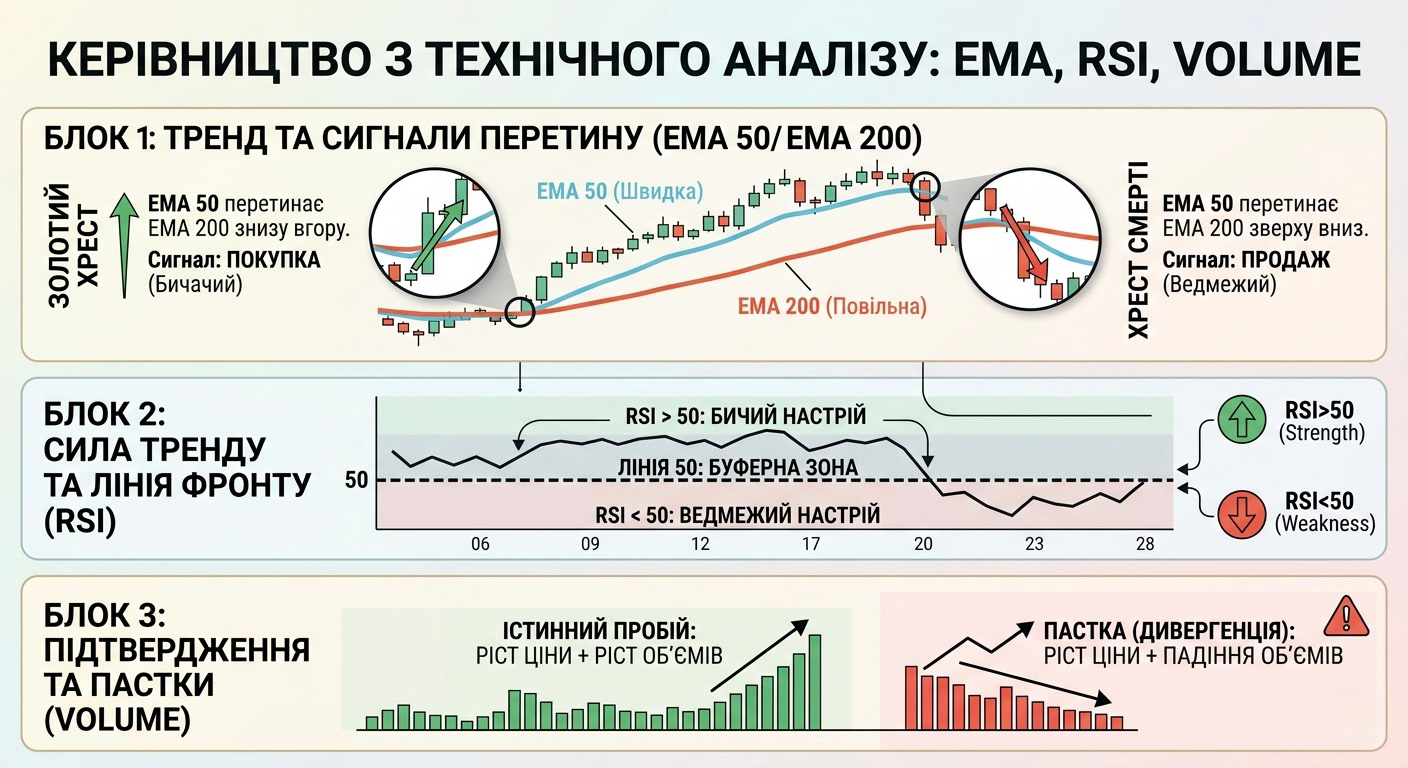

Set #1: 'Trend Control' (For calm and confident trading)
Works best on 1H, 4H, and 1D timeframes. Helps to capture big price movements.
•EMA 50 and EMA 200: When the short average (50) crosses above the long (200) — that's a 'Golden Cross' (signal for growth). Conversely — 'Death Cross'.
•RSI (Relative Strength Index): We use the 50 zone as the frontline. If RSI > 50 — bulls are stronger.
•Volume: Any breakout should be supported by increasing volumes. If the price is rising while volumes are falling — it's a trap.
❗️Logic: EMA sets the direction, RSI shows who controls the market, and volume confirms the reality of intentions.
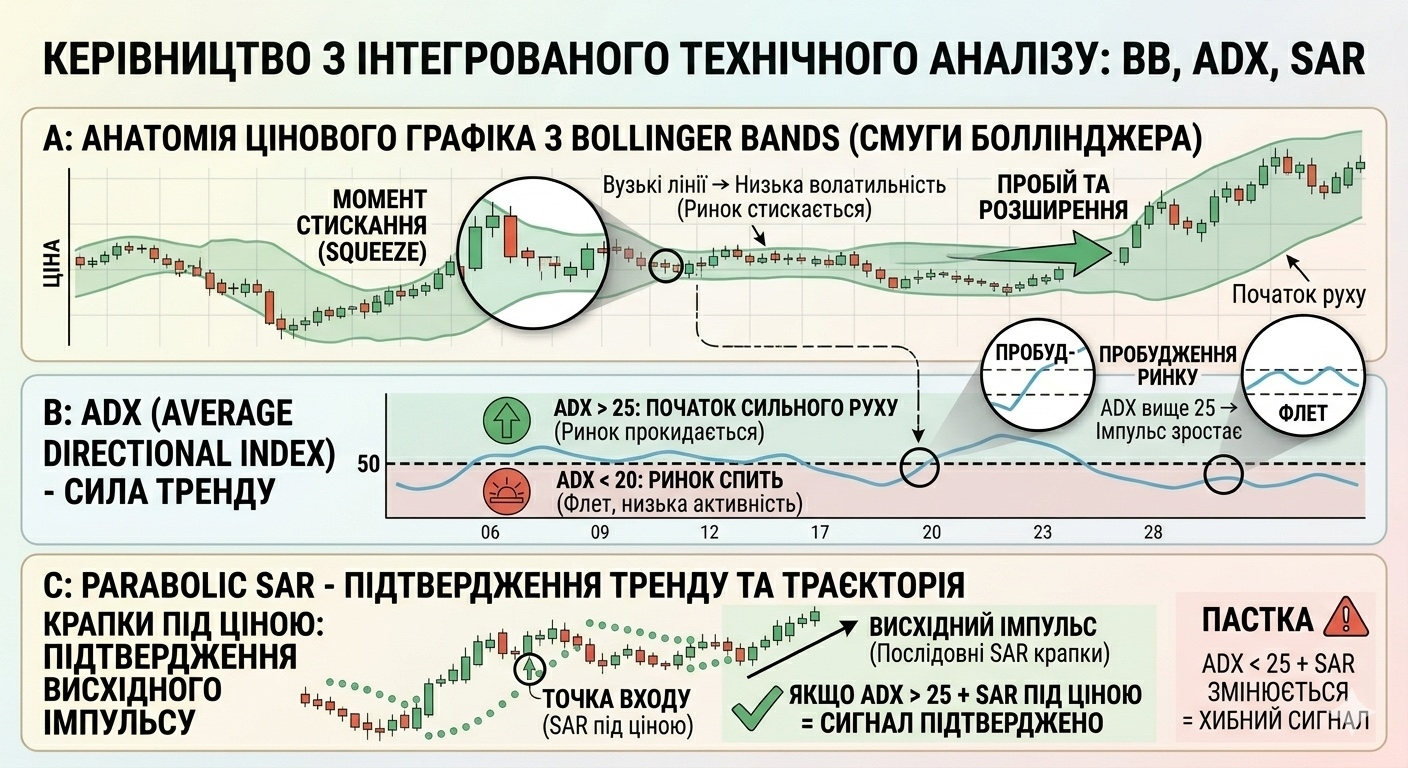

Set #2: 'Volatility Explosion' (For hunting impulses)
Perfect for crypto, when an asset accumulates for a long time and then 'shoots' up by 10-20%.
•Bollinger Bands: We're looking for the 'Squeeze' moment when the lines get super tight.
•ADX (Average Directional Index): If the ADX is below 20, the market is sleeping. Once it starts rising above 25, a strong move begins.
•Parabolic SAR: Dots below the price confirm the start of an upward impulse.
❗️Logic: Bollinger shows a coiled spring, ADX says 'movement has started', and Parabolic helps to ride the trade without closing it too early.
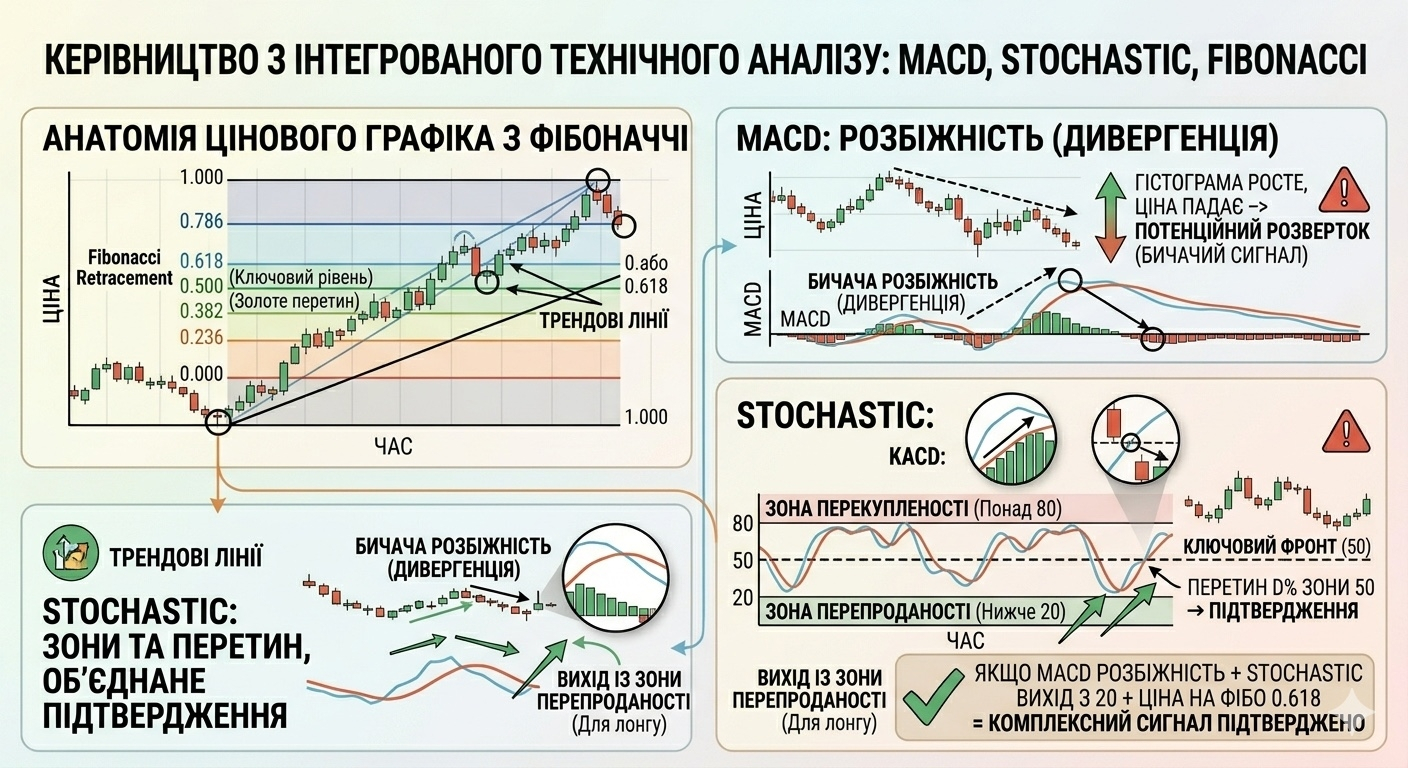

Set #3: 'Master of Reversals' (For finding peaks and bottoms)
This set is for those who don't want to buy at the highs. It works on divergences.
•MACD: Looking for divergence between the price chart and the indicator's histogram.
•Stochastic Oscillator: We wait for an exit from the oversold zone (below 20) for a long.
•Fibonacci Retracement: We stretch the grid to find levels 0.5 or 0.618 ('golden ratio'), where the price often reverses.
❗️Logic: MACD signals trend fatigue, Stochastic gives the entry point, and Fibonacci hints where the big players' limit orders are placed.
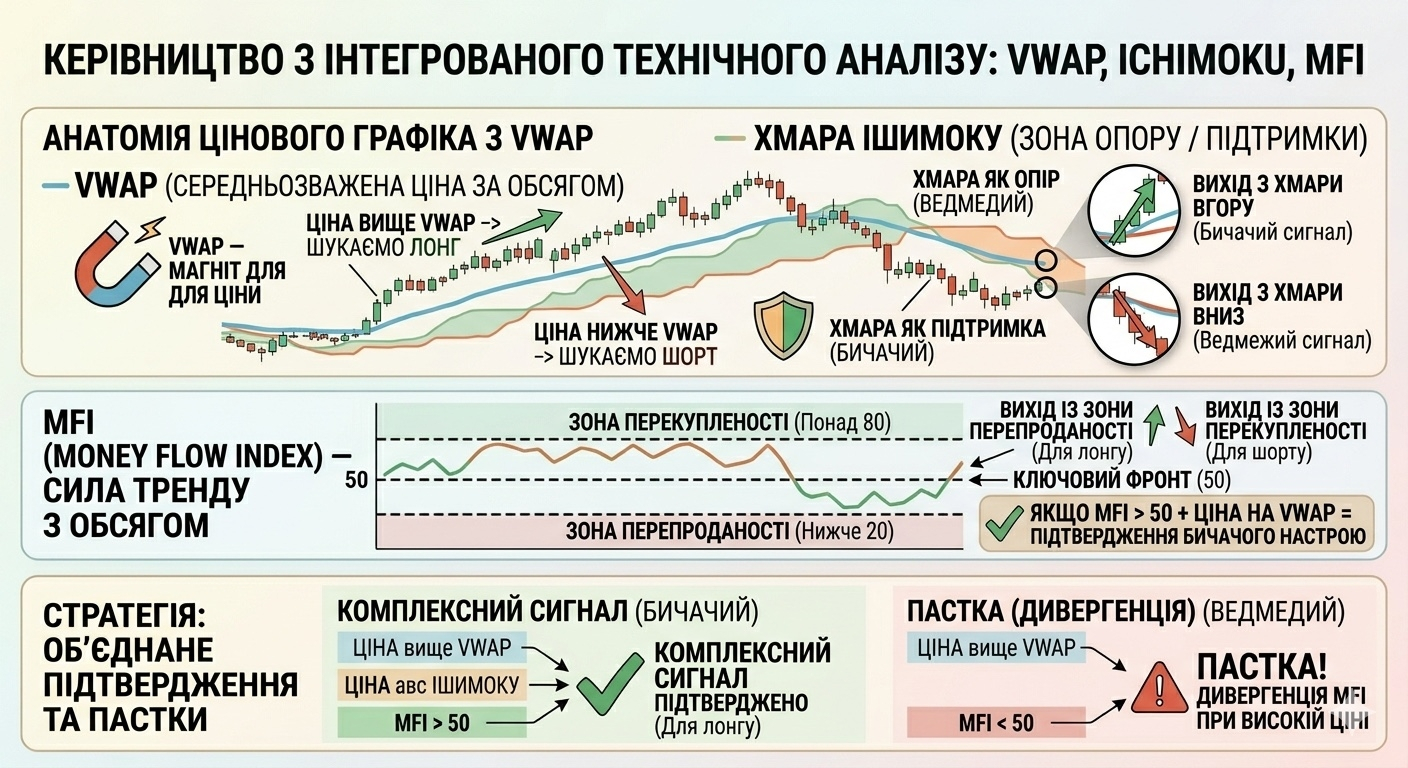
Set #4: 'Scalper's Boost' (For quick trades on 5m-15m)
For those who spend a lot of time in the market and love dynamics.
•VWAP (Volume Weighted Average Price): Price below VWAP — look for shorts, above — longs. It's a 'magnet' for price.
•Ichimoku Cloud: We use only the 'Cloud' as a support/resistance zone.
•MFI (Money Flow Index): This is 'RSI on steroids', which considers the volume of money flowing into the asset.
📅 Crypto trading from scratch in 30 days — a step-by-step plan to learn and trade confidently
🛠 How to properly combine indicators?
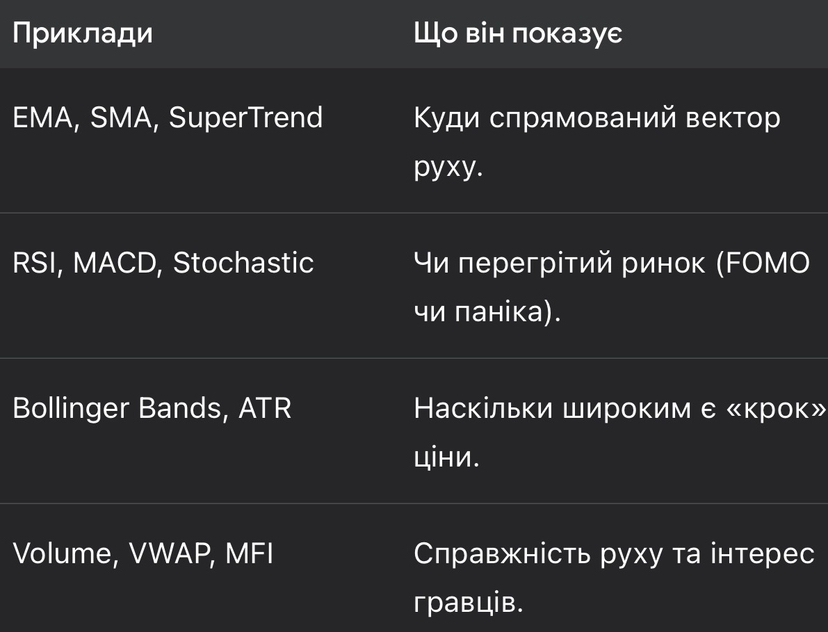
For your own set to work, it needs to consist of tools of various types:
1. Trend (EMA, Ichimoku) — tells you where we're heading.
2. Oscillator (RSI, Stochastic, MACD) — tells you if it's too late to enter.
3. Volume (Volume, MFI, OBV) — tells you if there's real money in this move.
⏱Timeframes: Where is the money hiding, and where are the nerves?
Beginners often rush to 1-minute charts (1m) because 'everything moves quickly' there. That's a mistake. On lower timeframes, there's a lot of 'market noise' — random fluctuations that mess up your stop-losses.
Best choice to start with:
• 4 hours (4H) and 1 day (1D): This is the 'golden standard'. Here you see the real trend, not the market makers' manipulations. You're calm, you have time to think and verify your indicator signals.
• 1 hour (1H): The lowest timeframe a beginner should go for precise entry if the direction is clear on the 4H.
⚠️ Conclusion: Start with daily chart analysis to understand where the market is headed, and open trades on the 4-hour chart.
📈 Bullish reversal patterns: How to recognize a market reversal upwards
💰 What amounts to invest?
Here the iron rule applies: 'Learning costs money, but not necessarily all your money.'
1. Test deposit 50 – 200
This is the amount you're psychologically ready to lose.
• Goal: Not to earn for a Lamborghini, but to learn how to press buttons, set Stop-Loss and Take-Profit, and check how your 'indicator sets' work.
• Tip: Trade on the spot market (without leverage) or with minimal leverage (2x-3x) on futures.
2. 1% Rule (Risk Management)
Regardless of whether you have $100 or $10,000, you shouldn't lose more than 1-2% of your total deposit in one trade.
• If your deposit is $100, then a closed trade at stop-loss should only take away $1-$2.
• This will allow you to make 50-100 mistakes in a row and still stay afloat.
stay in the game.
🚀 Checklist for beginners before entering
1. Don't trade on borrowed money. The market doesn't like pressure. Trade only what won't change your life in case of loss.
2. Forget about 100x leverage. High leverage is the shortest path to liquidation. For beginners, leverage above 5x is suicidal; best at 2x-3x.
3. Keeping a journal. Record: why you entered, which indicators signaled, what timeframe you used, and what the outcome was. After a month, you'll see your real statistics.
📖 Encyclopedia of Modern Trading: From Smart Money concepts to quantum algorithms📊
This encyclopedia is your navigator in a world where information is worth more than money, and patience pays off in gold. We'll journey from the 'footprints' of market makers (Smart Money) to the mathematical perfection of neural networks.