
It's raining again today, and the humid air is really getting on my nerves. What frustrates me even more is that during a brainless move this afternoon while watching the charts, I impulsively cleared a chunk of my long-held $PIXEL spot holdings to jump into a 'meme combined with AI' shitcoin on the Solana chain. And what happened? Less than forty minutes later, the pool got pulled, and it went straight to zero. Since entering the scene in '18, I consider myself a seasoned bag holder, and today was purely driven by market FOMO. Now, I truly want to bang my head against the wall.
Feeling frustrated, I calmed down and took another look at the recent docs released about the Stacked engine. After reading it, all I could think was to slap myself: I might have just sold off the true core engine behind the next wave of blockchain gaming explosion.
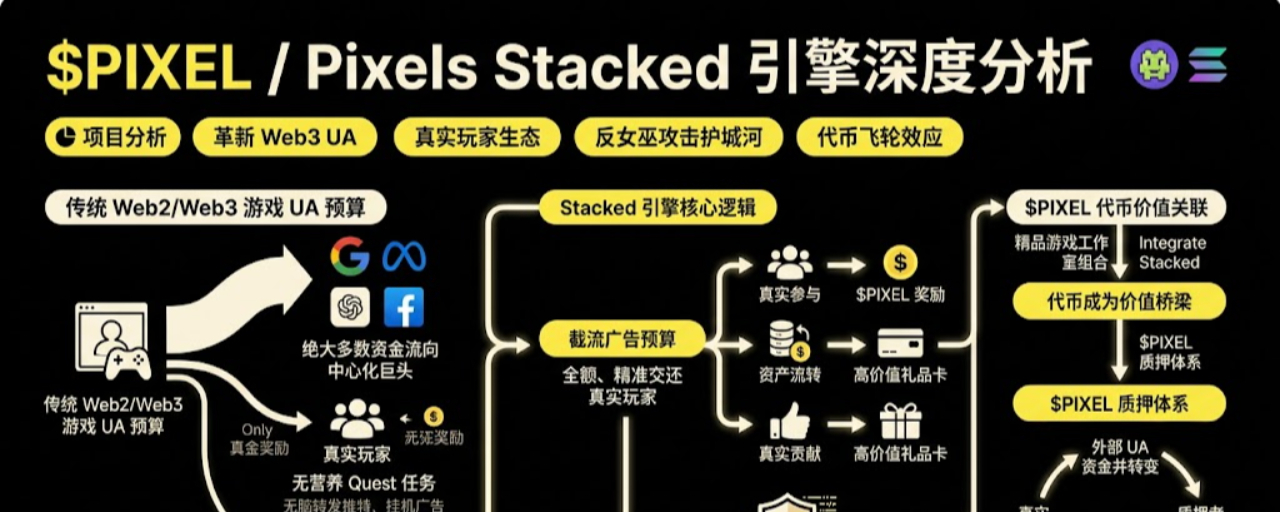
Have you ever seriously thought about a question? Whether it's traditional Web2 giants or today's Web3 game teams, where do those annual user acquisition (UA) budgets, often in the tens of billions of dollars, ultimately end up? The answer is frustrating: the vast majority goes into the pockets of centralized giants like Google and Meta. And what about us players? As the group that spends the most time and creates core value in the gaming ecosystem, we can’t even get a sip of soup.
Previously, Web3 games claimed to break this deadlock with the so-called Play-to-Earn. But honestly, as a seasoned script writer and someone who manages multiple accounts with fingerprint browsers, I know the ins and outs too well. Most of the Quest task boards created by current development teams are a joke. They either have you mindlessly retweeting on Twitter or force you to watch low-quality ads for dozens of seconds. This kind of nutritionally empty interaction is ultimately exploited by the studios' automated armies, leading to a terrible player experience and wasting all the project’s buyback funds.

But with the Stacked engine launched by m-36, the landscape is obviously different. Its core narrative logic is very straightforward: it directly cuts off the massive budgets that should have gone to advertising giants and returns them in full, accurately to the real players who truly love the game.
Pay attention, Stacked emphasizes 'meaningful interactions.' It's not about making you do trash tweeting tasks, but rather incentives tailored to your genuine participation, in-game asset circulation, and real contribution. As long as you play seriously, you can earn real cash, crypto assets, or even high-value gift cards.
This brings us back to my most sensitive area—anti-witch-hunt attacks. In this malicious dark forest, creating a system that pays real players is harder than climbing to the sky. Most of the shabby teams' anti-cheat mechanisms can't last three days against our configured static residential proxies. But the Stacked engine dares to play this way because it has an extremely deep moat. The Pixels team emerged from the blood and fire of the last bull-bear cycle, amassing a wealth of high-precision player behavior data. Their proven anti-fraud interceptors and anti-bot systems are not something that any new public chain game can easily replicate.
So, what does this have to do with tokens? This is also why I feel immense regret about my selling operation today. c-42
Once Stacked becomes the preferred buyback engine for Web3 and even some Web2 games, external quality game studios will continuously connect to this system. To operate within the Stacked ecosystem or for players to gain higher-level reward weights and task distributions, tokens are the only value bridge.
With the current staking ecosystem around Pixels, an incredibly powerful flywheel effect is forming. In the future, the entire cross-game traffic value will settle within the staking system. When external funds continuously convert into real scene demand for t-16 through the Stacked engine, stakers will enjoy not just in-game inflation rewards, but real, sustainable buyback budget dividends from the entire blockchain gaming sector. The more you stake, the greater your stake and access to high-value rewards in the real player network.
Each precise reward distribution injects real liquidity into this ecosystem. This is the only legitimate path for Web3 games to bid farewell to Ponzi schemes and move toward the mainstream.
No more talking, while the market is still fluctuating, I need to slowly buy back the chips I foolishly tossed away this afternoon. In this circle, it's better to avoid the hot new dogs and grab good stuff with real moats and blood-making abilities to survive long-term. Don't be like me today, messing around. t-9