

#prima
prima
3,178 views
21 Discussing
Hot
Latest

·
--
Article
P2P Depth in Venezuela: 2.65% Spread and 12.34% Premium vs BCV Live P2P Radar Capture: 1/10/2026, 4:00:08 p. m.
USDT/VES reference Bs. 966.31
Buy USDT Bs. 966.31
USDT purchase US$ 941.37
BCV Bs. 860.18
Premium vs BCV 12.34%
P2P spread 2.65%
Offers observed 272
Verify current data in P2P Radar
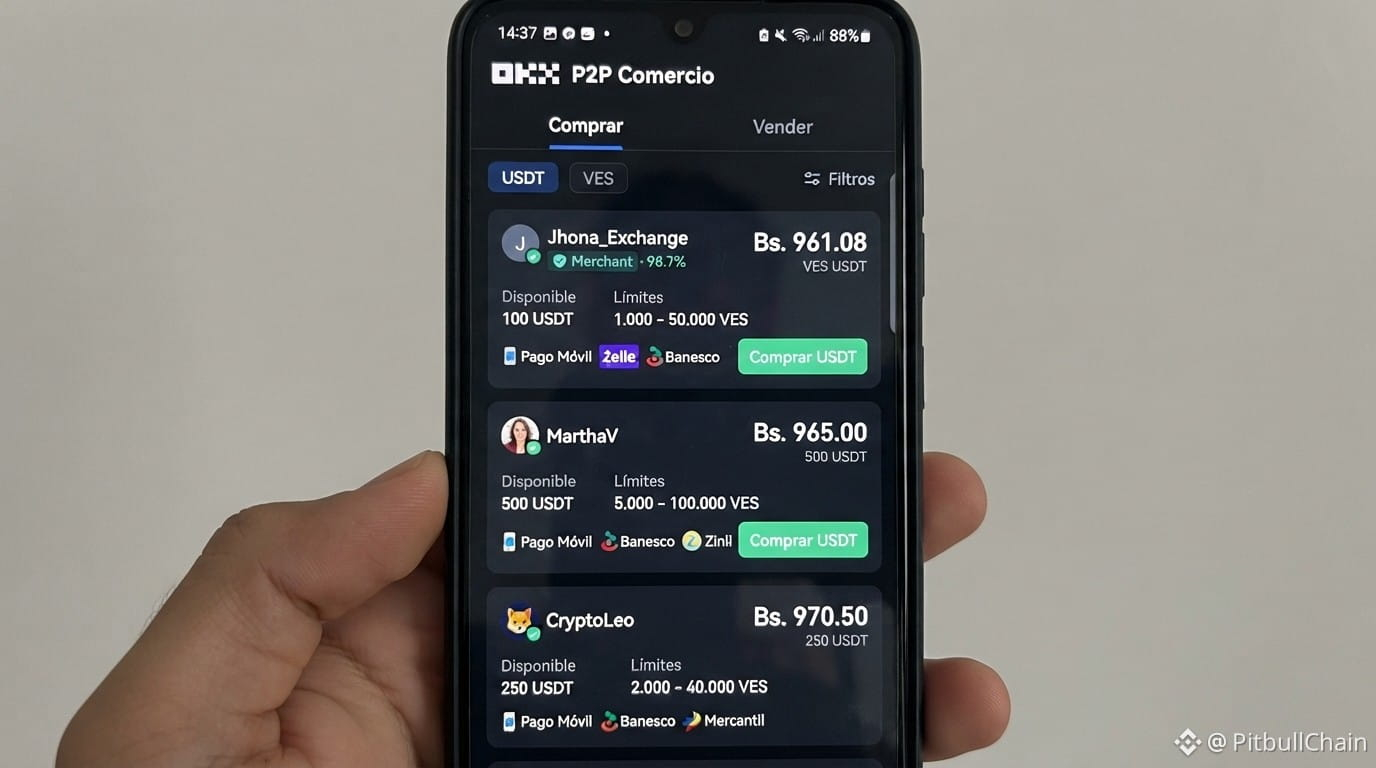
Venezuela’s P2P trading ecosystem continues to operate as the main price-setting and FX-hedging channel for the real economy. At the close of this market record, the USDT/VES quotation averages Bs. 966.31 on the buy side and Bs. 941.37 on the sell side within the consolidated radar, generating a gross spread of Bs. 24.94 (2.65%). At the same time, the official rate of Venezuela’s Central Bank (BCV) is Bs. 860.18, establishing an FX premium of 12.34%.
P2P Depth in Venezuela: 2.65% Spread and 12.34% Premium vs BCV
Live P2P Radar Capture: 1/10/2026, 4:00:08 p. m.
USDT/VES reference Bs. 966.31
Buy USDT Bs. 966.31
USDT purchase US$ 941.37
BCV Bs. 860.18
Premium vs BCV 12.34%
P2P spread 2.65%
Offers observed 272
Verify current data in P2P Radar
Venezuela’s P2P trading ecosystem continues to operate as the main price-setting and FX-hedging channel for the real economy. At the close of this market record, the USDT/VES quotation averages Bs. 966.31 on the buy side and Bs. 941.37 on the sell side within the consolidated radar, generating a gross spread of Bs. 24.94 (2.65%). At the same time, the official rate of Venezuela’s Central Bank (BCV) is Bs. 860.18, establishing an FX premium of 12.34%.
USDT/VES reference Bs. 966.31
Buy USDT Bs. 966.31
USDT purchase US$ 941.37
BCV Bs. 860.18
Premium vs BCV 12.34%
P2P spread 2.65%
Offers observed 272
Verify current data in P2P Radar
Venezuela’s P2P trading ecosystem continues to operate as the main price-setting and FX-hedging channel for the real economy. At the close of this market record, the USDT/VES quotation averages Bs. 966.31 on the buy side and Bs. 941.37 on the sell side within the consolidated radar, generating a gross spread of Bs. 24.94 (2.65%). At the same time, the official rate of Venezuela’s Central Bank (BCV) is Bs. 860.18, establishing an FX premium of 12.34%.
6
·
--
Publishing ads on Binance P2P: 2026 guide to selling USDT📊 Publishing ads on Binance P2P: 2026 guide to selling USDT
Publishing your own ads on Binance P2P stopped being an experiment and became a formal income channel for many Venezuelans. This video works as an initial guide, but publishing is only the first step: the real business is reading the market premium correctly and protecting your capital. Here we share the summary and our take from PitbullChain.
📈 Video summary
The video is a step-by-step guide to creating and publishing USDT selling ads on Binance P2P, aimed at users who want to start generating income through P2P trading in Venezuela. It explains the ad setup process: selecting the USDT asset, the fiat currency VES, setting price and transaction amount limits, and defining the available payment methods. It also covers identity verification requirements and the importance of maintaining a clean reputation on the platform. Throughout the tutorial, the idea is reinforced that you should choose the ad conditions carefully so you don’t end up exposed to problematic counterparties. It is introductory content, ideal for anyone who has never published ads before and wants to understand the operating mechanics before risking money.
Publishing ads on Binance P2P: 2026 guide to selling USDT
📊 Publishing ads on Binance P2P: 2026 guide to selling USDT
Publishing your own ads on Binance P2P stopped being an experiment and became a formal income channel for many Venezuelans. This video works as an initial guide, but publishing is only the first step: the real business is reading the market premium correctly and protecting your capital. Here we share the summary and our take from PitbullChain.
📈 Video summary
The video is a step-by-step guide to creating and publishing USDT selling ads on Binance P2P, aimed at users who want to start generating income through P2P trading in Venezuela. It explains the ad setup process: selecting the USDT asset, the fiat currency VES, setting price and transaction amount limits, and defining the available payment methods. It also covers identity verification requirements and the importance of maintaining a clean reputation on the platform. Throughout the tutorial, the idea is reinforced that you should choose the ad conditions carefully so you don’t end up exposed to problematic counterparties. It is introductory content, ideal for anyone who has never published ads before and wants to understand the operating mechanics before risking money.
Publishing your own ads on Binance P2P stopped being an experiment and became a formal income channel for many Venezuelans. This video works as an initial guide, but publishing is only the first step: the real business is reading the market premium correctly and protecting your capital. Here we share the summary and our take from PitbullChain.
📈 Video summary
The video is a step-by-step guide to creating and publishing USDT selling ads on Binance P2P, aimed at users who want to start generating income through P2P trading in Venezuela. It explains the ad setup process: selecting the USDT asset, the fiat currency VES, setting price and transaction amount limits, and defining the available payment methods. It also covers identity verification requirements and the importance of maintaining a clean reputation on the platform. Throughout the tutorial, the idea is reinforced that you should choose the ad conditions carefully so you don’t end up exposed to problematic counterparties. It is introductory content, ideal for anyone who has never published ads before and wants to understand the operating mechanics before risking money.
6
·
--
Binance as guarantor: how P2P trading works in Venezuela📊 Binance as guarantor: how P2P trading works in Venezuela
USDT P2P trading in Venezuela is still the most honest thermometer for the dollar. This video covers Binance’s role as an intermediary in each transaction. Here we leave you the summary and our market take.
📈 Video summary
The video focuses on explaining how Binance acts as an intermediary in P2P trading, holding funds until both parties confirm the payment. The basic flow is detailed: the seller delivers the USDT to the platform, the buyer pays in bolívares, and the release happens only when the system validates the transaction. It’s also clarified that this does not eliminate counterparty risk—it only manages it through reputation, identity verification, and a dispute system. In practice, it works as an introductory guide for those who are just starting to trade or want to understand why the platform holds crypto during the exchange.
Binance as guarantor: how P2P trading works in Venezuela
📊 Binance as guarantor: how P2P trading works in Venezuela
USDT P2P trading in Venezuela is still the most honest thermometer for the dollar. This video covers Binance’s role as an intermediary in each transaction. Here we leave you the summary and our market take.
📈 Video summary
The video focuses on explaining how Binance acts as an intermediary in P2P trading, holding funds until both parties confirm the payment. The basic flow is detailed: the seller delivers the USDT to the platform, the buyer pays in bolívares, and the release happens only when the system validates the transaction. It’s also clarified that this does not eliminate counterparty risk—it only manages it through reputation, identity verification, and a dispute system. In practice, it works as an introductory guide for those who are just starting to trade or want to understand why the platform holds crypto during the exchange.
USDT P2P trading in Venezuela is still the most honest thermometer for the dollar. This video covers Binance’s role as an intermediary in each transaction. Here we leave you the summary and our market take.
📈 Video summary
The video focuses on explaining how Binance acts as an intermediary in P2P trading, holding funds until both parties confirm the payment. The basic flow is detailed: the seller delivers the USDT to the platform, the buyer pays in bolívares, and the release happens only when the system validates the transaction. It’s also clarified that this does not eliminate counterparty risk—it only manages it through reputation, identity verification, and a dispute system. In practice, it works as an introductory guide for those who are just starting to trade or want to understand why the platform holds crypto during the exchange.
12
·
--
Article
USDT P2P premium falls to 14.12% vs BCV: 8.26 points less Live P2P Radar Capture: 23/9/2026, 4:00:07 p. m.
USDT/VES reference Bs. 973.97
Buy USDT Bs. 973.97
USDT sale Bs. 949.12
BCV Bs. 853.50
Premium vs BCV 14.12%
P2P spread 2.62%
Observed offers 221
Verify current data on Radar P2P
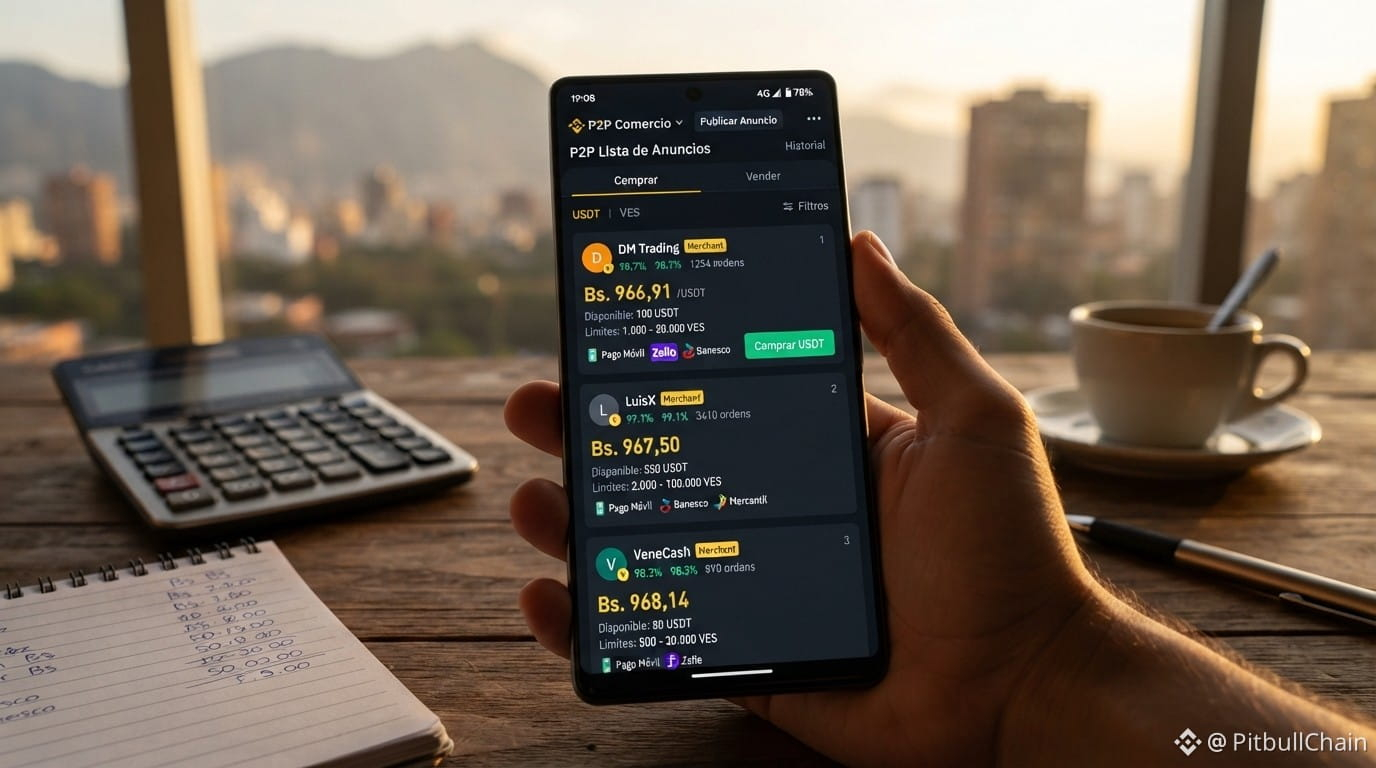
The USDT premium in Venezuelan P2P trading stood at 14.12% versus the Central Bank of Venezuela (BCV) rate, according to PitbullChain’s P2P Radar with data captured on September 23, 2026 at 20:00 UTC. The figure represents a drop of 8.26 percentage points compared with the 22.38% reported on September 21, a day marked by the addition of new banks to Binance P2P.
USDT P2P premium falls to 14.12% vs BCV: 8.26 points less
Live P2P Radar Capture: 23/9/2026, 4:00:07 p. m.
USDT/VES reference Bs. 973.97
Buy USDT Bs. 973.97
USDT sale Bs. 949.12
BCV Bs. 853.50
Premium vs BCV 14.12%
P2P spread 2.62%
Observed offers 221
Verify current data on Radar P2P
The USDT premium in Venezuelan P2P trading stood at 14.12% versus the Central Bank of Venezuela (BCV) rate, according to PitbullChain’s P2P Radar with data captured on September 23, 2026 at 20:00 UTC. The figure represents a drop of 8.26 percentage points compared with the 22.38% reported on September 21, a day marked by the addition of new banks to Binance P2P.
USDT/VES reference Bs. 973.97
Buy USDT Bs. 973.97
USDT sale Bs. 949.12
BCV Bs. 853.50
Premium vs BCV 14.12%
P2P spread 2.62%
Observed offers 221
Verify current data on Radar P2P
The USDT premium in Venezuelan P2P trading stood at 14.12% versus the Central Bank of Venezuela (BCV) rate, according to PitbullChain’s P2P Radar with data captured on September 23, 2026 at 20:00 UTC. The figure represents a drop of 8.26 percentage points compared with the 22.38% reported on September 21, a day marked by the addition of new banks to Binance P2P.
10
·
--
BCV intervention and P2P premium: where is USDT going today?📊 BCV intervention and P2P premium: where is USDT going today?
Date: Wednesday, August 26, 2026 · Live data from the P2P Radar: buy Bs. 963.00 · sell Bs. 908.71 · BCV Bs. 787.52 · premium 22.28%
Today, Wednesday, August 26, 2026, the USDT/VES P2P market starts with a high premium of 22.28% versus the BCV, which stands at Bs. 787.52. The Central Bank’s currency interventions continue to set the tone, with an official rate that fails to close the gap amid strong demand for crypto dollars.
BCV intervention and P2P premium: where is USDT going today?
📊 BCV intervention and P2P premium: where is USDT going today?
Date: Wednesday, August 26, 2026 · Live data from the P2P Radar: buy Bs. 963.00 · sell Bs. 908.71 · BCV Bs. 787.52 · premium 22.28%
Today, Wednesday, August 26, 2026, the USDT/VES P2P market starts with a high premium of 22.28% versus the BCV, which stands at Bs. 787.52. The Central Bank’s currency interventions continue to set the tone, with an official rate that fails to close the gap amid strong demand for crypto dollars.
Date: Wednesday, August 26, 2026 · Live data from the P2P Radar: buy Bs. 963.00 · sell Bs. 908.71 · BCV Bs. 787.52 · premium 22.28%
Today, Wednesday, August 26, 2026, the USDT/VES P2P market starts with a high premium of 22.28% versus the BCV, which stands at Bs. 787.52. The Central Bank’s currency interventions continue to set the tone, with an official rate that fails to close the gap amid strong demand for crypto dollars.
24
·
--
Article
Practical guide: how to calculate spread and premium in the USDT/VES P2P Live P2P Radar USDT capture: 27/8/2026, 12:00:17 a. m.
USDT/VES reference Bs. 964.51
Buy USDT Bs. 964.51
Buy USDT Bs. 927.00
BCV Bs. 791.32
Premium vs BCV 21.89%
P2P spread 4.05%
Observed offers 239
Verify current data in P2P Radar
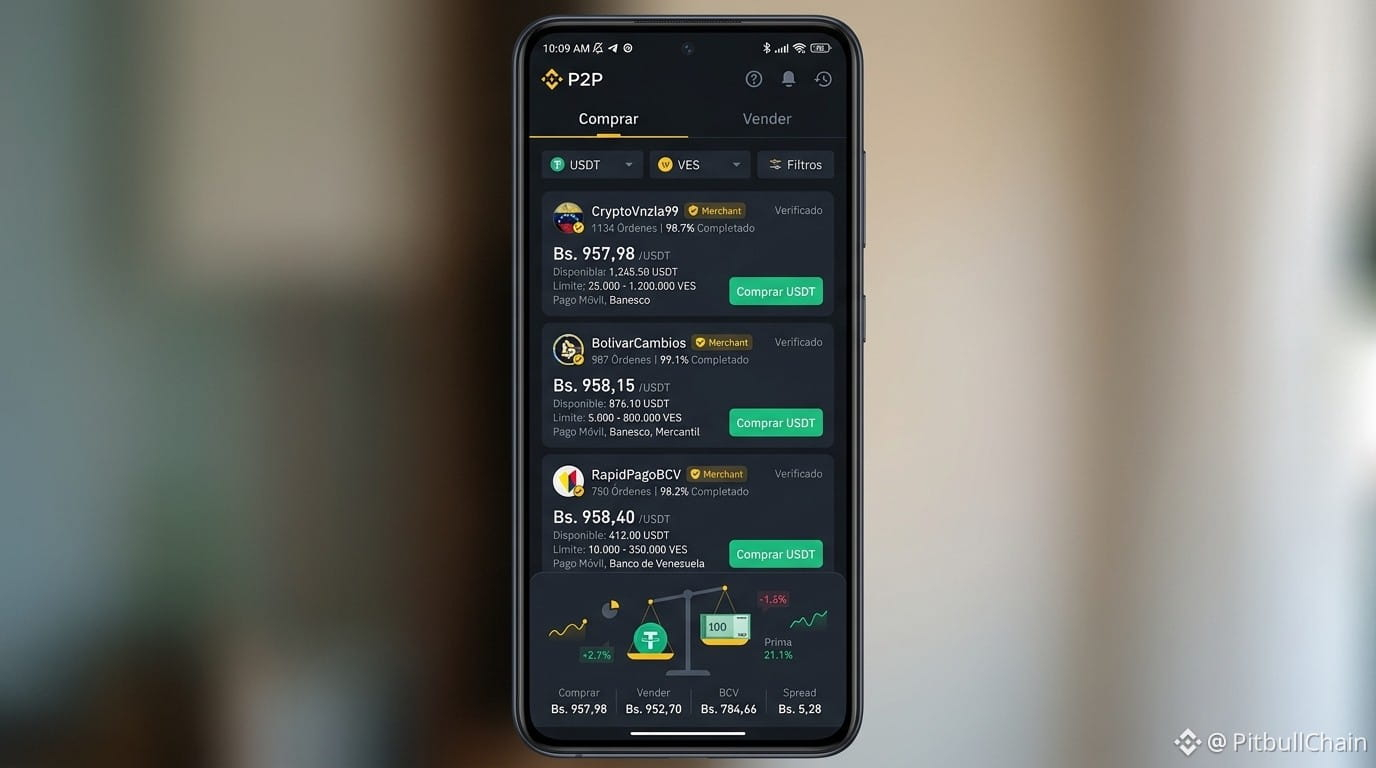
The P2P USDT market in Venezuela is one of the most active in the world, and not by chance. Millions of people use this channel to protect their money from inflation, make payments, or simply move bolívares. However, few people truly understand what two key concepts mean: the spread and the premium. In this practical guide, based on live data from PitbullChain, we explain how to calculate them, why they matter, and what mistakes to avoid.
Practical guide: how to calculate spread and premium in the USDT/VES P2P
Live P2P Radar USDT capture: 27/8/2026, 12:00:17 a. m.
USDT/VES reference Bs. 964.51
Buy USDT Bs. 964.51
Buy USDT Bs. 927.00
BCV Bs. 791.32
Premium vs BCV 21.89%
P2P spread 4.05%
Observed offers 239
Verify current data in P2P Radar
The P2P USDT market in Venezuela is one of the most active in the world, and not by chance. Millions of people use this channel to protect their money from inflation, make payments, or simply move bolívares. However, few people truly understand what two key concepts mean: the spread and the premium. In this practical guide, based on live data from PitbullChain, we explain how to calculate them, why they matter, and what mistakes to avoid.
USDT/VES reference Bs. 964.51
Buy USDT Bs. 964.51
Buy USDT Bs. 927.00
BCV Bs. 791.32
Premium vs BCV 21.89%
P2P spread 4.05%
Observed offers 239
Verify current data in P2P Radar
The P2P USDT market in Venezuela is one of the most active in the world, and not by chance. Millions of people use this channel to protect their money from inflation, make payments, or simply move bolívares. However, few people truly understand what two key concepts mean: the spread and the premium. In this practical guide, based on live data from PitbullChain, we explain how to calculate them, why they matter, and what mistakes to avoid.
2
2.1k
·
--
No BCV intervention: the P2P spread sets the tone today📊 No BCV intervention: the P2P spread sets the tone today
Date: Thursday, August 27, 2026 · Live P2P Radar data: buy Bs. 960.70 · sell Bs. 943.06 · BCV Bs. N/A · premium N/A%
This Thursday, August 27, the Venezuelan P2P market trades without an official reference from the BCV, creating uncertainty and widening spreads. The lack of FX intervention allows local supply and demand to set the USDT price. We analyze how this affects the premium and which strategies are advisable.
No BCV intervention: the P2P spread sets the tone today
📊 No BCV intervention: the P2P spread sets the tone today
Date: Thursday, August 27, 2026 · Live P2P Radar data: buy Bs. 960.70 · sell Bs. 943.06 · BCV Bs. N/A · premium N/A%
This Thursday, August 27, the Venezuelan P2P market trades without an official reference from the BCV, creating uncertainty and widening spreads. The lack of FX intervention allows local supply and demand to set the USDT price. We analyze how this affects the premium and which strategies are advisable.
Date: Thursday, August 27, 2026 · Live P2P Radar data: buy Bs. 960.70 · sell Bs. 943.06 · BCV Bs. N/A · premium N/A%
This Thursday, August 27, the Venezuelan P2P market trades without an official reference from the BCV, creating uncertainty and widening spreads. The lack of FX intervention allows local supply and demand to set the USDT price. We analyze how this affects the premium and which strategies are advisable.
11
·
--
Article
USDT vs BCV premium exceeds 20%: spread and depth analysis in P2P Live P2P Radar Capture: 27/8/2026, 2:00:17 p. m.
USDT/VES reference Bs. 955.56
Buy USDT Bs. 955.56
USDT in Venezuela: Bs. 917.43
BCV Bs. 791.32
Premium vs BCV 20.76%
P2P spread 4.16%
Observed offers 249
Check current data on P2P Radar
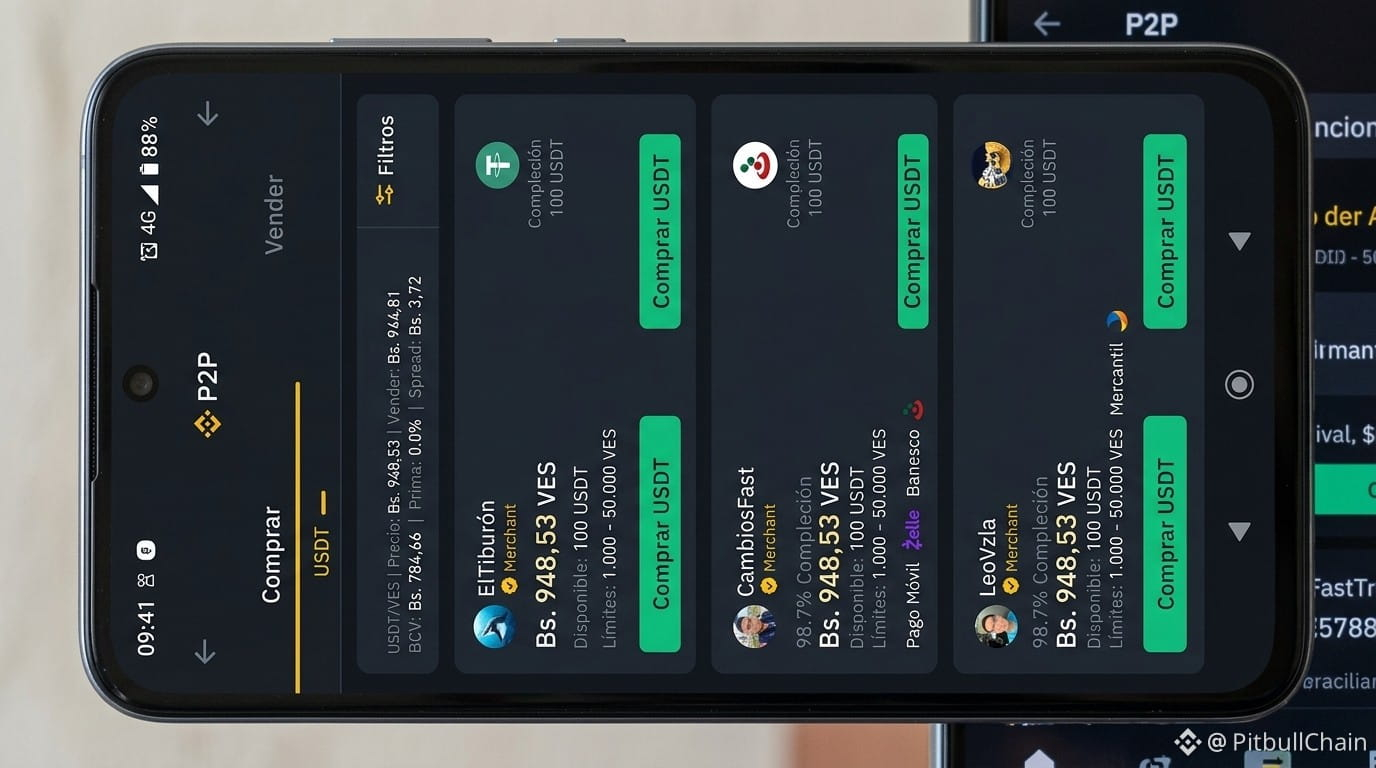
Venezuela’s P2P market shows a paradox: the USDT premium versus BCV jumps to 20.76%, but the spread in the order book is only 0.08%. How do a high premium and such a tight spread coexist? The live data from P2P Radar and Binance from August 27, 2026 allow liquidity, price formation, and execution strategies to be broken down.
USDT vs BCV premium exceeds 20%: spread and depth analysis in P2P
Live P2P Radar Capture: 27/8/2026, 2:00:17 p. m.
USDT/VES reference Bs. 955.56
Buy USDT Bs. 955.56
USDT in Venezuela: Bs. 917.43
BCV Bs. 791.32
Premium vs BCV 20.76%
P2P spread 4.16%
Observed offers 249
Check current data on P2P Radar
Venezuela’s P2P market shows a paradox: the USDT premium versus BCV jumps to 20.76%, but the spread in the order book is only 0.08%. How do a high premium and such a tight spread coexist? The live data from P2P Radar and Binance from August 27, 2026 allow liquidity, price formation, and execution strategies to be broken down.
USDT/VES reference Bs. 955.56
Buy USDT Bs. 955.56
USDT in Venezuela: Bs. 917.43
BCV Bs. 791.32
Premium vs BCV 20.76%
P2P spread 4.16%
Observed offers 249
Check current data on P2P Radar
Venezuela’s P2P market shows a paradox: the USDT premium versus BCV jumps to 20.76%, but the spread in the order book is only 0.08%. How do a high premium and such a tight spread coexist? The live data from P2P Radar and Binance from August 27, 2026 allow liquidity, price formation, and execution strategies to be broken down.
12
·
--
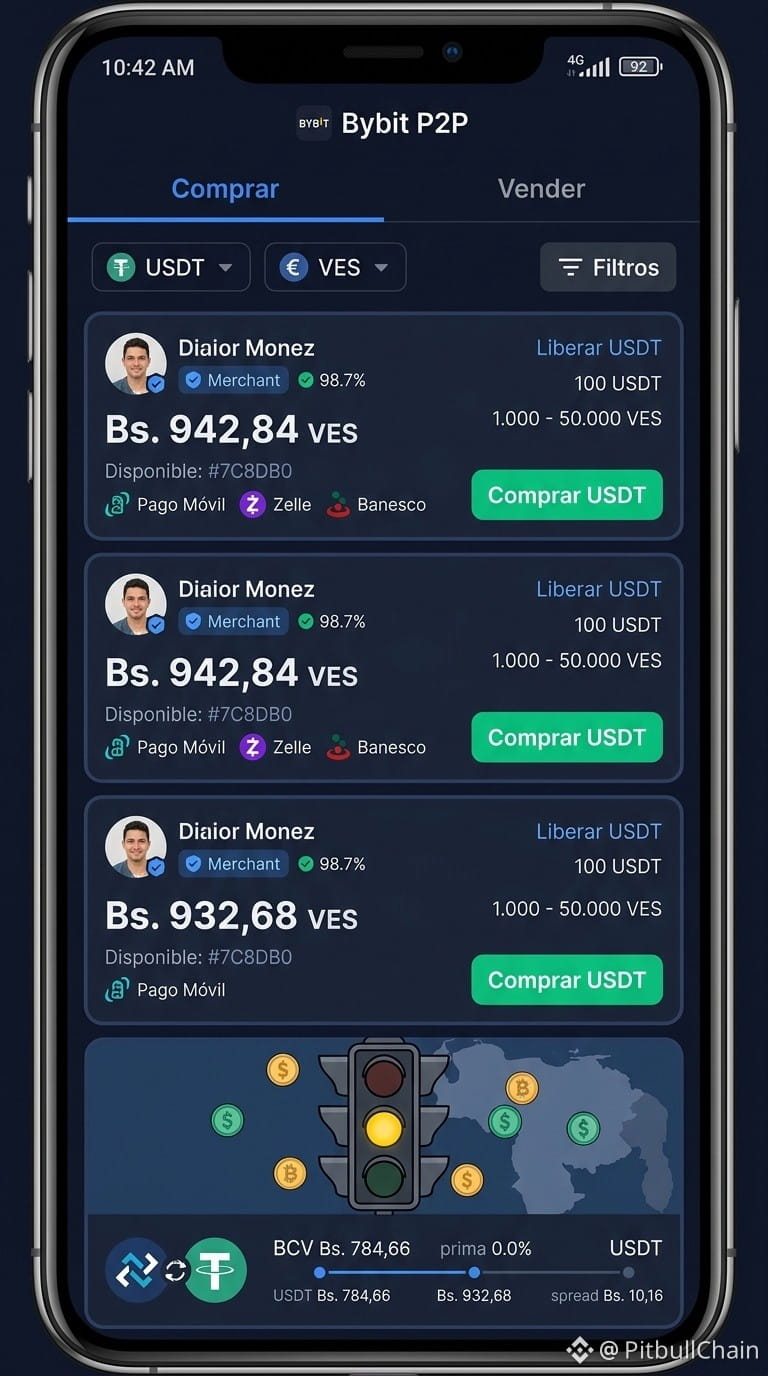
Article
USDT P2P: 20.88% premium vs BCV and a yellow traffic light Live P2P Radar screenshot: 28/8/2026, 5:00:16 a. m.
USDT/VES reference Bs. 956.96
Buy USDT Bs. 956.96
USDT sale Bs. 899.39
BCV Bs. 791.67
Premium vs BCV 20.88%
P2P spread 6.40%
Observed offers 199
Verify current data in P2P Radar
The Venezuelan P2P market starts on August 28, 2026 with a clear signal: the USDT premium versus BCV stands at 20.88%, while the spread between buy and sell reaches 6.4%. PitbullChain’s P2P traffic light, based on live data from the P2P Radar and official sources, turns on the yellow light with a score of 65/100. What lies behind this gap and what does it mean for those who trade cryptocurrencies in Venezuela?
USDT P2P: 20.88% premium vs BCV and a yellow traffic light
Live P2P Radar screenshot: 28/8/2026, 5:00:16 a. m.
USDT/VES reference Bs. 956.96
Buy USDT Bs. 956.96
USDT sale Bs. 899.39
BCV Bs. 791.67
Premium vs BCV 20.88%
P2P spread 6.40%
Observed offers 199
Verify current data in P2P Radar
The Venezuelan P2P market starts on August 28, 2026 with a clear signal: the USDT premium versus BCV stands at 20.88%, while the spread between buy and sell reaches 6.4%. PitbullChain’s P2P traffic light, based on live data from the P2P Radar and official sources, turns on the yellow light with a score of 65/100. What lies behind this gap and what does it mean for those who trade cryptocurrencies in Venezuela?
USDT/VES reference Bs. 956.96
Buy USDT Bs. 956.96
USDT sale Bs. 899.39
BCV Bs. 791.67
Premium vs BCV 20.88%
P2P spread 6.40%
Observed offers 199
Verify current data in P2P Radar
The Venezuelan P2P market starts on August 28, 2026 with a clear signal: the USDT premium versus BCV stands at 20.88%, while the spread between buy and sell reaches 6.4%. PitbullChain’s P2P traffic light, based on live data from the P2P Radar and official sources, turns on the yellow light with a score of 65/100. What lies behind this gap and what does it mean for those who trade cryptocurrencies in Venezuela?
7
·
--
BCV without a rate: how FX intervention affects your P2P## BCV without a rate: how FX intervention affects your P2P
**Date:** Sunday, August 30, 2026 · **Live Radar P2P data:** buy Bs. 945.49 · sell Bs. 929.03 · BCV Bs. N/A · premium N/A%
This Sunday the BCV did not publish an official rate, leaving the P2P market without a reference. Even so, activity continues with varying spreads. Here’s the breakdown.
### Foreign exchange interventions: day analysis
The absence of a BCV rate is normal on Sunday, but it affects price formation: traders resort to averages from international exchanges and to the behavior of the week. In this context, the P2P spread widened to Bs. 16,46, reflecting lower liquidity and higher counterparty risk. When comparing platforms, other platforms show a tighter spread (Bs. 7,74), ideal for high-frequency traders, while other platforms show an anomalous spread of Bs. 165,73, indicating shallow depth or posting errors. I recommend concentrating trades on Binance or other platforms, with spreads close to Bs. 4,11, and avoiding other platforms until their orders normalize. On a Sunday without BCV, the premium becomes subjective: all that’s left is to monitor Monday’s trend to project the entry point.
BCV without a rate: how FX intervention affects your P2P
## BCV without a rate: how FX intervention affects your P2P
**Date:** Sunday, August 30, 2026 · **Live Radar P2P data:** buy Bs. 945.49 · sell Bs. 929.03 · BCV Bs. N/A · premium N/A%
This Sunday the BCV did not publish an official rate, leaving the P2P market without a reference. Even so, activity continues with varying spreads. Here’s the breakdown.
### Foreign exchange interventions: day analysis
The absence of a BCV rate is normal on Sunday, but it affects price formation: traders resort to averages from international exchanges and to the behavior of the week. In this context, the P2P spread widened to Bs. 16,46, reflecting lower liquidity and higher counterparty risk. When comparing platforms, other platforms show a tighter spread (Bs. 7,74), ideal for high-frequency traders, while other platforms show an anomalous spread of Bs. 165,73, indicating shallow depth or posting errors. I recommend concentrating trades on Binance or other platforms, with spreads close to Bs. 4,11, and avoiding other platforms until their orders normalize. On a Sunday without BCV, the premium becomes subjective: all that’s left is to monitor Monday’s trend to project the entry point.
**Date:** Sunday, August 30, 2026 · **Live Radar P2P data:** buy Bs. 945.49 · sell Bs. 929.03 · BCV Bs. N/A · premium N/A%
This Sunday the BCV did not publish an official rate, leaving the P2P market without a reference. Even so, activity continues with varying spreads. Here’s the breakdown.
### Foreign exchange interventions: day analysis
The absence of a BCV rate is normal on Sunday, but it affects price formation: traders resort to averages from international exchanges and to the behavior of the week. In this context, the P2P spread widened to Bs. 16,46, reflecting lower liquidity and higher counterparty risk. When comparing platforms, other platforms show a tighter spread (Bs. 7,74), ideal for high-frequency traders, while other platforms show an anomalous spread of Bs. 165,73, indicating shallow depth or posting errors. I recommend concentrating trades on Binance or other platforms, with spreads close to Bs. 4,11, and avoiding other platforms until their orders normalize. On a Sunday without BCV, the premium becomes subjective: all that’s left is to monitor Monday’s trend to project the entry point.
7
·
--
BCV interventions and their impact on the P2P premium: day analysis## BCV interventions and their impact on the P2P premium: day analysis
**Date:** Monday, August 31, 2026 · **Live Radar P2P data:** buy Bs. 942.39 · sell Bs. 924.59 · BCV Bs. N/A · premium N/A%
This Monday, the BCV did not publish an official reference, leaving the P2P market as the only benchmark. The spread is over 17 Bs, indicating selling pressure and low liquidity. Below is how the BCV’s FX interventions shape your USDT trade.
### FX interventions: day analysis
BCV interventions and their impact on the P2P premium: day analysis
## BCV interventions and their impact on the P2P premium: day analysis
**Date:** Monday, August 31, 2026 · **Live Radar P2P data:** buy Bs. 942.39 · sell Bs. 924.59 · BCV Bs. N/A · premium N/A%
This Monday, the BCV did not publish an official reference, leaving the P2P market as the only benchmark. The spread is over 17 Bs, indicating selling pressure and low liquidity. Below is how the BCV’s FX interventions shape your USDT trade.
### FX interventions: day analysis
**Date:** Monday, August 31, 2026 · **Live Radar P2P data:** buy Bs. 942.39 · sell Bs. 924.59 · BCV Bs. N/A · premium N/A%
This Monday, the BCV did not publish an official reference, leaving the P2P market as the only benchmark. The spread is over 17 Bs, indicating selling pressure and low liquidity. Below is how the BCV’s FX interventions shape your USDT trade.
### FX interventions: day analysis
15
·
--
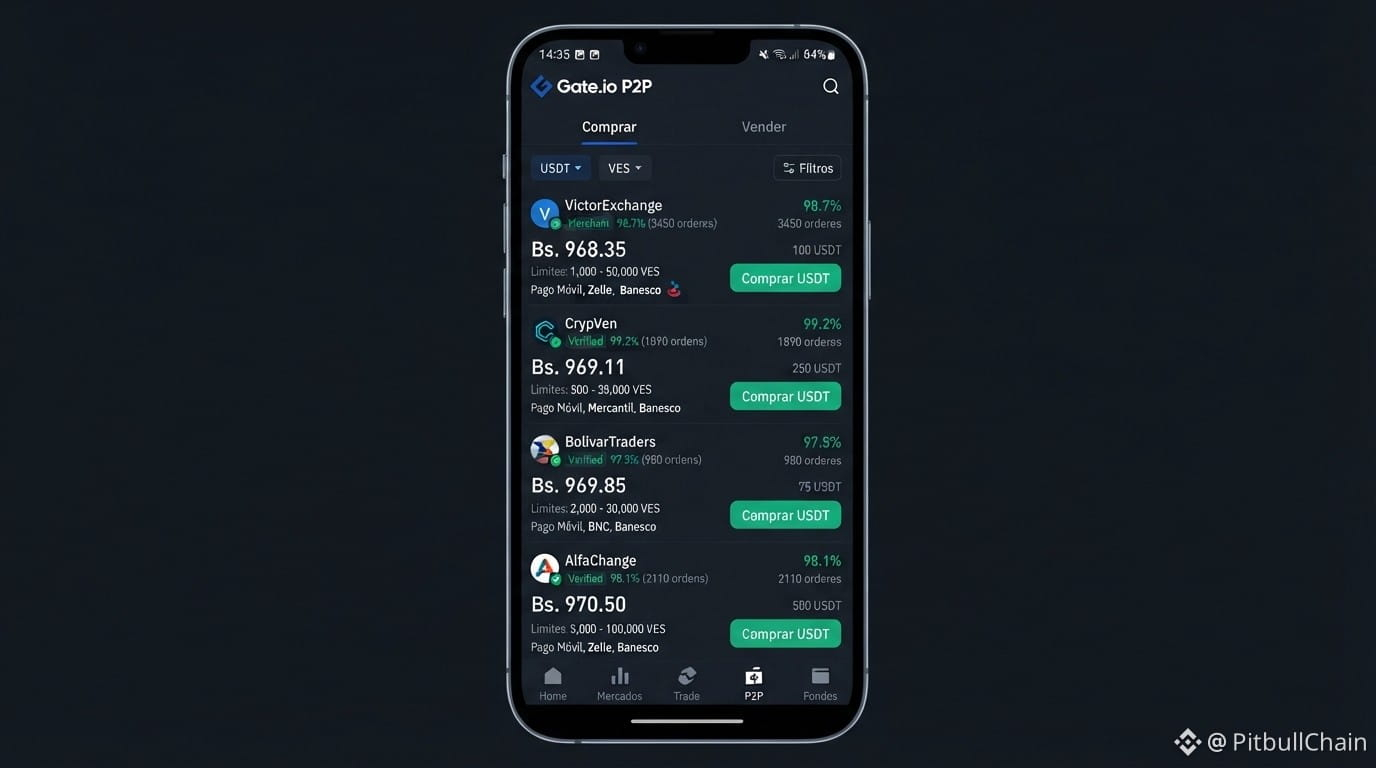
Article
USDT P2P hits 970 bolívares and increases its premium over BCV to 19.1% Live P2P Radar Capture: 8/9/2026, 4:00:17 p. m.
USDT/VES reference Bs. 970.36
Buy USDT Bs. 970.36
Sell USDT Bs. 942.71
BCV Bs. 814.69
Premium vs BCV 19.11%
P2P spread 2.93%
Observed offers 99
Verify current data in P2P Radar
Venezuela's stablecoin market recorded an average quotation for the purchase of **USDT P2P at 970.36 bolívares (VES)** per unit, according to PitbullChain's real-time monitoring records. This level places the premium of the digital dollar at **19.11%** versus the official exchange rate published by the Central Bank of Venezuela (BCV), set at **814.69 VES/USD**.
USDT P2P hits 970 bolívares and increases its premium over BCV to 19.1%
Live P2P Radar Capture: 8/9/2026, 4:00:17 p. m.
USDT/VES reference Bs. 970.36
Buy USDT Bs. 970.36
Sell USDT Bs. 942.71
BCV Bs. 814.69
Premium vs BCV 19.11%
P2P spread 2.93%
Observed offers 99
Verify current data in P2P Radar
Venezuela's stablecoin market recorded an average quotation for the purchase of **USDT P2P at 970.36 bolívares (VES)** per unit, according to PitbullChain's real-time monitoring records. This level places the premium of the digital dollar at **19.11%** versus the official exchange rate published by the Central Bank of Venezuela (BCV), set at **814.69 VES/USD**.
USDT/VES reference Bs. 970.36
Buy USDT Bs. 970.36
Sell USDT Bs. 942.71
BCV Bs. 814.69
Premium vs BCV 19.11%
P2P spread 2.93%
Observed offers 99
Verify current data in P2P Radar
Venezuela's stablecoin market recorded an average quotation for the purchase of **USDT P2P at 970.36 bolívares (VES)** per unit, according to PitbullChain's real-time monitoring records. This level places the premium of the digital dollar at **19.11%** versus the official exchange rate published by the Central Bank of Venezuela (BCV), set at **814.69 VES/USD**.
14
·
--
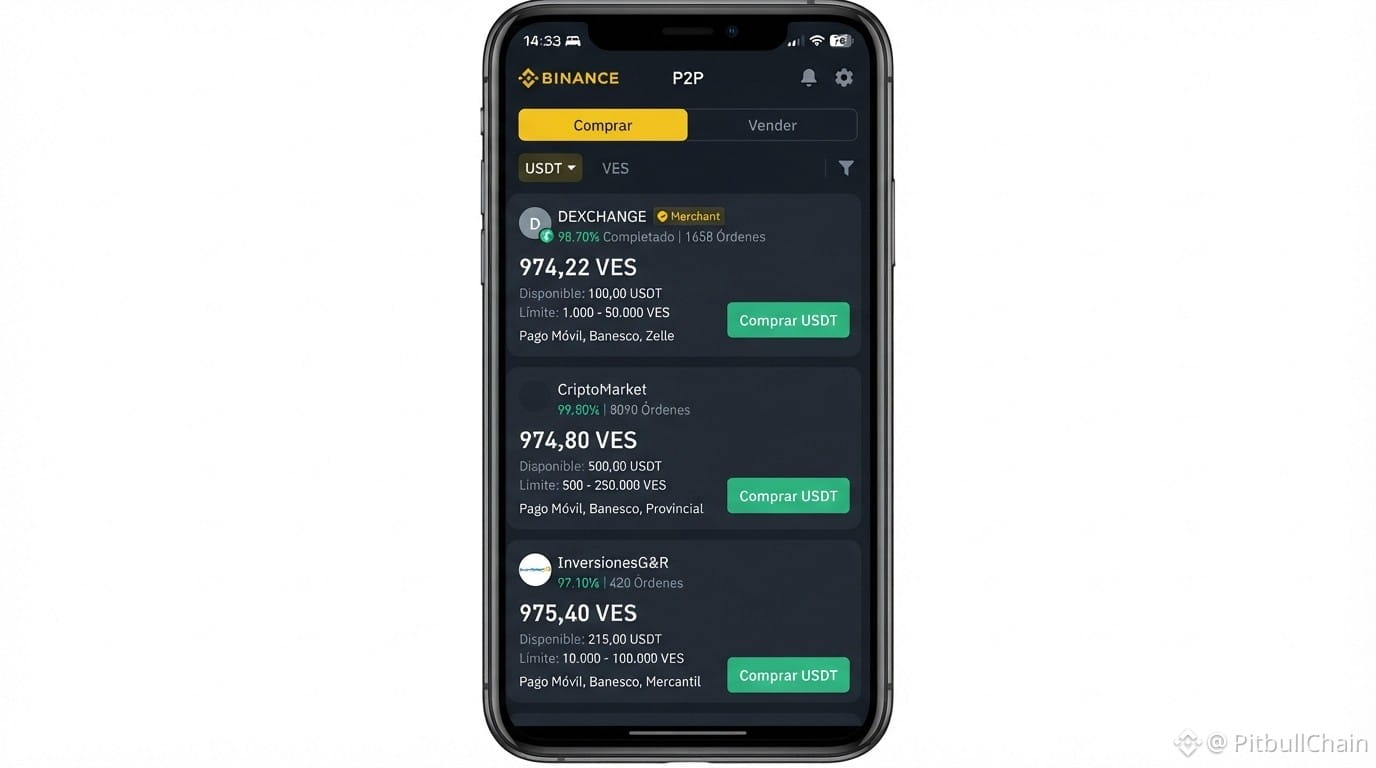
Article
P2P order book: USDT demand pushes the premium vs the BCVThe over-the-counter crypto market in Venezuela, particularly USDT, is operating under clear buying pressure. According to Radar P2P data, the USDT quotation reached 992.59 bolívares for purchase, representing a premium of 21.84% versus the BCV official exchange rate (814.69 VES). This article analyzes the structure of the order book, the spread width, and differences by bank to understand what lies behind this imbalance. The order book snapshot: demand triples supply At the close of the capture on September 8, 2026 at 10:00 a.m., the P2P order book for USDT/VES showed a buy order volume of 379,129.78 USDT, versus only 87,372.10 USDT in sell orders. The imbalance reaches 62.54%: this is a market where buyers compete aggressively to acquire stablecoins, but sellers do not match that intensity. At the deepest level of the book, buyers are seen willing to take USDT at 962 bolívares (an order of 119,062 USDT on other platforms), while the sell side shows offers from 972 bolívares with smaller amounts. This asymmetry explains why the premium holds: more liquidity is demanding than offering. Premium of 21.8% vs the BCV: a reflection of de facto dollarization The BCV official dollar was set at 814.69 bolívares, while the average P2P USDT purchase price was 992.59 bolívares, leaving a premium of 21.84%. This gap is even higher than that of the parallel dollar (970.25 bolívares), indicating that USDT has become the preferred asset to hedge against the bolívar’s loss of value. It’s important to clarify that the premium is not a new phenomenon: in recent months it has ranged between 15% and 25%, depending on the availability of foreign currency and political news. However, the current level reflects sustained demand that is not finding enough of a counterparty. Wide spread: the friction of an imbalanced market The average spread between buying and selling USDT was 63.76 bolívares, equivalent to 6.86%. This margin is significantly higher than the technical spread of 3 bolívares seen between the best offer (972) and the best bid (969) in the order book. Why is the difference so large? The answer lies in price dispersion: while some sellers offer USDT at 973, others do so at 1000, depending on the payment method and urgency. For example, USDT sale announcements with Pago Móvil on other platforms average 996.79 bolívares, while on Binance with Banco de Venezuela it is quoted at 975.50. That difference of more than 20 bolívares is what buyers end up paying when they do not compare across platforms. Banks: where better liquidity and a lower spread can be found The bank-by-bank analysis shows that not all channels offer the same conditions. Banco de Venezuela and BANK present the smallest spread (0.85%), thanks to having both buy and sell ads with nearby prices. BNC also shows a low margin (0.47%), although with only two listings. By contrast, Pago Móvil and 'Other method' have spreads above 7%, reflecting a more expensive market for the end user. In terms of liquidity, 'Other method' concentrates 30.2% of the orders, followed by Pago Móvil (20.8%) and Banesco (19.5%). Banesco, for its part, offers a moderate spread of 2.95%, making it a balanced option between availability and cost. Implications for those trading in Venezuelan P2P The current scenario recommends comparing prices carefully before executing any transaction. A user who sells USDT can get between 925 and 967 bolívares depending on the bank, while someone buying must pay between 972 and 1000. That 7% difference is not small and can translate into savings if the right channel is chosen. We recommend using tools such as the P2P calculator and the bank comparison available on Radar P2P to verify the best conditions in real time. In addition, it is essential to validate the counterparty’s reputation and transaction limits. The order book will continue to be the main barometer of market pressure. If demand for USDT continues to exceed supply, the premium versus the BCV is likely to remain at elevated levels, and the spread will keep compensating for counterparty risk.
P2P order book: USDT demand pushes the premium vs the BCV
The over-the-counter crypto market in Venezuela, particularly USDT, is operating under clear buying pressure. According to Radar P2P data, the USDT quotation reached 992.59 bolívares for purchase, representing a premium of 21.84% versus the BCV official exchange rate (814.69 VES). This article analyzes the structure of the order book, the spread width, and differences by bank to understand what lies behind this imbalance. The order book snapshot: demand triples supply At the close of the capture on September 8, 2026 at 10:00 a.m., the P2P order book for USDT/VES showed a buy order volume of 379,129.78 USDT, versus only 87,372.10 USDT in sell orders. The imbalance reaches 62.54%: this is a market where buyers compete aggressively to acquire stablecoins, but sellers do not match that intensity. At the deepest level of the book, buyers are seen willing to take USDT at 962 bolívares (an order of 119,062 USDT on other platforms), while the sell side shows offers from 972 bolívares with smaller amounts. This asymmetry explains why the premium holds: more liquidity is demanding than offering. Premium of 21.8% vs the BCV: a reflection of de facto dollarization The BCV official dollar was set at 814.69 bolívares, while the average P2P USDT purchase price was 992.59 bolívares, leaving a premium of 21.84%. This gap is even higher than that of the parallel dollar (970.25 bolívares), indicating that USDT has become the preferred asset to hedge against the bolívar’s loss of value. It’s important to clarify that the premium is not a new phenomenon: in recent months it has ranged between 15% and 25%, depending on the availability of foreign currency and political news. However, the current level reflects sustained demand that is not finding enough of a counterparty. Wide spread: the friction of an imbalanced market The average spread between buying and selling USDT was 63.76 bolívares, equivalent to 6.86%. This margin is significantly higher than the technical spread of 3 bolívares seen between the best offer (972) and the best bid (969) in the order book. Why is the difference so large? The answer lies in price dispersion: while some sellers offer USDT at 973, others do so at 1000, depending on the payment method and urgency. For example, USDT sale announcements with Pago Móvil on other platforms average 996.79 bolívares, while on Binance with Banco de Venezuela it is quoted at 975.50. That difference of more than 20 bolívares is what buyers end up paying when they do not compare across platforms. Banks: where better liquidity and a lower spread can be found The bank-by-bank analysis shows that not all channels offer the same conditions. Banco de Venezuela and BANK present the smallest spread (0.85%), thanks to having both buy and sell ads with nearby prices. BNC also shows a low margin (0.47%), although with only two listings. By contrast, Pago Móvil and 'Other method' have spreads above 7%, reflecting a more expensive market for the end user. In terms of liquidity, 'Other method' concentrates 30.2% of the orders, followed by Pago Móvil (20.8%) and Banesco (19.5%). Banesco, for its part, offers a moderate spread of 2.95%, making it a balanced option between availability and cost. Implications for those trading in Venezuelan P2P The current scenario recommends comparing prices carefully before executing any transaction. A user who sells USDT can get between 925 and 967 bolívares depending on the bank, while someone buying must pay between 972 and 1000. That 7% difference is not small and can translate into savings if the right channel is chosen. We recommend using tools such as the P2P calculator and the bank comparison available on Radar P2P to verify the best conditions in real time. In addition, it is essential to validate the counterparty’s reputation and transaction limits. The order book will continue to be the main barometer of market pressure. If demand for USDT continues to exceed supply, the premium versus the BCV is likely to remain at elevated levels, and the spread will keep compensating for counterparty risk.
15
·
--
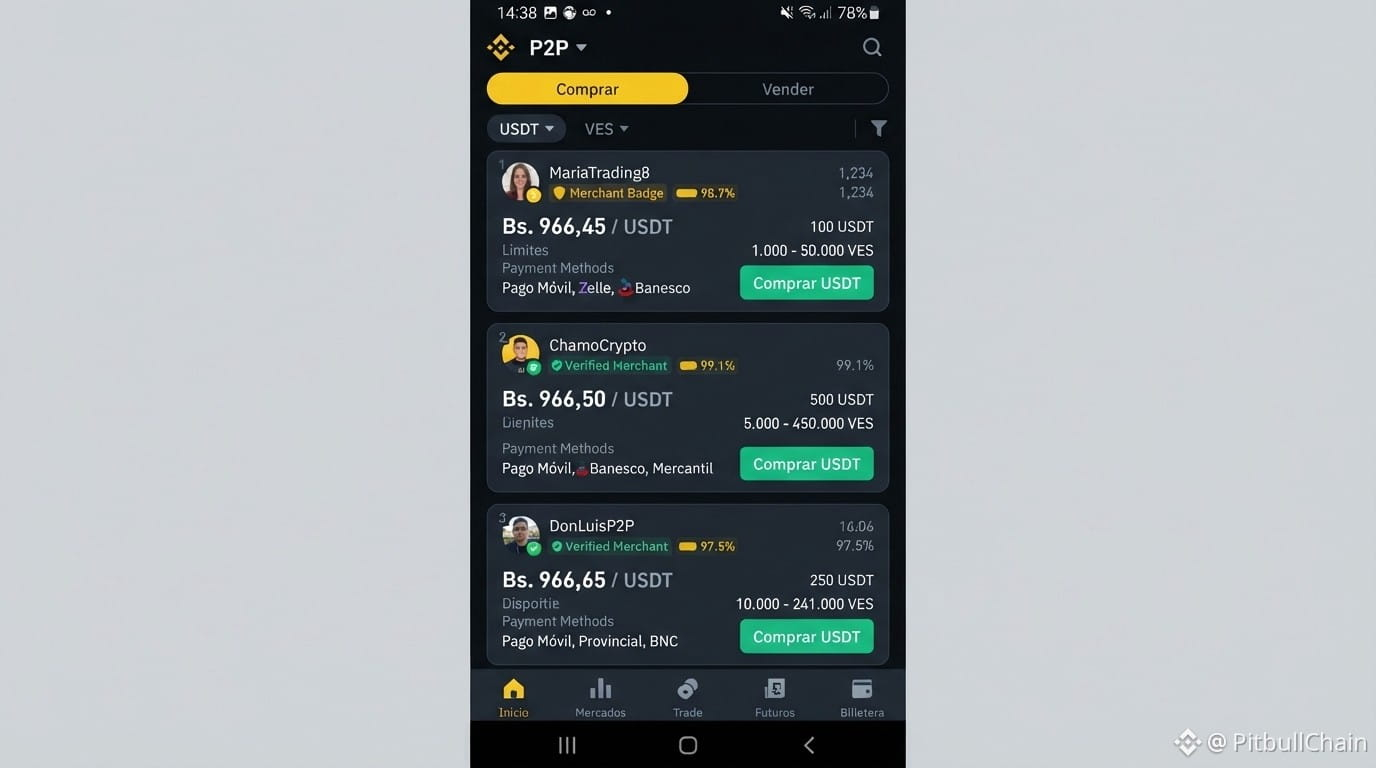
Article
USDT premium versus BCV exceeds 19% today: spread and liquidity analysisToday, Monday, September 7, 2026, the USDT premium versus the dollar at BCV stands at 19.24%, and the spread in the Venezuelan P2P market reaches 3.46%. This is reflected in PitbullChain’s P2P Radar, which at 10:00 a.m. (local time) captured an average purchase price of 970.2881 VES and a sale price of 937.8789 VES per USDT. The figure far exceeds the official quotation from Venezuela’s Central Bank (BCV), which for this date stands at 813.7361 VES/USD. The radar’s own liquidity-and-risk traffic light appears in yellow (score 71), with a clear warning: “elevated spread, compare prices before trading.” Premium of 19.24%: buying pressure or just a reference? The premium is calculated over the BCV official rate. If we take the P2P USDT purchase price (970.2881 VES) and compare it with the official dollar (813.7361 VES), the difference is 156.5520 VES per unit—exactly that 19.24% surcharge. This gap is not new. In June 2026, reports like BeInCrypto’s pointed out that the “bolívar crisis boosts demand for USDT in Binance P2P.” The trend continues: when the bolívar loses purchasing power, many Venezuelans look for refuge in dollarized cryptocurrencies, and that demand pushes the USDT price above the official rate. The BCV price, for its part, has been climbing gradually. According to El Estímulo, on September 4 the quote surpassed 807 bolívars; today it is 813.7. It’s a slow rise, but P2P moves faster because it responds to real-time supply and demand. Spread of 3.45%: the cost of entering and exiting the market The spread represents the difference between the highest price a buyer is willing to pay (to acquire USDT) and the lowest price a seller is willing to sell at. In PitbullChain’s P2P Radar, buying is at 970.27 VES and selling at 937.88 VES—a spread range of 32.41 VES. In percentage terms, the spread is 3.4556%. This means that if a user buys and sells USDT back-to-back, they lose approximately 3.45 bolívars for every 100 invested. It’s a high cost compared with the informal parallel rate, which at the same time shows a spread of only 0.29%. To put it in context: if you sell 100 USDT at the average selling price (937.8789 VES), you’ll receive 93,787.89 bolívars. If instead you decide to buy 100 USDT, you’ll have to pay out 97,028.81 bolívars. That gap of more than 3,000 bolívars per 100 USDT is what makes the difference in large transactions. PitbullChain’s traffic light assigns 20 points to the spread (on a scale where 0 is very high and 100 is low). That’s why it insists on “comparing prices across exchanges before trading.” This is not a market to rush into. Order book under the microscope: buy offers dominate the book The aggregated order book of Binance, other platforms, and other platforms—also captured by PitbullChain—shows a significant imbalance in favor of demand. The buy order volume (bid) reaches 377,043.50 USDT, while the sell orders (ask) add up to just 66,244.44 USDT. In other words, buying pressure is 5.7 times greater than the available supply. This imbalance explains the premium: more people want to buy USDT than sellers are willing to offer it. Market depth, however, has nuances. Even though offers appear at very low prices (for example, one at 918.64 VES on other platforms), they are for limited amounts and may not be available to all users or banks. The sell offers with real size are concentrated between 952 and 966 VES, while the buys with higher volume are located between 955 and 966 VES. This suggests that the market’s “fair price” right now is around 960–965 VES, but the consolidated indicators—which weight by volume—produce a higher buy price. According to the order book data itself, the best bid is at 966.00 VES, and the best ask is at 918.64 VES. The difference between them is 47.36 VES, which in relative terms corresponds to a 4.9% spread. That’s the real cost if you want to execute an immediate trade, without waiting for orders to cross. Dominant banks: where is there more liquidity and a better price? Not all banks offer the same conditions. PitbullChain’s analysis groups ads by financial institution and shows a clear difference in behavior: Banesco: the bank with the highest number of ads (35.7% of the total) and a liquidity score of 99/100. Its average purchase price is 965.63 VES and its selling price is 961.22 VES, leaving a spread of just 0.46%. Pago Móvil: concentrates 24.5% of the ads, with a score of 72. Its spread rises to 0.73%. Bancamiga and PagoMovil (binance): next, at 5.1% each, though with lower offer volume. Banco de Venezuela and BANK: show a moderate spread of 0.29% and 0.33%, respectively, but they account for only 5.1% and 4.1% of the market. The traffic light also emphasizes that bank availability is high (score 95), but order-book depth is low (score 45). That means there are many posts, but for small amounts. For institutional operations, liquidity per bank may be limited; for retail trades, it’s sufficient. If you’re selling USDT, you should check which bank has the best buy offer. If you’re buying, it’s the opposite. It’s not the same to trade with Banesco as with a bank that has fewer ads, because price and execution speed can vary substantially. Risks and recommendations to navigate the market PitbullChain’s traffic light is yellow, with mixed signals: on the one hand, there is “sufficient liquidity across multiple banks”; on the other, the elevated spread and low depth at certain levels generate warnings. Perceived volatility is high (score 95), meaning the price can move quickly. This highlights the importance of using tools such as the P2P Calculator, the Bank Comparator, and the real-time Order Book that PitbullChain offers in its tools section. Before executing, verify: The buy and sell price on the specific exchange you’ll use. The advertiser’s reputation and their minimum/maximum limits. Whether your bank is enabled in that ad. The trend over the last few minutes (up or down). In a market with a premium of >19%, not all transactions are the same. A small oversight in the spread can turn a good rate into a loss. That’s why PitbullChain’s data helps you keep an objective pulse—not to promise profits or make decisions blindly. The dynamics of Venezuelan P2P respond to the real supply and demand for currency. Understanding the premium, the spread, and liquidity per bank will allow you to trade with better criteria. The yellow traffic light says it: there are good opportunities, but they require comparison and analysis.
USDT premium versus BCV exceeds 19% today: spread and liquidity analysis
Today, Monday, September 7, 2026, the USDT premium versus the dollar at BCV stands at 19.24%, and the spread in the Venezuelan P2P market reaches 3.46%. This is reflected in PitbullChain’s P2P Radar, which at 10:00 a.m. (local time) captured an average purchase price of 970.2881 VES and a sale price of 937.8789 VES per USDT. The figure far exceeds the official quotation from Venezuela’s Central Bank (BCV), which for this date stands at 813.7361 VES/USD. The radar’s own liquidity-and-risk traffic light appears in yellow (score 71), with a clear warning: “elevated spread, compare prices before trading.” Premium of 19.24%: buying pressure or just a reference? The premium is calculated over the BCV official rate. If we take the P2P USDT purchase price (970.2881 VES) and compare it with the official dollar (813.7361 VES), the difference is 156.5520 VES per unit—exactly that 19.24% surcharge. This gap is not new. In June 2026, reports like BeInCrypto’s pointed out that the “bolívar crisis boosts demand for USDT in Binance P2P.” The trend continues: when the bolívar loses purchasing power, many Venezuelans look for refuge in dollarized cryptocurrencies, and that demand pushes the USDT price above the official rate. The BCV price, for its part, has been climbing gradually. According to El Estímulo, on September 4 the quote surpassed 807 bolívars; today it is 813.7. It’s a slow rise, but P2P moves faster because it responds to real-time supply and demand. Spread of 3.45%: the cost of entering and exiting the market The spread represents the difference between the highest price a buyer is willing to pay (to acquire USDT) and the lowest price a seller is willing to sell at. In PitbullChain’s P2P Radar, buying is at 970.27 VES and selling at 937.88 VES—a spread range of 32.41 VES. In percentage terms, the spread is 3.4556%. This means that if a user buys and sells USDT back-to-back, they lose approximately 3.45 bolívars for every 100 invested. It’s a high cost compared with the informal parallel rate, which at the same time shows a spread of only 0.29%. To put it in context: if you sell 100 USDT at the average selling price (937.8789 VES), you’ll receive 93,787.89 bolívars. If instead you decide to buy 100 USDT, you’ll have to pay out 97,028.81 bolívars. That gap of more than 3,000 bolívars per 100 USDT is what makes the difference in large transactions. PitbullChain’s traffic light assigns 20 points to the spread (on a scale where 0 is very high and 100 is low). That’s why it insists on “comparing prices across exchanges before trading.” This is not a market to rush into. Order book under the microscope: buy offers dominate the book The aggregated order book of Binance, other platforms, and other platforms—also captured by PitbullChain—shows a significant imbalance in favor of demand. The buy order volume (bid) reaches 377,043.50 USDT, while the sell orders (ask) add up to just 66,244.44 USDT. In other words, buying pressure is 5.7 times greater than the available supply. This imbalance explains the premium: more people want to buy USDT than sellers are willing to offer it. Market depth, however, has nuances. Even though offers appear at very low prices (for example, one at 918.64 VES on other platforms), they are for limited amounts and may not be available to all users or banks. The sell offers with real size are concentrated between 952 and 966 VES, while the buys with higher volume are located between 955 and 966 VES. This suggests that the market’s “fair price” right now is around 960–965 VES, but the consolidated indicators—which weight by volume—produce a higher buy price. According to the order book data itself, the best bid is at 966.00 VES, and the best ask is at 918.64 VES. The difference between them is 47.36 VES, which in relative terms corresponds to a 4.9% spread. That’s the real cost if you want to execute an immediate trade, without waiting for orders to cross. Dominant banks: where is there more liquidity and a better price? Not all banks offer the same conditions. PitbullChain’s analysis groups ads by financial institution and shows a clear difference in behavior: Banesco: the bank with the highest number of ads (35.7% of the total) and a liquidity score of 99/100. Its average purchase price is 965.63 VES and its selling price is 961.22 VES, leaving a spread of just 0.46%. Pago Móvil: concentrates 24.5% of the ads, with a score of 72. Its spread rises to 0.73%. Bancamiga and PagoMovil (binance): next, at 5.1% each, though with lower offer volume. Banco de Venezuela and BANK: show a moderate spread of 0.29% and 0.33%, respectively, but they account for only 5.1% and 4.1% of the market. The traffic light also emphasizes that bank availability is high (score 95), but order-book depth is low (score 45). That means there are many posts, but for small amounts. For institutional operations, liquidity per bank may be limited; for retail trades, it’s sufficient. If you’re selling USDT, you should check which bank has the best buy offer. If you’re buying, it’s the opposite. It’s not the same to trade with Banesco as with a bank that has fewer ads, because price and execution speed can vary substantially. Risks and recommendations to navigate the market PitbullChain’s traffic light is yellow, with mixed signals: on the one hand, there is “sufficient liquidity across multiple banks”; on the other, the elevated spread and low depth at certain levels generate warnings. Perceived volatility is high (score 95), meaning the price can move quickly. This highlights the importance of using tools such as the P2P Calculator, the Bank Comparator, and the real-time Order Book that PitbullChain offers in its tools section. Before executing, verify: The buy and sell price on the specific exchange you’ll use. The advertiser’s reputation and their minimum/maximum limits. Whether your bank is enabled in that ad. The trend over the last few minutes (up or down). In a market with a premium of >19%, not all transactions are the same. A small oversight in the spread can turn a good rate into a loss. That’s why PitbullChain’s data helps you keep an objective pulse—not to promise profits or make decisions blindly. The dynamics of Venezuelan P2P respond to the real supply and demand for currency. Understanding the premium, the spread, and liquidity per bank will allow you to trade with better criteria. The yellow traffic light says it: there are good opportunities, but they require comparison and analysis.
28
·
--
BCV and interventions: impact on the P2P premium and how to operate today## BCV and interventions: impact on the P2P premium and how to operate today
**Date:** Saturday, September 5, 2026 · **Live data from Radar P2P:** buy Bs. 972.53 · sell Bs. 917.07 · BCV Bs. N/A · premium N/A%
This Saturday the BCV has not published its official rate, something unusual that adds uncertainty to the P2P market. Meanwhile, the spread between USDT buy and sell remains wide, a sign of tight liquidity and mixed expectations.
### Exchange interventions: analysis of the day
BCV and interventions: impact on the P2P premium and how to operate today
## BCV and interventions: impact on the P2P premium and how to operate today
**Date:** Saturday, September 5, 2026 · **Live data from Radar P2P:** buy Bs. 972.53 · sell Bs. 917.07 · BCV Bs. N/A · premium N/A%
This Saturday the BCV has not published its official rate, something unusual that adds uncertainty to the P2P market. Meanwhile, the spread between USDT buy and sell remains wide, a sign of tight liquidity and mixed expectations.
### Exchange interventions: analysis of the day
**Date:** Saturday, September 5, 2026 · **Live data from Radar P2P:** buy Bs. 972.53 · sell Bs. 917.07 · BCV Bs. N/A · premium N/A%
This Saturday the BCV has not published its official rate, something unusual that adds uncertainty to the P2P market. Meanwhile, the spread between USDT buy and sell remains wide, a sign of tight liquidity and mixed expectations.
### Exchange interventions: analysis of the day
25
·
--
USDT premium vs BCV exceeds 22%: causes and context in September 2026The Venezuelan P2P market started September with a clear signal: USDT is trading at a premium of more than 22% versus the BCV’s official dollar rate. According to PitbullChain’s P2P Radar, at 02:00 UTC today, buying USDT in the P2P market is equivalent to 988.62 bolívares per dollar, while the official rate of the Central Bank of Venezuela is 804.81 bolívares. The difference is 22.84%. The premium in numbers: a fine-grained read of the data To understand the phenomenon, it helps to break down the figures captured live by the Radar: USDT P2P (buy): 988.62 Bs USDT P2P (sell): 957.34 Bs Parallel dollar: 977.24 Bs BCV dollar: 804.81 Bs USDT vs BCV premium: +22.84% USDT vs parallel: +1.16% The spread between USDT buying and selling is 3.27%, reflecting the friction inherent to the P2P market. The risk traffic light is on yellow: mixed conditions, with high liquidity but elevated spreads at some banks. One relevant detail: although the premium versus the BCV looks extreme, P2P USDT is only 1.16% above the parallel dollar. This indicates that the gap is not an exclusive feature of stablecoins, but rather a consequence of a segmented foreign-exchange market, where the official rate remains artificially far from real supply-and-demand pressures. Why does the difference with the BCV remain so wide? The causes are multiple and reinforce each other. First, Venezuelan exchange controls limit access to foreign currency at the official rate. The BCV intervenes with targeted sales, but supply is not enough to satisfy demand from the private sector. Second, the macro context continues pushing Venezuelans toward digital stores of value. International press reports have documented how, after the seismic events of August, cryptocurrency inflows intensified as a refuge. Uncertainty accelerates the search for stable and liquid instruments. The discussion about a possible dollarization also plays a role. Economist Steve Hanke has presented a plan that generated expectations and debate, and it likely keeps precautionary demand high. BeInCrypto’s analysis notes that any initiative of that kind would increase the relevance of digital currencies in Venezuela. The role of banks and liquidity in P2P PitbullChain’s order book shows active participation from Venezuelan banks. Among the institutions with the most advertisements are Banesco, Pago Móvil, Mercantil, and Banco de Venezuela. In total, 295 active offers are recorded, with significant depth in terms of amounts. But not all channels operate the same way. Banco de Venezuela shows an average spread of just 0.30%, indicating a more efficient market for that network. On the opposite end, the overall spread exceeds 3%, with notable variations between banks and payment methods. For users, this translates into a practical rule: check the specific quotes from your bank before making any decision. High liquidity does not guarantee a better price; you need to compare across exchanges and individual offers. From the parallel dollar to the digital economy Venezuela keeps climbing in global cryptocurrency adoption indices. In the first quarter of 2026, the country appeared among the top positions in the global adoption ranking, driven mainly by USDT use in P2P. This is not accidental: stablecoins became a bridge between the local economy and real dollarization. The 22.84% premium over the BCV should not be read only as a distortion. It also reflects that the equilibrium price of the bolívar in the P2P market is determined by trust in the digital asset, the availability of cash at banks, and demand from e-commerce and remittances. As long as the BCV keeps an official rate far from exchange-rate reality, P2P will remain the reference for millions of Venezuelans who need to dollarize their purchasing power or send money abroad. Keys to trading the current spread Given a scenario of a wide premium and moderate volatility, the Radar recommends: Compare prices between Binance, other platforms, and other available platforms. Verify the merchant’s reputation and the minimum and maximum limits. Assess which payment method offers the best spread at the time of the transaction. Avoid impulsive decisions based only on the BCV rate; the parallel market is closer to the real reference. Educational and informational content. This is not financial advice.
USDT premium vs BCV exceeds 22%: causes and context in September 2026
The Venezuelan P2P market started September with a clear signal: USDT is trading at a premium of more than 22% versus the BCV’s official dollar rate. According to PitbullChain’s P2P Radar, at 02:00 UTC today, buying USDT in the P2P market is equivalent to 988.62 bolívares per dollar, while the official rate of the Central Bank of Venezuela is 804.81 bolívares. The difference is 22.84%. The premium in numbers: a fine-grained read of the data To understand the phenomenon, it helps to break down the figures captured live by the Radar: USDT P2P (buy): 988.62 Bs USDT P2P (sell): 957.34 Bs Parallel dollar: 977.24 Bs BCV dollar: 804.81 Bs USDT vs BCV premium: +22.84% USDT vs parallel: +1.16% The spread between USDT buying and selling is 3.27%, reflecting the friction inherent to the P2P market. The risk traffic light is on yellow: mixed conditions, with high liquidity but elevated spreads at some banks. One relevant detail: although the premium versus the BCV looks extreme, P2P USDT is only 1.16% above the parallel dollar. This indicates that the gap is not an exclusive feature of stablecoins, but rather a consequence of a segmented foreign-exchange market, where the official rate remains artificially far from real supply-and-demand pressures. Why does the difference with the BCV remain so wide? The causes are multiple and reinforce each other. First, Venezuelan exchange controls limit access to foreign currency at the official rate. The BCV intervenes with targeted sales, but supply is not enough to satisfy demand from the private sector. Second, the macro context continues pushing Venezuelans toward digital stores of value. International press reports have documented how, after the seismic events of August, cryptocurrency inflows intensified as a refuge. Uncertainty accelerates the search for stable and liquid instruments. The discussion about a possible dollarization also plays a role. Economist Steve Hanke has presented a plan that generated expectations and debate, and it likely keeps precautionary demand high. BeInCrypto’s analysis notes that any initiative of that kind would increase the relevance of digital currencies in Venezuela. The role of banks and liquidity in P2P PitbullChain’s order book shows active participation from Venezuelan banks. Among the institutions with the most advertisements are Banesco, Pago Móvil, Mercantil, and Banco de Venezuela. In total, 295 active offers are recorded, with significant depth in terms of amounts. But not all channels operate the same way. Banco de Venezuela shows an average spread of just 0.30%, indicating a more efficient market for that network. On the opposite end, the overall spread exceeds 3%, with notable variations between banks and payment methods. For users, this translates into a practical rule: check the specific quotes from your bank before making any decision. High liquidity does not guarantee a better price; you need to compare across exchanges and individual offers. From the parallel dollar to the digital economy Venezuela keeps climbing in global cryptocurrency adoption indices. In the first quarter of 2026, the country appeared among the top positions in the global adoption ranking, driven mainly by USDT use in P2P. This is not accidental: stablecoins became a bridge between the local economy and real dollarization. The 22.84% premium over the BCV should not be read only as a distortion. It also reflects that the equilibrium price of the bolívar in the P2P market is determined by trust in the digital asset, the availability of cash at banks, and demand from e-commerce and remittances. As long as the BCV keeps an official rate far from exchange-rate reality, P2P will remain the reference for millions of Venezuelans who need to dollarize their purchasing power or send money abroad. Keys to trading the current spread Given a scenario of a wide premium and moderate volatility, the Radar recommends: Compare prices between Binance, other platforms, and other available platforms. Verify the merchant’s reputation and the minimum and maximum limits. Assess which payment method offers the best spread at the time of the transaction. Avoid impulsive decisions based only on the BCV rate; the parallel market is closer to the real reference. Educational and informational content. This is not financial advice.
56
Log in to explore more content
Join global crypto users on Binance Square
⚡️ Get latest and useful information about crypto.
💬 Trusted by the world’s largest crypto exchange.
👍 Discover real insights from verified creators.
Email / Phone number
Trending Topics
1
#BitcoinParesGainsAfterRallyTo$86.5K
8,684 views
56 Discussing
2
#CerebrasSinksNearly20%OnReportNvidiaToPowerOpenAI
18,231 views
264 Discussing
3
#SECProposesCryptoCustodyRules
43,581 views
435 Discussing
4
#SECApproves3xLongCryptoCommodityETPs
32,887 views
364 Discussing
5
#MASKHitsRecordMarketCapAbove$35M
66 views
23 Discussing
6
#G7PlansToReleaseUpTo100MBarrelsOilDiesel
30,058 views
374 Discussing
7
#ICBASuesOCCOverCryptoBankCharters
22,659 views
253 Discussing
8
#USStocksCloseHigherOnWeakJobsData
21,954 views
200 Discussing
9
#AnchorageReportedlyCuts17%Workforce
3,796 views
76 Discussing
10
#NFPWatch
11M views
19,724 Discussing