

#layer2
layer2
4.3M views
24,298 Discussing
Hot
Latest


·
--
I used to think Layer 2s were just a cheaper copy of the main chain, same security, lower fees.
But the more I read about how rollups actually work, the more that felt too simple. Optimistic rollups post transaction data to Ethereum and assume it's valid unless someone submits a fraud proof within a challenge window that can run about a week. Zero knowledge rollups post a cryptographic proof instead, which is why withdrawals there tend to finalize faster.
Either way, most of these chains still depend on a single sequencer ordering your transactions before anything gets posted back to layer one. If that sequencer goes down, your funds are still safe eventually, but you're stuck waiting.
What changed for me is separating fees from security. Cheap gas doesn't mean the same guarantees as the base layer.
What I'm not sure about yet is how decentralized sequencers actually get once real volume shows up.
What's something you got wrong at first about how Layer 2s work?
Personal view, not advice. Do your own research.
#Ethereum #Layer2
I used to think Layer 2s were just a cheaper copy of the main chain, same security, lower fees.
But the more I read about how rollups actually work, the more that felt too simple. Optimistic rollups post transaction data to Ethereum and assume it's valid unless someone submits a fraud proof within a challenge window that can run about a week. Zero knowledge rollups post a cryptographic proof instead, which is why withdrawals there tend to finalize faster.
Either way, most of these chains still depend on a single sequencer ordering your transactions before anything gets posted back to layer one. If that sequencer goes down, your funds are still safe eventually, but you're stuck waiting.
What changed for me is separating fees from security. Cheap gas doesn't mean the same guarantees as the base layer.
What I'm not sure about yet is how decentralized sequencers actually get once real volume shows up.
What's something you got wrong at first about how Layer 2s work?
Personal view, not advice. Do your own research.
#Ethereum #Layer2
But the more I read about how rollups actually work, the more that felt too simple. Optimistic rollups post transaction data to Ethereum and assume it's valid unless someone submits a fraud proof within a challenge window that can run about a week. Zero knowledge rollups post a cryptographic proof instead, which is why withdrawals there tend to finalize faster.
Either way, most of these chains still depend on a single sequencer ordering your transactions before anything gets posted back to layer one. If that sequencer goes down, your funds are still safe eventually, but you're stuck waiting.
What changed for me is separating fees from security. Cheap gas doesn't mean the same guarantees as the base layer.
What I'm not sure about yet is how decentralized sequencers actually get once real volume shows up.
What's something you got wrong at first about how Layer 2s work?
Personal view, not advice. Do your own research.
#Ethereum #Layer2
92

**Lisk ($LSK ) – A Key Player in the Layer-2 & Web3 Ecosystem!** 🚀
Lisk ($LSK) is an innovative crypto platform designed to make decentralized application (dApp) development accessible, fast, and scalable for developers worldwide.
✨ **Key Highlights of Lisk ($LSK ):**
* **Transition to Ethereum Layer-2:** Lisk has transitioned into an Ethereum L2 ecosystem powered by Optimism (OP Stack) and Gelato, offering significantly lower gas fees and faster transaction speeds.
* **Developer-Friendly (JavaScript):** Developers can build dApps and smart contracts using JavaScript, the most popular programming language in the world, dramatically lowering the barrier to entry for Web3 builders.
* **Focus on Real-World Assets & Emerging Markets:** Lisk is heavily focused on bringing real-world assets (RWA) onto the blockchain and growing local Web3 communities across emerging economies.
* **Staking Rewards:** Holders can stake their $LSK tokens to help secure the network while earning passive rewards.
💡 **The Verdict:**
If you are tracking promising Layer-2 projects with strong real-world utility and massive developer adoption potential, Lisk ($LSK) is definitely worth keeping on your watchlist!
#Crypto #Lisk #LSK #Layer2 #Ethereum #Web3 #Blockchain
**Lisk ($LSK ) – A Key Player in the Layer-2 & Web3 Ecosystem!** 🚀
Lisk ($LSK ) is an innovative crypto platform designed to make decentralized application (dApp) development accessible, fast, and scalable for developers worldwide.
✨ **Key Highlights of Lisk ($LSK ):**
* **Transition to Ethereum Layer-2:** Lisk has transitioned into an Ethereum L2 ecosystem powered by Optimism (OP Stack) and Gelato, offering significantly lower gas fees and faster transaction speeds.
* **Developer-Friendly (JavaScript):** Developers can build dApps and smart contracts using JavaScript, the most popular programming language in the world, dramatically lowering the barrier to entry for Web3 builders.
* **Focus on Real-World Assets & Emerging Markets:** Lisk is heavily focused on bringing real-world assets (RWA) onto the blockchain and growing local Web3 communities across emerging economies.
* **Staking Rewards:** Holders can stake their $LSK tokens to help secure the network while earning passive rewards.
💡 **The Verdict:**
If you are tracking promising Layer-2 projects with strong real-world utility and massive developer adoption potential, Lisk ($LSK ) is definitely worth keeping on your watchlist!
#Crypto #Lisk #LSK #Layer2 #Ethereum #Web3 #Blockchain
Lisk ($LSK ) is an innovative crypto platform designed to make decentralized application (dApp) development accessible, fast, and scalable for developers worldwide.
✨ **Key Highlights of Lisk ($LSK ):**
* **Transition to Ethereum Layer-2:** Lisk has transitioned into an Ethereum L2 ecosystem powered by Optimism (OP Stack) and Gelato, offering significantly lower gas fees and faster transaction speeds.
* **Developer-Friendly (JavaScript):** Developers can build dApps and smart contracts using JavaScript, the most popular programming language in the world, dramatically lowering the barrier to entry for Web3 builders.
* **Focus on Real-World Assets & Emerging Markets:** Lisk is heavily focused on bringing real-world assets (RWA) onto the blockchain and growing local Web3 communities across emerging economies.
* **Staking Rewards:** Holders can stake their $LSK tokens to help secure the network while earning passive rewards.
💡 **The Verdict:**
If you are tracking promising Layer-2 projects with strong real-world utility and massive developer adoption potential, Lisk ($LSK ) is definitely worth keeping on your watchlist!
#Crypto #Lisk #LSK #Layer2 #Ethereum #Web3 #Blockchain
1
236

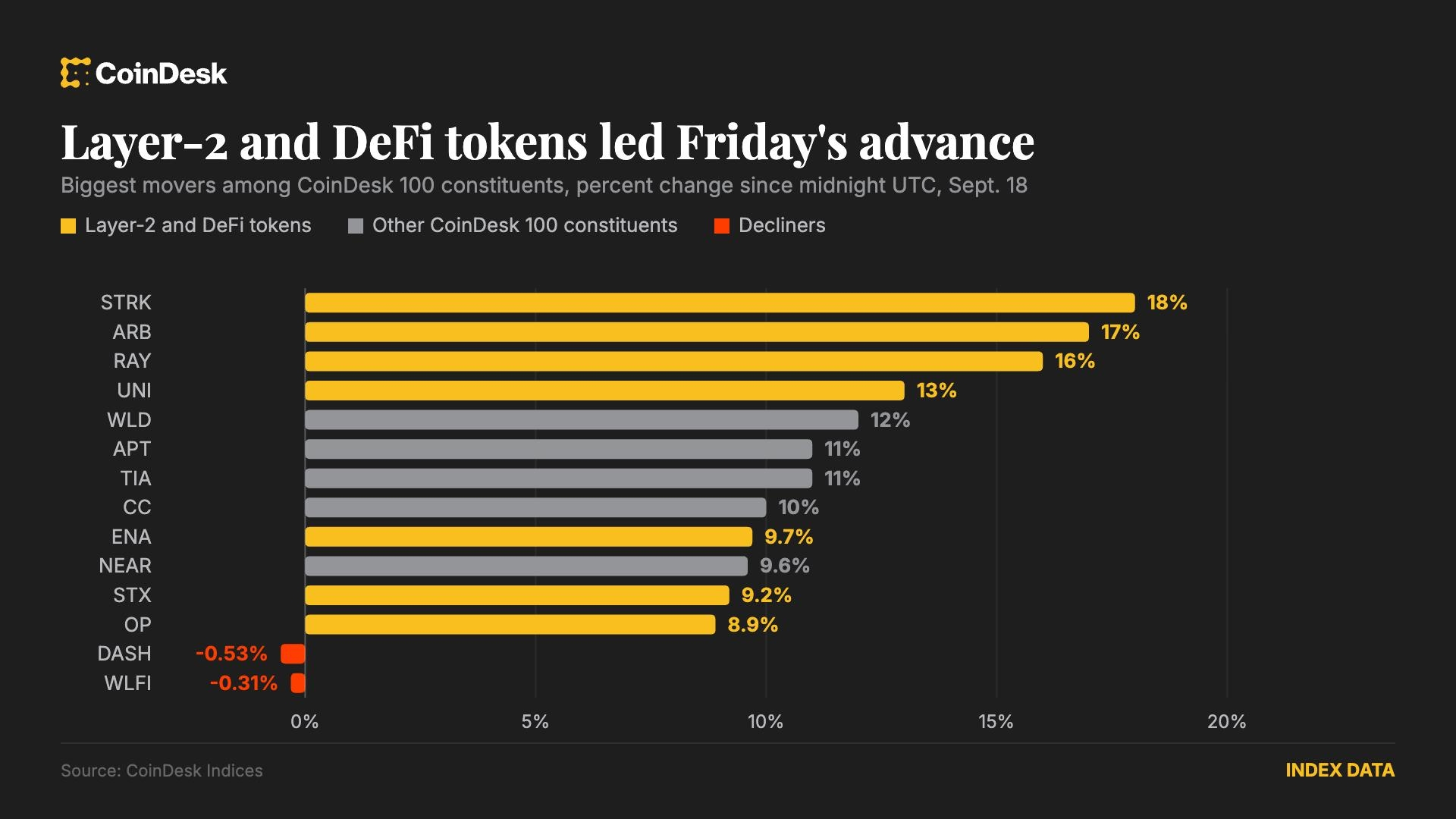
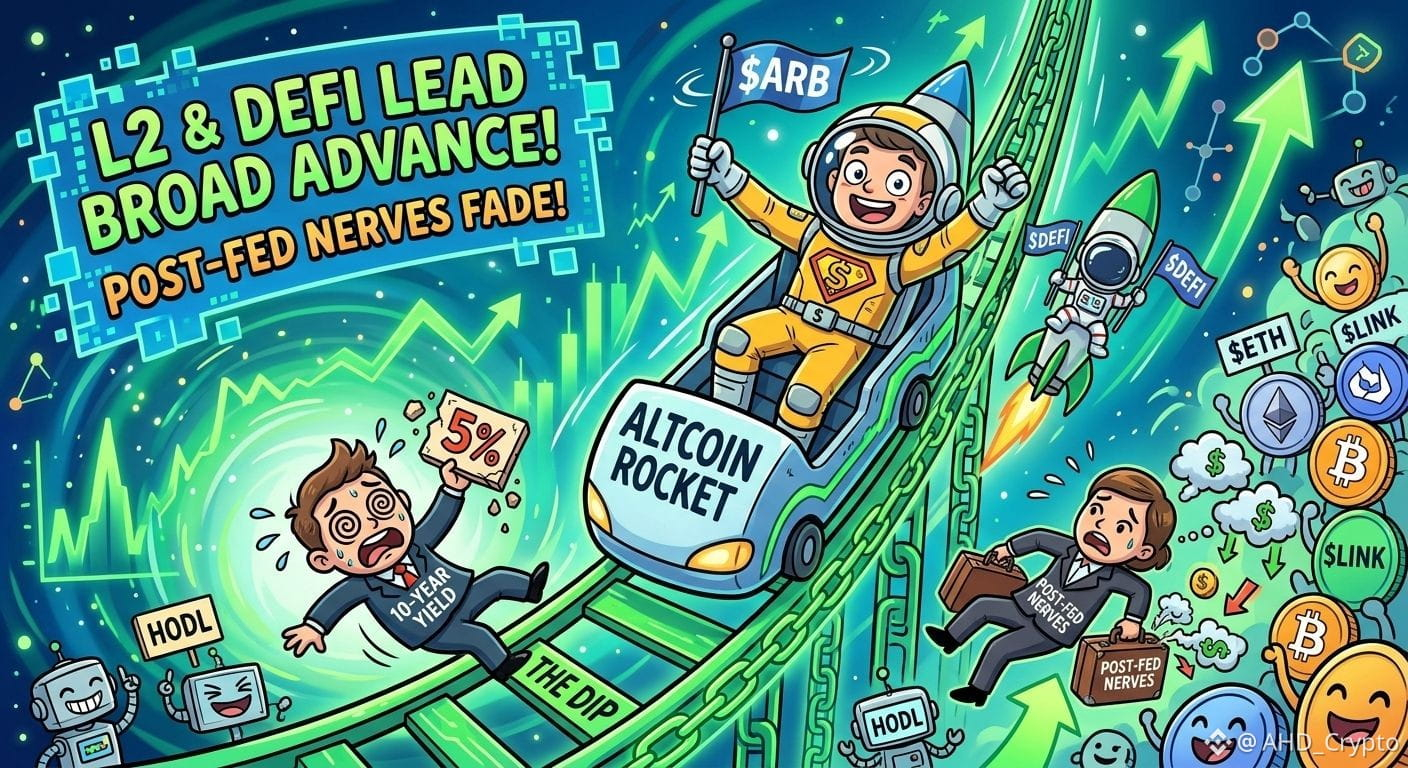
Layer-2 and DeFi tokens are driving a massive market comeback today. Macro pressure is finally letting up as post-Fed rate hike nerves begin to fade. With the 10-year Treasury yield slipping back below 5%, crypto buyers are stepping back in with full force across the board. 🔹 Over 98 of the top 100 crypto assets are trading in the green. 🚀 Major Layer-2 tokens like $ARB and $STRK posted huge gains over 17%. ⚡ Broader DeFi sector is seeing renewed momentum as capital rotates into scaling solutions. It feels like the market was just waiting for macro yields to cool off before ripping higher. #Layer2 #DeFi #CryptoMarket #Write2Earn
Layer-2 and DeFi tokens are driving a massive market comeback today. Macro pressure is finally letting up as post-Fed rate hike nerves begin to fade. With the 10-year Treasury yield slipping back below 5%, crypto buyers are stepping back in with full force across the board. 🔹 Over 98 of the top 100 crypto assets are trading in the green. 🚀 Major Layer-2 tokens like $ARB and $STRK posted huge gains over 17%. ⚡ Broader DeFi sector is seeing renewed momentum as capital rotates into scaling solutions. It feels like the market was just waiting for macro yields to cool off before ripping higher. #Layer2 #DeFi #CryptoMarket #Write2Earn
1
654

·
--
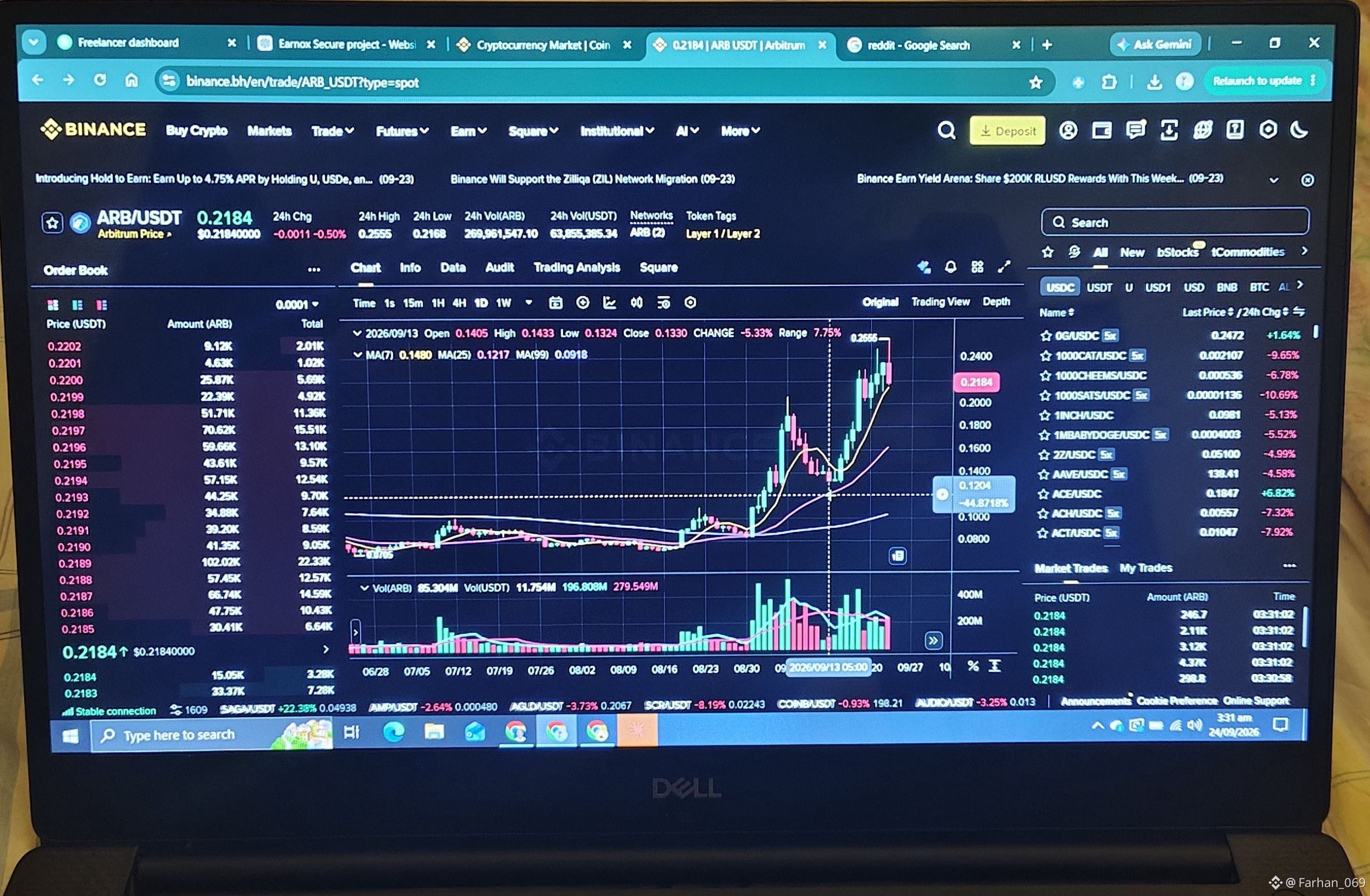
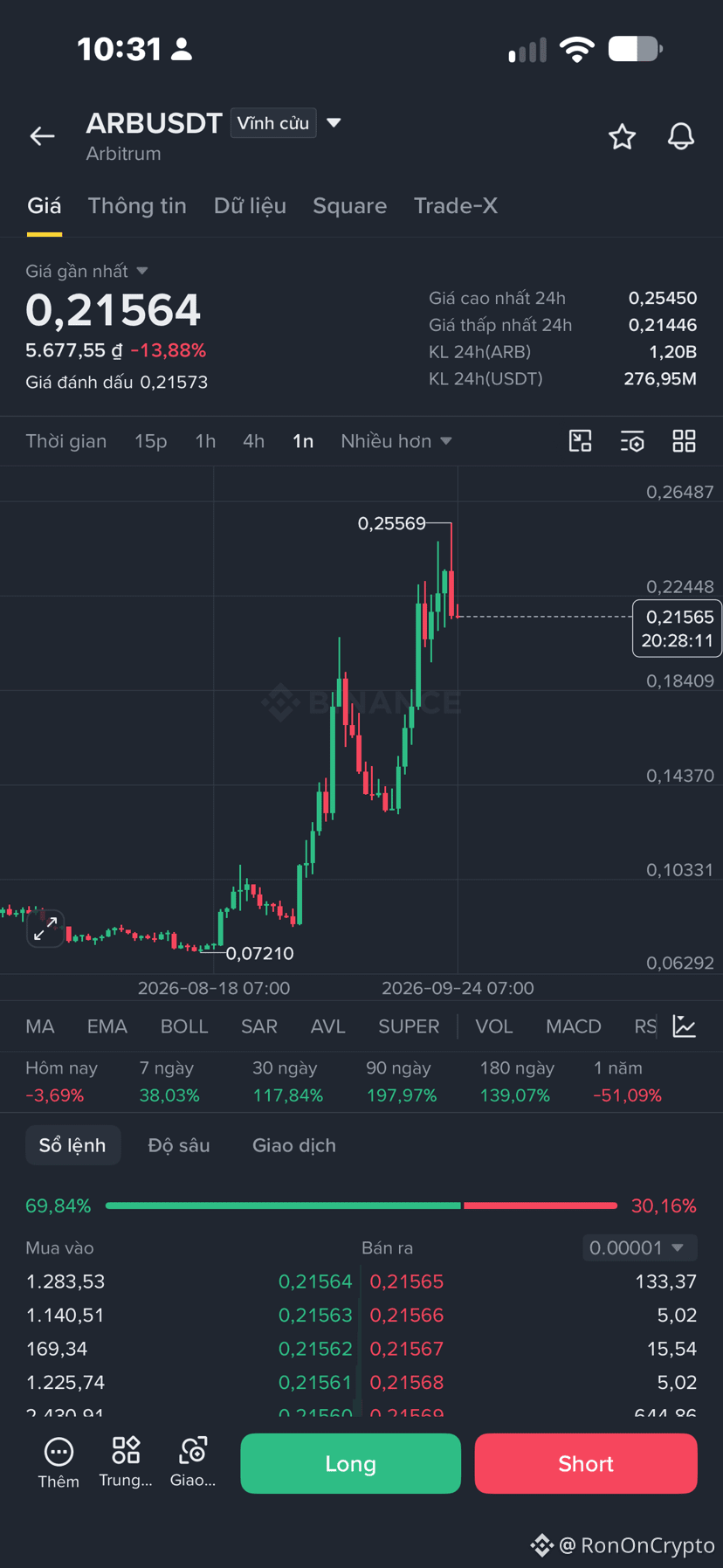
Took a position in $ARB, entry around 0.2175. Look at the chart — strong momentum has built up over the past few weeks, moving from around 0.07 all the way to 0.2555. The MA lines are also confirming the upward trend, and volume looks healthy right now.
My personal view is that if this momentum continues, there could be further upside, but the market is volatile so I've got a stop loss in place. DYOR, manage your own risk.
#BTC #ETH #Layer2 #CryptoPatience #BinanceSquare #writetoearn #CryptoTrading
Took a position in $ARB, entry around 0.2175. Look at the chart — strong momentum has built up over the past few weeks, moving from around 0.07 all the way to 0.2555. The MA lines are also confirming the upward trend, and volume looks healthy right now.
My personal view is that if this momentum continues, there could be further upside, but the market is volatile so I've got a stop loss in place. DYOR, manage your own risk.
#BTC #ETH #Layer2 #CryptoPatience #BinanceSquare #writetoearn #CryptoTrading
My personal view is that if this momentum continues, there could be further upside, but the market is volatile so I've got a stop loss in place. DYOR, manage your own risk.
#BTC #ETH #Layer2 #CryptoPatience #BinanceSquare #writetoearn #CryptoTrading
283

Market Leaders at Prime Levels — Position Before Acceleration
$ARB | $OP | $TIA
ARB, OP, and TIA continue to represent major scaling and modular blockchain narratives. With volatility tightening, market participants are watching whether these assets can defend their higher-timeframe structures.
A breakout becomes more meaningful when it follows a stable base.
Key Takeaway: Compression around support can precede a significant volatility expansion.
#ARB #OP #TIA #Layer2 #HighConviction
{future}(ARBUSDT)
{future}(OPUSDT)
{future}(TIAUSDT)
Market Leaders at Prime Levels — Position Before Acceleration
$ARB | $OP | $TIA
ARB, OP, and TIA continue to represent major scaling and modular blockchain narratives. With volatility tightening, market participants are watching whether these assets can defend their higher-timeframe structures.
A breakout becomes more meaningful when it follows a stable base.
Key Takeaway: Compression around support can precede a significant volatility expansion.
#ARB #OP #TIA #Layer2 #HighConviction
$ARB | $OP | $TIA
ARB, OP, and TIA continue to represent major scaling and modular blockchain narratives. With volatility tightening, market participants are watching whether these assets can defend their higher-timeframe structures.
A breakout becomes more meaningful when it follows a stable base.
Key Takeaway: Compression around support can precede a significant volatility expansion.
#ARB #OP #TIA #Layer2 #HighConviction
1
161
Market Leaders at Prime Levels — Position Before Acceleration
$ARB | $STRK | $ZK
ARB, STRK, and ZK remain active across Ethereum Layer-2 and scaling narratives. Their performance depends on both broader market liquidity and continued ecosystem participation.
Compression around support provides a useful technical framework.
Key Takeaway: Scaling narratives become stronger when price structure confirms renewed participation.
#ARB #STRK #ZK #Layer2 #HighConviction
{future}(ARBUSDT)
{future}(STRKUSDT)
{future}(ZKUSDT)
Market Leaders at Prime Levels — Position Before Acceleration
$ARB | $STRK | $ZK
ARB, STRK, and ZK remain active across Ethereum Layer-2 and scaling narratives. Their performance depends on both broader market liquidity and continued ecosystem participation.
Compression around support provides a useful technical framework.
Key Takeaway: Scaling narratives become stronger when price structure confirms renewed participation.
#ARB #STRK #ZK #Layer2 #HighConviction
$ARB | $STRK | $ZK
ARB, STRK, and ZK remain active across Ethereum Layer-2 and scaling narratives. Their performance depends on both broader market liquidity and continued ecosystem participation.
Compression around support provides a useful technical framework.
Key Takeaway: Scaling narratives become stronger when price structure confirms renewed participation.
#ARB #STRK #ZK #Layer2 #HighConviction
1
148

⚡ $$ARB Update: Trading at $0.2297 USDT — Layer 2 Accumulation Zone? $ARB is currently holding around the $0.2297 USDT mark, drawing the attention of traders and long-term believers in $Etharium scaling solutions.
As transaction activity continues to flow through layer-2 networks, price action around this range has the community discussing whether this level acts as a solid base for a reversal or if further consolidation is ahead.
📊 Key Levels to Watch:
Current Price: ~$0.2297 USDT
Support Zone: Monitoring local lows to see if buyers step in to defend current valuations.
Upside Target: A strong push with rising volume above immediate resistance could signal renewed bullish momentum.
Are you accumulating more $ARB at these prices, or waiting for clearer market direction? Let's discuss your targets below! 👇
💬 NFA (Not Financial Advice). Always DYOR (Do Your Own Research) before trading.
#ARB #Arbitrum #BinanceSquare #CryptoTrading. #Layer2 #Write2Earn
⚡ $$ARB Update: Trading at $0.2297 USDT — Layer 2 Accumulation Zone? $ARB is currently holding around the $0.2297 USDT mark, drawing the attention of traders and long-term believers in $Etharium scaling solutions.
As transaction activity continues to flow through layer-2 networks, price action around this range has the community discussing whether this level acts as a solid base for a reversal or if further consolidation is ahead.
📊 Key Levels to Watch:
Current Price: ~$0.2297 USDT
Support Zone: Monitoring local lows to see if buyers step in to defend current valuations.
Upside Target: A strong push with rising volume above immediate resistance could signal renewed bullish momentum.
Are you accumulating more $ARB at these prices, or waiting for clearer market direction? Let's discuss your targets below! 👇
💬 NFA (Not Financial Advice). Always DYOR (Do Your Own Research) before trading.
#ARB #Arbitrum #BinanceSquare #CryptoTrading. #Layer2 #Write2Earn
As transaction activity continues to flow through layer-2 networks, price action around this range has the community discussing whether this level acts as a solid base for a reversal or if further consolidation is ahead.
📊 Key Levels to Watch:
Current Price: ~$0.2297 USDT
Support Zone: Monitoring local lows to see if buyers step in to defend current valuations.
Upside Target: A strong push with rising volume above immediate resistance could signal renewed bullish momentum.
Are you accumulating more $ARB at these prices, or waiting for clearer market direction? Let's discuss your targets below! 👇
💬 NFA (Not Financial Advice). Always DYOR (Do Your Own Research) before trading.
#ARB #Arbitrum #BinanceSquare #CryptoTrading. #Layer2 #Write2Earn
3
545

·
--
📈 $STRK HOLDING STEADY WHILE LAYER2 SURGE GATHERS POWER! 🦈
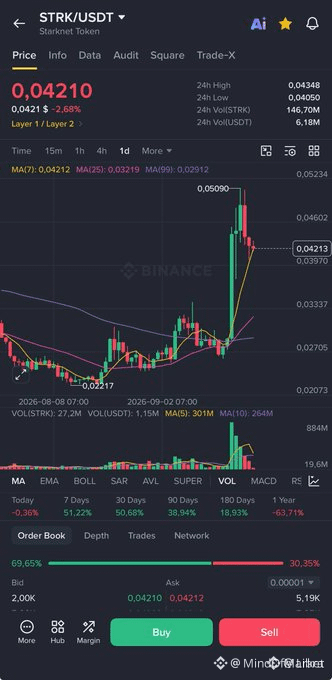
The daily chart is cradling a clean support zone, a classic demand block that has withstood three prior tests. 📊 Smart money has been anchoring liquidity here, turning the dip into a strategic accumulation point.
Layer‑2 sector momentum is ticking up, and $STRK is the spearhead, suggesting a potential swing back toward the recent highs. 🦈 Volume on the 4‑hour is expanding, indicating institutional hands stepping in.
💬 Do you see $STRK primed for a rebound or is the sector still in a consolidation phase? 👇
⚠️ Not financial advice. Always manage your risk. 🛡️
🏷️ #STRK #Layer2 #LongSetup #Crypto
🔥 💎
📈 $STRK HOLDING STEADY WHILE LAYER2 SURGE GATHERS POWER! 🦈
The daily chart is cradling a clean support zone, a classic demand block that has withstood three prior tests. 📊 Smart money has been anchoring liquidity here, turning the dip into a strategic accumulation point.
Layer‑2 sector momentum is ticking up, and $STRK is the spearhead, suggesting a potential swing back toward the recent highs. 🦈 Volume on the 4‑hour is expanding, indicating institutional hands stepping in.
💬 Do you see $STRK primed for a rebound or is the sector still in a consolidation phase? 👇
⚠️ Not financial advice. Always manage your risk. 🛡️
🏷️ #STRK #Layer2 #LongSetup #Crypto
🔥 💎
The daily chart is cradling a clean support zone, a classic demand block that has withstood three prior tests. 📊 Smart money has been anchoring liquidity here, turning the dip into a strategic accumulation point.
Layer‑2 sector momentum is ticking up, and $STRK is the spearhead, suggesting a potential swing back toward the recent highs. 🦈 Volume on the 4‑hour is expanding, indicating institutional hands stepping in.
💬 Do you see $STRK primed for a rebound or is the sector still in a consolidation phase? 👇
⚠️ Not financial advice. Always manage your risk. 🛡️
🏷️ #STRK #Layer2 #LongSetup #Crypto
🔥 💎
89

·
--
🚀 Layer-2 & DeFi Tokens Surge as Macro Post-Fed Jitters Cool Down!
The crypto market is back in green as post-Fed interest rate hike nerves begin to fade across the board. Leading the rally are Layer-2 networks and Decentralized Finance (DeFi) protocols, signaling strong risk-on sentiment across digital assets.
🔥 Key Market Highlights:
>> Layer-2 Leadership: $STRK (Starknet) and $ARB (Arbitrum) surged over 17%, outperforming major large-caps as scalability solutions gain huge momentum.
{spot}(ARBUSDT)
{spot}(STRKUSDT)
>> Macro Relief: The 10-year US Treasury yield slipped back below 5%, easing macroeconomic pressure and opening the floodgates for capital inflows into risk assets.
>> Broad Market Advance: A massive 98 out of 100 CoinDesk Index constituents traded higher, marking a near-unanimous market rebound.
With yields cooling off, institutional and retail liquidity is rotating straight into productive, yield-generating DeFi protocols and high-throughput L2s. Is this the start of a sustained altcoin rally, or just a temporary macro relief bounce?
👇 What’s your take? Are you accumulating STRK and ARB here, or waiting for a pullback? Let us know below!
#writetoearn #Layer2 #defi #Write2Earn #MarketRebound
🚀 Layer-2 & DeFi Tokens Surge as Macro Post-Fed Jitters Cool Down!
The crypto market is back in green as post-Fed interest rate hike nerves begin to fade across the board. Leading the rally are Layer-2 networks and Decentralized Finance (DeFi) protocols, signaling strong risk-on sentiment across digital assets.
🔥 Key Market Highlights:
>> Layer-2 Leadership: $STRK (Starknet) and $ARB (Arbitrum) surged over 17%, outperforming major large-caps as scalability solutions gain huge momentum.
>> Macro Relief: The 10-year US Treasury yield slipped back below 5%, easing macroeconomic pressure and opening the floodgates for capital inflows into risk assets.
>> Broad Market Advance: A massive 98 out of 100 CoinDesk Index constituents traded higher, marking a near-unanimous market rebound.
With yields cooling off, institutional and retail liquidity is rotating straight into productive, yield-generating DeFi protocols and high-throughput L2s. Is this the start of a sustained altcoin rally, or just a temporary macro relief bounce?
👇 What’s your take? Are you accumulating STRK and ARB here, or waiting for a pullback? Let us know below!
#writetoearn #Layer2 #defi #Write2Earn #MarketRebound
The crypto market is back in green as post-Fed interest rate hike nerves begin to fade across the board. Leading the rally are Layer-2 networks and Decentralized Finance (DeFi) protocols, signaling strong risk-on sentiment across digital assets.
🔥 Key Market Highlights:
>> Layer-2 Leadership: $STRK (Starknet) and $ARB (Arbitrum) surged over 17%, outperforming major large-caps as scalability solutions gain huge momentum.
>> Macro Relief: The 10-year US Treasury yield slipped back below 5%, easing macroeconomic pressure and opening the floodgates for capital inflows into risk assets.
>> Broad Market Advance: A massive 98 out of 100 CoinDesk Index constituents traded higher, marking a near-unanimous market rebound.
With yields cooling off, institutional and retail liquidity is rotating straight into productive, yield-generating DeFi protocols and high-throughput L2s. Is this the start of a sustained altcoin rally, or just a temporary macro relief bounce?
👇 What’s your take? Are you accumulating STRK and ARB here, or waiting for a pullback? Let us know below!
#writetoearn #Layer2 #defi #Write2Earn #MarketRebound
287

Layer-2 Scaling & Gas Fee Trends
Title: ⚡ L2 ECOSYSTEMS GROWING AT RECORD SPEED!
Layer-2 networks (Arbitrum, Optimism, Base) are processing record transaction volumes while keeping gas fees near zero! ⛽
📊 Key Takeaways:
• Lower fees are driving massive retail adoption for L2 dApps.
• Layer-1 base layer remains the ultimate security settlement layer.
Which L2 ecosystem do you use the most for daily transactions? Share below! 💬
#Layer2 #Arbitrum #Write2Earn
Layer-2 Scaling & Gas Fee Trends
Title: ⚡ L2 ECOSYSTEMS GROWING AT RECORD SPEED!
Layer-2 networks (Arbitrum, Optimism, Base) are processing record transaction volumes while keeping gas fees near zero! ⛽
📊 Key Takeaways:
• Lower fees are driving massive retail adoption for L2 dApps.
• Layer-1 base layer remains the ultimate security settlement layer.
Which L2 ecosystem do you use the most for daily transactions? Share below! 💬
#Layer2 #Arbitrum #Write2Earn
Title: ⚡ L2 ECOSYSTEMS GROWING AT RECORD SPEED!
Layer-2 networks (Arbitrum, Optimism, Base) are processing record transaction volumes while keeping gas fees near zero! ⛽
📊 Key Takeaways:
• Lower fees are driving massive retail adoption for L2 dApps.
• Layer-1 base layer remains the ultimate security settlement layer.
Which L2 ecosystem do you use the most for daily transactions? Share below! 💬
#Layer2 #Arbitrum #Write2Earn
2
325

·
--
Verified
$ARB saw a rise of over 30% in 1 week, but this time the reason is not the same as the previous waves.
According to AMBCrypto, Arbitrum network revenue has grown 5-fold in just 2 months, largely thanks to Robinhood Chain — an enterprise chain built on Arbitrum infrastructure — which has stepped up on-chain trading activity. Standard Chartered has just started tracking ARB on 21/9 with a target price of $10 for 2030.
This is different from those rallies that rely only on speculative capital inflows: there is real revenue behind it.
But there are 2 things worth watching before concluding the trend is sustainable: on 16/10, there will be a release of 92.65 million ARB (~$20 million, mostly belonging to the team), and the Arbitrum DAO has just voted (by 23/9) to permanently ban 3 projects that previously received grants after the Watchdog recovered around 532,000 ARB suspected of being used for improper purposes.
Is the real growth in revenue enough to carry the momentum through the upcoming unlock?
Reference sources: AMBCrypto, Bitcoinist, CoinGecko — not investment advice.
#ARB #Arbitrum #Layer2
{future}(ARBUSDT)
$ARB saw a rise of over 30% in 1 week, but this time the reason is not the same as the previous waves.
According to AMBCrypto, Arbitrum network revenue has grown 5-fold in just 2 months, largely thanks to Robinhood Chain — an enterprise chain built on Arbitrum infrastructure — which has stepped up on-chain trading activity. Standard Chartered has just started tracking ARB on 21/9 with a target price of $10 for 2030.
This is different from those rallies that rely only on speculative capital inflows: there is real revenue behind it.
But there are 2 things worth watching before concluding the trend is sustainable: on 16/10, there will be a release of 92.65 million ARB (~$20 million, mostly belonging to the team), and the Arbitrum DAO has just voted (by 23/9) to permanently ban 3 projects that previously received grants after the Watchdog recovered around 532,000 ARB suspected of being used for improper purposes.
Is the real growth in revenue enough to carry the momentum through the upcoming unlock?
Reference sources: AMBCrypto, Bitcoinist, CoinGecko — not investment advice.
#ARB #Arbitrum #Layer2
According to AMBCrypto, Arbitrum network revenue has grown 5-fold in just 2 months, largely thanks to Robinhood Chain — an enterprise chain built on Arbitrum infrastructure — which has stepped up on-chain trading activity. Standard Chartered has just started tracking ARB on 21/9 with a target price of $10 for 2030.
This is different from those rallies that rely only on speculative capital inflows: there is real revenue behind it.
But there are 2 things worth watching before concluding the trend is sustainable: on 16/10, there will be a release of 92.65 million ARB (~$20 million, mostly belonging to the team), and the Arbitrum DAO has just voted (by 23/9) to permanently ban 3 projects that previously received grants after the Watchdog recovered around 532,000 ARB suspected of being used for improper purposes.
Is the real growth in revenue enough to carry the momentum through the upcoming unlock?
Reference sources: AMBCrypto, Bitcoinist, CoinGecko — not investment advice.
#ARB #Arbitrum #Layer2
896

·
--
Article
Everyone is touting Layer2 as Ethereum’s savior, but the more I look, the more I feel that this might be the biggest narrative overextension for $ETH in the past few years.First, look at the data. $ETH Now the quote is $2,670.11, down 1.69% over the past 24 hours. It briefly hit a high of $2,723.57 before being pushed back down, with a low of $2,600.15. Trading volume: 300,609 ETH. Funding rate: +0.0075%—longs are still paying a little. Did you notice? The market is calm, but the calmness is a bit eerie—L2’s TVL keeps hitting new highs every day, yet the coin price is just lying around below 2700 pretending nothing’s happening. The gap in between—that’s the real thing worth discussing.
What is the market consensus? “The more L2s, the stronger Ethereum is, the more valuable ETH becomes.” This logic sounds airtight, but it has a fatal flaw: L2s thriving and ETH’s price going up are not the same thing. 🧐 L2s do help scale Ethereum, but at the same time they are doing another thing—capturing value that should have accrued on the mainnet, siphoning it off layer by layer. Gas fees drop, and user experience improves, but how much of these benefits truly flows back to $ETH holders? Very little. With their own token incentives, their own sequencer revenues, and their own ecosystem flywheel, L2s turn traffic into their moat—while the mainnet increasingly looks like a mere “settlement back office.”
Everyone is touting Layer2 as Ethereum’s savior, but the more I look, the more I feel that this might be the biggest narrative overextension for $ETH in the past few years.
First, look at the data. $ETH Now the quote is $2,670.11, down 1.69% over the past 24 hours. It briefly hit a high of $2,723.57 before being pushed back down, with a low of $2,600.15. Trading volume: 300,609 ETH. Funding rate: +0.0075%—longs are still paying a little. Did you notice? The market is calm, but the calmness is a bit eerie—L2’s TVL keeps hitting new highs every day, yet the coin price is just lying around below 2700 pretending nothing’s happening. The gap in between—that’s the real thing worth discussing.
What is the market consensus? “The more L2s, the stronger Ethereum is, the more valuable ETH becomes.” This logic sounds airtight, but it has a fatal flaw: L2s thriving and ETH’s price going up are not the same thing. 🧐 L2s do help scale Ethereum, but at the same time they are doing another thing—capturing value that should have accrued on the mainnet, siphoning it off layer by layer. Gas fees drop, and user experience improves, but how much of these benefits truly flows back to $ETH holders? Very little. With their own token incentives, their own sequencer revenues, and their own ecosystem flywheel, L2s turn traffic into their moat—while the mainnet increasingly looks like a mere “settlement back office.”
What is the market consensus? “The more L2s, the stronger Ethereum is, the more valuable ETH becomes.” This logic sounds airtight, but it has a fatal flaw: L2s thriving and ETH’s price going up are not the same thing. 🧐 L2s do help scale Ethereum, but at the same time they are doing another thing—capturing value that should have accrued on the mainnet, siphoning it off layer by layer. Gas fees drop, and user experience improves, but how much of these benefits truly flows back to $ETH holders? Very little. With their own token incentives, their own sequencer revenues, and their own ecosystem flywheel, L2s turn traffic into their moat—while the mainnet increasingly looks like a mere “settlement back office.”
138
Scaling Sector Watch
$ARB | $OP | $ZK
ARB, OP, and ZK are consolidating around important levels as Layer-2 liquidity remains selective.
ARB is working to maintain its broader structure. OP continues to defend key support, while ZK is building around its current range.
📊 The next volume expansion could provide the next directional signal.
Key Takeaway: Support first, confirmation second, acceleration next.
#ARB #OP #ZK #Layer2 #StrategicEntry
{future}(ARBUSDT)
{future}(OPUSDT)
{future}(ZKUSDT)
Scaling Sector Watch
$ARB | $OP | $ZK
ARB, OP, and ZK are consolidating around important levels as Layer-2 liquidity remains selective.
ARB is working to maintain its broader structure. OP continues to defend key support, while ZK is building around its current range.
📊 The next volume expansion could provide the next directional signal.
Key Takeaway: Support first, confirmation second, acceleration next.
#ARB #OP #ZK #Layer2 #StrategicEntry
$ARB | $OP | $ZK
ARB, OP, and ZK are consolidating around important levels as Layer-2 liquidity remains selective.
ARB is working to maintain its broader structure. OP continues to defend key support, while ZK is building around its current range.
📊 The next volume expansion could provide the next directional signal.
Key Takeaway: Support first, confirmation second, acceleration next.
#ARB #OP #ZK #Layer2 #StrategicEntry
1
232

$MANTA
Manta remains an actively traded Layer-2 ecosystem token. Traders are watching for stronger volume before treating any range break as significant.
{spot}(MANTAUSDT)
$ZK
ZK remains a high-beta Ethereum scaling token. Sharp liquidity changes can produce fast moves, making confirmation important.
{spot}(ZKUSDT)
$BLZ
Blz continues to trade as a speculative Layer-2 asset. The key signal is whether fresh participation can push price out of its range.
#MANTA #ZK #BLZ #Layer2 #CryptoTrading
$MANTA
Manta remains an actively traded Layer-2 ecosystem token. Traders are watching for stronger volume before treating any range break as significant.
$ZK
ZK remains a high-beta Ethereum scaling token. Sharp liquidity changes can produce fast moves, making confirmation important.
$BLZ
Blz continues to trade as a speculative Layer-2 asset. The key signal is whether fresh participation can push price out of its range.
#MANTA #ZK #BLZ #Layer2 #CryptoTrading
Manta remains an actively traded Layer-2 ecosystem token. Traders are watching for stronger volume before treating any range break as significant.
$ZK
ZK remains a high-beta Ethereum scaling token. Sharp liquidity changes can produce fast moves, making confirmation important.
$BLZ
Blz continues to trade as a speculative Layer-2 asset. The key signal is whether fresh participation can push price out of its range.
#MANTA #ZK #BLZ #Layer2 #CryptoTrading

204
$ARB
Arbitrum remains a major Ethereum Layer-2 asset with significant market liquidity. The current focus is whether buyers can reclaim important resistance zones.
{spot}(ARBUSDT)
$OP
Optimism remains one of the most established Layer-2 tokens on Binance. Volume expansion would be important for confirming a larger directional move.
{spot}(OPUSDT)
$STRK
Starknet remains a high-beta Layer-2 trading name. Traders should watch liquidity closely because sharp moves can develop quickly.
{spot}(STRKUSDT)
#ARB #OP #STRK #Layer2 #CryptoTrading
$ARB
Arbitrum remains a major Ethereum Layer-2 asset with significant market liquidity. The current focus is whether buyers can reclaim important resistance zones.
$OP
Optimism remains one of the most established Layer-2 tokens on Binance. Volume expansion would be important for confirming a larger directional move.
$STRK
Starknet remains a high-beta Layer-2 trading name. Traders should watch liquidity closely because sharp moves can develop quickly.
#ARB #OP #STRK #Layer2 #CryptoTrading
Arbitrum remains a major Ethereum Layer-2 asset with significant market liquidity. The current focus is whether buyers can reclaim important resistance zones.
$OP
Optimism remains one of the most established Layer-2 tokens on Binance. Volume expansion would be important for confirming a larger directional move.
$STRK
Starknet remains a high-beta Layer-2 trading name. Traders should watch liquidity closely because sharp moves can develop quickly.
#ARB #OP #STRK #Layer2 #CryptoTrading
6

·
--
Bullish
$ARB is trading around $0.215, up roughly 135% over the past month, and it hit its highest price since January during last week's Layer-2 rally.
The rotation into L2 and DeFi tokens was sharp, but $ARB Arbitrum is still far below where it traded in earlier cycles. A big monthly gain from a low base tells us less than a big gain from a high one.
What I'd watch: does trading volume stay elevated once the rally slows?
#Arbitrum #ARB #Layer2 #CryptoNews #BinanceSquare
{future}(ARBUSDT)
$ARB is trading around $0.215, up roughly 135% over the past month, and it hit its highest price since January during last week's Layer-2 rally.
The rotation into L2 and DeFi tokens was sharp, but $ARB Arbitrum is still far below where it traded in earlier cycles. A big monthly gain from a low base tells us less than a big gain from a high one.
What I'd watch: does trading volume stay elevated once the rally slows?
#Arbitrum #ARB #Layer2 #CryptoNews #BinanceSquare
The rotation into L2 and DeFi tokens was sharp, but $ARB Arbitrum is still far below where it traded in earlier cycles. A big monthly gain from a low base tells us less than a big gain from a high one.
What I'd watch: does trading volume stay elevated once the rally slows?
#Arbitrum #ARB #Layer2 #CryptoNews #BinanceSquare

1
330

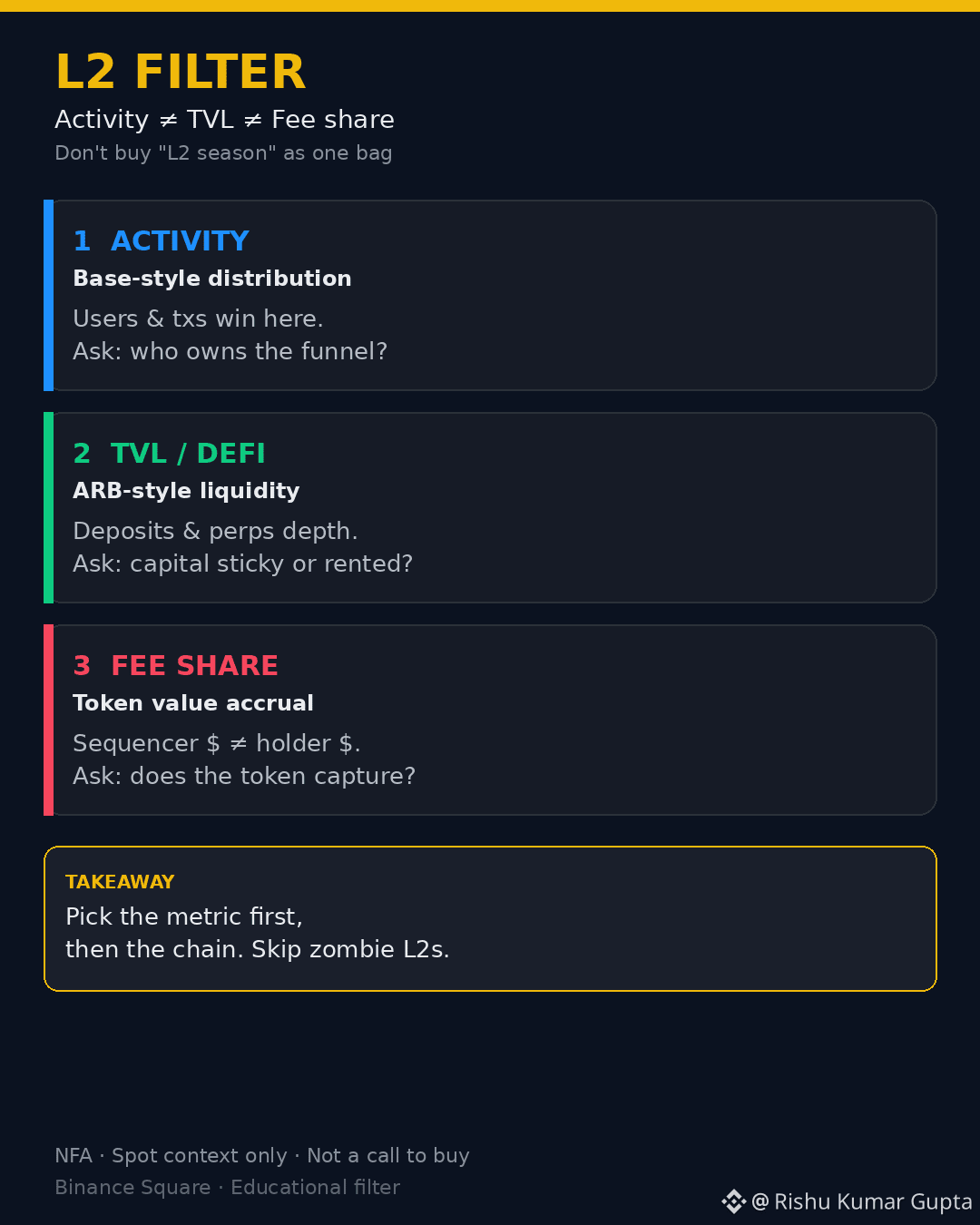
L2 season is not one trade.
Activity leader ≠ TVL leader ≠ fee-share token. Buying "all L2s" as a sector ETF is how you catch zombie chains.
2026 filter (pick the metric first):
1) Activity / distribution — who owns the user funnel? Base-style consumer rails win txs; that is not the same as a liquid L2 governance bag.
2) TVL / DeFi gravity — deep perps + lending stickiness. $ARB still sits in that lane; deposits ≠ automatic fee share to holders.
3) Fee accrual — sequencer revenue can look strong while the token captures none of it. Ask where the cash actually lands.
Live spot context (Binance ~08:00 IST): $ARB ~$0.215 (+4.3% 24h), $OP ~$0.125 (+2.8%), $ETH ~$2,654 (+1.7%). Strength on the tape is not thesis confirmation.
Fake-hype tells: "all L2s moon together," TVL flex with dead utilization, incentive farming sold as organic growth.
Takeaway: choose ACTIVITY, TVL, or FEE SHARE — then the chain. Skip the long tail of sub-scale rollups.
NFA. Which filter do you actually use — reply 1, 2, or 3?
$ARB $OP $ETH
#Layer2 #DeFi #TradingTips
L2 season is not one trade.
Activity leader ≠ TVL leader ≠ fee-share token. Buying "all L2s" as a sector ETF is how you catch zombie chains.
2026 filter (pick the metric first):
1) Activity / distribution — who owns the user funnel? Base-style consumer rails win txs; that is not the same as a liquid L2 governance bag.
2) TVL / DeFi gravity — deep perps + lending stickiness. $ARB still sits in that lane; deposits ≠ automatic fee share to holders.
3) Fee accrual — sequencer revenue can look strong while the token captures none of it. Ask where the cash actually lands.
Live spot context (Binance ~08:00 IST): $ARB ~$0.215 (+4.3% 24h), $OP ~$0.125 (+2.8%), $ETH ~$2,654 (+1.7%). Strength on the tape is not thesis confirmation.
Fake-hype tells: "all L2s moon together," TVL flex with dead utilization, incentive farming sold as organic growth.
Takeaway: choose ACTIVITY, TVL, or FEE SHARE — then the chain. Skip the long tail of sub-scale rollups.
NFA. Which filter do you actually use — reply 1, 2, or 3?
$ARB $OP $ETH
#Layer2 #DeFi #TradingTips
Activity leader ≠ TVL leader ≠ fee-share token. Buying "all L2s" as a sector ETF is how you catch zombie chains.
2026 filter (pick the metric first):
1) Activity / distribution — who owns the user funnel? Base-style consumer rails win txs; that is not the same as a liquid L2 governance bag.
2) TVL / DeFi gravity — deep perps + lending stickiness. $ARB still sits in that lane; deposits ≠ automatic fee share to holders.
3) Fee accrual — sequencer revenue can look strong while the token captures none of it. Ask where the cash actually lands.
Live spot context (Binance ~08:00 IST): $ARB ~$0.215 (+4.3% 24h), $OP ~$0.125 (+2.8%), $ETH ~$2,654 (+1.7%). Strength on the tape is not thesis confirmation.
Fake-hype tells: "all L2s moon together," TVL flex with dead utilization, incentive farming sold as organic growth.
Takeaway: choose ACTIVITY, TVL, or FEE SHARE — then the chain. Skip the long tail of sub-scale rollups.
NFA. Which filter do you actually use — reply 1, 2, or 3?
$ARB $OP $ETH
#Layer2 #DeFi #TradingTips
254

·
--

Article
Arbitrum’s 70‑X Future: Why the Market Is Still Blind to the Real UpsideMost traders focus on price swings. Smart money watches the flow of institutional capital into layer‑2 rollups instead.
The signal: Standard Chartered’s latest research now projects that Arbitrum ($ARB) could rise 70× by 2030, driven by a surge in tokenized stock liquidity and the Bitcoin Reserve’s expansion. On-chain data shows a 45% jump in $ARB liquidity over the past month, while whale activity in the $ARB/USDC pool has doubled. #ARB #Layer2 #InstitutionalCrypto
Interpretation: If tokenized equities continue to flood Arbitrum, the demand for $ARB as a bridge and settlement layer will skyrocket. The 70× forecast isn’t a speculative hype; it’s rooted in the projected $10 trillion tokenized equity market and the $5 trillion Bitcoin Reserve, both of which will funnel liquidity through Arbitrum’s cheaper, faster transactions. Price could see a sustained upward drift as institutional flows lock in.
Watch list: Keep an eye on the $ARB/USDC liquidity pool size and the daily volume of tokenized stock trades on Arbitrum. A sudden spike in either could signal the next rally. #ArbitrumWatch
Thought closer: If you’re looking for a layer‑2 that’s poised to dominate the next decade, is $ARB the one you’re overlooking?
Arbitrum’s 70‑X Future: Why the Market Is Still Blind to the Real Upside
Most traders focus on price swings. Smart money watches the flow of institutional capital into layer‑2 rollups instead.
The signal: Standard Chartered’s latest research now projects that Arbitrum ($ARB ) could rise 70× by 2030, driven by a surge in tokenized stock liquidity and the Bitcoin Reserve’s expansion. On-chain data shows a 45% jump in $ARB liquidity over the past month, while whale activity in the $ARB /USDC pool has doubled. #ARB #Layer2 #InstitutionalCrypto
Interpretation: If tokenized equities continue to flood Arbitrum, the demand for $ARB as a bridge and settlement layer will skyrocket. The 70× forecast isn’t a speculative hype; it’s rooted in the projected $10 trillion tokenized equity market and the $5 trillion Bitcoin Reserve, both of which will funnel liquidity through Arbitrum’s cheaper, faster transactions. Price could see a sustained upward drift as institutional flows lock in.
Watch list: Keep an eye on the $ARB /USDC liquidity pool size and the daily volume of tokenized stock trades on Arbitrum. A sudden spike in either could signal the next rally. #ArbitrumWatch
Thought closer: If you’re looking for a layer‑2 that’s poised to dominate the next decade, is $ARB the one you’re overlooking?
The signal: Standard Chartered’s latest research now projects that Arbitrum ($ARB ) could rise 70× by 2030, driven by a surge in tokenized stock liquidity and the Bitcoin Reserve’s expansion. On-chain data shows a 45% jump in $ARB liquidity over the past month, while whale activity in the $ARB /USDC pool has doubled. #ARB #Layer2 #InstitutionalCrypto
Interpretation: If tokenized equities continue to flood Arbitrum, the demand for $ARB as a bridge and settlement layer will skyrocket. The 70× forecast isn’t a speculative hype; it’s rooted in the projected $10 trillion tokenized equity market and the $5 trillion Bitcoin Reserve, both of which will funnel liquidity through Arbitrum’s cheaper, faster transactions. Price could see a sustained upward drift as institutional flows lock in.
Watch list: Keep an eye on the $ARB /USDC liquidity pool size and the daily volume of tokenized stock trades on Arbitrum. A sudden spike in either could signal the next rally. #ArbitrumWatch
Thought closer: If you’re looking for a layer‑2 that’s poised to dominate the next decade, is $ARB the one you’re overlooking?
166

·
--
Verified
A South Korean mint and banknote printing company used OP technology to successfully power a local payments run—recharge, consumption, and settlement all packed into a single on-chain transaction. The moment the news hit, discussions about OP on the Binance Square surged 3.18x in three days. Sounds pretty convincing, but don’t rush to buy in.
This was only a drill in a test environment, not an official rollout, and Optimism hasn’t even said when it will truly go into production. The price, however, cooperated with the performance—up nearly 25% over the past seven days, with a 24-hour trading volume of $127 million, and funding rates also skewed positive—but this looks more like sentiment running ahead of facts.
Some people have already started linking it to the January proposal for a “50% Superchain revenue buyback,” thinking that if enterprises use it, tokens must be bought back. They’re thinking too far ahead. This test didn’t come with any new buyback announcement and didn’t create any direct demand for OP tokens.
In the short term, bias is bearish—can’t escape it. A PR piece for a test environment can’t support this kind of rally. Sentiment will eventually have to give back. If I were to change my mind, there’s only one scenario: if Toss and KOMSCO really bring this whole process into the production environment and produce real, verifiable transaction volume. Only then would it be genuine demand—right now, it’s still just a story.
$OP #Optimism #Layer2
A South Korean mint and banknote printing company used OP technology to successfully power a local payments run—recharge, consumption, and settlement all packed into a single on-chain transaction. The moment the news hit, discussions about OP on the Binance Square surged 3.18x in three days. Sounds pretty convincing, but don’t rush to buy in.
This was only a drill in a test environment, not an official rollout, and Optimism hasn’t even said when it will truly go into production. The price, however, cooperated with the performance—up nearly 25% over the past seven days, with a 24-hour trading volume of $127 million, and funding rates also skewed positive—but this looks more like sentiment running ahead of facts.
Some people have already started linking it to the January proposal for a “50% Superchain revenue buyback,” thinking that if enterprises use it, tokens must be bought back. They’re thinking too far ahead. This test didn’t come with any new buyback announcement and didn’t create any direct demand for OP tokens.
In the short term, bias is bearish—can’t escape it. A PR piece for a test environment can’t support this kind of rally. Sentiment will eventually have to give back. If I were to change my mind, there’s only one scenario: if Toss and KOMSCO really bring this whole process into the production environment and produce real, verifiable transaction volume. Only then would it be genuine demand—right now, it’s still just a story.
$OP #Optimism #Layer2
This was only a drill in a test environment, not an official rollout, and Optimism hasn’t even said when it will truly go into production. The price, however, cooperated with the performance—up nearly 25% over the past seven days, with a 24-hour trading volume of $127 million, and funding rates also skewed positive—but this looks more like sentiment running ahead of facts.
Some people have already started linking it to the January proposal for a “50% Superchain revenue buyback,” thinking that if enterprises use it, tokens must be bought back. They’re thinking too far ahead. This test didn’t come with any new buyback announcement and didn’t create any direct demand for OP tokens.
In the short term, bias is bearish—can’t escape it. A PR piece for a test environment can’t support this kind of rally. Sentiment will eventually have to give back. If I were to change my mind, there’s only one scenario: if Toss and KOMSCO really bring this whole process into the production environment and produce real, verifiable transaction volume. Only then would it be genuine demand—right now, it’s still just a story.
$OP #Optimism #Layer2
693

·
--
🚀 $OP — A significant name in the world of Ethereum scaling
As Web3 continues to move forward rapidly, the need for fast, low-cost, and more efficient transactions for Ethereum is also increasing. In this space, Optimism is drawing attention as an important Layer-2 scaling ecosystem.
🔹 What is $OP ?
It is the native token of the Optimism ecosystem, linked to governance and community participation in the ecosystem.
💡 Why keep an eye on $OP ?
• Layer-2 technology for Ethereum scaling
• Growing development of the Optimism ecosystem
• OP Stack-based blockchain ecosystem
• Scaling infrastructure for Web3 and decentralized applications
• Governance and community participation
📊 What you may want to watch next:
🔸 Development of the Optimism ecosystem
🔸 Adoption of the OP Stack
🔸 Growth of the Layer-2 sector
🔸 Network activity and ecosystem expansion
🔸 Overall crypto market sentiment
🔥 As the Ethereum ecosystem moves toward more scalable infrastructure, the importance of Layer-2 solutions like Optimism may also come up in discussion.
In your opinion, how big could the $OP ecosystem become in the future? 👀
#OP #Optimism #Crypto #Ethereum #Layer2 #Web3 #DeFi #Blockchain #BinanceSquare
⚠️ Disclaimer: This post is created only for informational and educational purposes. It is not financial advice
🚀 $OP — A significant name in the world of Ethereum scaling
As Web3 continues to move forward rapidly, the need for fast, low-cost, and more efficient transactions for Ethereum is also increasing. In this space, Optimism is drawing attention as an important Layer-2 scaling ecosystem.
🔹 What is $OP ?
It is the native token of the Optimism ecosystem, linked to governance and community participation in the ecosystem.
💡 Why keep an eye on $OP ?
• Layer-2 technology for Ethereum scaling
• Growing development of the Optimism ecosystem
• OP Stack-based blockchain ecosystem
• Scaling infrastructure for Web3 and decentralized applications
• Governance and community participation
📊 What you may want to watch next:
🔸 Development of the Optimism ecosystem
🔸 Adoption of the OP Stack
🔸 Growth of the Layer-2 sector
🔸 Network activity and ecosystem expansion
🔸 Overall crypto market sentiment
🔥 As the Ethereum ecosystem moves toward more scalable infrastructure, the importance of Layer-2 solutions like Optimism may also come up in discussion.
In your opinion, how big could the $OP ecosystem become in the future? 👀
#OP #Optimism #Crypto #Ethereum #Layer2 #Web3 #DeFi #Blockchain #BinanceSquare
⚠️ Disclaimer: This post is created only for informational and educational purposes. It is not financial advice
As Web3 continues to move forward rapidly, the need for fast, low-cost, and more efficient transactions for Ethereum is also increasing. In this space, Optimism is drawing attention as an important Layer-2 scaling ecosystem.
🔹 What is $OP ?
It is the native token of the Optimism ecosystem, linked to governance and community participation in the ecosystem.
💡 Why keep an eye on $OP ?
• Layer-2 technology for Ethereum scaling
• Growing development of the Optimism ecosystem
• OP Stack-based blockchain ecosystem
• Scaling infrastructure for Web3 and decentralized applications
• Governance and community participation
📊 What you may want to watch next:
🔸 Development of the Optimism ecosystem
🔸 Adoption of the OP Stack
🔸 Growth of the Layer-2 sector
🔸 Network activity and ecosystem expansion
🔸 Overall crypto market sentiment
🔥 As the Ethereum ecosystem moves toward more scalable infrastructure, the importance of Layer-2 solutions like Optimism may also come up in discussion.
In your opinion, how big could the $OP ecosystem become in the future? 👀
#OP #Optimism #Crypto #Ethereum #Layer2 #Web3 #DeFi #Blockchain #BinanceSquare
⚠️ Disclaimer: This post is created only for informational and educational purposes. It is not financial advice
21
Log in to explore more content
Join global crypto users on Binance Square
⚡️ Get latest and useful information about crypto.
💬 Trusted by the world’s largest crypto exchange.
👍 Discover real insights from verified creators.
Email / Phone number
Trending Topics
1
#BinanceWillListHyperliquid(HYPE)
40,643 views
1,102 Discussing
2
#FedOctoberRateHikeOddsRiseTo69.7%
3,524 views
259 Discussing
3
#BitcoinFallsBelow$83,000
1,726 views
20 Discussing
4
#BitcoinFallsToAround$84,600ThisWeek
0 views
0 Discussing
5
#US30YearYieldHighestSince2004
8,908 views
275 Discussing
6
#ETHBreaksAbove$2,700
905 views
20 Discussing
7
#USWeighsPromotingDollarStablecoinsAbroad
36,235 views
1,122 Discussing
8
#US10YTreasuryYieldHits19YearHigh
34,997 views
865 Discussing
9
#SpotBitcoinETFsInflow$2.31BInFourDays
4,673 views
60 Discussing
10
#BitcoinRejectedAt$87,300Twice
0 views
0 Discussing