

#ethcryptohub
ethcryptohub
177,395 views
392 Discussing
Hot
Latest

·
--
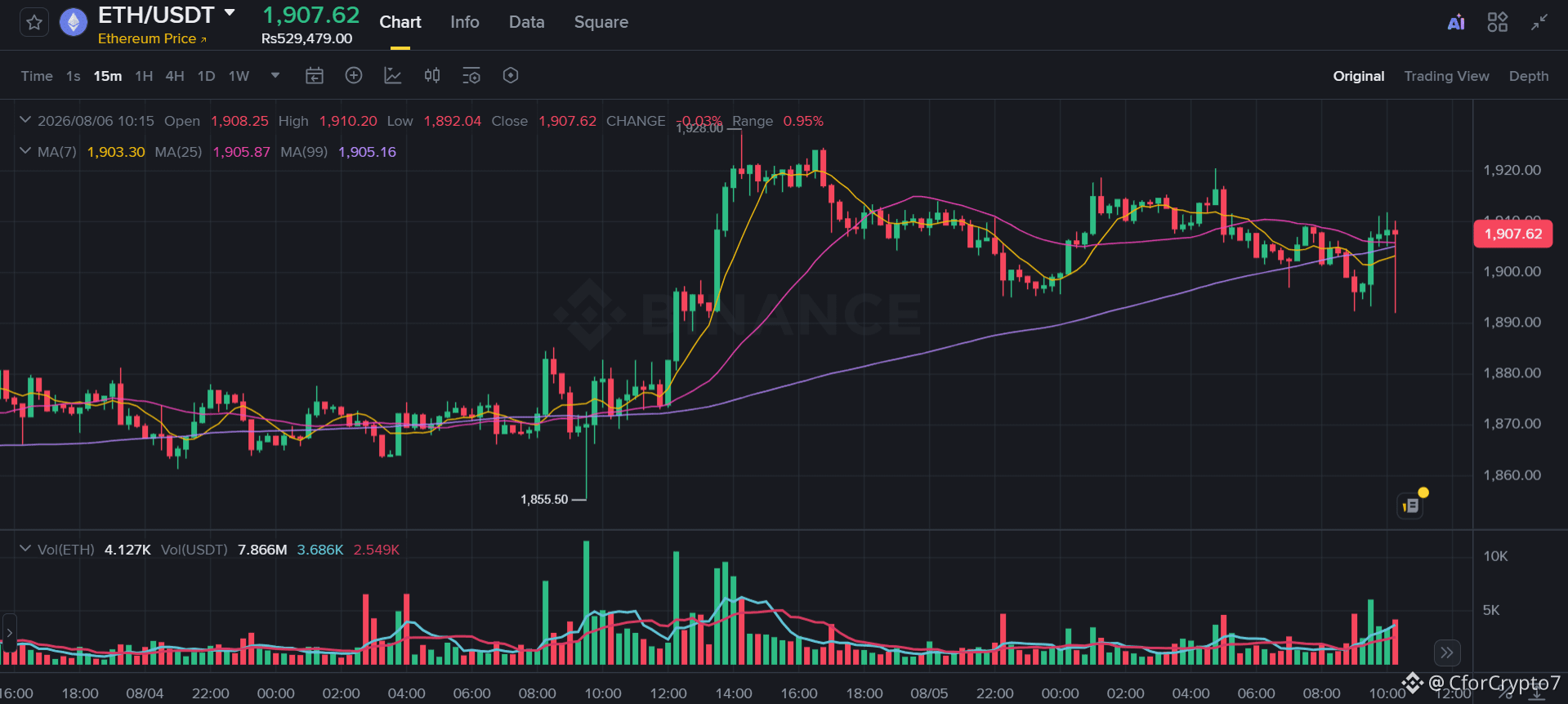
Guys $ETH bounced off 1,892 and reclaimed the short term MAs....
Trading above the 7, 25 AND 99 MA now....
momentum improving.
Still stuck in the bigger range tho.
LONG SCALP
Entry: 1,906 – 1,909
SL: 1,899
TP1: 1,915 TP2: 1,920 TP3: 1,928
click here to trade
$eth
what do u think, breaks the range or fades back?
manage ur risk. $ETH DYOR NFA
#ETH #Ethereum #Ethcryptohub
Guys $ETH bounced off 1,892 and reclaimed the short term MAs....
Trading above the 7, 25 AND 99 MA now....
momentum improving.
Still stuck in the bigger range tho.
LONG SCALP
Entry: 1,906 – 1,909
SL: 1,899
TP1: 1,915 TP2: 1,920 TP3: 1,928
click here to trade
$eth
what do u think, breaks the range or fades back?
manage ur risk. $ETH DYOR NFA
#ETH #Ethereum #Ethcryptohub
Trading above the 7, 25 AND 99 MA now....
momentum improving.
Still stuck in the bigger range tho.
LONG SCALP
Entry: 1,906 – 1,909
SL: 1,899
TP1: 1,915 TP2: 1,920 TP3: 1,928
click here to trade
$eth
what do u think, breaks the range or fades back?
manage ur risk. $ETH DYOR NFA
#ETH #Ethereum #Ethcryptohub
1
152


·
--
$ZAMA I think this can make me profitable if yes comment below 👇 and if no hit like button ✅😔#trading #Ethcryptohub
$ZAMA I think this can make me profitable if yes comment below 👇 and if no hit like button ✅😔#trading #Ethcryptohub
I am pro 2:
I follow you please follow back
2
2
648
·
--
$GTC I unfortunately picked up Top Gainers Coin and it's going against my Trade 😭 what's your point of view Suggest 😞#trading #Ethcryptohub
$GTC I unfortunately picked up Top Gainers Coin and it's going against my Trade 😭 what's your point of view Suggest 😞#trading #Ethcryptohub
327
·
--
$DEXE will it give me profit or only loss, suggest me your point of view 😞 will it reach $40 😂#trading #Ethcryptohub
$DEXE will it give me profit or only loss, suggest me your point of view 😞 will it reach $40 😂#trading #Ethcryptohub
1
722
·
--
$MARSCOIN Still I am confused 🤔 what is happening in Mars, Suggest me still I should hold the position or exit 😭#trading #Ethcryptohub
$MARSCOIN Still I am confused 🤔 what is happening in Mars, Suggest me still I should hold the position or exit 😭#trading #Ethcryptohub
1
735

·
--
SahiDin69:
Yes
4.1k
137
199
4.1k

·
--
CforCrypto7
·
--
got some profit in my btc holding in trust wallet and other 😅 should hold it till 90k ?

73

·
--
Verified
The CPI print could decide what the Fed does next. 👀 #CPIWatch
The U.S. jobs report definitely changed the conversation.
August Nonfarm Payrolls jumped by 162K, way above the roughly 56K expected, while unemployment stayed at 4.1%. That sounds clearly bullish for the economy, but there’s one detail I don’t want to ignore: wage growth cooled slightly to 3.1% year over year. So the labor market is stronger, but it isn’t necessarily creating a fresh wage inflation problem.
Now comes the bigger test: CPI.
Markets are looking for around 0.4% monthly headline inflation and 3.4% YoY, while core CPI is expected around 0.2% MoM and 2.4% YoY. At the same time, August PPI came in at 0.4%, with energy and some service costs adding pressure.
Personally, I’m not convinced the NFP number alone is enough for a hike. If core CPI lands close to expectations, I think the Fed still has a reasonable argument to hold and watch the trend. But a hotter than expected core number could quickly strengthen the case for a 25 bps hike.
That’s why I’m watching CPI more than NFP now.
My Analysis: neutral to bearish for stocks if CPI surprises higher, while a softer print could support risk assets and keep gold interesting.
What’s your call Fed hike or hold?? 🔥
#CPIWatch #Ethcryptohub $BTC $NVDA.US
{future}(BNBUSDT)
{future}(ETHUSDT)
{future}(BTCUSDT)
The CPI print could decide what the Fed does next. 👀 #CPIWatch
The U.S. jobs report definitely changed the conversation.
August Nonfarm Payrolls jumped by 162K, way above the roughly 56K expected, while unemployment stayed at 4.1%. That sounds clearly bullish for the economy, but there’s one detail I don’t want to ignore: wage growth cooled slightly to 3.1% year over year. So the labor market is stronger, but it isn’t necessarily creating a fresh wage inflation problem.
Now comes the bigger test: CPI.
Markets are looking for around 0.4% monthly headline inflation and 3.4% YoY, while core CPI is expected around 0.2% MoM and 2.4% YoY. At the same time, August PPI came in at 0.4%, with energy and some service costs adding pressure.
Personally, I’m not convinced the NFP number alone is enough for a hike. If core CPI lands close to expectations, I think the Fed still has a reasonable argument to hold and watch the trend. But a hotter than expected core number could quickly strengthen the case for a 25 bps hike.
That’s why I’m watching CPI more than NFP now.
My Analysis: neutral to bearish for stocks if CPI surprises higher, while a softer print could support risk assets and keep gold interesting.
What’s your call Fed hike or hold?? 🔥
#CPIWatch #Ethcryptohub $BTC $NVDA.US
The U.S. jobs report definitely changed the conversation.
August Nonfarm Payrolls jumped by 162K, way above the roughly 56K expected, while unemployment stayed at 4.1%. That sounds clearly bullish for the economy, but there’s one detail I don’t want to ignore: wage growth cooled slightly to 3.1% year over year. So the labor market is stronger, but it isn’t necessarily creating a fresh wage inflation problem.
Now comes the bigger test: CPI.
Markets are looking for around 0.4% monthly headline inflation and 3.4% YoY, while core CPI is expected around 0.2% MoM and 2.4% YoY. At the same time, August PPI came in at 0.4%, with energy and some service costs adding pressure.
Personally, I’m not convinced the NFP number alone is enough for a hike. If core CPI lands close to expectations, I think the Fed still has a reasonable argument to hold and watch the trend. But a hotter than expected core number could quickly strengthen the case for a 25 bps hike.
That’s why I’m watching CPI more than NFP now.
My Analysis: neutral to bearish for stocks if CPI surprises higher, while a softer print could support risk assets and keep gold interesting.
What’s your call Fed hike or hold?? 🔥
#CPIWatch #Ethcryptohub $BTC $NVDA.US

14
1
29
12.6k
·
--
@OpenGradient
What stands out to me about OpenGradient is that it seems to challenge the usual relationship between users and digital platforms. In most traditional systems, users generate value through their activity, but control over that value often remains concentrated elsewhere. OpenGradient appears to explore a model where participation and control are more closely connected, which I think changes the dynamic in a meaningful way.
When I look at traditional platforms, I think of busy marketplaces where vendors set all the rules while visitors simply participate within fixed boundaries. The marketplace grows because of user activity, but most decisions still flow from the top. OpenGradient feels like an environment friendly, where participants have greater influence over how the space functions and evolves over time.
What interests me is how that shift can affect incentives and long-term engagement. Capital and user activity usually move toward systems where value distribution feels fair and sustainable. When people feel like contributors instead of just users, participants can become more consistent and more deeply engaged in the network itself.
Of course, building a different model brings its own challenges. Greater control can also introduce friction, and many users naturally prefer to convenience over complexity. Creating a system that balances both, one of the hardest problems in digital infrastructure.
The way I see it, the bigger question is whether the future of digital platforms will continue following centralized models or gradually move toward systems with stronger user ownership. Which model do you think creates more lasting value over time? $OPG
#OPG #Ethcryptohub
$AGT
$ESPORTS
#opg
@OpenGradient
What stands out to me about OpenGradient is that it seems to challenge the usual relationship between users and digital platforms. In most traditional systems, users generate value through their activity, but control over that value often remains concentrated elsewhere. OpenGradient appears to explore a model where participation and control are more closely connected, which I think changes the dynamic in a meaningful way.
When I look at traditional platforms, I think of busy marketplaces where vendors set all the rules while visitors simply participate within fixed boundaries. The marketplace grows because of user activity, but most decisions still flow from the top. OpenGradient feels like an environment friendly, where participants have greater influence over how the space functions and evolves over time.
What interests me is how that shift can affect incentives and long-term engagement. Capital and user activity usually move toward systems where value distribution feels fair and sustainable. When people feel like contributors instead of just users, participants can become more consistent and more deeply engaged in the network itself.
Of course, building a different model brings its own challenges. Greater control can also introduce friction, and many users naturally prefer to convenience over complexity. Creating a system that balances both, one of the hardest problems in digital infrastructure.
The way I see it, the bigger question is whether the future of digital platforms will continue following centralized models or gradually move toward systems with stronger user ownership. Which model do you think creates more lasting value over time? $OPG
#OPG #Ethcryptohub
$AGT
$ESPORTS
#opg
What stands out to me about OpenGradient is that it seems to challenge the usual relationship between users and digital platforms. In most traditional systems, users generate value through their activity, but control over that value often remains concentrated elsewhere. OpenGradient appears to explore a model where participation and control are more closely connected, which I think changes the dynamic in a meaningful way.
When I look at traditional platforms, I think of busy marketplaces where vendors set all the rules while visitors simply participate within fixed boundaries. The marketplace grows because of user activity, but most decisions still flow from the top. OpenGradient feels like an environment friendly, where participants have greater influence over how the space functions and evolves over time.
What interests me is how that shift can affect incentives and long-term engagement. Capital and user activity usually move toward systems where value distribution feels fair and sustainable. When people feel like contributors instead of just users, participants can become more consistent and more deeply engaged in the network itself.
Of course, building a different model brings its own challenges. Greater control can also introduce friction, and many users naturally prefer to convenience over complexity. Creating a system that balances both, one of the hardest problems in digital infrastructure.
The way I see it, the bigger question is whether the future of digital platforms will continue following centralized models or gradually move toward systems with stronger user ownership. Which model do you think creates more lasting value over time? $OPG
#OPG #Ethcryptohub
$AGT
$ESPORTS
#opg
328
158
12.1k
·
--
Article
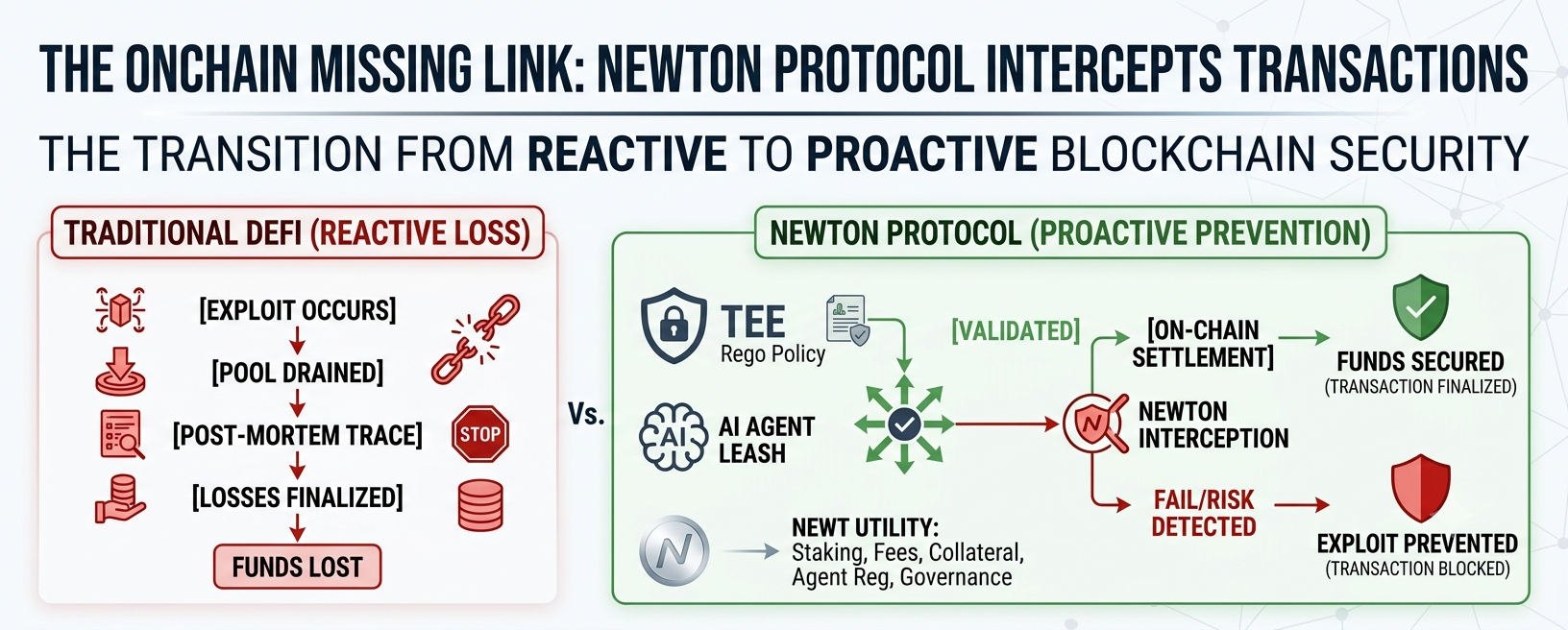
Why Newton Protocol Intercepts Transactions Before It’s Too LateThe current onchain state is fundamentally reactive. We usually watch a malicious exploit that keeps draining a DeFi pool in real time, trace the hacker’s wallet on Etherscan, and tweet about it post mortem. It is an exhausting loop. For years, crypto has operated under a strict tenet: once a transaction enters the mempool and settles, it is final for better or worse.
But what if we could intercept a transaction, before the damage is done, without destroying the decentralized networks? Will it worth?
That is exactly the question that let me down the rabbit hole of Newton Protocol (NEWT). Newton positions itself as the industry's decentralized policy engine an infrastructure layer designed to act as an invisible, real time guard rail for smart contracts, compliance, and autonomous AI agents.
When I first encountered Newton Protocol, I was admittedly skeptical. Intercepting transactions sounds dangerously close to centralized gatekeeping or a permissioned firewall. In Web3, any mechanism that filters transactions usually triggers alarms regarding censorship.
However, as I dug into their documentation and whitepaper, my perspective shifted. Newton does not act as an arbitrary centralized judge. Instead, it functions as a decentralized automation and compliance as code layer built by Magic Labs. It allows developers to embed predefined risk, compliance, and execution rules directly into the smart contract execution path.
Instead of waiting for a transaction to break a protocol and fixing it after the fact, Newton evaluates the transaction's conditions on the fly against a set of upgradeable, programmable rules.
The Core Problem Solved
Traditional smart contracts are rigid. Once deployed, their logic is practically set. If a novel exploit vector emerges or international sanctions update, standard smart contracts struggle to adapt quickly without complex governance migrations.
Newton Protocol addresses this by introducing programmable policy enforcement at the smart contract layer. Think of it as a decentralized referee that reviews the intent and context of a transaction before letting it pass through to final state execution.
For protocols handling high value TVL or institutional enterprise funds, this provides a vital layer of protection: ensuring compliance, enforcing daily spend limits, and verifying identity credentials natively onchain.
Architecture: Trusted Execution and zkPermissions
Newton’s architecture achieves this without slowing down user experience by offloading heavy evaluation offchain while anchoring its security on-chain.
The system uses a policy code (written in Rego) combined with data oracles to evaluate data inputs. To keep this process tamper proof and private, Newton totally depends on Trusted Execution Environments (TEEs) secure hardware enclaves and zero knowledge proofs (zkPermissions).
This hybrid structure ensures that private data remains hidden, gas fees stay low, and the transaction is rigorously checked against the ruleset before completion.
Tokenomics and Current Market Realities
The NEWT token sits at the center of this ecosystem, driving utility across five major vectors:
Staking & DPoS Security: Securing the network's delegated validator set. Execution Fees: Paying for computational policy checks.Operator Collateral: Ensuring offchain node runners act honestly. Agent Registration: Onboarding autonomous AI workflows.Governance: Voting on protocol parameters.
Looking strictly at the numbers, $NEWT currently faces a classic mid-cycle challenge. Trading around $0.047 with a circulating supply of roughly 215 - 264 million tokens against a 1 billion maximum supply, the token has experienced notable unlocking pressure over the last year.
However, macro momentum is building. Binance recently spotlighted the token via its 2026 Summer Earn Fiesta, providing up to 29.9% APR on locked products and generating strong buy-side engagement to absorb early VC unlocks.
The Risk Factor: A Realist’s View
No protocol is without risk, and Newton’s biggest hurdle is latency and adoption friction. For high-frequency DeFi applications, introducing a secondary policy engine could mean added execution lag. Furthermore, if a developer writes an imperfect Rego policy, it could accidentally brick valid user transactions, causing friction in user experience.
Investors must closely monitor the upcoming unlocking schedules. Until the remaining supply is fully digested by the market, sustained upside will depend entirely on real world integration by major DeFi applications and stablecoin issuers.
Strategic Insight:
What most creators are overlooking is Newton's massive relevance to the AI Agent narrative. As autonomous agents increasingly manage crypto portfolios, execute cross chain yield optimization, and run dollar cost averaging loops, they require strict boundaries. You cannot let an AI agent roam wild with a hot wallet.
Newton’s zkPermissions framework acts as the ultimate leash for AI. It allows users to say: "You can rebalance my portfolio, but you can never withdraw funds to any external address." This is the real growth vector for Newton serving as the foundational security layer for the entire onchain AI economy.
What's My Point of View?
Newton Protocol represents a major step toward practical, institutional grade on chain safety, but it flips the traditional code is law mentality on its head.
Do you really think real time transaction interception preserves the spirit of DeFi, or does it complicate censorship resistance? Would you trust an AI agent governed by Newton to manage your portfolio?
Let’s talk in the comments below. Drop your insights, and don’t forget to like and share if you found this deep dive valuable!
@NewtonProtocol #Newt $NEWT #Ethcryptohub $IN
Why Newton Protocol Intercepts Transactions Before It’s Too Late
The current onchain state is fundamentally reactive. We usually watch a malicious exploit that keeps draining a DeFi pool in real time, trace the hacker’s wallet on Etherscan, and tweet about it post mortem. It is an exhausting loop. For years, crypto has operated under a strict tenet: once a transaction enters the mempool and settles, it is final for better or worse.
But what if we could intercept a transaction, before the damage is done, without destroying the decentralized networks? Will it worth?
That is exactly the question that let me down the rabbit hole of Newton Protocol (NEWT). Newton positions itself as the industry's decentralized policy engine an infrastructure layer designed to act as an invisible, real time guard rail for smart contracts, compliance, and autonomous AI agents.
When I first encountered Newton Protocol, I was admittedly skeptical. Intercepting transactions sounds dangerously close to centralized gatekeeping or a permissioned firewall. In Web3, any mechanism that filters transactions usually triggers alarms regarding censorship.
However, as I dug into their documentation and whitepaper, my perspective shifted. Newton does not act as an arbitrary centralized judge. Instead, it functions as a decentralized automation and compliance as code layer built by Magic Labs. It allows developers to embed predefined risk, compliance, and execution rules directly into the smart contract execution path.
Instead of waiting for a transaction to break a protocol and fixing it after the fact, Newton evaluates the transaction's conditions on the fly against a set of upgradeable, programmable rules.
The Core Problem Solved
Traditional smart contracts are rigid. Once deployed, their logic is practically set. If a novel exploit vector emerges or international sanctions update, standard smart contracts struggle to adapt quickly without complex governance migrations.
Newton Protocol addresses this by introducing programmable policy enforcement at the smart contract layer. Think of it as a decentralized referee that reviews the intent and context of a transaction before letting it pass through to final state execution.
For protocols handling high value TVL or institutional enterprise funds, this provides a vital layer of protection: ensuring compliance, enforcing daily spend limits, and verifying identity credentials natively onchain.
Architecture: Trusted Execution and zkPermissions
Newton’s architecture achieves this without slowing down user experience by offloading heavy evaluation offchain while anchoring its security on-chain.
The system uses a policy code (written in Rego) combined with data oracles to evaluate data inputs. To keep this process tamper proof and private, Newton totally depends on Trusted Execution Environments (TEEs) secure hardware enclaves and zero knowledge proofs (zkPermissions).
This hybrid structure ensures that private data remains hidden, gas fees stay low, and the transaction is rigorously checked against the ruleset before completion.
Tokenomics and Current Market Realities
The NEWT token sits at the center of this ecosystem, driving utility across five major vectors:
Staking & DPoS Security: Securing the network's delegated validator set. Execution Fees: Paying for computational policy checks.Operator Collateral: Ensuring offchain node runners act honestly. Agent Registration: Onboarding autonomous AI workflows.Governance: Voting on protocol parameters.
Looking strictly at the numbers, $NEWT currently faces a classic mid-cycle challenge. Trading around $0.047 with a circulating supply of roughly 215 - 264 million tokens against a 1 billion maximum supply, the token has experienced notable unlocking pressure over the last year.
However, macro momentum is building. Binance recently spotlighted the token via its 2026 Summer Earn Fiesta, providing up to 29.9% APR on locked products and generating strong buy-side engagement to absorb early VC unlocks.
The Risk Factor: A Realist’s View
No protocol is without risk, and Newton’s biggest hurdle is latency and adoption friction. For high-frequency DeFi applications, introducing a secondary policy engine could mean added execution lag. Furthermore, if a developer writes an imperfect Rego policy, it could accidentally brick valid user transactions, causing friction in user experience.
Investors must closely monitor the upcoming unlocking schedules. Until the remaining supply is fully digested by the market, sustained upside will depend entirely on real world integration by major DeFi applications and stablecoin issuers.
Strategic Insight:
What most creators are overlooking is Newton's massive relevance to the AI Agent narrative. As autonomous agents increasingly manage crypto portfolios, execute cross chain yield optimization, and run dollar cost averaging loops, they require strict boundaries. You cannot let an AI agent roam wild with a hot wallet.
Newton’s zkPermissions framework acts as the ultimate leash for AI. It allows users to say: "You can rebalance my portfolio, but you can never withdraw funds to any external address." This is the real growth vector for Newton serving as the foundational security layer for the entire onchain AI economy.
What's My Point of View?
Newton Protocol represents a major step toward practical, institutional grade on chain safety, but it flips the traditional code is law mentality on its head.
Do you really think real time transaction interception preserves the spirit of DeFi, or does it complicate censorship resistance? Would you trust an AI agent governed by Newton to manage your portfolio?
Let’s talk in the comments below. Drop your insights, and don’t forget to like and share if you found this deep dive valuable!
@NewtonProtocol #Newt $NEWT #Ethcryptohub $IN
But what if we could intercept a transaction, before the damage is done, without destroying the decentralized networks? Will it worth?
That is exactly the question that let me down the rabbit hole of Newton Protocol (NEWT). Newton positions itself as the industry's decentralized policy engine an infrastructure layer designed to act as an invisible, real time guard rail for smart contracts, compliance, and autonomous AI agents.
When I first encountered Newton Protocol, I was admittedly skeptical. Intercepting transactions sounds dangerously close to centralized gatekeeping or a permissioned firewall. In Web3, any mechanism that filters transactions usually triggers alarms regarding censorship.
However, as I dug into their documentation and whitepaper, my perspective shifted. Newton does not act as an arbitrary centralized judge. Instead, it functions as a decentralized automation and compliance as code layer built by Magic Labs. It allows developers to embed predefined risk, compliance, and execution rules directly into the smart contract execution path.
Instead of waiting for a transaction to break a protocol and fixing it after the fact, Newton evaluates the transaction's conditions on the fly against a set of upgradeable, programmable rules.
The Core Problem Solved
Traditional smart contracts are rigid. Once deployed, their logic is practically set. If a novel exploit vector emerges or international sanctions update, standard smart contracts struggle to adapt quickly without complex governance migrations.
Newton Protocol addresses this by introducing programmable policy enforcement at the smart contract layer. Think of it as a decentralized referee that reviews the intent and context of a transaction before letting it pass through to final state execution.
For protocols handling high value TVL or institutional enterprise funds, this provides a vital layer of protection: ensuring compliance, enforcing daily spend limits, and verifying identity credentials natively onchain.
Architecture: Trusted Execution and zkPermissions
Newton’s architecture achieves this without slowing down user experience by offloading heavy evaluation offchain while anchoring its security on-chain.
The system uses a policy code (written in Rego) combined with data oracles to evaluate data inputs. To keep this process tamper proof and private, Newton totally depends on Trusted Execution Environments (TEEs) secure hardware enclaves and zero knowledge proofs (zkPermissions).
This hybrid structure ensures that private data remains hidden, gas fees stay low, and the transaction is rigorously checked against the ruleset before completion.
Tokenomics and Current Market Realities
The NEWT token sits at the center of this ecosystem, driving utility across five major vectors:
Staking & DPoS Security: Securing the network's delegated validator set. Execution Fees: Paying for computational policy checks.Operator Collateral: Ensuring offchain node runners act honestly. Agent Registration: Onboarding autonomous AI workflows.Governance: Voting on protocol parameters.
Looking strictly at the numbers, $NEWT currently faces a classic mid-cycle challenge. Trading around $0.047 with a circulating supply of roughly 215 - 264 million tokens against a 1 billion maximum supply, the token has experienced notable unlocking pressure over the last year.
However, macro momentum is building. Binance recently spotlighted the token via its 2026 Summer Earn Fiesta, providing up to 29.9% APR on locked products and generating strong buy-side engagement to absorb early VC unlocks.
The Risk Factor: A Realist’s View
No protocol is without risk, and Newton’s biggest hurdle is latency and adoption friction. For high-frequency DeFi applications, introducing a secondary policy engine could mean added execution lag. Furthermore, if a developer writes an imperfect Rego policy, it could accidentally brick valid user transactions, causing friction in user experience.
Investors must closely monitor the upcoming unlocking schedules. Until the remaining supply is fully digested by the market, sustained upside will depend entirely on real world integration by major DeFi applications and stablecoin issuers.
Strategic Insight:
What most creators are overlooking is Newton's massive relevance to the AI Agent narrative. As autonomous agents increasingly manage crypto portfolios, execute cross chain yield optimization, and run dollar cost averaging loops, they require strict boundaries. You cannot let an AI agent roam wild with a hot wallet.
Newton’s zkPermissions framework acts as the ultimate leash for AI. It allows users to say: "You can rebalance my portfolio, but you can never withdraw funds to any external address." This is the real growth vector for Newton serving as the foundational security layer for the entire onchain AI economy.
What's My Point of View?
Newton Protocol represents a major step toward practical, institutional grade on chain safety, but it flips the traditional code is law mentality on its head.
Do you really think real time transaction interception preserves the spirit of DeFi, or does it complicate censorship resistance? Would you trust an AI agent governed by Newton to manage your portfolio?
Let’s talk in the comments below. Drop your insights, and don’t forget to like and share if you found this deep dive valuable!
@NewtonProtocol #Newt $NEWT #Ethcryptohub $IN
58
48
899
·
--
Article
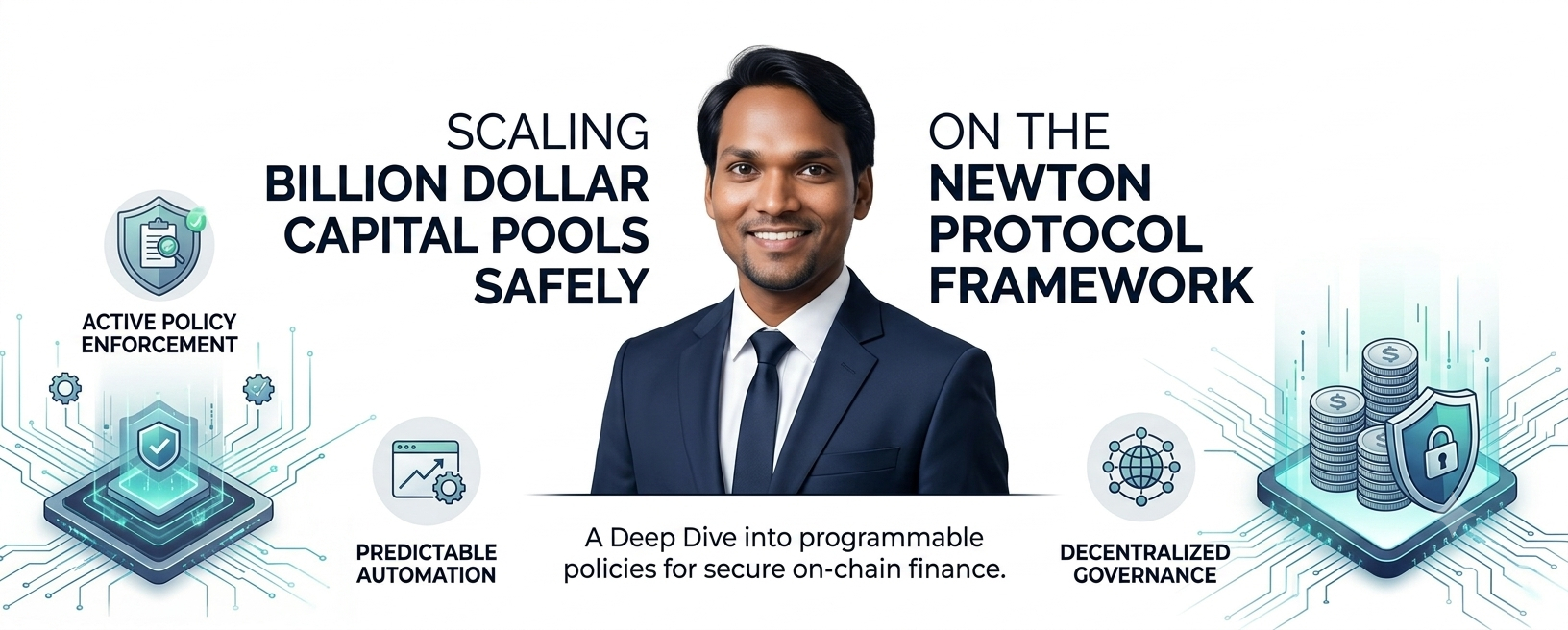
Scaling Billion Dollar Capital Pools Safely on the Newton Protocol FrameworkToday I have explored something useful information from White paper. Do you know I was literally shocked by seeing. Let's explore every information.
Money moves quickly in crypto. Trust does not.
That is something I keep noticing back to, whenever I think about what the next stage of blockchain adoption will look like. We already have fast blockchains, liquid markets, and too much increasingly sophisticated financial products. Yet when the conversation turns to managing billions of dollars onchain, the mood changes. Speed is no longer the priority. Safety becomes the first question everyone asks.
I think that is exactly where Newton Protocol starts to stand out.
Managing a few thousand dollars and managing a billion-dollar treasury are completely different challenges. A retail user might recover from a mistaken transaction or a poor investment decision. Large organizations rarely have that luxury. A single unauthorized transfer, or a compromised wallet, also an automated system behaving unexpectedly can also put enormous amounts of capital at risk within minutes.
That reality explains me, why many institutions still hesitate to move significant assets fully onchain. The technology itself has been matured but operational risk remains difficult to be ignored.
One thing I have noticed is that the blockchain discussions often focus on the decentralization and scalability while giving less attention to execution control. Everyone wants faster settlement and lower fees, but those improvements mean very little if there is no reliable way to ensure transactions follow predefined rules before they are executed.
The bigger the capital pool, the more important those rules become.
Imagine an investment fund that manages billions across multiple DeFi strategies. Different teams may oversee different allocations. Risk limits may change depending on market conditions. Some assets may only be moved during certain time windows. Other transactions might require multiple approvals before execution.
Trying to coordinate all of that manually creates friction. Leaving everything fully automated introduces another kind of risk.
That is the balance Newton Protocol is trying to solve.
Instead of treating every valid transaction as something that should automatically execute, Newton introduces programmable policy checks before settlement. In simple terms, every action can be evaluated against predefined conditions before assets actually move.
I find that approach much more practical than assuming every transaction signed by an authorized wallet is automatically safe.
A wallet can be compromised.
An AI agent can make an unexpected decision.
A trading algorithm can behave differently during the period of extreme volatility.
Even experienced operators can make costly mistakes.
None of those situations necessarily involve flaws in the blockchain itself. They are operational problems, and operational problems become more expensive as the amount of capital increases.
This is why active policy enforcement feels increasingly relevant.
Rather than relying entirely on people to monitor every transaction, policies become part of the infrastructure itself. Spending limits, approval requirements, asset restrictions, counterparty verification, and many other conditions can all become part of the decision-making process before execution happens.
That changes the way I think about blockchain security.
Traditionally, security has often meant protecting private keys or auditing smart contracts. Those remain essential, but they do not address every source of risk. Many losses happen because authorized systems perform actions that technically follow the rules of the blockchain while violating the intentions of the organization behind them.
That distinction matters.
The blockchain may consider a transaction perfectly valid.
The organization may consider it completely unacceptable.
Newton attempts to close that gap by allowing intent to become enforceable through programmable policies.
As I have followed the evolution of crypto infrastructure, one trend has become increasingly clear. Automation has been expanding much faster than governance. As AI agents are beginning to execute trades, rebalance portfolios, manage liquidity, and coordinate increasingly complex workflows. Those capabilities are very much exciting, but they also introduce new questions about accountability and control.
Automation without boundaries scales risk just as efficiently as it scales opportunity.
That is why I think policy layers will become more valuable over time.
Large capital pools do not simply need automation. They need predictable automation.
There is an important difference between those two ideas.
Predictable automation means stakeholders understand exactly what conditions must be satisfied before funds can move. It creates confidence that automated systems will remain within clearly defined limits even when markets become volatile or unexpected situations arise.
That confidence is difficult to build through manual oversight alone.
Infrastructure has to participate.
Another aspect I appreciate about Newton's framework is that it aims to achieve stronger security without depending on a single centralized decision maker. Crypto has always struggled to balance protection with decentralization. Lean too far toward control and the system begins to resemble traditional finance. Remove every layer of oversight and operational risk increases dramatically.
Finding a middle ground has never been easy.
Newton appears to approach that challenge by allowing policies themselves to become decentralized, and creating safeguards that can operate without introducing unnecessary central points of failure.
Whether this model becomes an industry standard remains to be seen. Crypto has an history of experimenting with a new infrastructure before the market eventually that decides what works best. Still, I also thinking that the direction is worth paying attention to because it reflects a broader shift in priorities.
For years the industry focused on making blockchains faster.
Now the conversation is slowly expanding toward making them safer for increasingly complex financial activity.
Those are not competing goals.
In fact, I would argue they depend on one another.
The next wave of institutional participation is unlikely to be driven by speed alone. Large organizations already know blockchain technology can settle transactions efficiently. What they continue to evaluate is whether they can trust automated systems to protect massive pools of capital under real market conditions.
That is a much harder question to answer.
Projects like Newton Protocol are interesting because they are trying to answer it at the infrastructure level rather than leaving every organization to build its own security framework from scratch.
Personally, I think that is one of the more important conversations happening in blockchain today. As digital assets continue growing, the industry will eventually need systems capable of protecting not just millions of dollars, but billions. The protocols that make that possible may end up shaping the future of onchain finance far more than the ones that simply make transactions a little faster.
For me, that is the bigger story behind Newton Protocol. It is not just about processing transactions. It is about creating an environment where large amounts of capital can move with greater confidence, clearer rules, and stronger safeguards. If blockchain is going to support the world's largest financial participants, that foundation will matter just as much as scalability itself.
@NewtonProtocol #Newt $NEWT #Ethcryptohub
Scaling Billion Dollar Capital Pools Safely on the Newton Protocol Framework
Today I have explored something useful information from White paper. Do you know I was literally shocked by seeing. Let's explore every information.
Money moves quickly in crypto. Trust does not.
That is something I keep noticing back to, whenever I think about what the next stage of blockchain adoption will look like. We already have fast blockchains, liquid markets, and too much increasingly sophisticated financial products. Yet when the conversation turns to managing billions of dollars onchain, the mood changes. Speed is no longer the priority. Safety becomes the first question everyone asks.
I think that is exactly where Newton Protocol starts to stand out.
Managing a few thousand dollars and managing a billion-dollar treasury are completely different challenges. A retail user might recover from a mistaken transaction or a poor investment decision. Large organizations rarely have that luxury. A single unauthorized transfer, or a compromised wallet, also an automated system behaving unexpectedly can also put enormous amounts of capital at risk within minutes.
That reality explains me, why many institutions still hesitate to move significant assets fully onchain. The technology itself has been matured but operational risk remains difficult to be ignored.
One thing I have noticed is that the blockchain discussions often focus on the decentralization and scalability while giving less attention to execution control. Everyone wants faster settlement and lower fees, but those improvements mean very little if there is no reliable way to ensure transactions follow predefined rules before they are executed.
The bigger the capital pool, the more important those rules become.
Imagine an investment fund that manages billions across multiple DeFi strategies. Different teams may oversee different allocations. Risk limits may change depending on market conditions. Some assets may only be moved during certain time windows. Other transactions might require multiple approvals before execution.
Trying to coordinate all of that manually creates friction. Leaving everything fully automated introduces another kind of risk.
That is the balance Newton Protocol is trying to solve.
Instead of treating every valid transaction as something that should automatically execute, Newton introduces programmable policy checks before settlement. In simple terms, every action can be evaluated against predefined conditions before assets actually move.
I find that approach much more practical than assuming every transaction signed by an authorized wallet is automatically safe.
A wallet can be compromised.
An AI agent can make an unexpected decision.
A trading algorithm can behave differently during the period of extreme volatility.
Even experienced operators can make costly mistakes.
None of those situations necessarily involve flaws in the blockchain itself. They are operational problems, and operational problems become more expensive as the amount of capital increases.
This is why active policy enforcement feels increasingly relevant.
Rather than relying entirely on people to monitor every transaction, policies become part of the infrastructure itself. Spending limits, approval requirements, asset restrictions, counterparty verification, and many other conditions can all become part of the decision-making process before execution happens.
That changes the way I think about blockchain security.
Traditionally, security has often meant protecting private keys or auditing smart contracts. Those remain essential, but they do not address every source of risk. Many losses happen because authorized systems perform actions that technically follow the rules of the blockchain while violating the intentions of the organization behind them.
That distinction matters.
The blockchain may consider a transaction perfectly valid.
The organization may consider it completely unacceptable.
Newton attempts to close that gap by allowing intent to become enforceable through programmable policies.
As I have followed the evolution of crypto infrastructure, one trend has become increasingly clear. Automation has been expanding much faster than governance. As AI agents are beginning to execute trades, rebalance portfolios, manage liquidity, and coordinate increasingly complex workflows. Those capabilities are very much exciting, but they also introduce new questions about accountability and control.
Automation without boundaries scales risk just as efficiently as it scales opportunity.
That is why I think policy layers will become more valuable over time.
Large capital pools do not simply need automation. They need predictable automation.
There is an important difference between those two ideas.
Predictable automation means stakeholders understand exactly what conditions must be satisfied before funds can move. It creates confidence that automated systems will remain within clearly defined limits even when markets become volatile or unexpected situations arise.
That confidence is difficult to build through manual oversight alone.
Infrastructure has to participate.
Another aspect I appreciate about Newton's framework is that it aims to achieve stronger security without depending on a single centralized decision maker. Crypto has always struggled to balance protection with decentralization. Lean too far toward control and the system begins to resemble traditional finance. Remove every layer of oversight and operational risk increases dramatically.
Finding a middle ground has never been easy.
Newton appears to approach that challenge by allowing policies themselves to become decentralized, and creating safeguards that can operate without introducing unnecessary central points of failure.
Whether this model becomes an industry standard remains to be seen. Crypto has an history of experimenting with a new infrastructure before the market eventually that decides what works best. Still, I also thinking that the direction is worth paying attention to because it reflects a broader shift in priorities.
For years the industry focused on making blockchains faster.
Now the conversation is slowly expanding toward making them safer for increasingly complex financial activity.
Those are not competing goals.
In fact, I would argue they depend on one another.
The next wave of institutional participation is unlikely to be driven by speed alone. Large organizations already know blockchain technology can settle transactions efficiently. What they continue to evaluate is whether they can trust automated systems to protect massive pools of capital under real market conditions.
That is a much harder question to answer.
Projects like Newton Protocol are interesting because they are trying to answer it at the infrastructure level rather than leaving every organization to build its own security framework from scratch.
Personally, I think that is one of the more important conversations happening in blockchain today. As digital assets continue growing, the industry will eventually need systems capable of protecting not just millions of dollars, but billions. The protocols that make that possible may end up shaping the future of onchain finance far more than the ones that simply make transactions a little faster.
For me, that is the bigger story behind Newton Protocol. It is not just about processing transactions. It is about creating an environment where large amounts of capital can move with greater confidence, clearer rules, and stronger safeguards. If blockchain is going to support the world's largest financial participants, that foundation will matter just as much as scalability itself.
@NewtonProtocol #Newt $NEWT #Ethcryptohub
Money moves quickly in crypto. Trust does not.
That is something I keep noticing back to, whenever I think about what the next stage of blockchain adoption will look like. We already have fast blockchains, liquid markets, and too much increasingly sophisticated financial products. Yet when the conversation turns to managing billions of dollars onchain, the mood changes. Speed is no longer the priority. Safety becomes the first question everyone asks.
I think that is exactly where Newton Protocol starts to stand out.
Managing a few thousand dollars and managing a billion-dollar treasury are completely different challenges. A retail user might recover from a mistaken transaction or a poor investment decision. Large organizations rarely have that luxury. A single unauthorized transfer, or a compromised wallet, also an automated system behaving unexpectedly can also put enormous amounts of capital at risk within minutes.
That reality explains me, why many institutions still hesitate to move significant assets fully onchain. The technology itself has been matured but operational risk remains difficult to be ignored.
One thing I have noticed is that the blockchain discussions often focus on the decentralization and scalability while giving less attention to execution control. Everyone wants faster settlement and lower fees, but those improvements mean very little if there is no reliable way to ensure transactions follow predefined rules before they are executed.
The bigger the capital pool, the more important those rules become.
Imagine an investment fund that manages billions across multiple DeFi strategies. Different teams may oversee different allocations. Risk limits may change depending on market conditions. Some assets may only be moved during certain time windows. Other transactions might require multiple approvals before execution.
Trying to coordinate all of that manually creates friction. Leaving everything fully automated introduces another kind of risk.
That is the balance Newton Protocol is trying to solve.
Instead of treating every valid transaction as something that should automatically execute, Newton introduces programmable policy checks before settlement. In simple terms, every action can be evaluated against predefined conditions before assets actually move.
I find that approach much more practical than assuming every transaction signed by an authorized wallet is automatically safe.
A wallet can be compromised.
An AI agent can make an unexpected decision.
A trading algorithm can behave differently during the period of extreme volatility.
Even experienced operators can make costly mistakes.
None of those situations necessarily involve flaws in the blockchain itself. They are operational problems, and operational problems become more expensive as the amount of capital increases.
This is why active policy enforcement feels increasingly relevant.
Rather than relying entirely on people to monitor every transaction, policies become part of the infrastructure itself. Spending limits, approval requirements, asset restrictions, counterparty verification, and many other conditions can all become part of the decision-making process before execution happens.
That changes the way I think about blockchain security.
Traditionally, security has often meant protecting private keys or auditing smart contracts. Those remain essential, but they do not address every source of risk. Many losses happen because authorized systems perform actions that technically follow the rules of the blockchain while violating the intentions of the organization behind them.
That distinction matters.
The blockchain may consider a transaction perfectly valid.
The organization may consider it completely unacceptable.
Newton attempts to close that gap by allowing intent to become enforceable through programmable policies.
As I have followed the evolution of crypto infrastructure, one trend has become increasingly clear. Automation has been expanding much faster than governance. As AI agents are beginning to execute trades, rebalance portfolios, manage liquidity, and coordinate increasingly complex workflows. Those capabilities are very much exciting, but they also introduce new questions about accountability and control.
Automation without boundaries scales risk just as efficiently as it scales opportunity.
That is why I think policy layers will become more valuable over time.
Large capital pools do not simply need automation. They need predictable automation.
There is an important difference between those two ideas.
Predictable automation means stakeholders understand exactly what conditions must be satisfied before funds can move. It creates confidence that automated systems will remain within clearly defined limits even when markets become volatile or unexpected situations arise.
That confidence is difficult to build through manual oversight alone.
Infrastructure has to participate.
Another aspect I appreciate about Newton's framework is that it aims to achieve stronger security without depending on a single centralized decision maker. Crypto has always struggled to balance protection with decentralization. Lean too far toward control and the system begins to resemble traditional finance. Remove every layer of oversight and operational risk increases dramatically.
Finding a middle ground has never been easy.
Newton appears to approach that challenge by allowing policies themselves to become decentralized, and creating safeguards that can operate without introducing unnecessary central points of failure.
Whether this model becomes an industry standard remains to be seen. Crypto has an history of experimenting with a new infrastructure before the market eventually that decides what works best. Still, I also thinking that the direction is worth paying attention to because it reflects a broader shift in priorities.
For years the industry focused on making blockchains faster.
Now the conversation is slowly expanding toward making them safer for increasingly complex financial activity.
Those are not competing goals.
In fact, I would argue they depend on one another.
The next wave of institutional participation is unlikely to be driven by speed alone. Large organizations already know blockchain technology can settle transactions efficiently. What they continue to evaluate is whether they can trust automated systems to protect massive pools of capital under real market conditions.
That is a much harder question to answer.
Projects like Newton Protocol are interesting because they are trying to answer it at the infrastructure level rather than leaving every organization to build its own security framework from scratch.
Personally, I think that is one of the more important conversations happening in blockchain today. As digital assets continue growing, the industry will eventually need systems capable of protecting not just millions of dollars, but billions. The protocols that make that possible may end up shaping the future of onchain finance far more than the ones that simply make transactions a little faster.
For me, that is the bigger story behind Newton Protocol. It is not just about processing transactions. It is about creating an environment where large amounts of capital can move with greater confidence, clearer rules, and stronger safeguards. If blockchain is going to support the world's largest financial participants, that foundation will matter just as much as scalability itself.
@NewtonProtocol #Newt $NEWT #Ethcryptohub
58
1
47
923
·
--
@NewtonProtocol
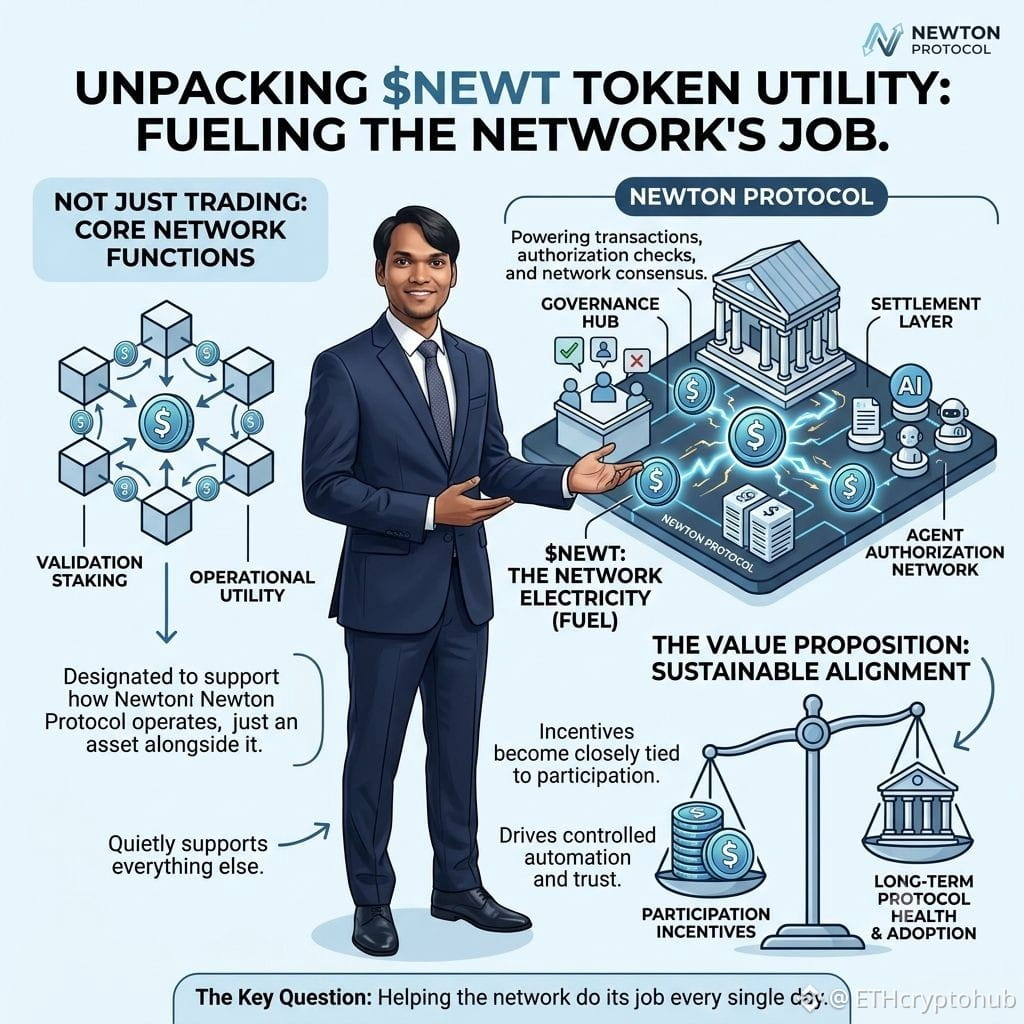
One thing I always pay attention to in crypto is whether a token actually has a reason to exist beyond trading. That is what made me spend more time looking at $NEWT. From what I understand, it is designed to support how Newton Protocol operates rather than simply sitting alongside the project. For me, that makes the token part of the system instead of just another asset attached to it.
I think of it like, an electricity that keeps a building running. People usually notice the lights, elevators, and machines, but none of them work without the power flowing between them. It is not the most visible part of the building, but still it's quietly supports everything else.
The same idea applies here. When a token is connected to how a network functions, incentives become more closely tied to participation. The people helping the system operate have a clearer reason to stay involved, and that can create a healthier balance between activity and long-term commitment if the design continues to hold up.
Of course, every token model has to prove itself over time. Good design on paper does not always mean for lasting demand, and real adoption is what ultimately determines whether those incentives remain meaningful.
What I keep coming back to is a simple question. Should a protocol's token mainly represent market value, or should its biggest role be helping the network do its job every single day? $NEWT
#Newt $LAB $BTW
#Ethcryptohub
@NewtonProtocol
One thing I always pay attention to in crypto is whether a token actually has a reason to exist beyond trading. That is what made me spend more time looking at $NEWT . From what I understand, it is designed to support how Newton Protocol operates rather than simply sitting alongside the project. For me, that makes the token part of the system instead of just another asset attached to it.
I think of it like, an electricity that keeps a building running. People usually notice the lights, elevators, and machines, but none of them work without the power flowing between them. It is not the most visible part of the building, but still it's quietly supports everything else.
The same idea applies here. When a token is connected to how a network functions, incentives become more closely tied to participation. The people helping the system operate have a clearer reason to stay involved, and that can create a healthier balance between activity and long-term commitment if the design continues to hold up.
Of course, every token model has to prove itself over time. Good design on paper does not always mean for lasting demand, and real adoption is what ultimately determines whether those incentives remain meaningful.
What I keep coming back to is a simple question. Should a protocol's token mainly represent market value, or should its biggest role be helping the network do its job every single day? $NEWT
#Newt $LAB $BTW
#Ethcryptohub
One thing I always pay attention to in crypto is whether a token actually has a reason to exist beyond trading. That is what made me spend more time looking at $NEWT . From what I understand, it is designed to support how Newton Protocol operates rather than simply sitting alongside the project. For me, that makes the token part of the system instead of just another asset attached to it.
I think of it like, an electricity that keeps a building running. People usually notice the lights, elevators, and machines, but none of them work without the power flowing between them. It is not the most visible part of the building, but still it's quietly supports everything else.
The same idea applies here. When a token is connected to how a network functions, incentives become more closely tied to participation. The people helping the system operate have a clearer reason to stay involved, and that can create a healthier balance between activity and long-term commitment if the design continues to hold up.
Of course, every token model has to prove itself over time. Good design on paper does not always mean for lasting demand, and real adoption is what ultimately determines whether those incentives remain meaningful.
What I keep coming back to is a simple question. Should a protocol's token mainly represent market value, or should its biggest role be helping the network do its job every single day? $NEWT
#Newt $LAB $BTW
#Ethcryptohub
73
2
65
5.5k

·
--
@babylonlabs_io
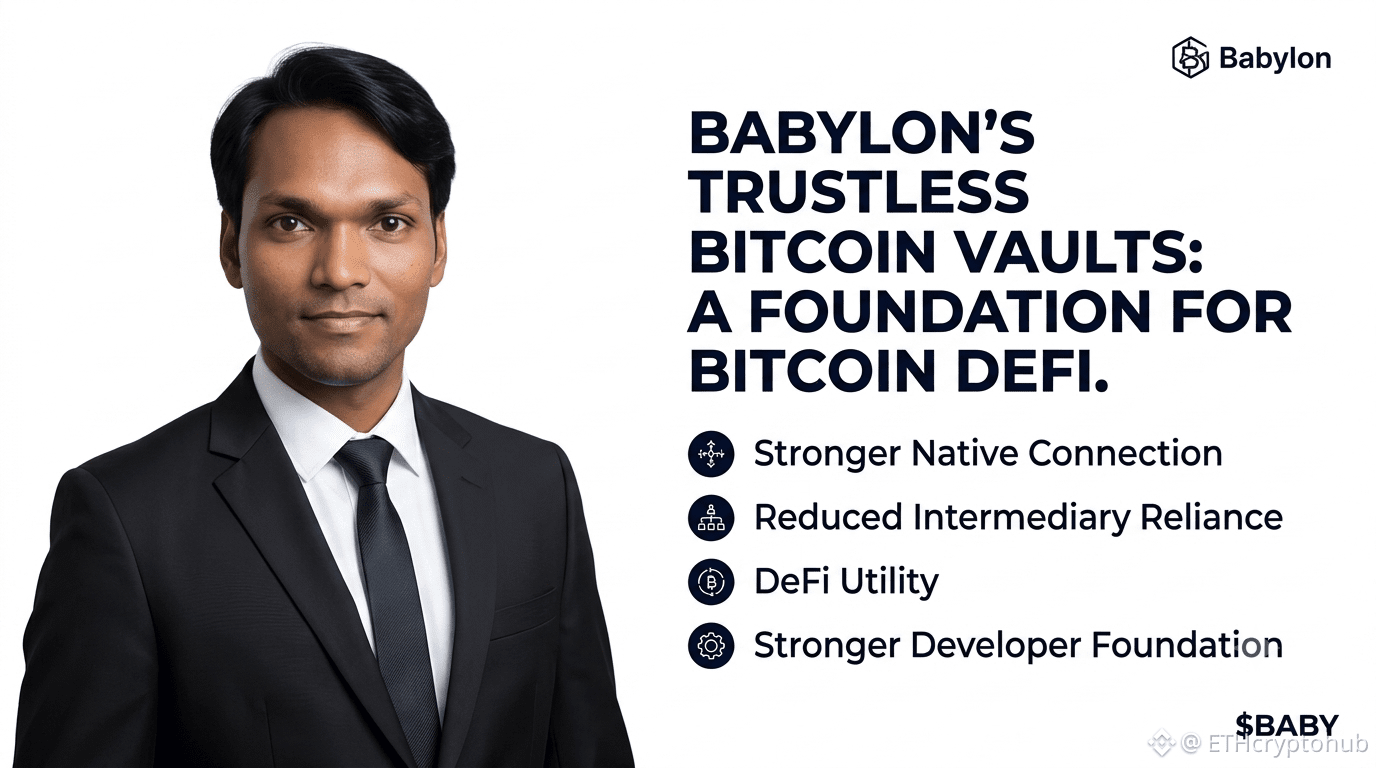
When I read about Babylon's Trustless Bitcoin Vaults (TBV), I did not see them as just another Bitcoin feature. What stood out to me was how they try to solve several long-standing problems with one approach. Instead of asking Bitcoin holders to choose between security, control, and utility, the goal seems to be bringing those pieces closer together. For me, that is a more interesting direction than simply adding another way to use BTC.
I think of it is like a well designed toolbox. A good toolbox is not valuable because it contains one excellent tool. It becomes useful because each tool serves a different purpose, and together they make difficult jobs much easier. Looking at TBVs, I get a similar impression. Their value comes from how multiple benefits work together rather than from a single feature.
The four benefits that stand out to me are keeping a stronger connection to native Bitcoin, reducing reliance on intermediaries, making Bitcoin more useful in DeFi, and giving developers a stronger foundation for building the new financial applications. Those ideas reinforce one another. If users feel more confident participating and developers have better tools to work with, the ecosystem has a better chance of attracting long-term capital instead of short-term activity.
Of course, good design alone is never enough. Bitcoin holders are usually careful about adopting new infrastructure, and that caution is understandable. The real measure of success will be whether these benefits remain meaningful after the years of real world use.
I keep wondering whether the next chapter of Bitcoin DeFi will be shaped by adding more products, or by building stronger foundations that make those products possible. Which do you think creates more lasting value over time? $BABY #baby #Ethcryptohub
@BabylonLabs_io
When I read about Babylon's Trustless Bitcoin Vaults (TBV), I did not see them as just another Bitcoin feature. What stood out to me was how they try to solve several long-standing problems with one approach. Instead of asking Bitcoin holders to choose between security, control, and utility, the goal seems to be bringing those pieces closer together. For me, that is a more interesting direction than simply adding another way to use BTC.
I think of it is like a well designed toolbox. A good toolbox is not valuable because it contains one excellent tool. It becomes useful because each tool serves a different purpose, and together they make difficult jobs much easier. Looking at TBVs, I get a similar impression. Their value comes from how multiple benefits work together rather than from a single feature.
The four benefits that stand out to me are keeping a stronger connection to native Bitcoin, reducing reliance on intermediaries, making Bitcoin more useful in DeFi, and giving developers a stronger foundation for building the new financial applications. Those ideas reinforce one another. If users feel more confident participating and developers have better tools to work with, the ecosystem has a better chance of attracting long-term capital instead of short-term activity.
Of course, good design alone is never enough. Bitcoin holders are usually careful about adopting new infrastructure, and that caution is understandable. The real measure of success will be whether these benefits remain meaningful after the years of real world use.
I keep wondering whether the next chapter of Bitcoin DeFi will be shaped by adding more products, or by building stronger foundations that make those products possible. Which do you think creates more lasting value over time? $BABY #baby #Ethcryptohub
When I read about Babylon's Trustless Bitcoin Vaults (TBV), I did not see them as just another Bitcoin feature. What stood out to me was how they try to solve several long-standing problems with one approach. Instead of asking Bitcoin holders to choose between security, control, and utility, the goal seems to be bringing those pieces closer together. For me, that is a more interesting direction than simply adding another way to use BTC.
I think of it is like a well designed toolbox. A good toolbox is not valuable because it contains one excellent tool. It becomes useful because each tool serves a different purpose, and together they make difficult jobs much easier. Looking at TBVs, I get a similar impression. Their value comes from how multiple benefits work together rather than from a single feature.
The four benefits that stand out to me are keeping a stronger connection to native Bitcoin, reducing reliance on intermediaries, making Bitcoin more useful in DeFi, and giving developers a stronger foundation for building the new financial applications. Those ideas reinforce one another. If users feel more confident participating and developers have better tools to work with, the ecosystem has a better chance of attracting long-term capital instead of short-term activity.
Of course, good design alone is never enough. Bitcoin holders are usually careful about adopting new infrastructure, and that caution is understandable. The real measure of success will be whether these benefits remain meaningful after the years of real world use.
I keep wondering whether the next chapter of Bitcoin DeFi will be shaped by adding more products, or by building stronger foundations that make those products possible. Which do you think creates more lasting value over time? $BABY #baby #Ethcryptohub
42
34
662
·
--
@Bedrock
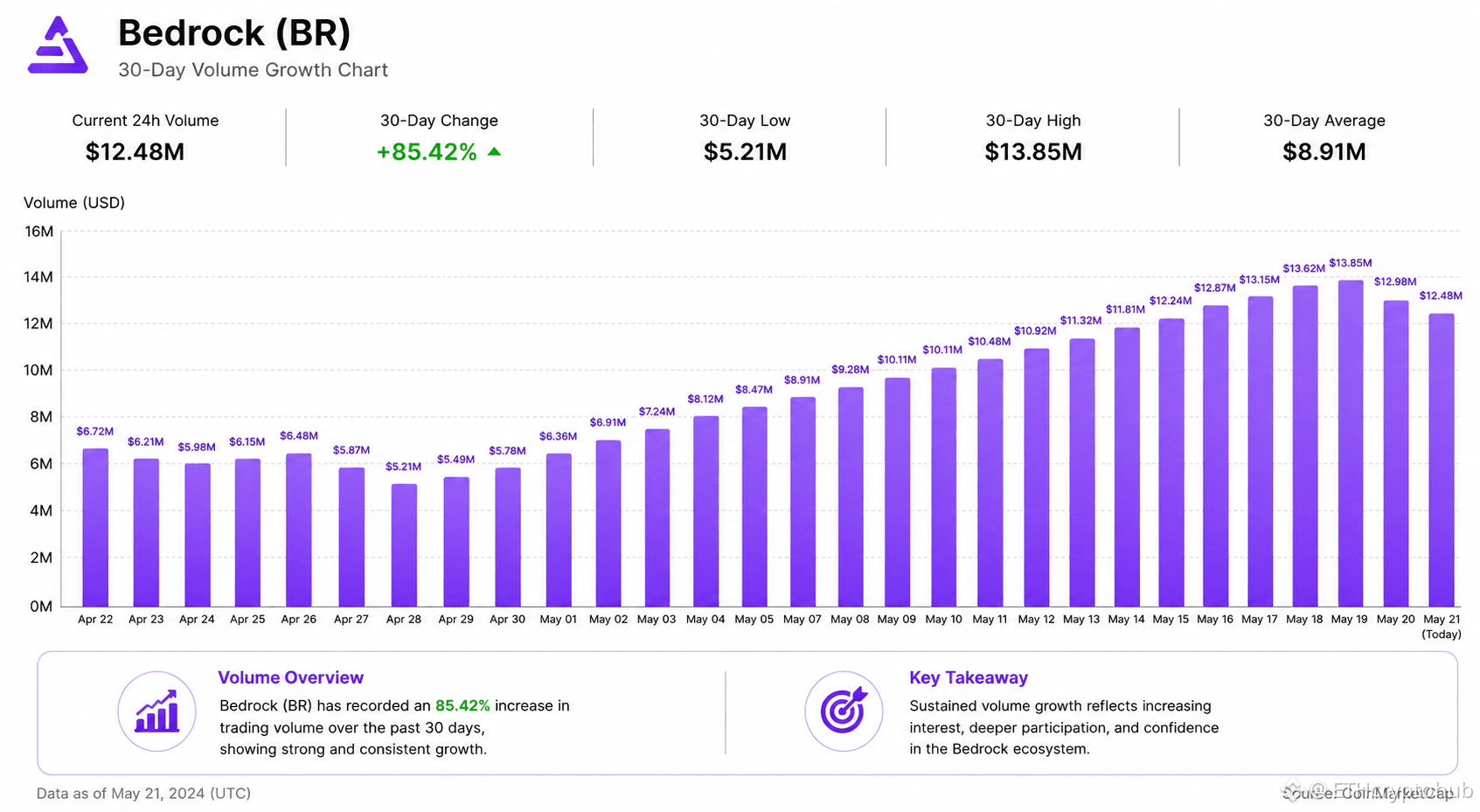
The more time I spend watching Bedrock, the more I feel that veBR is doing a lot of work behind the scenes that many people barely notice. Most discussions focus on rewards, yields, or token movements, but veBR seems to play a different role. It quietly influences how people behave inside the ecosystem.
What I find interesting is that veBR gives users a reason to think beyond the next reward cycle. Instead of treating Bedrock like a place to collect incentives and move on, participants have a reason to stay involved and pay attention to how the ecosystem develops. In a way, it reminds me of owning a small stake in a local business. Once you have some skin in the game, you naturally care more about where things are heading.
That doesn't mean the model is perfect. Long-term commitment only works when users continue seeing value in participating. If activity slows down or influence becomes concentrated among a small group, engagement can fade over time.
Still, when I look at Bedrock as a whole, veBR feels like one of those quiet pieces that helps connect incentives, participation, and long-term alignment. It may not get the most attention, but it often seems to shape the behavior that keeps the ecosystem moving.
Do you see veBR as a real source of long-term alignment in Bedrock, or just another incentive layer that works while rewards remain attractive?
#bedrock $BR
#Ethcryptohub #Bedrock
@Bedrock
The more time I spend watching Bedrock, the more I feel that veBR is doing a lot of work behind the scenes that many people barely notice. Most discussions focus on rewards, yields, or token movements, but veBR seems to play a different role. It quietly influences how people behave inside the ecosystem.
What I find interesting is that veBR gives users a reason to think beyond the next reward cycle. Instead of treating Bedrock like a place to collect incentives and move on, participants have a reason to stay involved and pay attention to how the ecosystem develops. In a way, it reminds me of owning a small stake in a local business. Once you have some skin in the game, you naturally care more about where things are heading.
That doesn't mean the model is perfect. Long-term commitment only works when users continue seeing value in participating. If activity slows down or influence becomes concentrated among a small group, engagement can fade over time.
Still, when I look at Bedrock as a whole, veBR feels like one of those quiet pieces that helps connect incentives, participation, and long-term alignment. It may not get the most attention, but it often seems to shape the behavior that keeps the ecosystem moving.
Do you see veBR as a real source of long-term alignment in Bedrock, or just another incentive layer that works while rewards remain attractive?
#bedrock $BR
#Ethcryptohub #Bedrock
The more time I spend watching Bedrock, the more I feel that veBR is doing a lot of work behind the scenes that many people barely notice. Most discussions focus on rewards, yields, or token movements, but veBR seems to play a different role. It quietly influences how people behave inside the ecosystem.
What I find interesting is that veBR gives users a reason to think beyond the next reward cycle. Instead of treating Bedrock like a place to collect incentives and move on, participants have a reason to stay involved and pay attention to how the ecosystem develops. In a way, it reminds me of owning a small stake in a local business. Once you have some skin in the game, you naturally care more about where things are heading.
That doesn't mean the model is perfect. Long-term commitment only works when users continue seeing value in participating. If activity slows down or influence becomes concentrated among a small group, engagement can fade over time.
Still, when I look at Bedrock as a whole, veBR feels like one of those quiet pieces that helps connect incentives, participation, and long-term alignment. It may not get the most attention, but it often seems to shape the behavior that keeps the ecosystem moving.
Do you see veBR as a real source of long-term alignment in Bedrock, or just another incentive layer that works while rewards remain attractive?
#bedrock $BR
#Ethcryptohub #Bedrock
Aylin956:
Bedrock is proving that a productive asset doesn't have to be a reckless asset.@Bedrock
156
1
89
3.9k
·
--
@OpenGradient
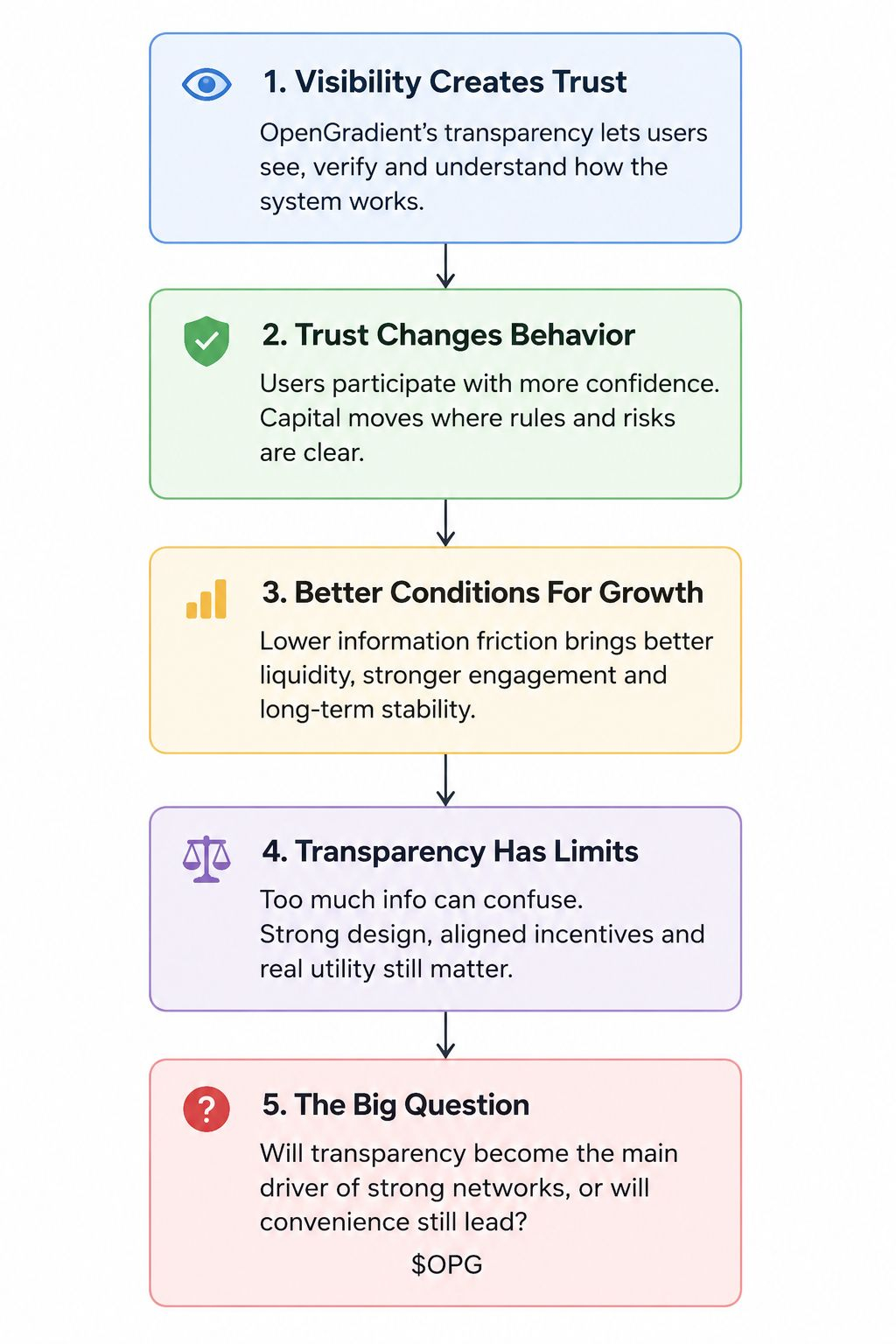
A pattern I keep noticing in digital systems is that strength often comes from visibility, not just performance. OpenGradient makes me think about how transparency changes the way people interact with a network. I find @OpenGradient interesting because its transparency is not limited to dashboards or numbers. Features like verification and visible AI execution allow users to check how the system works instead of trusting it blindly. This gives people more confidence because they can validate things themselves.
I often compare this to financial markets. Markets with clearer information usually attract more stable participation because capital prefers environments where risk can be evaluated rather than guessed. The same principle applies to digital networks. Clearer systems often create better conditions for long-term engagement.
What makes this interesting is how transparency affects behavior at every layer. Users participate differently when they understand the rules. Capital moves differently when incentives are easier to evaluate. Liquidity trends to settle where information friction is lower and where participants feel the system is operating in a more predictable way.
Ofcourse, transparency alone does not solve everything. Too much information can confuse everyone, and clarity does not automatically guarantee better outcomes. A system still needs strong design, aligned incentives, and real utility to keep participants engaged over time.
What I find most compelling is that crypto continues pushing toward systems where visibility matters more than blind confidence. Over time, do you think transparency becomes the main driver of stronger networks, or will convenience continue to matter more?
$OPG
#opg #OPG
#Ethcryptohub
$BTW
{future}(BTWUSDT)
$RE
{future}(REUSDT)
@OpenGradient
A pattern I keep noticing in digital systems is that strength often comes from visibility, not just performance. OpenGradient makes me think about how transparency changes the way people interact with a network. I find @OpenGradient interesting because its transparency is not limited to dashboards or numbers. Features like verification and visible AI execution allow users to check how the system works instead of trusting it blindly. This gives people more confidence because they can validate things themselves.
I often compare this to financial markets. Markets with clearer information usually attract more stable participation because capital prefers environments where risk can be evaluated rather than guessed. The same principle applies to digital networks. Clearer systems often create better conditions for long-term engagement.
What makes this interesting is how transparency affects behavior at every layer. Users participate differently when they understand the rules. Capital moves differently when incentives are easier to evaluate. Liquidity trends to settle where information friction is lower and where participants feel the system is operating in a more predictable way.
Ofcourse, transparency alone does not solve everything. Too much information can confuse everyone, and clarity does not automatically guarantee better outcomes. A system still needs strong design, aligned incentives, and real utility to keep participants engaged over time.
What I find most compelling is that crypto continues pushing toward systems where visibility matters more than blind confidence. Over time, do you think transparency becomes the main driver of stronger networks, or will convenience continue to matter more?
$OPG
#opg #OPG
#Ethcryptohub
$BTW
$RE
A pattern I keep noticing in digital systems is that strength often comes from visibility, not just performance. OpenGradient makes me think about how transparency changes the way people interact with a network. I find @OpenGradient interesting because its transparency is not limited to dashboards or numbers. Features like verification and visible AI execution allow users to check how the system works instead of trusting it blindly. This gives people more confidence because they can validate things themselves.
I often compare this to financial markets. Markets with clearer information usually attract more stable participation because capital prefers environments where risk can be evaluated rather than guessed. The same principle applies to digital networks. Clearer systems often create better conditions for long-term engagement.
What makes this interesting is how transparency affects behavior at every layer. Users participate differently when they understand the rules. Capital moves differently when incentives are easier to evaluate. Liquidity trends to settle where information friction is lower and where participants feel the system is operating in a more predictable way.
Ofcourse, transparency alone does not solve everything. Too much information can confuse everyone, and clarity does not automatically guarantee better outcomes. A system still needs strong design, aligned incentives, and real utility to keep participants engaged over time.
What I find most compelling is that crypto continues pushing toward systems where visibility matters more than blind confidence. Over time, do you think transparency becomes the main driver of stronger networks, or will convenience continue to matter more?
$OPG
#opg #OPG
#Ethcryptohub
$BTW
$RE
289
145
7k
Log in to explore more content
Join global crypto users on Binance Square
⚡️ Get latest and useful information about crypto.
💬 Trusted by the world’s largest crypto exchange.
👍 Discover real insights from verified creators.
Email / Phone number
Trending Topics
1
#ADAGains10%Above$0.27
12,598 views
171 Discussing
2
#ETHUp70%InQ3ButLiquidityFalls
142,968 views
1,005 Discussing
3
#EthStakingExitQueueHits2026High
50,062 views
728 Discussing
4
#FedOctoberHoldOdds82.3%
49,827 views
677 Discussing
5
#Nikkei225Jumps2.5%ToThreeMonthHigh
76,583 views
1,055 Discussing
6
#CircleMints$2.75BUSDCOnSolanaIn7Days
1,651 views
44 Discussing
7
#DriftHackVictimsBeginClaims
168,363 views
1,701 Discussing
8
#SolanaTokenizedStockVolumeTops$4.4BInSeptember
13,013 views
130 Discussing
9
#BitcoinSpotETFsDraw$6.34BInflowsInQ3
52,998 views
262 Discussing
10
#EthereumValidatorExitQueueJumps392%
301,005 views
2,560 Discussing