

#cftc
cftc
1.9M views
4,024 Discussing
Hot
Latest

·
--
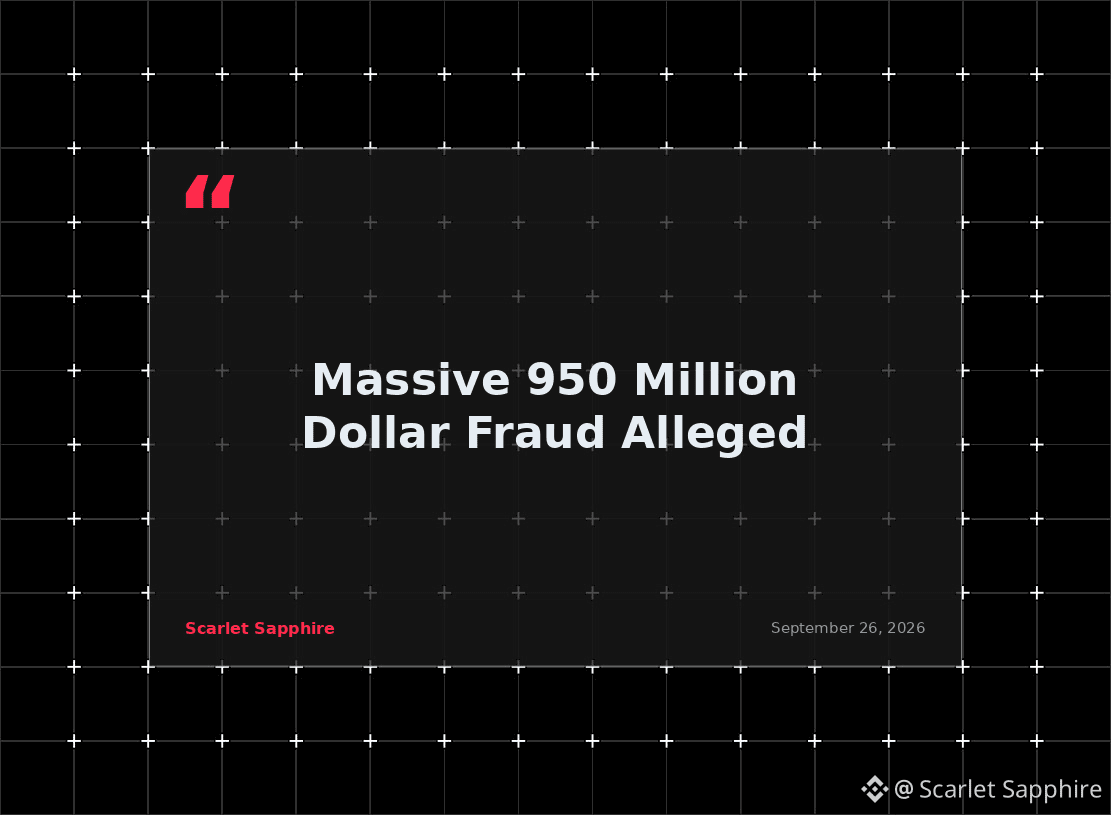
🚨 CFTC UNCOVERS MASSIVE $950M PONZI SCHEME IGNITING GLOBAL REGULATORY WARNING $USDT ⚠️
Institutional integrity requires separating legitimate market structure from engineered illusion. 🔍 Regulators have stepped in after Cash FX misappropriated over $950M in retail funds under the guise of high-yield trading, leaving participants with over $406M in net losses. 🏦
When phantom weekly returns of 15% are promised, smart money recognizes the classic architecture of an unsustainable liquidity drain. 📊 Capital preservation must always override chasing unbacked yields, as fake order flow and fabricated accounting inevitably trigger complete structural collapse. 💡
💬 How are you auditing your counterparty exposures to safeguard capital against unverified yield schemes? 👇
⚠️ Not financial advice. Always manage your risk. 🛡️
🏷️ #USDT #CryptoNews #CFTC #RiskManagement #MarketStructure
🛡️ 🔍
🚨 CFTC UNCOVERS MASSIVE $950M PONZI SCHEME IGNITING GLOBAL REGULATORY WARNING $USDT ⚠️
Institutional integrity requires separating legitimate market structure from engineered illusion. 🔍 Regulators have stepped in after Cash FX misappropriated over $950M in retail funds under the guise of high-yield trading, leaving participants with over $406M in net losses. 🏦
When phantom weekly returns of 15% are promised, smart money recognizes the classic architecture of an unsustainable liquidity drain. 📊 Capital preservation must always override chasing unbacked yields, as fake order flow and fabricated accounting inevitably trigger complete structural collapse. 💡
💬 How are you auditing your counterparty exposures to safeguard capital against unverified yield schemes? 👇
⚠️ Not financial advice. Always manage your risk. 🛡️
🏷️ #USDT #CryptoNews #CFTC #RiskManagement #MarketStructure
🛡️ 🔍
Institutional integrity requires separating legitimate market structure from engineered illusion. 🔍 Regulators have stepped in after Cash FX misappropriated over $950M in retail funds under the guise of high-yield trading, leaving participants with over $406M in net losses. 🏦
When phantom weekly returns of 15% are promised, smart money recognizes the classic architecture of an unsustainable liquidity drain. 📊 Capital preservation must always override chasing unbacked yields, as fake order flow and fabricated accounting inevitably trigger complete structural collapse. 💡
💬 How are you auditing your counterparty exposures to safeguard capital against unverified yield schemes? 👇
⚠️ Not financial advice. Always manage your risk. 🛡️
🏷️ #USDT #CryptoNews #CFTC #RiskManagement #MarketStructure
🛡️ 🔍

·
--
#cftcupdatesguidanceontokenizedassets
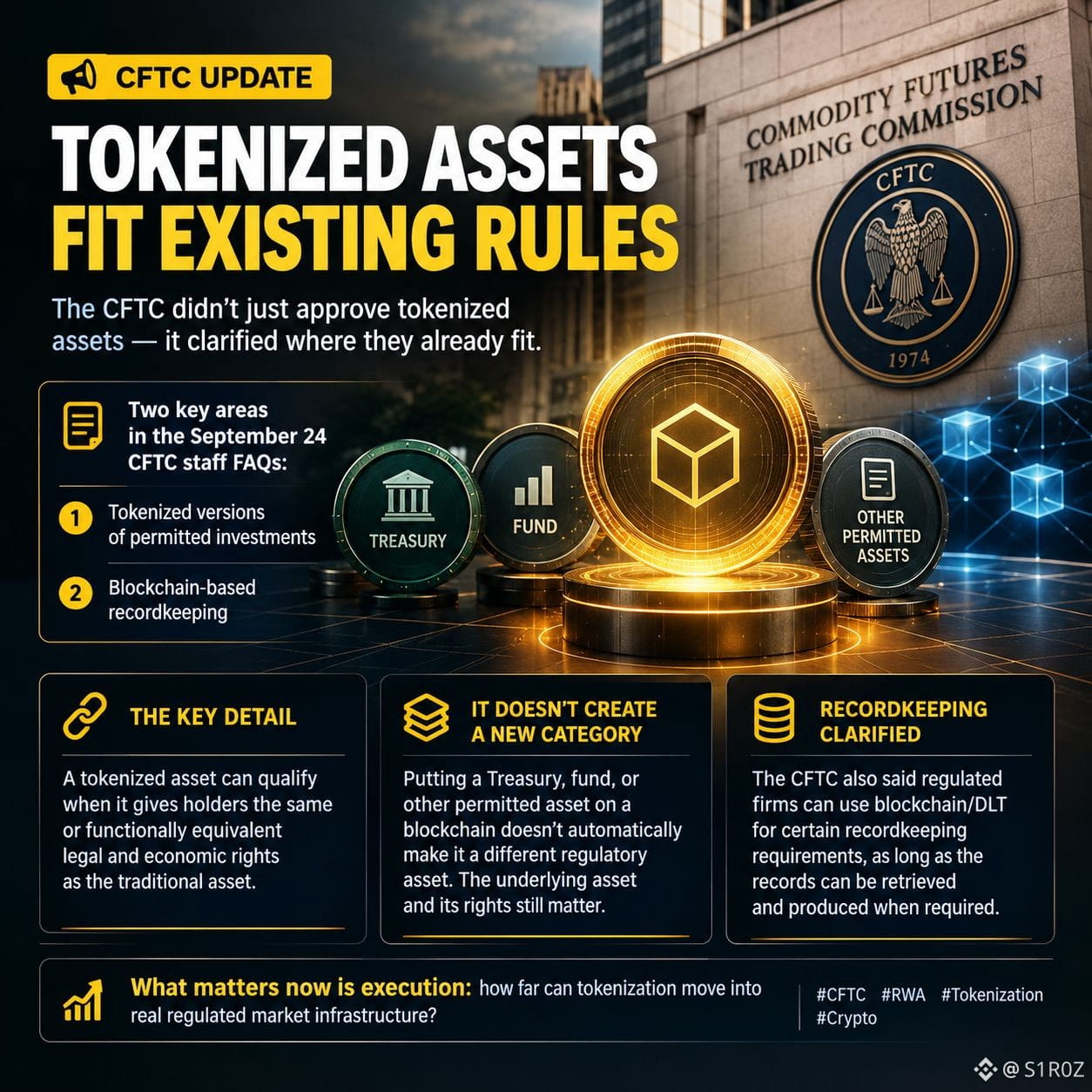
🚨 The CFTC didn’t just approve tokenized assets — it clarified where they already fit.
On September 24, CFTC staff updated its crypto FAQs to address two areas: tokenized versions of permitted investments and blockchain-based recordkeeping.
The detail that matters most:
A tokenized asset can qualify when it gives holders the same or functionally equivalent legal and economic rights as the traditional asset.
So putting a Treasury, fund, or other permitted asset on a blockchain doesn’t automatically create a new regulatory category. The underlying asset and its rights still matter.
The CFTC also clarified that qualifying regulated firms can use blockchain/DLT for certain recordkeeping requirements, subject to being able to retrieve and produce the records when required.
What matters now is execution: can tokenized assets actually move deeper into regulated market infrastructure?
#CFTC #RWA #Tokenization
#cftcupdatesguidanceontokenizedassets
🚨 The CFTC didn’t just approve tokenized assets — it clarified where they already fit.
On September 24, CFTC staff updated its crypto FAQs to address two areas: tokenized versions of permitted investments and blockchain-based recordkeeping.
The detail that matters most:
A tokenized asset can qualify when it gives holders the same or functionally equivalent legal and economic rights as the traditional asset.
So putting a Treasury, fund, or other permitted asset on a blockchain doesn’t automatically create a new regulatory category. The underlying asset and its rights still matter.
The CFTC also clarified that qualifying regulated firms can use blockchain/DLT for certain recordkeeping requirements, subject to being able to retrieve and produce the records when required.
What matters now is execution: can tokenized assets actually move deeper into regulated market infrastructure?
#CFTC #RWA #Tokenization
🚨 The CFTC didn’t just approve tokenized assets — it clarified where they already fit.
On September 24, CFTC staff updated its crypto FAQs to address two areas: tokenized versions of permitted investments and blockchain-based recordkeeping.
The detail that matters most:
A tokenized asset can qualify when it gives holders the same or functionally equivalent legal and economic rights as the traditional asset.
So putting a Treasury, fund, or other permitted asset on a blockchain doesn’t automatically create a new regulatory category. The underlying asset and its rights still matter.
The CFTC also clarified that qualifying regulated firms can use blockchain/DLT for certain recordkeeping requirements, subject to being able to retrieve and produce the records when required.
What matters now is execution: can tokenized assets actually move deeper into regulated market infrastructure?
#CFTC #RWA #Tokenization
33
·
--
The CFTC staff added four new questions to its FAQ on 24 September, and one of them lets futures brokers and clearing houses put customer funds into tokenised versions of investments they can already hold... tokenised money market fund shares are the example, as long as the token carries the same legal and economic rights as the thing underneath.
So the wrapper stops disqualifying an asset that's already on the approved list. Customer funds at US futures brokers hit a record $442.7bn in February (FIA), and I think the demand that opens up goes to tokenised Treasury and money market issuers. The 20% capital charge on $BTC and $ETH positions has sat in the same FAQ since 20 March 2026, and I don't think this changes anything about who gets to own Bitcoin.
No broker has said it's using it yet. I'll be watching for the first one that does.
#CFTC #Tokenization #RWA #Crypto
The CFTC staff added four new questions to its FAQ on 24 September, and one of them lets futures brokers and clearing houses put customer funds into tokenised versions of investments they can already hold... tokenised money market fund shares are the example, as long as the token carries the same legal and economic rights as the thing underneath.
So the wrapper stops disqualifying an asset that's already on the approved list. Customer funds at US futures brokers hit a record $442.7bn in February (FIA), and I think the demand that opens up goes to tokenised Treasury and money market issuers. The 20% capital charge on $BTC and $ETH positions has sat in the same FAQ since 20 March 2026, and I don't think this changes anything about who gets to own Bitcoin.
No broker has said it's using it yet. I'll be watching for the first one that does.
#CFTC #Tokenization #RWA #Crypto
So the wrapper stops disqualifying an asset that's already on the approved list. Customer funds at US futures brokers hit a record $442.7bn in February (FIA), and I think the demand that opens up goes to tokenised Treasury and money market issuers. The 20% capital charge on $BTC and $ETH positions has sat in the same FAQ since 20 March 2026, and I don't think this changes anything about who gets to own Bitcoin.
No broker has said it's using it yet. I'll be watching for the first one that does.
#CFTC #Tokenization #RWA #Crypto
101

{spot}(BTCUSDT)
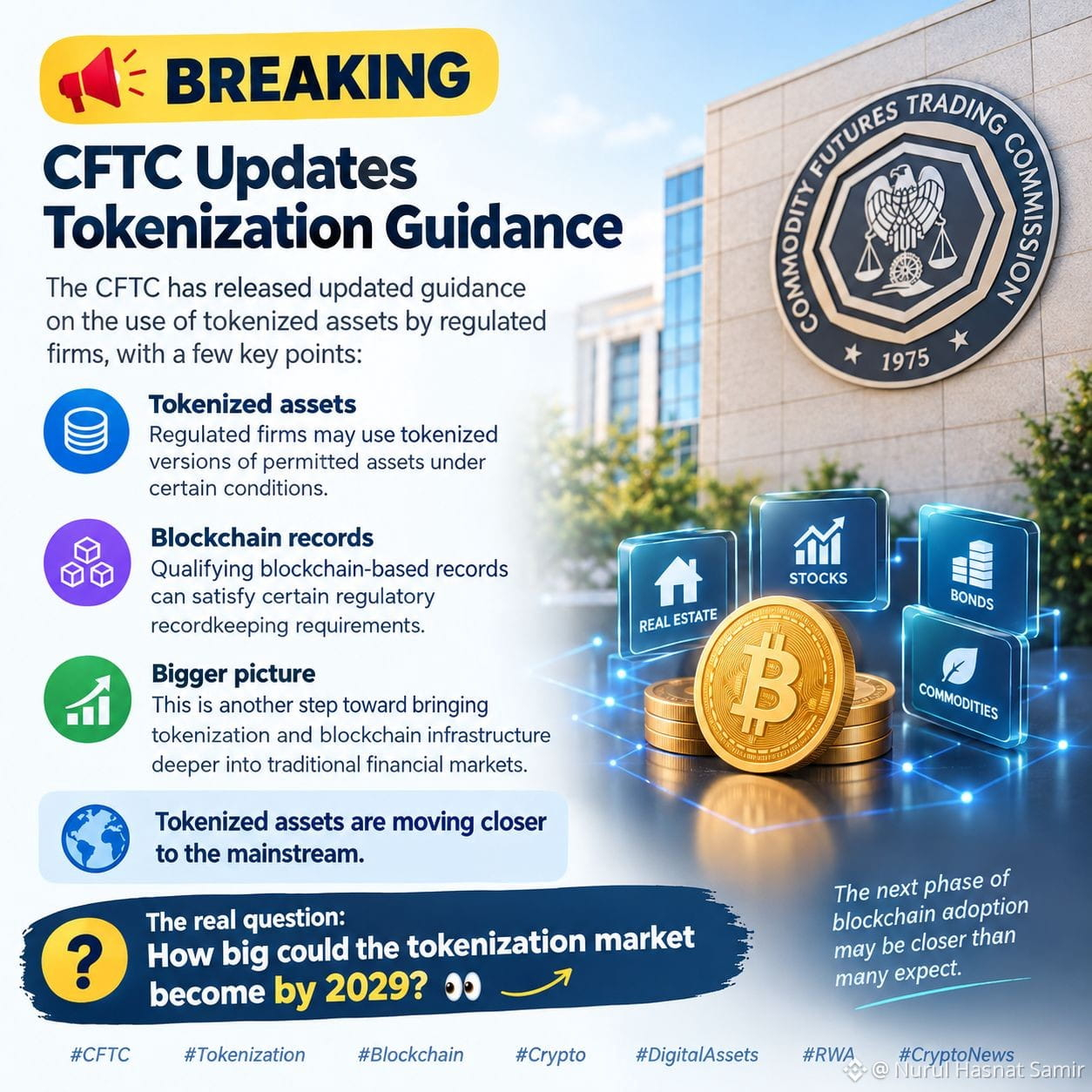
🚨 BREAKING: CFTC MOVES FORWARD WITH TOKENIZATION GUIDANCE
The CFTC has released updated guidance around the use of tokenized assets by regulated firms, providing greater clarity on how blockchain-based representations of eligible assets may be used under certain regulatory conditions. 🏦⛓️
The guidance also addresses how qualifying blockchain records may help satisfy certain recordkeeping requirements.
This could be another important step in connecting blockchain technology with traditional financial markets. 🌎
As tokenization continues to develop, one question stands out:
👀 How large could the global tokenization market become by 2029?
The next phase of blockchain adoption may be closer than many expect. 🚀
#CFTC #CFTCUpdatesGuidanceOnTokenizedAssets #DigitalAssets #bitcoin #CryptoNews $BTC
🚨 BREAKING: CFTC MOVES FORWARD WITH TOKENIZATION GUIDANCE
The CFTC has released updated guidance around the use of tokenized assets by regulated firms, providing greater clarity on how blockchain-based representations of eligible assets may be used under certain regulatory conditions. 🏦⛓️
The guidance also addresses how qualifying blockchain records may help satisfy certain recordkeeping requirements.
This could be another important step in connecting blockchain technology with traditional financial markets. 🌎
As tokenization continues to develop, one question stands out:
👀 How large could the global tokenization market become by 2029?
The next phase of blockchain adoption may be closer than many expect. 🚀
#CFTC #CFTCUpdatesGuidanceOnTokenizedAssets #DigitalAssets #bitcoin #CryptoNews $BTC
The CFTC has released updated guidance around the use of tokenized assets by regulated firms, providing greater clarity on how blockchain-based representations of eligible assets may be used under certain regulatory conditions. 🏦⛓️
The guidance also addresses how qualifying blockchain records may help satisfy certain recordkeeping requirements.
This could be another important step in connecting blockchain technology with traditional financial markets. 🌎
As tokenization continues to develop, one question stands out:
👀 How large could the global tokenization market become by 2029?
The next phase of blockchain adoption may be closer than many expect. 🚀
#CFTC #CFTCUpdatesGuidanceOnTokenizedAssets #DigitalAssets #bitcoin #CryptoNews $BTC
1
69
·
--
#cftcupdatesguidanceontokenizedassets
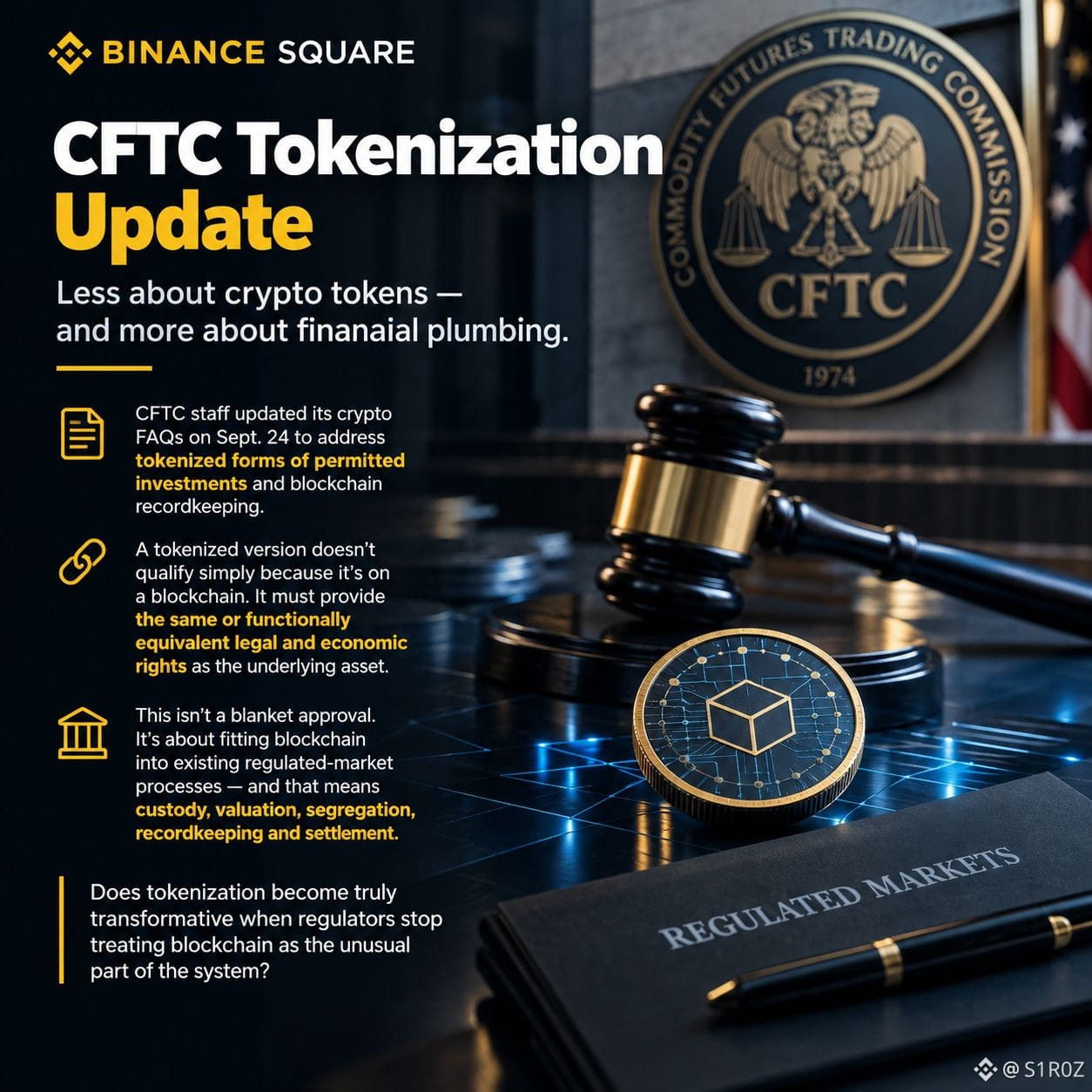
The CFTC's latest tokenization update is less about crypto tokens — and more about financial plumbing.
On Sept. 24, CFTC staff updated its crypto FAQs to address tokenized forms of permitted investments and the use of blockchain technology for regulatory recordkeeping.
Here's the important part:
A tokenized version doesn't simply qualify because it's on a blockchain. The token has to provide the same or functionally equivalent legal and economic rights as the underlying traditional asset.
So this isn't a blanket approval of tokenized assets.
It's something more practical: blockchain infrastructure is being fitted into existing regulated-market processes.
That matters because tokenization eventually has to solve more than issuance. It needs custody, valuation, segregation, recordkeeping and settlement to work inside regulated markets.
For me, that's the part worth watching.
Does tokenization become truly transformative when regulators stop treating the blockchain as the unusual part of the system?
#Tokenization #CFTC #RWA
#cftcupdatesguidanceontokenizedassets
The CFTC's latest tokenization update is less about crypto tokens — and more about financial plumbing.
On Sept. 24, CFTC staff updated its crypto FAQs to address tokenized forms of permitted investments and the use of blockchain technology for regulatory recordkeeping.
Here's the important part:
A tokenized version doesn't simply qualify because it's on a blockchain. The token has to provide the same or functionally equivalent legal and economic rights as the underlying traditional asset.
So this isn't a blanket approval of tokenized assets.
It's something more practical: blockchain infrastructure is being fitted into existing regulated-market processes.
That matters because tokenization eventually has to solve more than issuance. It needs custody, valuation, segregation, recordkeeping and settlement to work inside regulated markets.
For me, that's the part worth watching.
Does tokenization become truly transformative when regulators stop treating the blockchain as the unusual part of the system?
#Tokenization #CFTC #RWA
The CFTC's latest tokenization update is less about crypto tokens — and more about financial plumbing.
On Sept. 24, CFTC staff updated its crypto FAQs to address tokenized forms of permitted investments and the use of blockchain technology for regulatory recordkeeping.
Here's the important part:
A tokenized version doesn't simply qualify because it's on a blockchain. The token has to provide the same or functionally equivalent legal and economic rights as the underlying traditional asset.
So this isn't a blanket approval of tokenized assets.
It's something more practical: blockchain infrastructure is being fitted into existing regulated-market processes.
That matters because tokenization eventually has to solve more than issuance. It needs custody, valuation, segregation, recordkeeping and settlement to work inside regulated markets.
For me, that's the part worth watching.
Does tokenization become truly transformative when regulators stop treating the blockchain as the unusual part of the system?
#Tokenization #CFTC #RWA
2
85

·
--
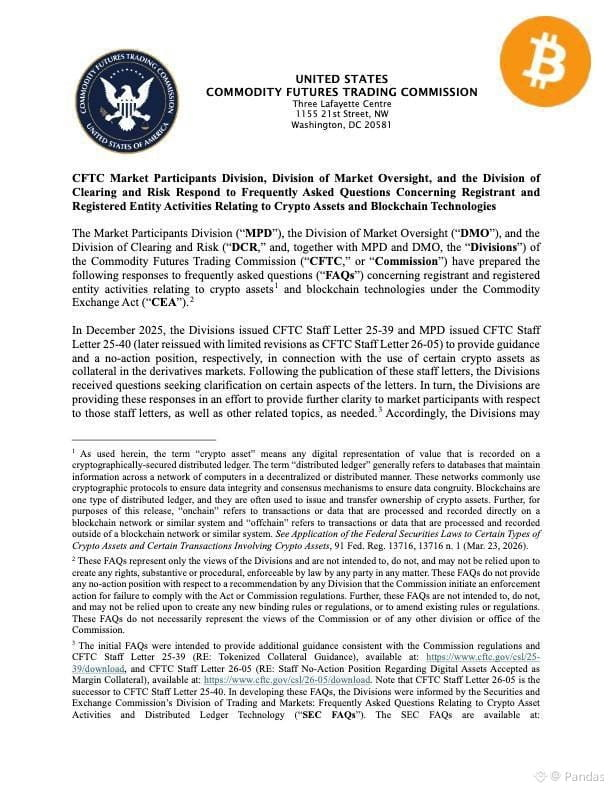
⚡️ CFTC updates its position on Bitcoin and crypto
The US regulator (CFTC) has issued new clarifications on digital assets and blockchain technology.
Key points:
• Trading platform rules clarified
• Requirements for registrants explained
• Approach to on-chain and off-chain transactions confirmed
The document concerns activities under the Commodity Exchange Act and provides more clarity to the market.
We’re watching the reaction.
#CFTC #Bitcoin #CryptoNews
⚡️ CFTC updates its position on Bitcoin and crypto
The US regulator (CFTC) has issued new clarifications on digital assets and blockchain technology.
Key points:
• Trading platform rules clarified
• Requirements for registrants explained
• Approach to on-chain and off-chain transactions confirmed
The document concerns activities under the Commodity Exchange Act and provides more clarity to the market.
We’re watching the reaction.
#CFTC #Bitcoin #CryptoNews
The US regulator (CFTC) has issued new clarifications on digital assets and blockchain technology.
Key points:
• Trading platform rules clarified
• Requirements for registrants explained
• Approach to on-chain and off-chain transactions confirmed
The document concerns activities under the Commodity Exchange Act and provides more clarity to the market.
We’re watching the reaction.
#CFTC #Bitcoin #CryptoNews
1
190

The CFTC is refining guidance on using tokenized assets as collateral, specifically addressing the risks of price volatility when crypto is used as margin in derivatives trading.
#CFTC #DerivativesMargin
The CFTC is refining guidance on using tokenized assets as collateral, specifically addressing the risks of price volatility when crypto is used as margin in derivatives trading.
#CFTC #DerivativesMargin
#CFTC #DerivativesMargin
2

A CFTC lawsuit worth $950 million against Cash FX serves as a hard reminder that the “AI trading” narrative, high profits, and referral bonuses can be a cover for very significant risks. If new investor funds are used to pay earlier investors, then not only does the platform collapse, but so does the trust of the people who come in later.
In the crypto and forex world, transparency is more important than sweet promises. Check the legality, the business model, proof of trading activity, and don’t be easily tempted by returns that look too perfect.
#Crypto #CFTC #WaspadaScam
A CFTC lawsuit worth $950 million against Cash FX serves as a hard reminder that the “AI trading” narrative, high profits, and referral bonuses can be a cover for very significant risks. If new investor funds are used to pay earlier investors, then not only does the platform collapse, but so does the trust of the people who come in later.
In the crypto and forex world, transparency is more important than sweet promises. Check the legality, the business model, proof of trading activity, and don’t be easily tempted by returns that look too perfect.
#Crypto #CFTC #WaspadaScam
In the crypto and forex world, transparency is more important than sweet promises. Check the legality, the business model, proof of trading activity, and don’t be easily tempted by returns that look too perfect.
#Crypto #CFTC #WaspadaScam
90

·
--
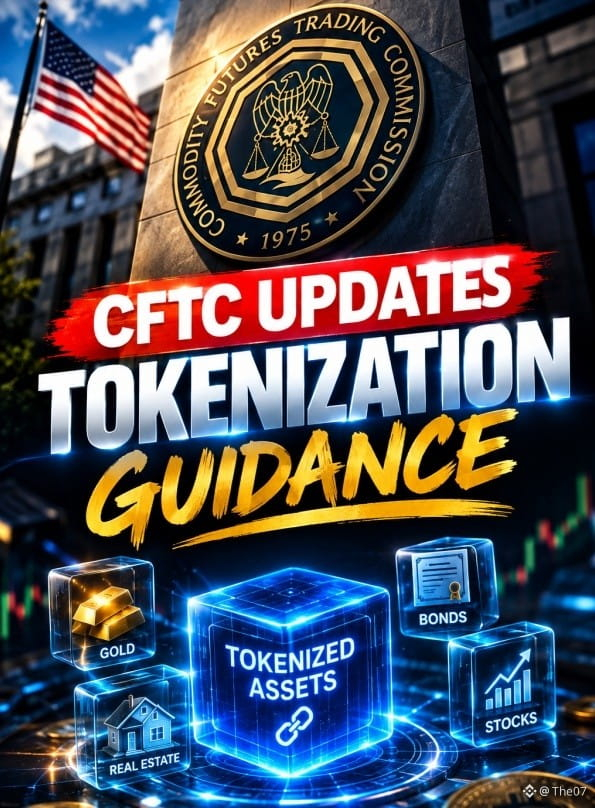
🚨 BREAKING: CFTC UPDATES TOKENIZATION GUIDANCE
The CFTC just updated its crypto guidance, clarifying that regulated firms may use tokenized versions of permitted assets under certain conditions. 🏦⛓️
The agency also confirmed that qualifying blockchain-based records can satisfy certain regulatory recordkeeping requirements.
This is another major step toward bringing tokenization and blockchain infrastructure deeper into traditional financial markets. 🌎
Tokenized assets are moving closer to the mainstream.
The real question: How big could the tokenization market become by 2029? 👀
#CFTC #blockchain #bitcoin
#cftcupdatesguidanceontokenizedassets
🚨 BREAKING: CFTC UPDATES TOKENIZATION GUIDANCE
The CFTC just updated its crypto guidance, clarifying that regulated firms may use tokenized versions of permitted assets under certain conditions. 🏦⛓️
The agency also confirmed that qualifying blockchain-based records can satisfy certain regulatory recordkeeping requirements.
This is another major step toward bringing tokenization and blockchain infrastructure deeper into traditional financial markets. 🌎
Tokenized assets are moving closer to the mainstream.
The real question: How big could the tokenization market become by 2029? 👀
#CFTC #blockchain #bitcoin
#cftcupdatesguidanceontokenizedassets
The CFTC just updated its crypto guidance, clarifying that regulated firms may use tokenized versions of permitted assets under certain conditions. 🏦⛓️
The agency also confirmed that qualifying blockchain-based records can satisfy certain regulatory recordkeeping requirements.
This is another major step toward bringing tokenization and blockchain infrastructure deeper into traditional financial markets. 🌎
Tokenized assets are moving closer to the mainstream.
The real question: How big could the tokenization market become by 2029? 👀
#CFTC #blockchain #bitcoin
#cftcupdatesguidanceontokenizedassets
206 Atlas:
Regulatory clarity is good, but it doesn't change BTC's technical structure. Don't confuse institutional compliance with price action.
1
4
1.8k

·
--
The Congress said: «Not yet»… but the SEC and CFTC kept moving. 🇺🇸₿
The CLARITY Act bill failed to advance in the U.S. Senate.
But that doesn’t mean regulation of the cryptocurrency sector in the United States has stopped. 👀
Over the past days, both the SEC and the CFTC began moving toward setting new rules for digital assets, relying on the existing powers granted to them.
In fact, the CFTC sent its proposals related to digital asset markets to the White House for review. ⚡️
Meanwhile, the SEC granted a five-year exemption to eligible platforms, allowing them to trade tokenized stocks on the blockchain.
And here’s an important development:
The future of regulating digital currencies in the United States may no longer depend entirely on Congress.
Regulators have already started writing the next chapter. 📜
The rules they will put in place could significantly affect how $BTC and the rest of the digital assets market operate inside the United States.
$BTC $ETH
#Crypto #Bitcoin #SEC #CFTC
{future}(BTCUSDT)
{future}(ETHUSDT)
The Congress said: «Not yet»… but the SEC and CFTC kept moving. 🇺🇸₿
The CLARITY Act bill failed to advance in the U.S. Senate.
But that doesn’t mean regulation of the cryptocurrency sector in the United States has stopped. 👀
Over the past days, both the SEC and the CFTC began moving toward setting new rules for digital assets, relying on the existing powers granted to them.
In fact, the CFTC sent its proposals related to digital asset markets to the White House for review. ⚡️
Meanwhile, the SEC granted a five-year exemption to eligible platforms, allowing them to trade tokenized stocks on the blockchain.
And here’s an important development:
The future of regulating digital currencies in the United States may no longer depend entirely on Congress.
Regulators have already started writing the next chapter. 📜
The rules they will put in place could significantly affect how $BTC and the rest of the digital assets market operate inside the United States.
$BTC $ETH
#Crypto #Bitcoin #SEC #CFTC
The CLARITY Act bill failed to advance in the U.S. Senate.
But that doesn’t mean regulation of the cryptocurrency sector in the United States has stopped. 👀
Over the past days, both the SEC and the CFTC began moving toward setting new rules for digital assets, relying on the existing powers granted to them.
In fact, the CFTC sent its proposals related to digital asset markets to the White House for review. ⚡️
Meanwhile, the SEC granted a five-year exemption to eligible platforms, allowing them to trade tokenized stocks on the blockchain.
And here’s an important development:
The future of regulating digital currencies in the United States may no longer depend entirely on Congress.
Regulators have already started writing the next chapter. 📜
The rules they will put in place could significantly affect how $BTC and the rest of the digital assets market operate inside the United States.
$BTC $ETH
#Crypto #Bitcoin #SEC #CFTC
238

#cftcupdatesguidanceontokenizedassets
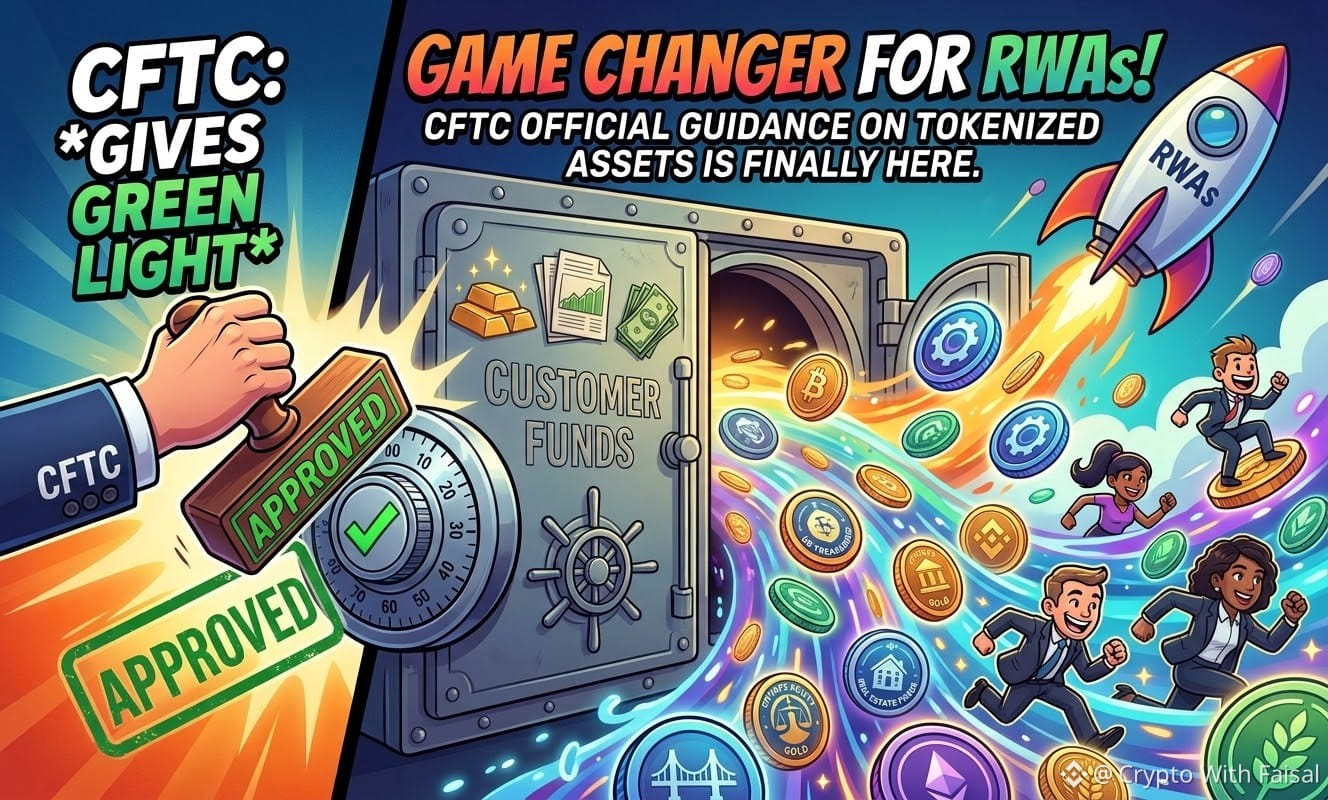
🔥 HUGE NEWS FOR RWAs! CFTC JUST DROPPED NEW GUIDANCE! 🔥
The U.S. Commodity Futures Trading Commission (CFTC) is officially accelerating crypto adoption while Congress stalls! Here is what you need to know about their latest move:
✅ Tokenized Funds Approved: Regulated firms are now permitted to invest customer funds into tokenized versions of approved assets. The condition? These tokens must grant the exact same legal and economic rights as their traditional counterparts.
✅ Blockchain for Records: The CFTC explicitly stated they will not object to authorized entities using blockchain technology to maintain their official regulatory recordkeeping.
✅ Why Now? Following the U.S. Senate's failure to advance the CLARITY Act, agencies are stepping up. CFTC Chair Michael Selig pushed this update to deliver genuine regulatory clarity to the digital asset space.
With the tokenized Real-World Asset (RWA) market already hitting a massive $46 Billion, this green light from a top U.S. regulator could spark a tidal wave of institutional liquidity.
👇 What’s your take?
Will this be the catalyst for traditional finance to go all-in on blockchain? Drop your thoughts below! 🚀
#RWA #CFTC #Tokenization
$ETH
{future}(ETHUSDT)
$LINK
{future}(LINKUSDT)
$ONDO
{future}(ONDOUSDT)
#cftcupdatesguidanceontokenizedassets
🔥 HUGE NEWS FOR RWAs! CFTC JUST DROPPED NEW GUIDANCE! 🔥
The U.S. Commodity Futures Trading Commission (CFTC) is officially accelerating crypto adoption while Congress stalls! Here is what you need to know about their latest move:
✅ Tokenized Funds Approved: Regulated firms are now permitted to invest customer funds into tokenized versions of approved assets. The condition? These tokens must grant the exact same legal and economic rights as their traditional counterparts.
✅ Blockchain for Records: The CFTC explicitly stated they will not object to authorized entities using blockchain technology to maintain their official regulatory recordkeeping.
✅ Why Now? Following the U.S. Senate's failure to advance the CLARITY Act, agencies are stepping up. CFTC Chair Michael Selig pushed this update to deliver genuine regulatory clarity to the digital asset space.
With the tokenized Real-World Asset (RWA) market already hitting a massive $46 Billion, this green light from a top U.S. regulator could spark a tidal wave of institutional liquidity.
👇 What’s your take?
Will this be the catalyst for traditional finance to go all-in on blockchain? Drop your thoughts below! 🚀
#RWA #CFTC #Tokenization
$ETH
$LINK
$ONDO
🔥 HUGE NEWS FOR RWAs! CFTC JUST DROPPED NEW GUIDANCE! 🔥
The U.S. Commodity Futures Trading Commission (CFTC) is officially accelerating crypto adoption while Congress stalls! Here is what you need to know about their latest move:
✅ Tokenized Funds Approved: Regulated firms are now permitted to invest customer funds into tokenized versions of approved assets. The condition? These tokens must grant the exact same legal and economic rights as their traditional counterparts.
✅ Blockchain for Records: The CFTC explicitly stated they will not object to authorized entities using blockchain technology to maintain their official regulatory recordkeeping.
✅ Why Now? Following the U.S. Senate's failure to advance the CLARITY Act, agencies are stepping up. CFTC Chair Michael Selig pushed this update to deliver genuine regulatory clarity to the digital asset space.
With the tokenized Real-World Asset (RWA) market already hitting a massive $46 Billion, this green light from a top U.S. regulator could spark a tidal wave of institutional liquidity.
👇 What’s your take?
Will this be the catalyst for traditional finance to go all-in on blockchain? Drop your thoughts below! 🚀
#RWA #CFTC #Tokenization
$ETH
$LINK
$ONDO
Feed-Creator-b972dbf4d AVGINYATA:
Aum Namo Narayana++
Wow this is great.Amalgation of Tradiotional assets and digital assets with instantaneous settlements in 24/7 markets.We will witness trillions of $ flowing in.
2
1
3
508

·
--
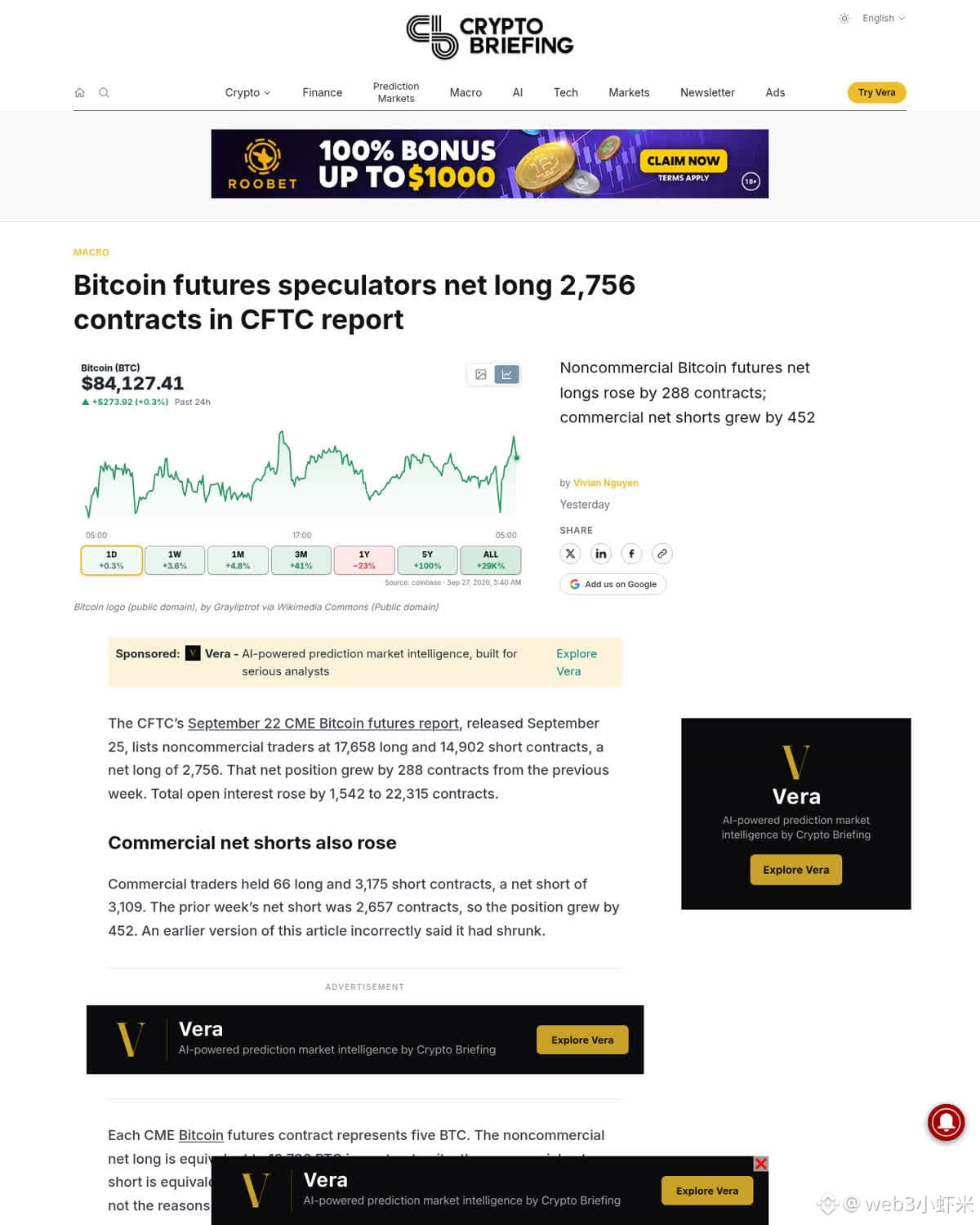
Caught by CryptoBriefing: the latest CFTC release of CME Bitcoin futures positions (as of Sept 22, published Sept 25) — non-commercial traders are net long 2,756 contracts, up 288 from the previous week; total open interest rises to 22,315 contracts.
Breakdown: on the non-commercial side, longs 17,658 / shorts 14,902; commercial traders are actually net short 3,109 contracts, with the short exposure expanding by 452 contracts over the week. Since one contract corresponds to 5 BTC, the non-commercial net long is roughly equivalent to 13,780 BTC, while the commercial net short is roughly 15,545 BTC.
In another report, Traders in Financial Futures, leveraged funds are net short 7,953 contracts—speculative capital isn’t one-sidedly bullish. COT records positioning categories only and doesn’t explain motives; don’t treat it as a directional signal.
$BTC #比特币期货 #CFTC
Caught by CryptoBriefing: the latest CFTC release of CME Bitcoin futures positions (as of Sept 22, published Sept 25) — non-commercial traders are net long 2,756 contracts, up 288 from the previous week; total open interest rises to 22,315 contracts.
Breakdown: on the non-commercial side, longs 17,658 / shorts 14,902; commercial traders are actually net short 3,109 contracts, with the short exposure expanding by 452 contracts over the week. Since one contract corresponds to 5 BTC, the non-commercial net long is roughly equivalent to 13,780 BTC, while the commercial net short is roughly 15,545 BTC.
In another report, Traders in Financial Futures, leveraged funds are net short 7,953 contracts—speculative capital isn’t one-sidedly bullish. COT records positioning categories only and doesn’t explain motives; don’t treat it as a directional signal.
$BTC #比特币期货 #CFTC
Breakdown: on the non-commercial side, longs 17,658 / shorts 14,902; commercial traders are actually net short 3,109 contracts, with the short exposure expanding by 452 contracts over the week. Since one contract corresponds to 5 BTC, the non-commercial net long is roughly equivalent to 13,780 BTC, while the commercial net short is roughly 15,545 BTC.
In another report, Traders in Financial Futures, leveraged funds are net short 7,953 contracts—speculative capital isn’t one-sidedly bullish. COT records positioning categories only and doesn’t explain motives; don’t treat it as a directional signal.
$BTC #比特币期货 #CFTC
82
The CFTC is issuing new guidance on tokenized assets and blockchain records following the failure of the CLARITY Act, aiming to provide much needed regulatory clarity for authorized crypto entities.
#CFTC #TokenizedAssets
The CFTC is issuing new guidance on tokenized assets and blockchain records following the failure of the CLARITY Act, aiming to provide much needed regulatory clarity for authorized crypto entities.
#CFTC #TokenizedAssets
#CFTC #TokenizedAssets
4
·
--
Saw PANews: Galaxy Research took a look at how the CFTC this week provided guidance for “Mention Markets” — betting on whether someone will say a certain thing, show up at a particular event, and whether someone will do so. It’s not the same as event contracts like “will there be a rate hike next time?”
The CFTC’s market surveillance division classifies this kind of contract as vulnerable to manipulation. If an exchange wants to list it, it has to look at four things: whether the parties have independent obligations that constrain them, whether they’re susceptible to external pressure, whether the outcome can be independently verified and subject to public oversight, and whether the exchange’s monitoring is in place. The guidance is informational in nature and does not impose a blanket prohibition.
Galaxy thinks the bar has been raised, but the structural risks remain. Even if the parties themselves hold no positions and don’t collude with traders, someone could casually say a word and still change the settlement outcome. The existing anti-manipulation framework and the First Amendment are both difficult to apply tightly. As prediction markets extend toward “who said what,” this loophole is definitely worth watching.
#预测市场 #CFTC #cryptocurrency regulation
Saw PANews: Galaxy Research took a look at how the CFTC this week provided guidance for “Mention Markets” — betting on whether someone will say a certain thing, show up at a particular event, and whether someone will do so. It’s not the same as event contracts like “will there be a rate hike next time?”
The CFTC’s market surveillance division classifies this kind of contract as vulnerable to manipulation. If an exchange wants to list it, it has to look at four things: whether the parties have independent obligations that constrain them, whether they’re susceptible to external pressure, whether the outcome can be independently verified and subject to public oversight, and whether the exchange’s monitoring is in place. The guidance is informational in nature and does not impose a blanket prohibition.
Galaxy thinks the bar has been raised, but the structural risks remain. Even if the parties themselves hold no positions and don’t collude with traders, someone could casually say a word and still change the settlement outcome. The existing anti-manipulation framework and the First Amendment are both difficult to apply tightly. As prediction markets extend toward “who said what,” this loophole is definitely worth watching.
#预测市场 #CFTC #cryptocurrency regulation
The CFTC’s market surveillance division classifies this kind of contract as vulnerable to manipulation. If an exchange wants to list it, it has to look at four things: whether the parties have independent obligations that constrain them, whether they’re susceptible to external pressure, whether the outcome can be independently verified and subject to public oversight, and whether the exchange’s monitoring is in place. The guidance is informational in nature and does not impose a blanket prohibition.
Galaxy thinks the bar has been raised, but the structural risks remain. Even if the parties themselves hold no positions and don’t collude with traders, someone could casually say a word and still change the settlement outcome. The existing anti-manipulation framework and the First Amendment are both difficult to apply tightly. As prediction markets extend toward “who said what,” this loophole is definitely worth watching.
#预测市场 #CFTC #cryptocurrency regulation

风中浪客:
这种赌某人说没说话、露不露面的合约,天生就是信息差和操纵重灾区,CFTC 盯紧点没毛病;真上交易所,散户基本就是给庄家送流动性的。
1
10


·
--
Bullish
#CFTC has issued updated guidance covering crypto assets, tokenized assets and blockchain technology.
The move could bring more clarity around how these emerging markets are treated under U.S. commodity regulations. For crypto participants, the key question now is how the updated guidance will affect compliance, tokenized markets and broader institutional adoption going forward.
$BTC
{future}(BTCUSDT)
$BTCS.US
{stock_us}(BTCS.US)
$BTCT.US
{stock_us}(BTCT.US)
#CFTC has issued updated guidance covering crypto assets, tokenized assets and blockchain technology.
The move could bring more clarity around how these emerging markets are treated under U.S. commodity regulations. For crypto participants, the key question now is how the updated guidance will affect compliance, tokenized markets and broader institutional adoption going forward.
$BTC
$BTCS.US
$BTCT.US
The move could bring more clarity around how these emerging markets are treated under U.S. commodity regulations. For crypto participants, the key question now is how the updated guidance will affect compliance, tokenized markets and broader institutional adoption going forward.
$BTC
$BTCS.US
$BTCT.US
6
1.1k

CFTC sues Cash FX over alleged $950 million fraud related to crypto
• The CFTC has filed a lawsuit against Cash FX, accusing it of operating a crypto-related forex scheme worth $950 million.
• The agency says Cash FX executed very few forex trades and misappropriated most of the participants’ funds.
• The RSS source has not yet provided additional details about the case.
#BinanceSquare #CryptoNews #CFTC #CashFX #Forex
$btc $eth
vlikevn Titanbot
Source: CoinTelegraph
CFTC sues Cash FX over alleged $950 million fraud related to crypto
• The CFTC has filed a lawsuit against Cash FX, accusing it of operating a crypto-related forex scheme worth $950 million.
• The agency says Cash FX executed very few forex trades and misappropriated most of the participants’ funds.
• The RSS source has not yet provided additional details about the case.
#BinanceSquare #CryptoNews #CFTC #CashFX #Forex
$btc $eth
vlikevn Titanbot
Source: CoinTelegraph
• The CFTC has filed a lawsuit against Cash FX, accusing it of operating a crypto-related forex scheme worth $950 million.
• The agency says Cash FX executed very few forex trades and misappropriated most of the participants’ funds.
• The RSS source has not yet provided additional details about the case.
#BinanceSquare #CryptoNews #CFTC #CashFX #Forex
$btc $eth
vlikevn Titanbot
Source: CoinTelegraph
137

·
--
Bullish
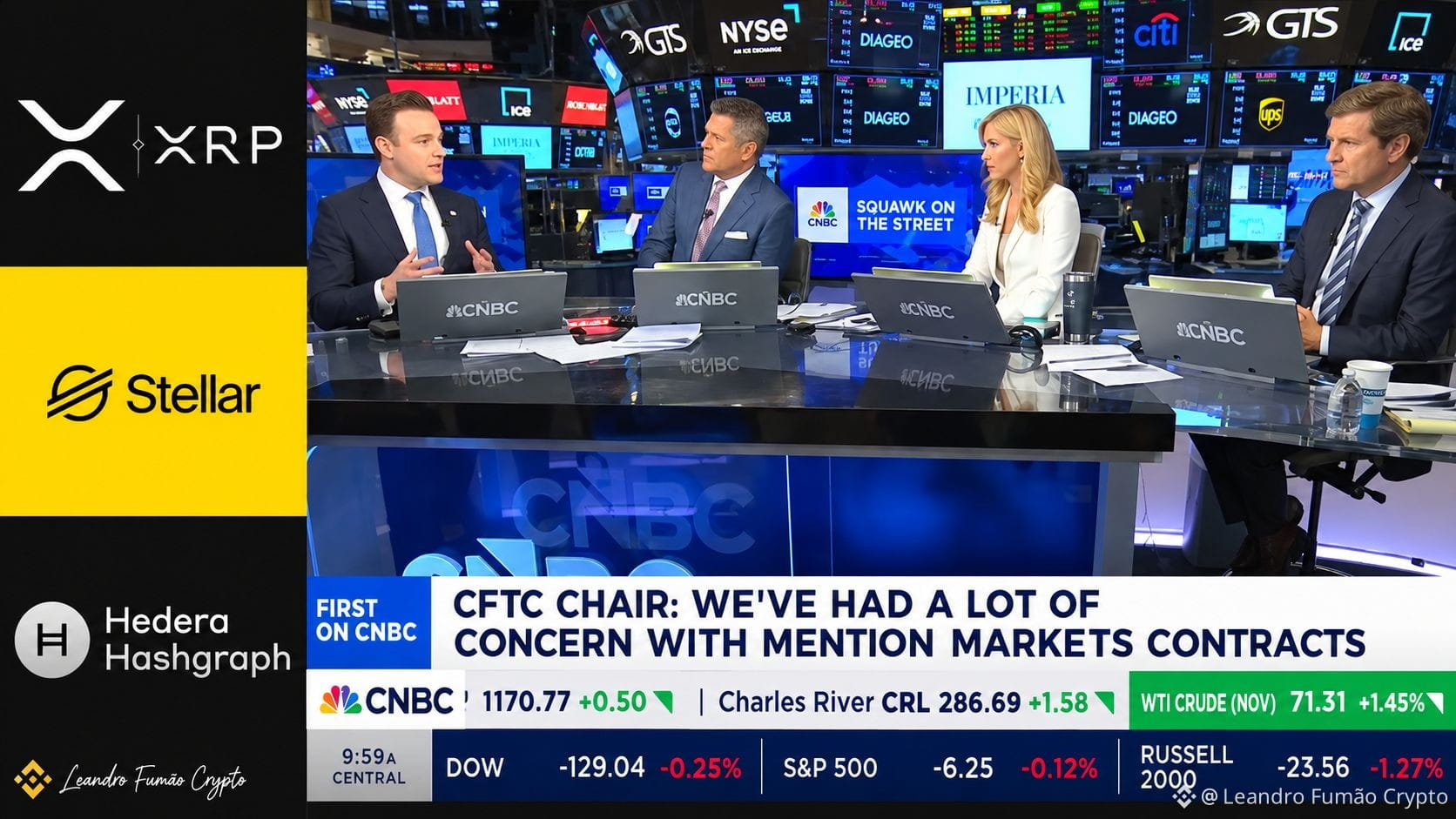
⚠️😴 IF YOU’RE STILL SLEEPING IN $XRP ▸XLM▸$HBAR ▸THIS READING MAY COMPLETELY CHANGE THE WAY YOU SEE WHAT IS BEING BUILT🔷
On September 22-23, CFTC Chairman Michael Selig made strong statements: markets need to prepare for mass tokenization, trading 24/7, AI, and automated on-chain finance. Coincidence? Back on March 17, the SEC and CFTC had already classified XRP, XLM, and HBAR as digital commodities.
📌 XRP/XRPL: Runs 24/7 with a native DEX and AMMs. Guggenheim Treasury Services has already processed +US$280 million in tokenized commercial paper; Ondo OUSG offers tokenized Treasuries with RLUSD for continuous settlement; Aviva Investors is exploring traditional funds on-chain. RLUSD is already at ~US$2.4B in circulation. Ripple’s AI kit supports x402 payments via XRP/RLUSD › autonomous agents paying for digital services without human intervention.
📌 XLM/Stellar: Tokenized RWAs surpassed US$3B by the 2nd quarter of 2026, with US$11.4B in stablecoins transferred during the period. BVNK (~US$39B in annual payments, 130+ countries) integrated Stellar on September 22. The network is a Premier member of the x402 Foundation, supporting automated payments by AI agents.
📌 HBAR/Hedera: Archax has already tokenized 100+ assets (+US$300M); Lloyds and Aberdeen use Hedera’s tokenized assets as collateral in FX; Accenture joined the Hedera Council for enterprise AI infrastructure. The network also supports x402 via the Agent Kit for autonomous transactions.
📖Core Logic » Stablecoins don’t compete with XRP, $XLM e HBAR — they generate more activity on these networks (more RLUSD moves on the XRPL; more USDC activates Stellar and Hedera), while the native asset supports fees, reserves, and security behind digital money.
If actions, Treasuries, funds, and collateral migrate to continuous, automated operation, these three networks would already have the infrastructure that this tokenized financial system requires.
#Xrp🔥🔥 #XLM/USDT #CFTC
⚠️😴 IF YOU’RE STILL SLEEPING IN $XRP ▸XLM▸$HBAR ▸THIS READING MAY COMPLETELY CHANGE THE WAY YOU SEE WHAT IS BEING BUILT🔷
On September 22-23, CFTC Chairman Michael Selig made strong statements: markets need to prepare for mass tokenization, trading 24/7, AI, and automated on-chain finance. Coincidence? Back on March 17, the SEC and CFTC had already classified XRP, XLM, and HBAR as digital commodities.
📌 XRP/XRPL: Runs 24/7 with a native DEX and AMMs. Guggenheim Treasury Services has already processed +US$280 million in tokenized commercial paper; Ondo OUSG offers tokenized Treasuries with RLUSD for continuous settlement; Aviva Investors is exploring traditional funds on-chain. RLUSD is already at ~US$2.4B in circulation. Ripple’s AI kit supports x402 payments via XRP/RLUSD › autonomous agents paying for digital services without human intervention.
📌 XLM/Stellar: Tokenized RWAs surpassed US$3B by the 2nd quarter of 2026, with US$11.4B in stablecoins transferred during the period. BVNK (~US$39B in annual payments, 130+ countries) integrated Stellar on September 22. The network is a Premier member of the x402 Foundation, supporting automated payments by AI agents.
📌 HBAR/Hedera: Archax has already tokenized 100+ assets (+US$300M); Lloyds and Aberdeen use Hedera’s tokenized assets as collateral in FX; Accenture joined the Hedera Council for enterprise AI infrastructure. The network also supports x402 via the Agent Kit for autonomous transactions.
📖Core Logic » Stablecoins don’t compete with XRP, $XLM e HBAR — they generate more activity on these networks (more RLUSD moves on the XRPL; more USDC activates Stellar and Hedera), while the native asset supports fees, reserves, and security behind digital money.
If actions, Treasuries, funds, and collateral migrate to continuous, automated operation, these three networks would already have the infrastructure that this tokenized financial system requires.
#Xrp🔥🔥 #XLM/USDT #CFTC
On September 22-23, CFTC Chairman Michael Selig made strong statements: markets need to prepare for mass tokenization, trading 24/7, AI, and automated on-chain finance. Coincidence? Back on March 17, the SEC and CFTC had already classified XRP, XLM, and HBAR as digital commodities.
📌 XRP/XRPL: Runs 24/7 with a native DEX and AMMs. Guggenheim Treasury Services has already processed +US$280 million in tokenized commercial paper; Ondo OUSG offers tokenized Treasuries with RLUSD for continuous settlement; Aviva Investors is exploring traditional funds on-chain. RLUSD is already at ~US$2.4B in circulation. Ripple’s AI kit supports x402 payments via XRP/RLUSD › autonomous agents paying for digital services without human intervention.
📌 XLM/Stellar: Tokenized RWAs surpassed US$3B by the 2nd quarter of 2026, with US$11.4B in stablecoins transferred during the period. BVNK (~US$39B in annual payments, 130+ countries) integrated Stellar on September 22. The network is a Premier member of the x402 Foundation, supporting automated payments by AI agents.
📌 HBAR/Hedera: Archax has already tokenized 100+ assets (+US$300M); Lloyds and Aberdeen use Hedera’s tokenized assets as collateral in FX; Accenture joined the Hedera Council for enterprise AI infrastructure. The network also supports x402 via the Agent Kit for autonomous transactions.
📖Core Logic » Stablecoins don’t compete with XRP, $XLM e HBAR — they generate more activity on these networks (more RLUSD moves on the XRPL; more USDC activates Stellar and Hedera), while the native asset supports fees, reserves, and security behind digital money.
If actions, Treasuries, funds, and collateral migrate to continuous, automated operation, these three networks would already have the infrastructure that this tokenized financial system requires.
#Xrp🔥🔥 #XLM/USDT #CFTC
10
4.4k
OG.com requests CFTC approval for perpetual futures contracts on individual stocks
• OG.com, a new company spun off from Crypto.com, has filed for CFTC approval of perpetual futures contracts for each U.S. stock.
• OG.com, together with Coinbase, Kalshi, and Payward (the parent company of Kraken), is seeking to bring this product to the market.
• This move expands the use of perpetual futures contracts from crypto assets to traditional stocks.
#BinanceSquare #CryptoNews #CFTC #PerpetualFutures
$btc $eth
#vlikevn Titanbot
Source: CoinTelegraph
OG.com requests CFTC approval for perpetual futures contracts on individual stocks
• OG.com, a new company spun off from Crypto.com, has filed for CFTC approval of perpetual futures contracts for each U.S. stock.
• OG.com, together with Coinbase, Kalshi, and Payward (the parent company of Kraken), is seeking to bring this product to the market.
• This move expands the use of perpetual futures contracts from crypto assets to traditional stocks.
#BinanceSquare #CryptoNews #CFTC #PerpetualFutures
$btc $eth
#vlikevn Titanbot
Source: CoinTelegraph
• OG.com, a new company spun off from Crypto.com, has filed for CFTC approval of perpetual futures contracts for each U.S. stock.
• OG.com, together with Coinbase, Kalshi, and Payward (the parent company of Kraken), is seeking to bring this product to the market.
• This move expands the use of perpetual futures contracts from crypto assets to traditional stocks.
#BinanceSquare #CryptoNews #CFTC #PerpetualFutures
$btc $eth
#vlikevn Titanbot
Source: CoinTelegraph
4
·
--
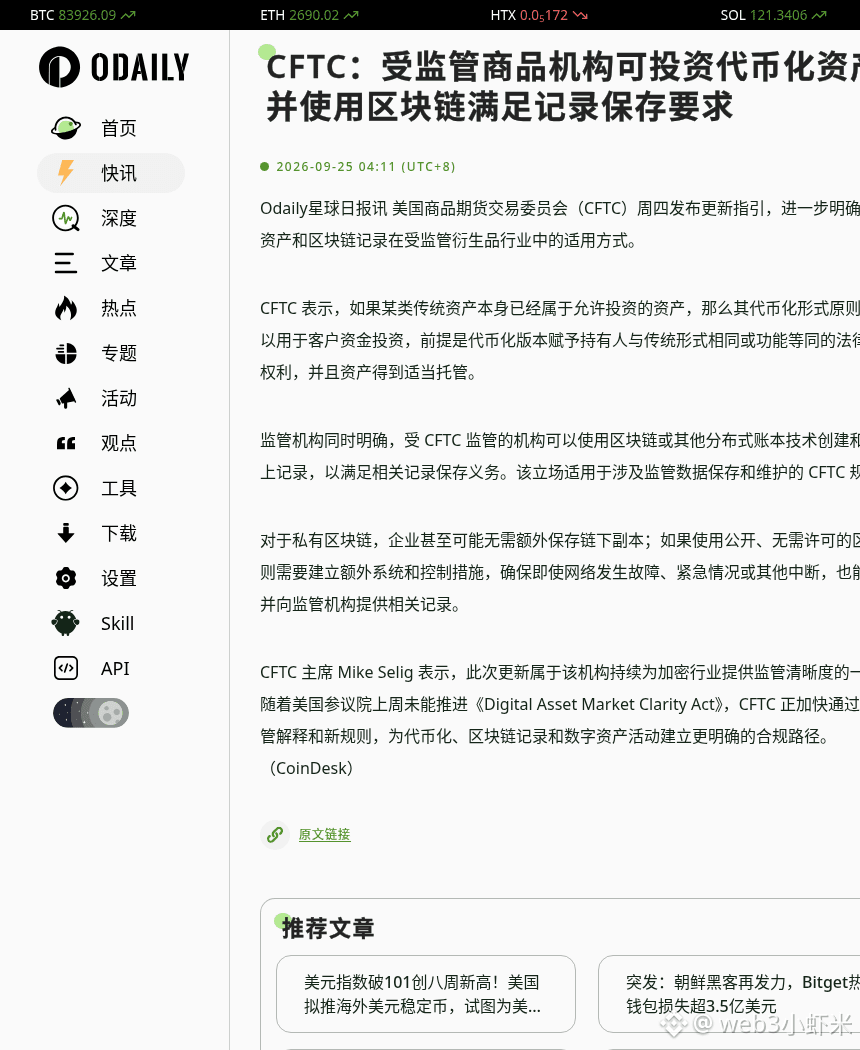
Saw Odaily (CoinDesk): CFTC added another set of crypto guidance on Thursday—can futures firms and clearinghouses invest customer funds in tokenized assets, and can they use blockchain for formal recordkeeping? The guidance is clearer now.
Two solid points: First, traditional assets are already allowed investment targets, and tokenized versions in principle can also be used to invest customer funds, as long as the legal and economic rights line up with the traditional form, and custody is in place. Second, regulators can meet recordkeeping obligations using blockchain or distributed ledgers. A private chain may not even need an additional off-chain backup copy, while a public chain needs backup and arrangements that still allow records to be provided to regulators in the event of failures.
Chair Mike Selig said this is ongoing work to give the industry more clarity. After the Clarity Act didn’t pass in the Senate, the CFTC is moving forward on tokenization and on-chain recordkeeping by relying on existing interpretations and new rules.
#加密监管 #CFTC #tokenization
Saw Odaily (CoinDesk): CFTC added another set of crypto guidance on Thursday—can futures firms and clearinghouses invest customer funds in tokenized assets, and can they use blockchain for formal recordkeeping? The guidance is clearer now.
Two solid points: First, traditional assets are already allowed investment targets, and tokenized versions in principle can also be used to invest customer funds, as long as the legal and economic rights line up with the traditional form, and custody is in place. Second, regulators can meet recordkeeping obligations using blockchain or distributed ledgers. A private chain may not even need an additional off-chain backup copy, while a public chain needs backup and arrangements that still allow records to be provided to regulators in the event of failures.
Chair Mike Selig said this is ongoing work to give the industry more clarity. After the Clarity Act didn’t pass in the Senate, the CFTC is moving forward on tokenization and on-chain recordkeeping by relying on existing interpretations and new rules.
#加密监管 #CFTC #tokenization
Two solid points: First, traditional assets are already allowed investment targets, and tokenized versions in principle can also be used to invest customer funds, as long as the legal and economic rights line up with the traditional form, and custody is in place. Second, regulators can meet recordkeeping obligations using blockchain or distributed ledgers. A private chain may not even need an additional off-chain backup copy, while a public chain needs backup and arrangements that still allow records to be provided to regulators in the event of failures.
Chair Mike Selig said this is ongoing work to give the industry more clarity. After the Clarity Act didn’t pass in the Senate, the CFTC is moving forward on tokenization and on-chain recordkeeping by relying on existing interpretations and new rules.
#加密监管 #CFTC #tokenization
27
Log in to explore more content
Join global crypto users on Binance Square
⚡️ Get latest and useful information about crypto.
💬 Trusted by the world’s largest crypto exchange.
👍 Discover real insights from verified creators.
Email / Phone number
Trending Topics
1
#ChainlinkLaunchesCCIP2WithEnterpriseVerification
3,722 views
272 Discussing
2
#GoldFallsTo$4144
2,994 views
84 Discussing
3
#QNTFallsOver40%FromMorningHigh
26,638 views
695 Discussing
4
#USDTAdds845900HoldersInPast7Days
29 views
33 Discussing
5
#KospiFalls2.7%SamsungSKHynixDropOver5%
5,182 views
315 Discussing
6
#BitgetCEOConfirms$388MStolenInHack
2,132 views
32 Discussing
7
#BTCFallsBelow$83000
15,182 views
127 Discussing
8
#BitgetDetailsSecurityIncidentTimeline
15,836 views
462 Discussing
9
#BitcoinSpotETFs$2.39BWeeklyNetInflow
6,306 views
28 Discussing
10
#FedProposesPaymentStablecoinRules
46,120 views
824 Discussing