This month’s research roundup looks at what data on tokenized equities, stablecoin liquidity, and wallet security reveals about how market infrastructure is evolving.
The findings show tokenized equities gaining traction, more trading happening after hours, and stablecoin liquidity concentrating on Binance.
Together, they point to Binance playing a growing role across trading, liquidity, and custody in an increasingly always-on market.
Every month, crypto’s research desks publish work that rewards a closer read. August 2026 brought four worth knowing about: DeFiLlama on after-hours tokenized stock trading; CryptoQuant on stablecoin reserves; The Block on wallet security; and CoinDesk on real-world-asset inflows.
Read on to see what each report found, and what the findings add up to.
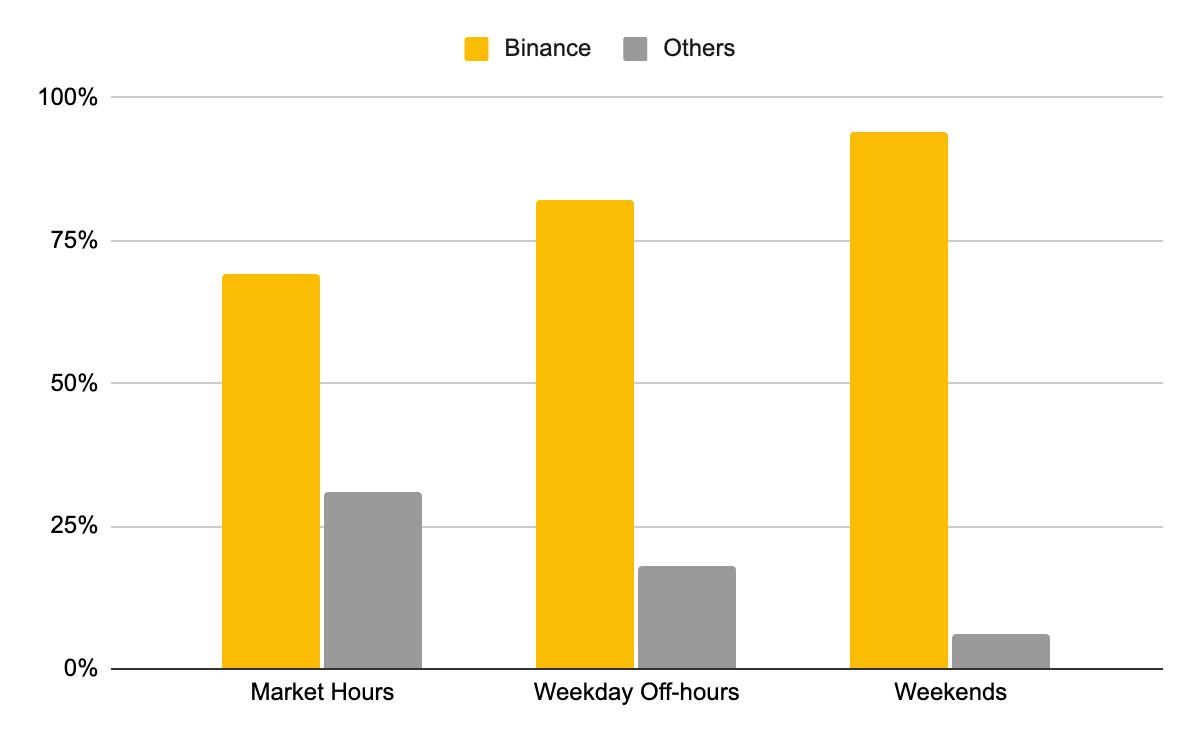
DeFiLlama analyzed six weeks of hourly trading data across major tokenized stock venues to examine activity outside traditional U.S. market hours. It found that more than half of weekday trading volume takes place outside the regular session. Binance leads both during and outside U.S. market hours, with its share of activity increasing after traditional markets close.
Chart 1: Share of tokenized stock volume, comparing market hours, weekday off-hours, and weekends
The difference partly reflects how tokenized stock venues are structured. Some mint and redeem against live trades in the underlying U.S. markets, making them dependent on traditional market hours. Others rely on pre-funded liquidity pools, which can become thinner outside market hours or offer a more limited range of assets over the weekend. bStocks (tokenized securities on Binance), by contrast, trade through Binance’s order book around the clock. According to DeFiLlama, this continuous liquidity could give Binance a larger role in tokenized stock price discovery when traditional markets and other venues are less active
Stablecoins held on exchanges reflect ready trading capital.
According to CryptoQuant, exchange-held stablecoin reserves have fallen by around 20% from their late-2025 peak to roughly $64 billion, largely in USDT.
A smaller reserve base can be a sign of a quieter market. That was also the case in 2022, before reserves expanded again during the recovery that followed. What stands out this time is where the remaining capital is concentrated.
Of all stablecoins held on centralized exchanges, a little over two-thirds are on Binance, up from the low-60% range late last year. CryptoQuant’s data also shows a smaller decline in stablecoin balances on Binance than across the exchange market as a whole. As a result, a significant portion of trade-ready stablecoin liquidity currently sits on Binance, reinforcing its role as a primary venue for deploying capital when market activity picks up.
A July breach of a widely used hardware wallet cost users around $130 million. The wallet’s key generation wasn’t sufficiently random, making some seed phrases predictable and allowing attackers to reconstruct them remotely. This meant users could have followed every best practice and still lost funds because the seed phrase was compromised from creation.
That’s the problem The Block’s report examines: the risk of a single key controlling an entire wallet. Multi-party computation (MPC) addresses this by splitting signing authority across separate key shares, with two of three shares commonly required to approve a transaction. The full key is never reassembled, while individual shares can be rotated when a user changes devices, meaning recovery does not require starting over with a new address.
The report uses Binance Wallet as a case study, highlighting its default MPC design and two-of-three key-share model. MPC cannot prevent phishing, malicious approvals, compromised devices, or unsafe transactions users authorize themselves. But by removing the seed phrase as a single point of failure, it makes self-custody and recovery more resilient.
According to CoinDesk, real-world assets (RWAs) have held up better than much of crypto this year, with total market capitalization passing $30 billion and their share of both spot and perpetual futures volume rising even as overall trading activity contracted.
Within that market, tokenized equities have emerged as a major area of demand. CoinDesk found that they led 30-day net inflows, ahead of bonds and gold. Together, the three categories accounted for roughly three-quarters of RWA inflows.
bStocks has grown quickly within tokenized equities. CoinDesk reports that bStocks reached second place by market capitalization within two months of its June launch and now accounts for 90% of on-chain tokenized equity volume.
The user behavior behind that growth is particularly telling. In July, 58.5% of bStocks holders also traded perpetual futures or direct equities, while around 31% of assets under management were posted as margin collateral. For many users, tokenized equities appear to be part of a broader trading strategy rather than simply assets to hold, helping explain the demand for continuous, after-hours access highlighted by DeFiLlama.
August’s reports point to a market becoming more concentrated around liquidity, continuous access, and stronger infrastructure. DeFiLlama shows tokenized stock activity clustering around venues that remain active beyond U.S. market hours. CryptoQuant shows exchange-held stablecoin liquidity becoming more concentrated, while CoinDesk highlights the rapid growth of tokenized equities and their use in active trading strategies.
As more assets trade around the clock and move onchain, custody becomes part of the same picture. Binance Wallet’s MPC design addresses one of self-custody’s key vulnerabilities by reducing reliance on a single seed phrase. Taken together, the reports show liquidity, access, and security increasingly converging — with Binance playing a growing role in how users trade, move capital, and manage assets across an always-on market.