

币圈导航0xnav
376 Posts

币圈导航0xnav
Report
Block User
🎈币安手续费邀请码:FANXIAN,频繁交易的手续费,甚至可能超过你的本金,这是一大笔费用!
36 Following
73 Followers
91 Liked
Posts
All
Videos
·
--
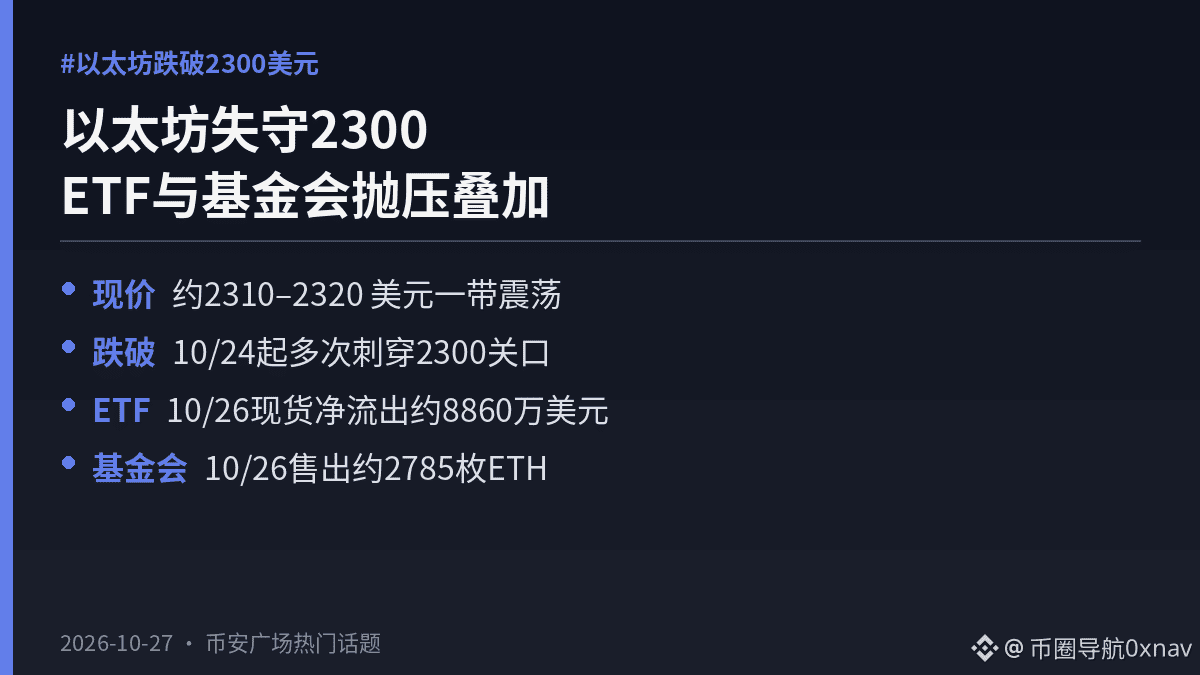
The $2,300 line has been tested by Ethereum repeatedly over the past few days — and failing to hold it is even more frustrating than the “first break below.”
A few easily overlooked details 👇
🔹 Price: During intraday trading on Oct. 24, it briefly fell to around $2,298; on Oct. 26 and 27, it pierced $2,300 multiple times again. The current price is roughly fluctuating in a narrow range around $2,310–$2,320, with the 24-hour low near $2,295.
🔹 Monthly: So far in October, it has pulled back by about 13%, clearly weaker than the feeling of “just a short-term shakeout.” The market commonly mentions support below in the roughly $2,280–$2,200 zone.
🔹 Institutional buying: U.S. spot Ethereum ETFs saw a net outflow of about $88.6 million on Oct. 26, and on Oct. 22 there was also a single-day outflow of about $110 million — what the level nearby lacks most is sustained net inflows to provide support.
🔹 Supply side: On-chain data shows the Ethereum Foundation sold about 2,785 ETH on Oct. 26 for roughly $6.42 million in stablecoins. Combined with news of early large holders selling, the short-term selling-pressure narrative has been amplified.
🔹 For holders: Spot and futures are not the same thing. The easiest thing to get liquidated in a chain reaction around $2,300 are high-leverage long positions; if you only hold spot, you should be watching future ETF flows and risk sentiment after the Fed decision, not letting the words “broke below” drive you into chasing shorts or panic-selling.
Simply put: this is a stress test caused by “key level lost + ETF outflows + Foundation selling” all piling up together, not something that can be explained by a single bearish factor. First clarify what type of position you have, then decide whether to act.
Would you choose to buy spot in batches around 2300, or first reduce leverage and wait for the rate decision to land?
#以太坊跌破2300美元 #ETH #BTC
233
·
--
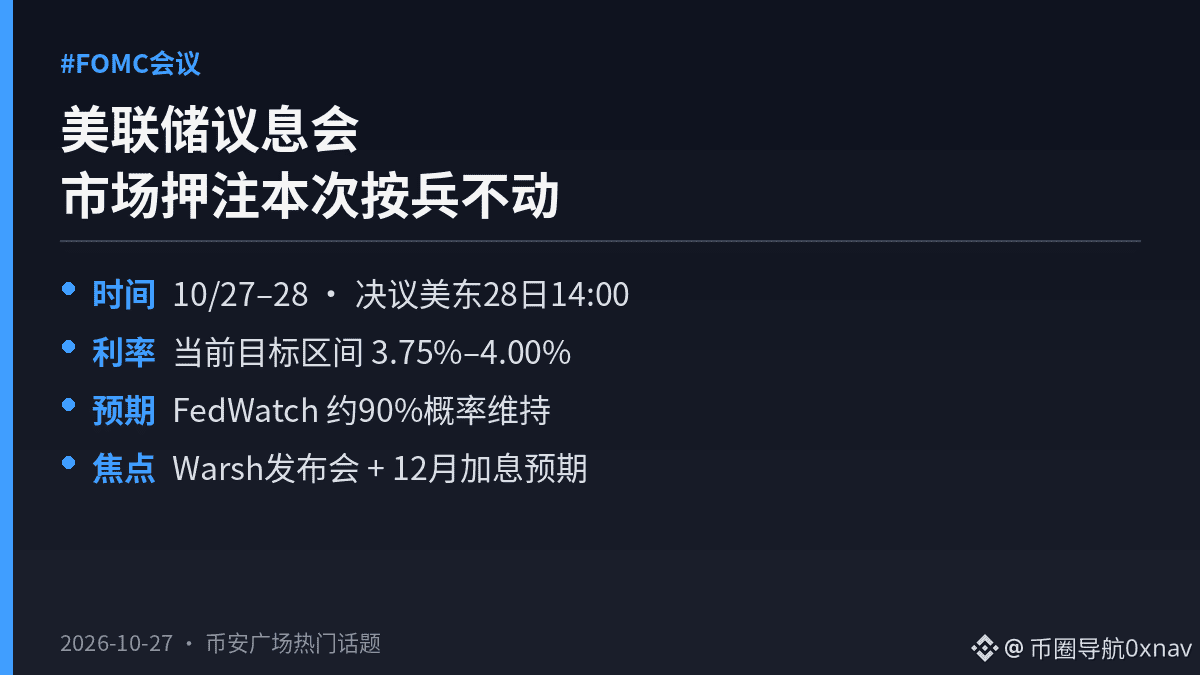
Should you hold your contract position through tonight’s Fed decision? The answer may be more important than you think — because what really gets priced in is often not whether rates are raised, but the wording of the statement and the tone of the press conference.
A few easily overlooked details 👇
🔹 Timeline: The FOMC meets over two days, October 27–28; the rate decision is set for 2:00 p.m. ET on October 28 (2:00 a.m. Beijing time on October 29), followed by a press conference by Chair Kevin Warsh
🔹 Rate status: The federal funds target range remains 3.75%–4.00%; after a 25 bps hike in September, the market’s mainstream expectation this time is to stay on hold
🔹 Probabilities: According to CME FedWatch, the probability of keeping rates unchanged is about 90%, while the probability of a hike is about 10%; but the probability of another 25 bps hike in December is priced above 70%
🔹 Inflation backdrop: September CPI was about 3.7% YoY, with core CPI around 2.6%, still clearly above the 2% target; elevated energy prices are the key issue at the center of officials’ debate over whether to keep tightening
🔹 For ordinary people: BTC/ETH volatility before the decision is mostly noise; what could really reshape risk appetite is the wording on inflation in the statement, and whether Warsh frames a “pause” as “another hike is still possible by year-end” — leveraged positions are most vulnerable to a sudden shift in expectations from dovish to hawkish
To put it simply: this is more like a preview of a hawkish hold, not an immediate rate-cut celebration. Long-term spot holding and riding out a contract position are two different things; if your position can’t handle the overnight volatility, reducing leverage first is more practical than trying to guess direction.
Would you choose to clear out your high-leverage position before the decision and wait, or stick with your spot holdings as planned and wait for the statement to land?
#FOMC会议 #BTC #ETH
305
·
--
Brazilian users opened the app today to find that lending, liquidity pools, leverage, Launchpool, Megadrop, HODLer airdrops, and Alpha 2.0 can no longer be newly accessed—and 22 trading pairs have been delisted locally. This isn’t a flash crash; it’s a regulatory countdown.
Binance has submitted an application through its local entity to the Central Bank of Brazil for an SPSAV virtual asset service provider license. A few details that are easy to miss 👇
🔹 The application was filed on October 23. The transition period for existing providers ends on October 30; miss the deadline and they’ll have to suspend crypto services within 30 days. Applying doesn’t mean approval.
🔹 Starting today, users in Brazil can no longer open new positions in the 8 services listed above. Existing positions can be closed or reduced in accordance with the rules. After the 22 tokens are delisted locally, balances can still be withdrawn or converted into other assets.
🔹 Starting October 29, personal receiving accounts will be handled through the local brokerage entity. From November 1, cross-border crypto transfers must include the purpose and counterparty details reported to the Central Bank.
🔹 A local representative said they hope to continue discussions with the Central Bank and work toward restoring some of the suspended products.
Put simply: this brings the services and tradable assets available to Brazilian users under a local licensing framework. What matters more to you: which options disappeared today, or whether you’ll still be able to use the platform compliantly after the October 30 deadline?
#韩国考虑对加密交易所征教育税 #BNB #BTC


88
·
--
People holding RLUSD now have another layer of “federal oversight of its reserves”: the U.S. Office of the Comptroller of the Currency (OCC) has granted final approval for Ripple National Trust Bank (RNTB) to commence operations.
A few easily overlooked details 👇
🔹 Timeline: It first received conditional approval in December 2025, then final approval on October 26, 2026—moving from “okay to prepare” to “officially operating under the national trust bank framework.”
🔹 What this means most directly for ordinary users: RNTB is authorized to manage the segregated reserves backing RLUSD and act as trustee for the reserve collateral. In plain English, the dollar assets behind the stablecoin now have an additional layer of federal trust oversight, rather than being solely a matter of what the company says.
🔹 The issuer hasn’t changed: RLUSD is still issued by Standard Custody & Trust Company, which is regulated by the New York State Department of Financial Services (NYDFS). OCC oversight adds a federal layer, creating both state and federal supervision.
🔹 What it can and can’t do: Manage trust reserves and provide fiduciary custody for digital assets; it does not take deposits and make loans like a traditional bank. BNY remains the primary custodian of RLUSD’s reserves, and Ripple publishes third-party attestations monthly.
🔹 The licensing landscape: Circle and others have previously pursued similar national trust pathways. Ripple has now gone from “conditional” to “full approval,” raising the bar for compliance another notch.
Put simply: this is regulation becoming reality, not a signal about price movements. For holders, it’s more important to watch reserve disclosures, whether redemptions arrive on time, and how custody responsibilities are defined under the federal trust framework. Don’t interpret the words “approved” as a buy or sell signal.
Would “federal trust oversight of reserves” make you more willing to use RLUSD, or will you stick with the stablecoin you know best?
#Ripple获全面批准运营国家信托银行 #BTC #XRP


130
·
--
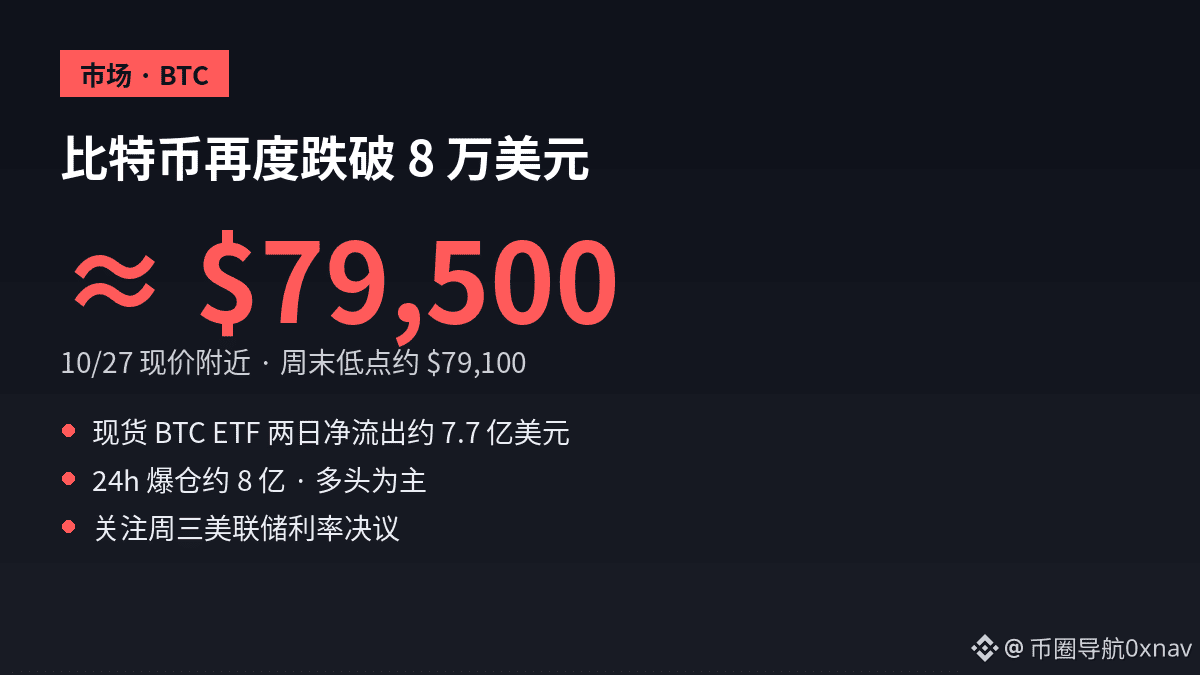
The $80,000 psychological threshold was breached over the weekend, and the price still hasn’t truly reclaimed it.
A few easy-to-overlook details 👇
🔹 Price: The intraday low on Oct. 24 was around $79,100–$79,300. As of Oct. 27, the price is still hovering around $79,500–$79,800, below the lower end of the $80,000–$87,000 range seen over the past month.
🔹 Institutional buying: U.S. spot Bitcoin ETFs saw combined net outflows of about $770 million over Oct. 22–23 ($636 million in a single day on Oct. 22, the largest since June). BlackRock’s IBIT and Fidelity’s FBTC led the outflows.
🔹 Leverage: According to CoinGlass, roughly $800 million worth of positions were liquidated in the 24 hours around the day Bitcoin fell below the threshold. Longs accounted for the vast majority, with more than 200,000 traders liquidated. Retail futures positions are especially vulnerable to cascading liquidations when a key level like this gives way.
🔹 Macro backdrop: Concerns about valuations in AI and tech stocks, hawkish expectations ahead of the Fed’s meeting this week (around Oct. 28), and broad pressure on risk assets are all weighing on the market. Corporate Bitcoin holder Strategy also paused its purchases last week.
🔹 For holders: Holding spot and using leveraged futures are two different things. Near a key level, the biggest danger is high-leverage longs getting wiped out. If you’re only holding spot, it’s more important to watch subsequent ETF flows and the Fed’s messaging than to let the words “breaks below again” push you into chasing shorts or panic-selling.
Put simply: this isn’t a case of “crypto having a problem all by itself.” It looks more like risk appetite shrinking, ETF outflows, and leveraged liquidations all piling up at once. The $80,000 area is likely to remain contested. Don’t treat trending headlines as trading instructions.
Would you reduce leverage and wait for the Fed meeting, or stick to your original plan of buying spot in stages?
#比特币再度跌破8万美元 #BTC #ETH
470
·
--
Serves you right—delivering food for the rest of your life.
$BTC
Serves you right—delivering food for the rest of your life.
$BTC
$BTC

20
·
--
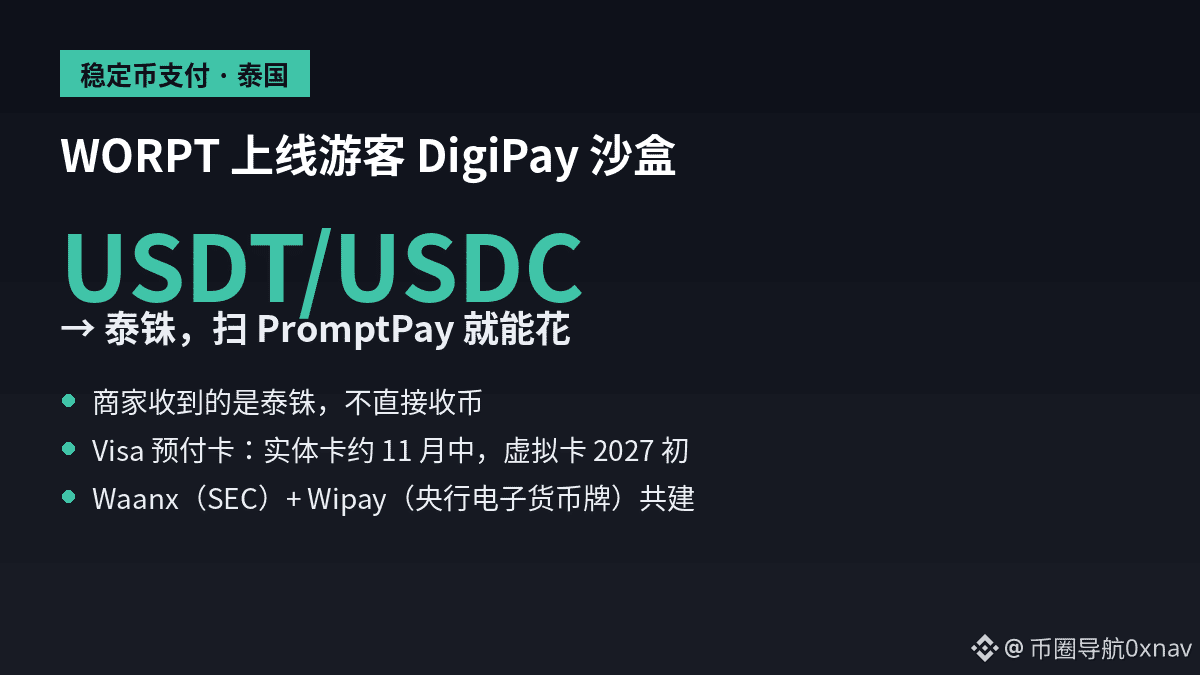
Traveling in Thailand—can you use the U in your phone to scan a QR code and buy a milk tea? The Tourist DigiPay sandbox has already given us the answer: yes.
WORPT has officially launched in Thailand’s Tourist DigiPay regulatory sandbox. Here are a few details that are easy to miss 👇
🔹 Who’s behind it: Jointly developed by Waanx (licensed by the SEC for digital assets) and Wipay (licensed by the central bank for e-money); partners also include Tether, The Mall Group, and Visa
🔹 How it works: Convert USDT or USDC into Thai baht and pay via Thailand’s PromptPay QR codes; merchants receive baht, not cryptocurrency directly
🔹 What’s next: A physical Visa prepaid card is planned for mid-November, with a virtual card expected in early 2027; the same baht balance can be used for both QR payments and card payments
🔹 Who can use it now: International tourists. The app is already available to download (identity verification and transaction monitoring are still required under the sandbox rules)
In short: this isn’t another “swipe your card on-chain” concept post—it connects stablecoins to Thailand’s everyday QR payment network. For people traveling to Thailand with crypto, there’s now a much clearer compliant way to spend it. Would you scan a QR code first, or wait for the Visa card?
#泰国推出WORPT稳定币QR支付应用 #BTC #BNB

230
·
--
I was stunned: The founder of Baihe.com is begging for money on social media, taking in over 5,000 yuan in a day.
I never expected that Mu Yan, co-founder of Baihe.com, would be struggling financially because his assets were frozen and would personally turn to his social media contacts to ask for donations.
The transfer records show that some people sent 1,000 yuan or 500 yuan, while others sent 10 yuan, 6.6 yuan, or even 0.01 yuan. He received over 5,800 yuan in just one day.
$BTC
$BNB

273
·
--
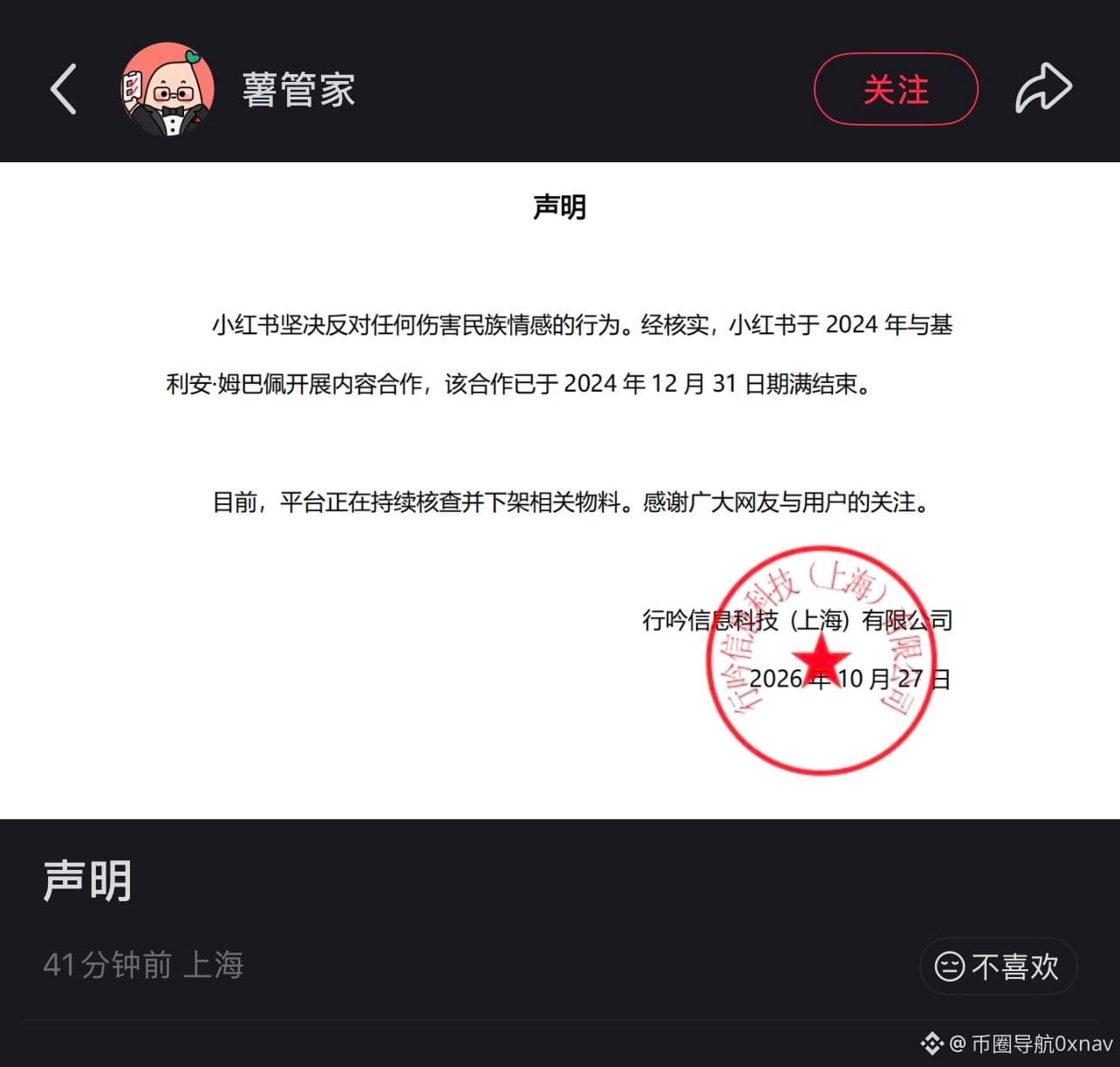
Mbappé really went through it this time
$BNB
$BTC
Mbappé really went through it this time
$BNB
$BTC
$BNB
$BTC
184
·
--
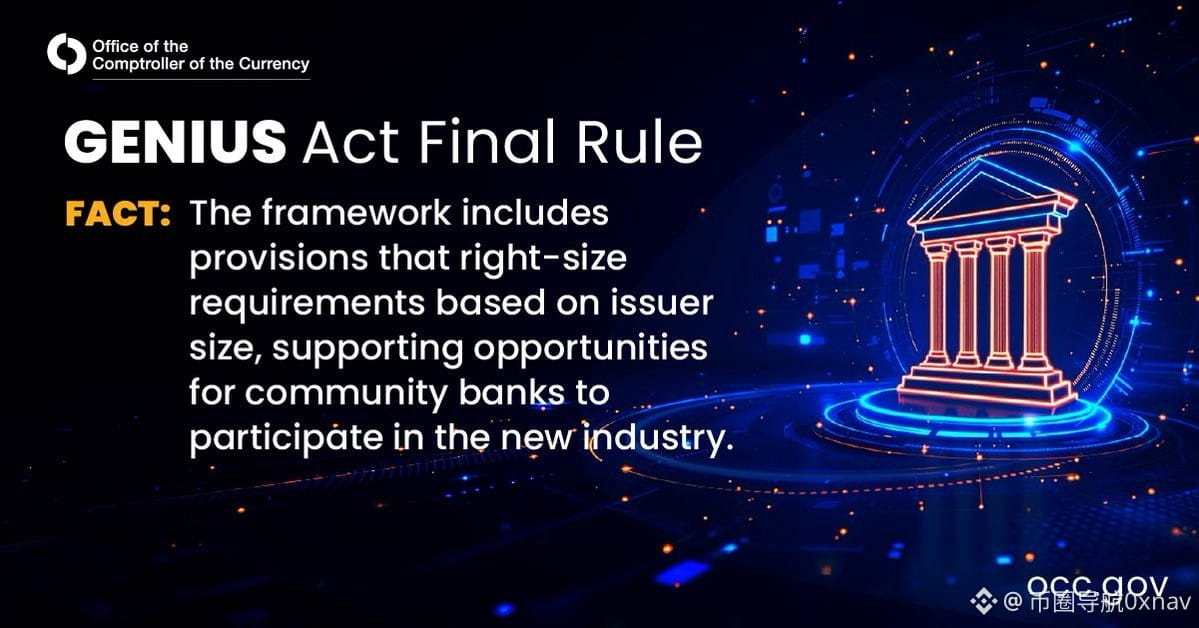
Will the U in your wallet eventually come from the community bank on the corner? The U.S. Office of the Comptroller of the Currency (OCC) has officially put that question on the table for small banks.
A few easy-to-miss details 👇
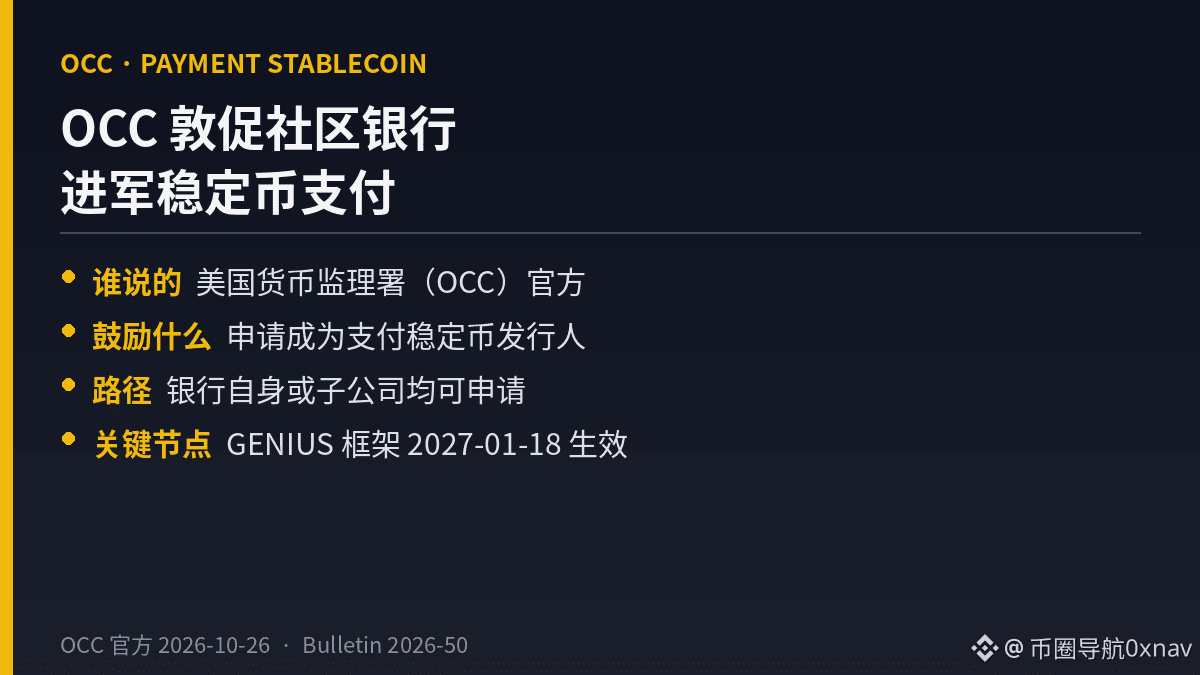
🔹 On October 26, the OCC’s official account posted that it encourages community banks to develop “payment stablecoin” capabilities. Interested banks can consider applying to become authorized payment stablecoin issuers, or have a subsidiary apply instead.
🔹 This isn’t just talk: On October 21, the OCC finalized the implementing rules for the GENIUS Act (Bulletin 2026-50), setting out regulatory requirements for reserves, redemption, custody, and risk management. The rules take effect on January 18, 2027.
🔹 Applications aren’t open yet—the OCC will begin accepting them once the federal information collection form is approved by OMB. But applicants who submit a substantially complete application before January 18 may apply for a transition period of up to about 12 months under the rules.
🔹 The OCC’s accompanying guidance for community banks emphasizes that requirements will be “right-sized” based on issuer size. It also requires issuers to disclose that payment stablecoins are not backed by the full faith and credit of the U.S. government and are not covered by federal deposit insurance.
🔹 The most direct takeaway for everyday users: Stablecoin competition could spread from a handful of major companies and crypto firms to payment services at thousands of local banks. If cross-border payments and merchant settlements use compliant stablecoins, fees and payment times could change—but redemption and reserve transparency will depend on licensing.
Put simply: Regulators are saying, “Small banks can join in too.” That doesn’t mean your neighborhood bank will start issuing coins next week. The application window isn’t open yet, and the rules take effect next January. The key things to watch are when applications open, whether local banks use subsidiaries to isolate risk, and whether the disclosure that these aren’t covered by deposit insurance is made clear.
Would you feel more comfortable using a stablecoin issued under a “local bank license,” or would you stick with the few you already know best?
#OCC敦促社区银行进军稳定币支付 #BNB #BTC
37
·
--
Roughly 1 out of every 20 ETH in circulation is held by a single publicly listed company—and it kept buying last week.
A few easy-to-miss details 👇
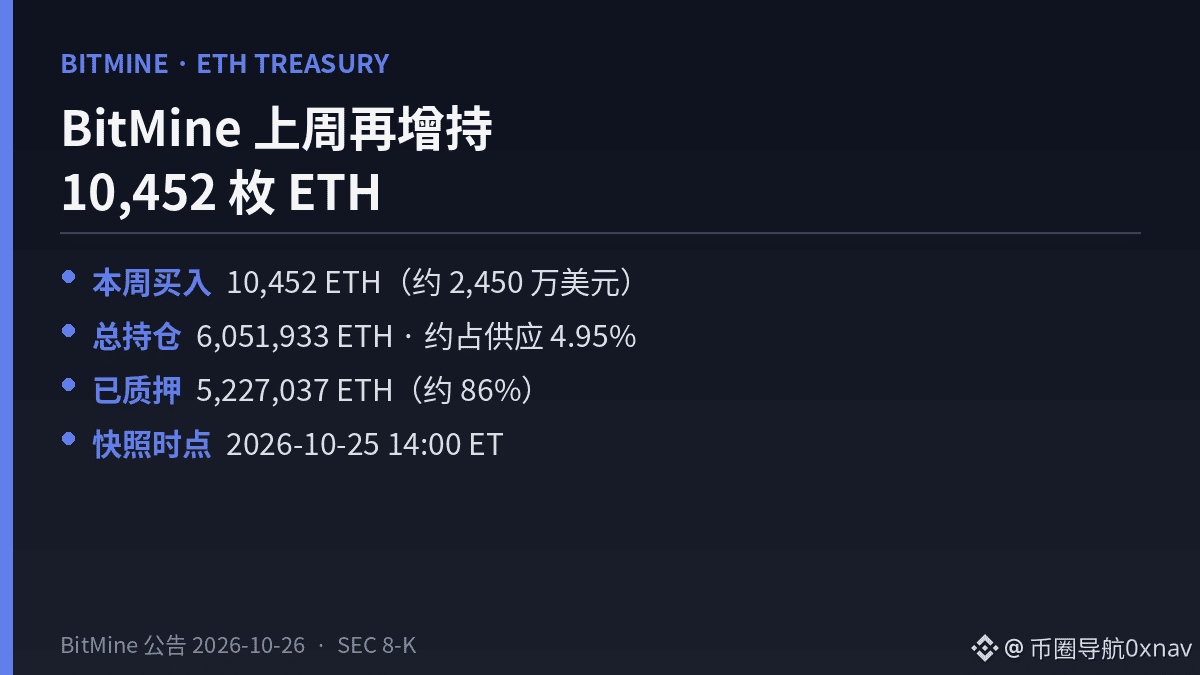
🔹 BitMine Immersion (NYSE: BMNR) announced on October 26 that it had added another 10,452 ETH over the past week. As of 14:00 ET on October 25, its total holdings stood at 6,051,933 ETH.
🔹 Based on the company’s figures (a total supply of about 122.2 million ETH), that’s roughly 4.95%—just 0.05 percentage points shy of its publicly stated “Alchemy of 5%” target.
🔹 At the same time, with ETH priced at about $2,356 on Coinbase, the holdings were worth roughly $14.3 billion. The company also disclosed that it had staked 5,227,037 ETH (about 86% of its total holdings), representing annualized staking income of about $318 million at the current staked amount.
🔹 The company says it has been buying every week since launching its ETH treasury strategy on June 30, 2025. This latest purchase of 10,500 ETH was slightly slower than in recent weeks, but the direction hasn’t changed.
🔹 Its assets aren’t limited to ETH: it also holds 215 BTC and about $514 million in cash and marketable securities. Crypto, cash, and other investments total roughly $15 billion—and that figure fluctuates daily with crypto prices.
Put simply: this is another step forward for the “companies stockpiling ETH on their balance sheets” narrative—not a signal for retail investors to follow suit. For everyday investors, the more important questions are whether buying will slow at the margin once the 5% target is reached, and whether staking income can offset share-price volatility—not whether “bought another 10,000 coins” means prices are guaranteed to rise in the short term.
Do you think BitMine will keep buying every week after reaching 5%, or will it really stop, as its slogan suggests?
#BitMine增持10452枚ETH #ETH #BTC
327
·
--
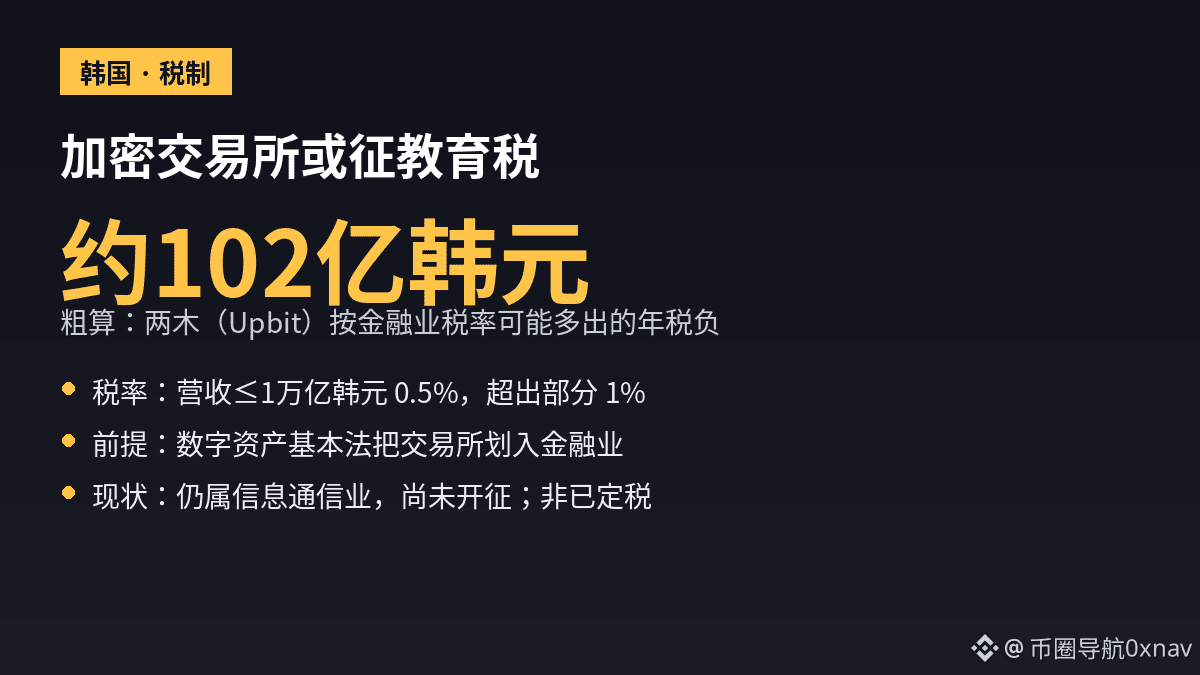
It’s the same Korean crypto tax story, but this time it’s not targeting the profits in your account—it’s targeting exchanges’ business revenue. If they’re classified as part of the financial industry, the education tax could hit platforms first and then be passed on indirectly through trading fees.
A few details that are easy to miss 👇
🔹 According to an exclusive report by the Seoul Economic Daily on October 26, the government raised the issue of an “education tax” when meeting recently with executives from domestic exchanges. If the Digital Asset Basic Act brings exchanges under the financial and insurance industry classification, they could face this tax. Crypto trading and brokerage are currently classified as information and communications activities, so they don’t pay it for now.
🔹 The financial-sector education tax is calculated on operating revenue, not profit: from this year, it’s 0.5% on the portion of the tax base up to 1 trillion won and 1% on anything above that. Even businesses that lose money still have to pay, as long as they have taxable revenue.
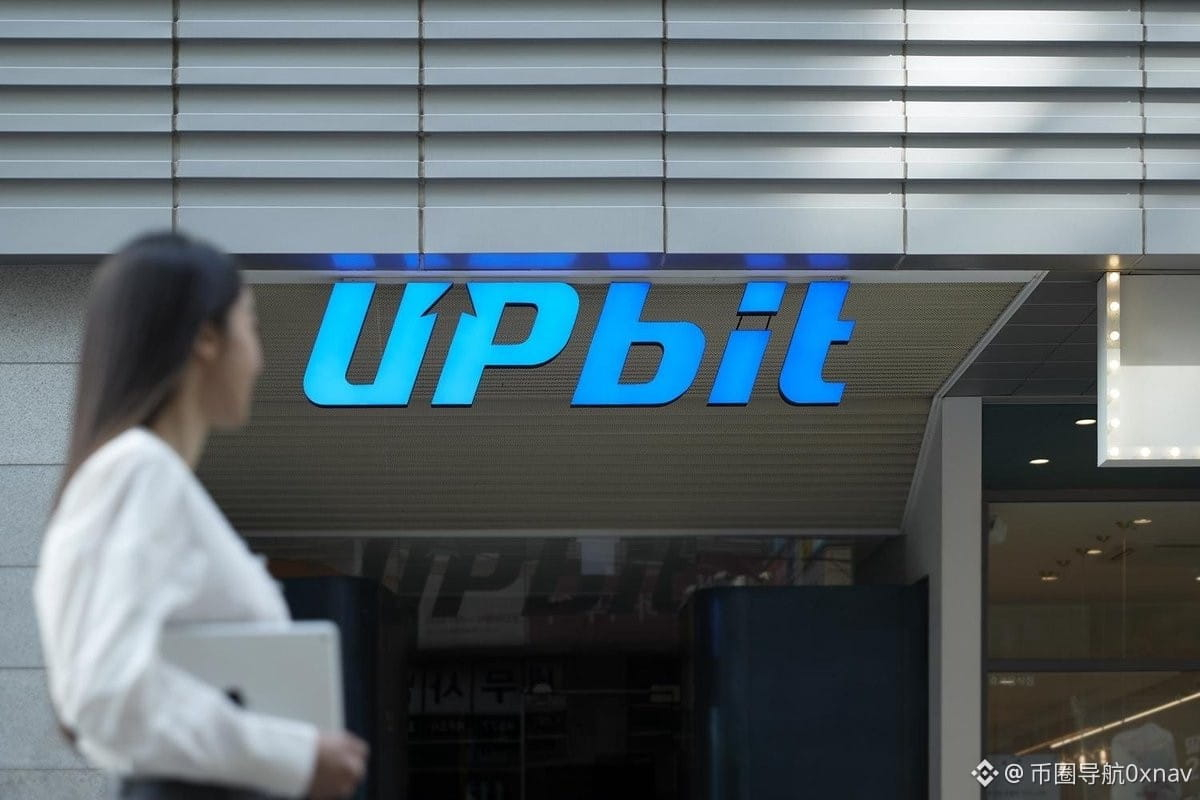
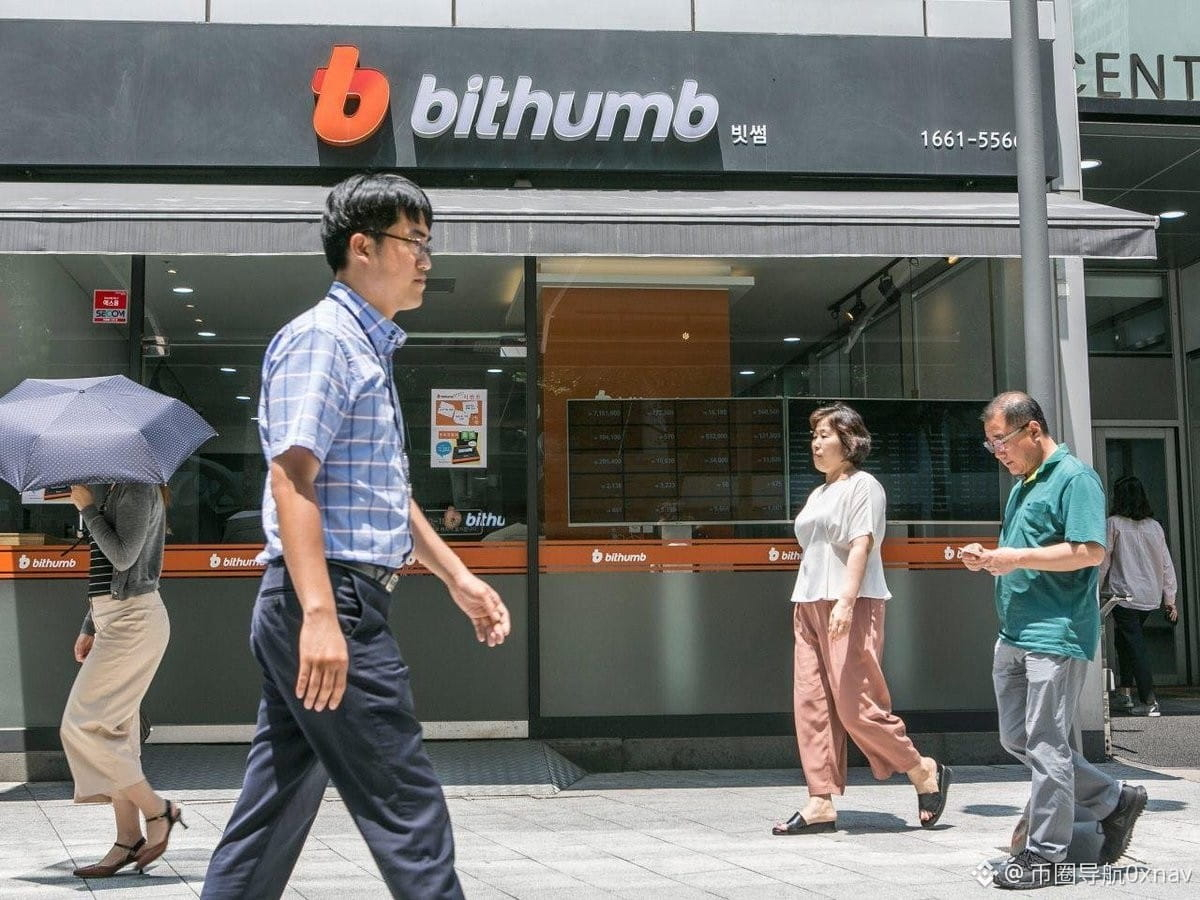
🔹 A rough estimate of the scale (based on media calculations assuming full application to 2025 financial statements): Dunamu, Upbit’s operator, with annual revenue of about 1.52 trillion won, would owe around 10.2 billion won; Bithumb, with about 651.3 billion won in revenue, around 3.2 billion won. This assumes they are designated as liable taxpayers—the tax has not already been imposed.
🔹 For ordinary users, this may not necessarily be bad news across the board: if exchanges are classified as part of the financial industry, trading fees could become VAT-exempt. Platforms might also cut discounts or raise fees to absorb the education-tax cost. How fees ultimately change will depend on how these factors offset one another.
🔹 The official position is that this is under “discussion/review,” not that a tax-law amendment has been passed. The actual trigger would be changes to classification and the taxation system after the Digital Asset Basic Act takes effect.
Put simply: the 22% personal income tax is a separate issue; this education tax would target platform revenue first. In the short term, Korean retail investors should pay closer attention to trading fees and whether platforms pass on their costs—not treat “about 10.2 billion won” as a tax bill they’ll personally have to pay right away.
What do you think—will more of this cost ultimately be passed on through trading fees, or offset by VAT exemption?
#韩国考虑对加密交易所征教育税 #BTC #ETH
3.8k
·
--
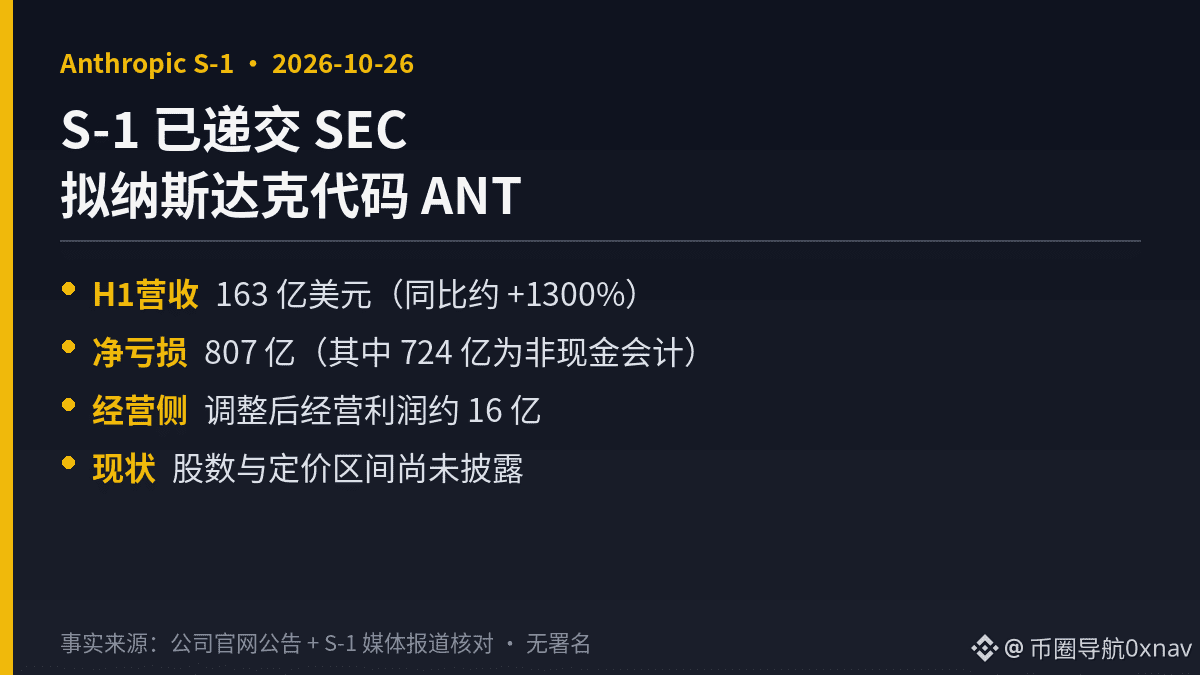
The trending tag still says “Expected today,” but Anthropic actually filed its S-1 with the U.S. Securities and Exchange Commission (SEC) on October 26.
A few easy-to-miss details 👇
🔹 Official confirmation: Anthropic, PBC filed a Form S-1 for a proposed initial public offering of Class A common stock. It plans to list on the Nasdaq Global Select Market under the ticker ANT. The number of shares and price range haven’t been set yet, and the shares can’t be sold before the registration statement becomes effective.
🔹 First-half figures: Revenue for the first half of 2026 was about $16.3 billion, up roughly 1,300% year over year. Net loss for the same period was about $80.7 billion—with roughly $72.4 billion stemming from valuation changes in convertible notes and other instruments (an accounting charge, not an equivalent amount of cash burned).
🔹 Figures closer to actual operations: Operating loss narrowed to about $693 million (compared with about $2.1 billion in the same period last year). Excluding stock-based compensation and other items, the company reports adjusted operating profit of about $1.6 billion for the first half. Cash flow from operating activities turned positive for the first time, at about $3.9 billion.
🔹 Structure and concentration: The company is a Delaware public benefit corporation (PBC). Its five largest customers accounted for about a quarter of revenue in the first three quarters of 2026, and close to half of its revenue comes through cloud marketplaces such as Amazon, Google, and Microsoft.
🔹 For crypto readers: This isn’t a stock you can buy right now; it’s a public snapshot of AI capital spending and risk appetite. Swings in U.S. tech and AI sentiment often ripple through the pricing of risk assets like Bitcoin and altcoins—but don’t mistake IPO buzz for a trading signal.
In short: filing the paperwork doesn’t mean you can buy in tomorrow. What really matters is the price range once it’s announced, losses excluding accounting noise, customer concentration, and whether ongoing compute commitments will keep squeezing cash flow.
Would you treat “a major AI company going public” as a signal of risk appetite in the next phase, or keep focusing only on the on-chain data you track?
#Anthropic预计今日公布S1招股书 #BTC #ETH

174
·
--
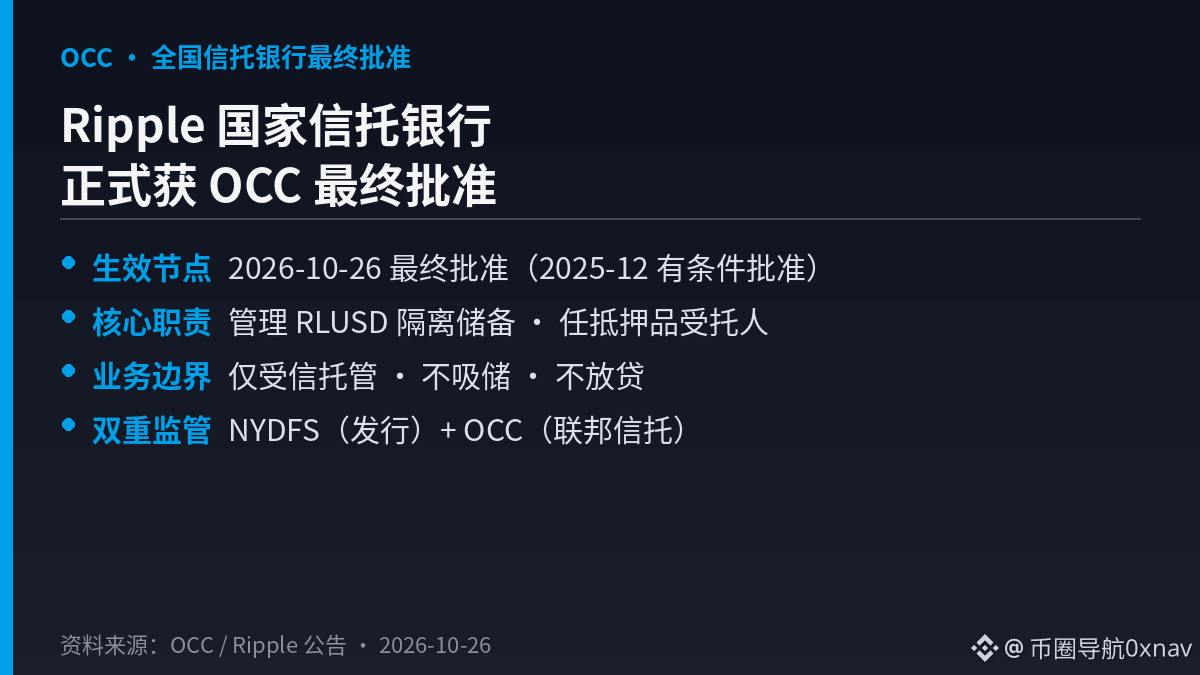
Who’s actually managing the reserves behind the stablecoins you hold? Ripple has a federal-level answer: the U.S. Office of the Comptroller of the Currency (OCC) has given final approval for the formation of Ripple National Trust Bank (RNTB).
A few easy-to-miss details 👇
🔹 Timeline: It received conditional approval on December 12, 2025, followed by final approval on October 26, 2026. Proposed charter number: 25364. Headquarters: New York.
🔹 What it means most directly for everyday users: RNTB is authorized to manage the segregated reserves backing RLUSD and serve as trustee for the reserve collateral. In plain English, the basket of dollar assets backing the RLUSD you hold now has an additional layer of federal trust oversight.
🔹 The issuer hasn’t changed: RLUSD is still issued by Standard Custody & Trust Company, which is regulated by the New York State Department of Financial Services (NYDFS). The OCC adds federal oversight, creating a state-and-federal double layer of supervision.
🔹 What it can and can’t do: It can provide fiduciary custody and reserve management, but it can’t take deposits or make loans. It can also provide digital asset custody to business clients.
🔹 The broader context: On the same day in December 2025, Circle, Paxos, BitGo, and others also received conditional approval. Ripple is the first to turn that “conditional” approval into “final” approval.
Put simply: This isn’t just another marketing headline. It formally brings stablecoin reserves and custody under the U.S. national trust bank framework. For holders, redemption and reserve transparency gain another layer of federal backing; for competitors, the compliance lane just got narrower. Don’t treat this as a buy or sell signal. What really matters is whether reserve disclosures and redemptions can keep pace with the charter narrative.
Would you trust a stablecoin more if its reserves were overseen by a federal trust bank, or stick with the one you know best?
#加拿大提议稳定币赎回规则 #BTC #XRP

130
·
--
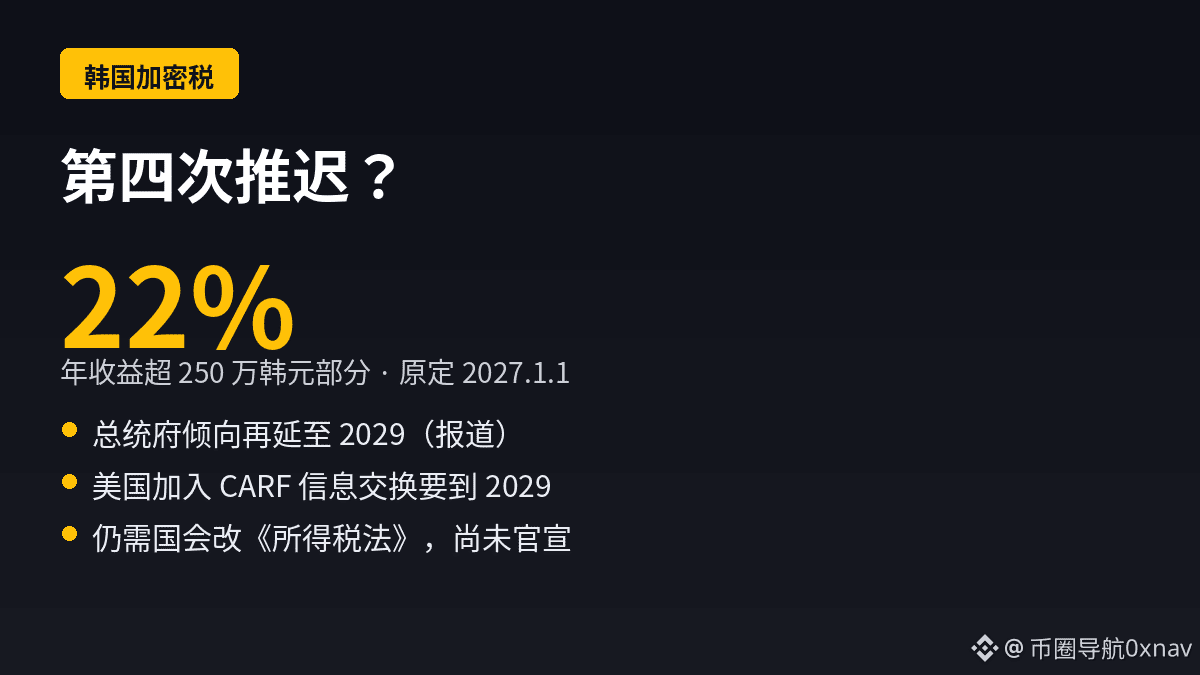
South Korea’s crypto income tax, originally set to take effect on January 1, 2027, looks set to be delayed by another two years.
A few details that are easy to miss 👇
🔹 The tax rate remains about 22% in total (other income tax + local tax). Each year, income from transferring or lending virtual assets is taxed only after deducting the basic exemption of 2.5 million won—the rules are laid out in the current Income Tax Act and haven’t changed.
🔹 Under the original plan, the tax would take effect on New Year’s Day next year. Another delay would be the fourth since the legislation was passed in 2020, with 2029 widely cited as the new target year.
🔹 Presidential office officials told Korean media that discussions are “moving in the direction of a delay,” but the public position remains that “no final decision has been made.” Don’t mistake media reports for an amendment to the law.
🔹 One key concern: the US won’t join the OECD’s Crypto-Asset Reporting Framework (CARF) until 2029. If South Korea taxes crypto first and information from major overseas exchanges doesn’t match up, the tax burden could fall more heavily on users of domestic exchanges—drawing criticism of “reverse discrimination.”
🔹 Rules are also still incomplete for complex transactions, including deposits from overseas, cost-basis calculations for self-custody wallets, airdrops, and staking. The ruling party has already proposed an amendment to push the tax’s start date to 2029, and the opposition broadly supports another delay. The November tax review will be a key moment to watch.
Put simply: for South Korean retail investors, this looks more like another two-year reprieve from having to rush into tax planning around a 22% rate. But the reprieve isn’t permanent—the tax will only be truly delayed if the National Assembly changes that 2027 date in the law.
Do you think a fourth delay would be pragmatic, or another case of regulation being kicked down the road?
#据报韩国考虑第四次推迟加密税 #BTC #ETH

2
1.8k
·
--
A publicly traded company that hoards Bitcoin has actually surpassed the Nasdaq exchange operator itself in market value.
A few easily overlooked details 👇
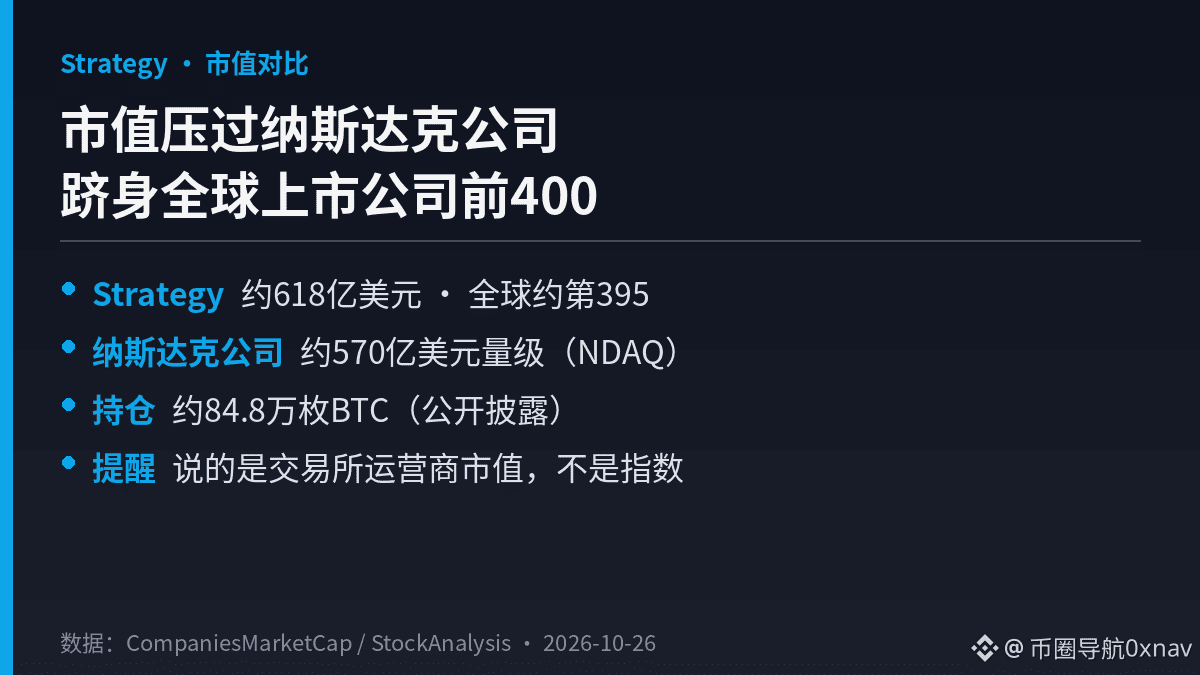
🔹 This refers to the market cap of Strategy (formerly MicroStrategy, ticker MSTR), compared with that of Nasdaq, Inc. (NDAQ)—not the Nasdaq index level.
🔹 Several market-cap rankings show Strategy recently at around $61.8 billion, ranked roughly 395th globally, while Nasdaq, Inc. was at around $57 billion, ranked outside the top 400.
🔹 A similar flip happened on September 3: the stock surged about 17.5% that day, briefly lifting its market cap to around $57 billion and above Nasdaq, Inc.’s. Since then, rankings have fluctuated along with Bitcoin and share prices.
🔹 The company has publicly disclosed that it holds about 848,000 bitcoins. Its market-cap story is closely tied to BTC’s price: gains can look like leverage, while losses can amplify the impact too.
🔹 Rankings can change every day. Don’t treat “making the top 400” as a permanent honor—it’s more like a market snapshot of how investors value a “Bitcoin-hoarding company.”
Put simply: this is the capital market assigning a value to a “Bitcoin balance sheet,” not a sudden boom in its software business. For ordinary investors, it’s more useful to watch its Bitcoin cost basis, financing-related dilution, and volatility than to focus on slogan-like market-cap rankings.
Do you think this “surpassing the exchange operator in market cap” comparison shows that institutions are more bullish on BTC, or is it just the climax of a leverage-driven narrative?
#Strategy市值超越纳斯达克跻身全球前400 #BTC #BNB
67
·
--
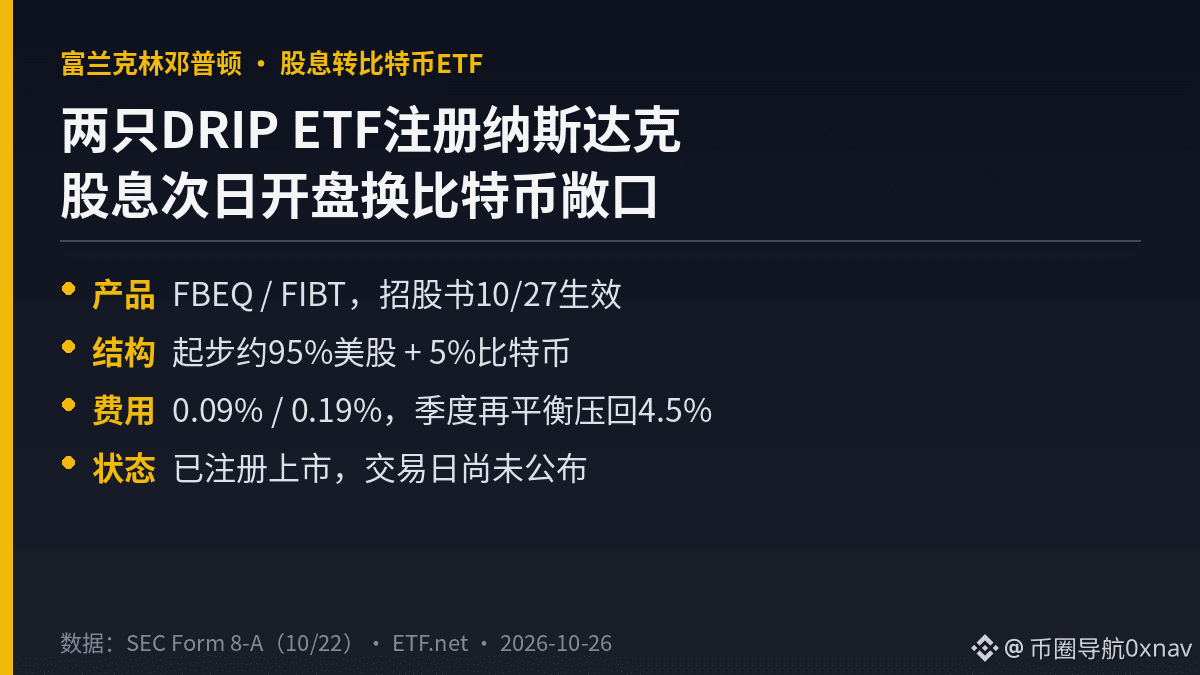
Ordinary stock dividends are automatically converted into Bitcoin exposure at the next day's market open—Franklin Templeton has built this pathway into two new ETFs.
A few easy-to-miss details 👇
🔹 On October 22, Franklin Templeton ETF Trust filed Form 8-A with the SEC, registering two products for listing on Nasdaq: FBEQ (Franklin US Equity Bitcoin DRIP Index ETF) and FIBT (Franklin US Innovation Bitcoin DRIP Index ETF)
🔹 The prospectus is dated October 27, when it becomes effective; this is the registration and effectiveness process, not the start of trading. The first trading day has not yet been announced
🔹 The initial allocation is about 95% US stocks + 5% Bitcoin-related exposure; regular and special stock dividends are reinvested on the Bitcoin side at the market open on the day after the ex-dividend date
🔹 Quarterly rebalancing: if Bitcoin's weight exceeds 5%, it is reduced to 4.5%; if it rises above 20% in between rebalances, the index will reduce it to 4.5% near the close of the second trading day after the trigger
🔹 Fees: about 0.09% for FBEQ and 0.19% for FIBT; they track the corresponding VettaFi “Bitcoin DRIP” indexes, not spot Bitcoin ETFs themselves
Put simply: this doesn't let you directly buy a basket of spot BTC. Instead, it gives people accustomed to buying stock ETFs a disciplined way to “drip” their dividends into Bitcoin exposure. For everyday investors, what really matters is whether they can trade it, the fees, how it's taxed, and whether they can tolerate the volatility of that 5% allocation—don't treat the buzz around the listings as a buy or sell signal.
Would you let your stock dividends “drip” into Bitcoin, or would you rather keep taking them in cash?
#富兰克林邓普顿申请股息转比特币ETF #BTC #ETH

243
·
--
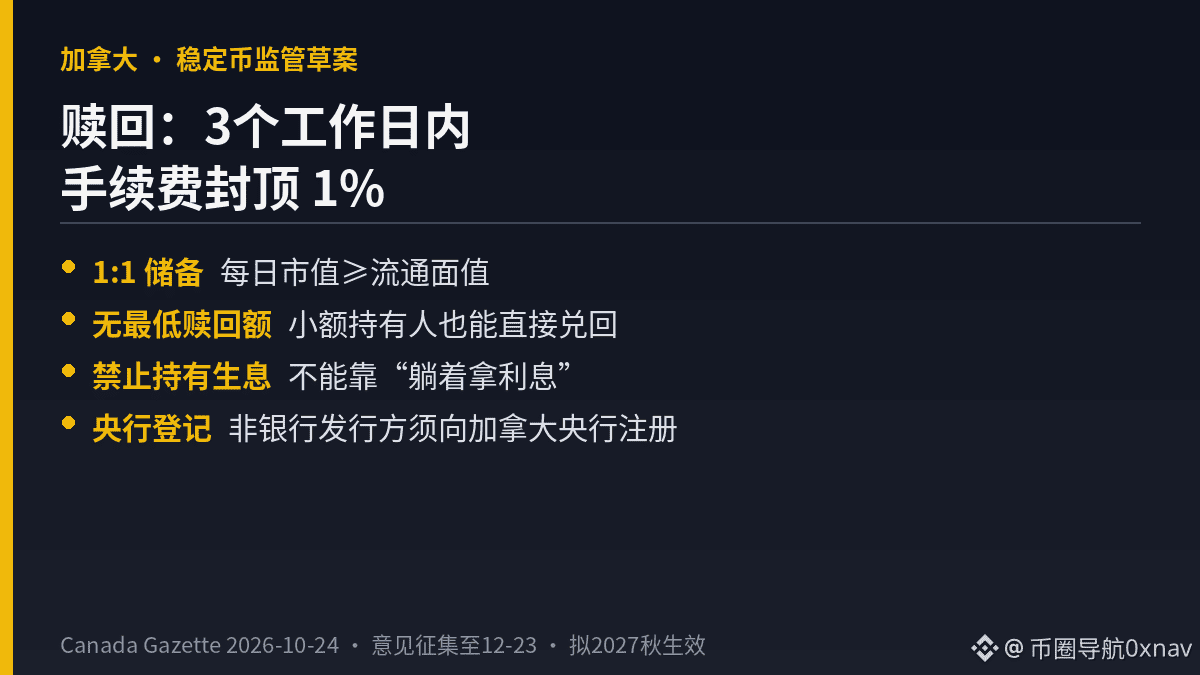
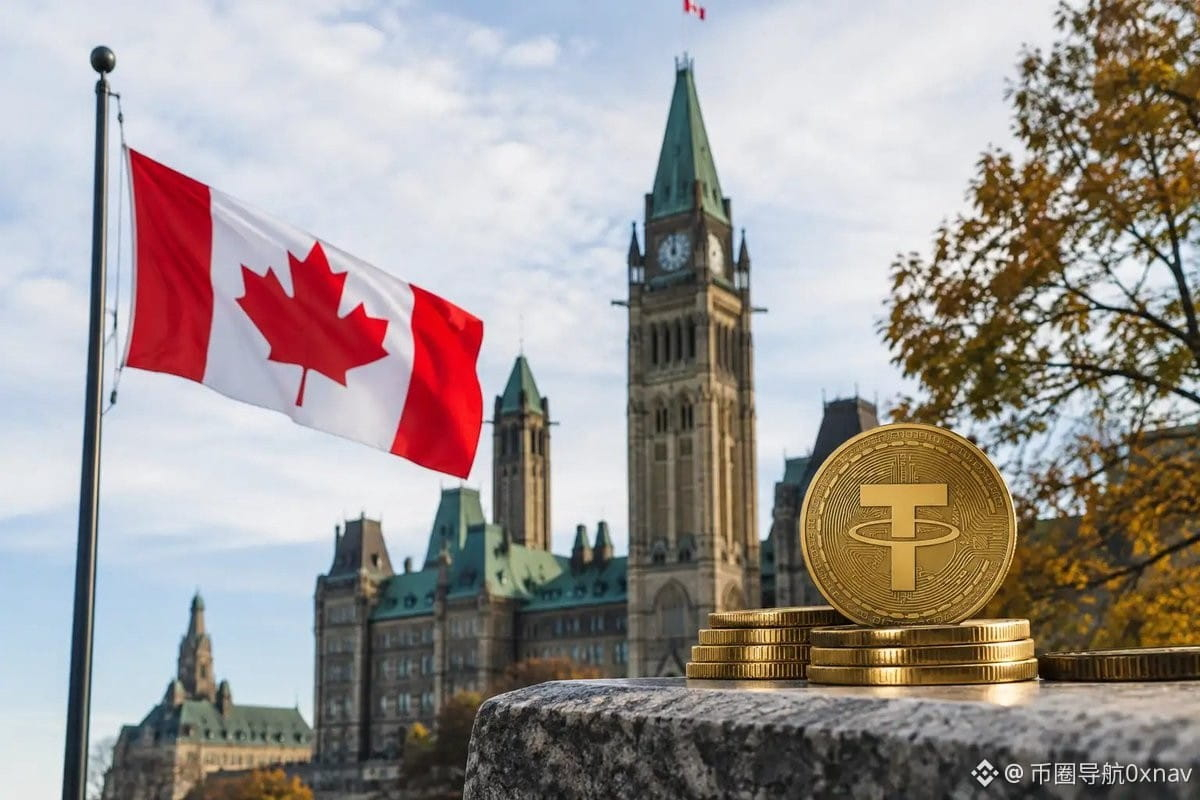
Can stablecoins be redeemed for fiat currency at any time? Canada’s draft rules make the answer clear: issuers generally have to begin redemption within 3 business days, fees can’t exceed 1%, and there’s no minimum redemption amount—even if you hold just a little, you can go directly to the issuer to get your money back.
On October 24, the Department of Finance Canada published draft Stablecoin Regulations in the Canada Gazette to implement the Stablecoin Act, passed this March. Here are the key points that matter directly to everyday people👇
🔹 1:1 reserves: At the end of each day, the market value of reserve assets must be at least equal to the face value of stablecoins in circulation; reserves can only consist of high-quality liquid assets, such as cash and short-term securities
🔹 Redemption timeline: Complete the redemption process within 3 business days of receiving a request (sell reserve assets and initiate the fiat transfer)
🔹 Fees capped at 1%, with at least 7 days’ notice on the issuer’s website before any fee increase
🔹 Issuers can’t pay holders interest or yield just for holding stablecoins; rewards for encouraging their use are allowed
🔹 Non-bank issuers must register with the Bank of Canada; financial institutions such as banks and credit unions are outside the scope of this law
🔹 Public consultation runs until December 23, with the rules expected to take effect alongside the Act in fall 2027—these are still draft rules, not yet in force
In plain English: in the future, if you buy, use, or redeem stablecoins in Canada, redemption timelines and fee caps will be set out in law. Issuers also won’t be able to compete with bank deposits by offering “interest for holding.” For stablecoin holders, that means an extra layer of redemption protection; for projects looking to issue stablecoins, it means a higher compliance bar.
Do you think 3 business days and a 1% fee cap are fair for everyday users?
#加拿大提议稳定币赎回规则 #BTC #ETH
1
1
5.3k
·
--
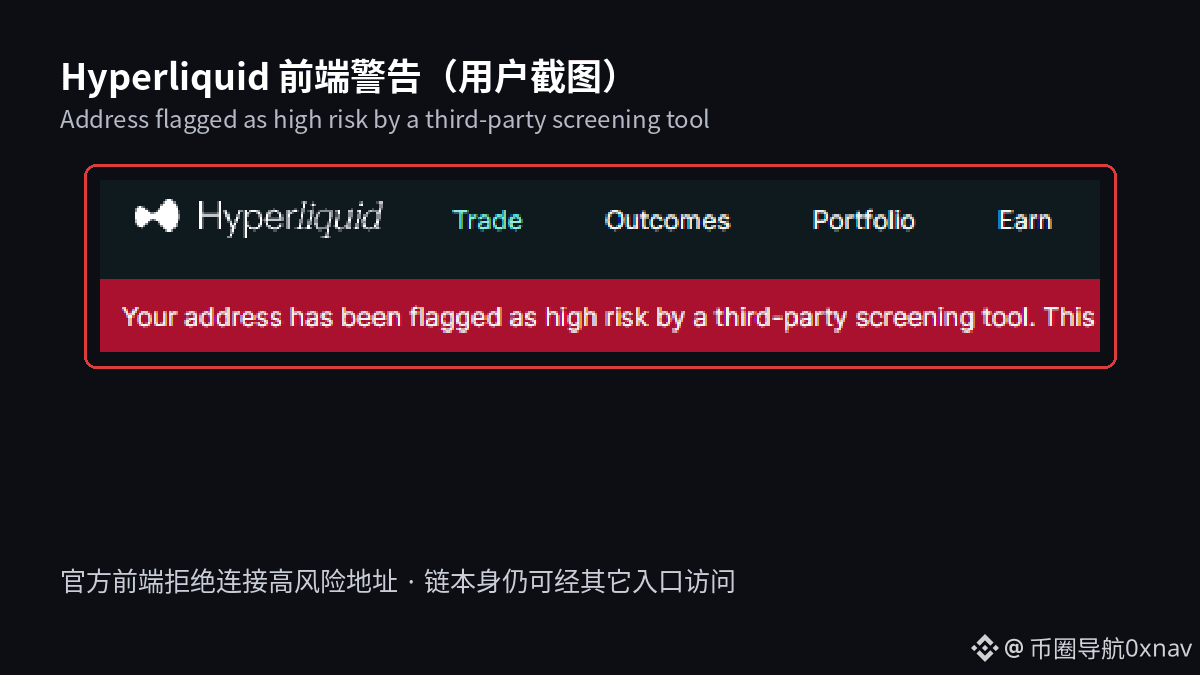
Just now, a Hyperliquid user reported that they had never opened a Huobi HTX account and had only received a loan repayment from a friend, yet the official frontend flagged their wallet as “high risk” and wouldn’t let them connect.
A few easily overlooked details 👇
🔹 What happened: A few months ago, the user lent a friend several thousand dollars. The friend repaid them via a transfer from HTX (formerly Huobi). The user had never used HTX, and the friend didn’t know at the time that the platform had sanctions-related issues.
🔹 Frontend notice: A red warning appeared on the official interface, saying the address had been flagged as high risk by a “third-party screening tool” and that the frontend does not support connecting high-risk addresses to the Hyperliquid chain.
🔹 Sanctions background: On May 26 this year, the UK added Huobi Global S.A. to its Russia-related financial sanctions list. The UK Office of Financial Sanctions Implementation (OFSI) later clarified that HTX also falls within the scope of the sanctions due to its ownership structure. HTX, for its part, maintains that it is not the same legal entity as Huobi Global S.A.
🔹 Scope of impact: The chain itself can still be accessed through other gateways or via API, but logging in through the official frontend—and claiming some airdrops that rely on the official interface—may be blocked. Users have reported similar cases since June.
🔹 What remains unclear: Hyperliquid has not publicly explained the specific rules behind this flagging. Some users worry that even tiny “dust” transfers could taint an address, but there has been no official confirmation of an automatic guilt-by-association mechanism.
In short: sanctions screening doesn’t just look at whether you’ve directly used a particular exchange. Even indirectly receiving funds connected to it could get you blocked by the frontend. Don’t rush to send coins from sanctioned or high-risk platforms to your regular trading wallet; if you receive a small transfer from an unknown source, don’t casually consolidate it into another address either.
Would you keep your “regular trading address” separate from your “receiving address”?
#英国算法加密交易应用或需FCA授权 #BTC #ETH

100
·
--
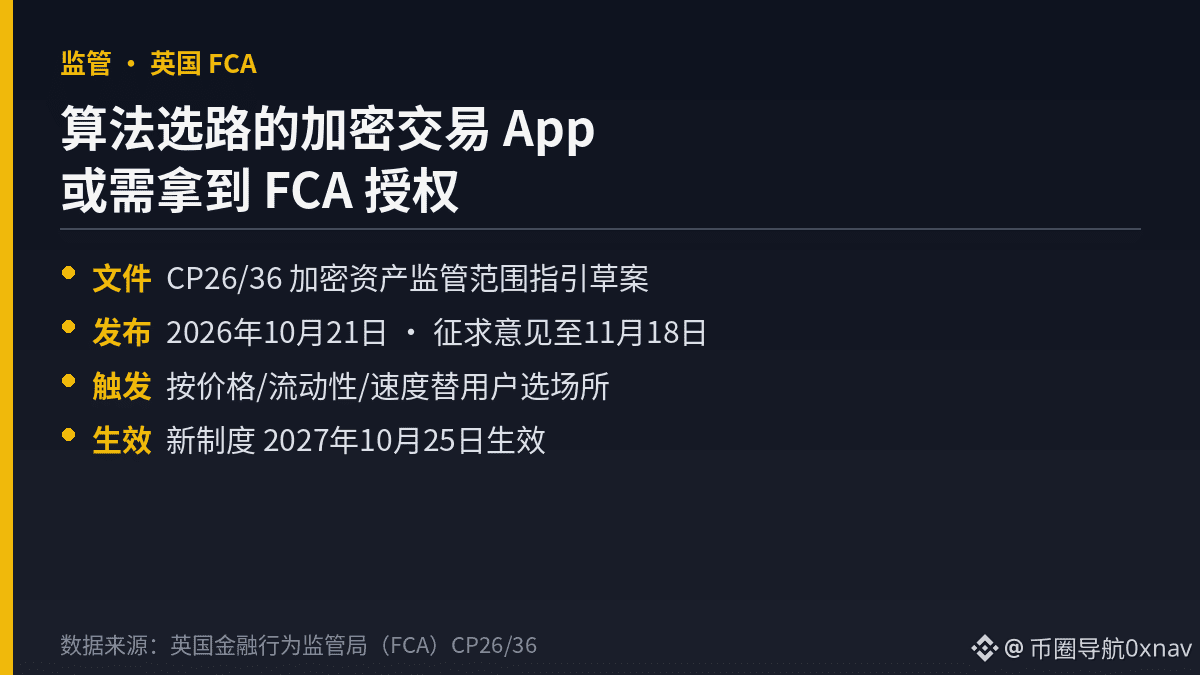
Just now, the UK’s Financial Conduct Authority (FCA) has put a “gray area” for crypto trading apps into a draft: if software selects a trading venue or execution route for users based on price, liquidity, cost, or execution speed, it could be considered to be “arranging cryptoasset transactions.” Once the new regime takes effect in 2027, businesses of this kind may need FCA authorization.
A few easily overlooked details 👇
🔹 Document: Draft guidance on the regulatory perimeter for cryptoassets, CP26/36, published on October 21, 2026; consultation closes on November 18
🔹 What triggers it: It’s not the use of an algorithm itself, but whether there is “discretionary involvement”—modifying instructions, deciding when to execute, or choosing a route based on counterparty risk or expected outcomes could all be warning signs. Promising customers “best execution” could also attract scrutiny
🔹 Exemption boundary: A technical interface that simply relays user instructions unchanged to a third-party platform or decentralized protocol, without intervening in execution, may still qualify for the technology services exemption
🔹 Technology offers no protection: Using algorithms, smart contracts, or distributed governance does not automatically remove regulatory obligations. Responsibility depends on the activity in practice, not the story told by the code
🔹 Timeline: Existing businesses must apply by February 28, 2027; the full new regime is scheduled to take effect on October 25, 2027
Put simply: teams offering aggregators, smart order routing, or automated price comparison to customers in the UK will soon need to answer not “Am I decentralized enough?” but “Am I making execution decisions on the user’s behalf?” Individuals who write their own quantitative trading scripts and don’t provide services to others are generally not the target of this initiative.
Would you keep your aggregator because of those two words, “best price,” or rather turn off automatic routing?
#英国算法加密交易应用或需FCA授权 #BTC #ETH

17
Log in to explore more content
Join global crypto users on Binance Square
⚡️ Get latest and useful information about crypto.
💬 Trusted by the world’s largest crypto exchange.
👍 Discover real insights from verified creators.
Email / Phone number