
“Annualized 20%”——When you first see this number on the YGG official staking page, your heart might skip a beat. But upon closer inspection, you find that the rewards are not paid in YGG, but in “vault earnings sharing”, distributed in USDC or game tokens. Strangely, the longer the lock-up period, the lower the APY.
This is completely different from the 100% mining APY often seen on Uniswap.
So many people conclude that staking YGG is not worth it, and it's better to trade meme coins.
But perhaps the issue is not with the level of returns, but with using the wrong measurement standards.
The essence of staking YGG has never been 'high-yield investment,' but rather a right to participate in the dividends of a virtual economic entity. Its returns do not come from transaction fees or inflation subsidies, but from the real cash flow of the YGG treasury—player gold-sharing, NFT rental income, new project cooperation commissions, etc.
Let me give a specific example:
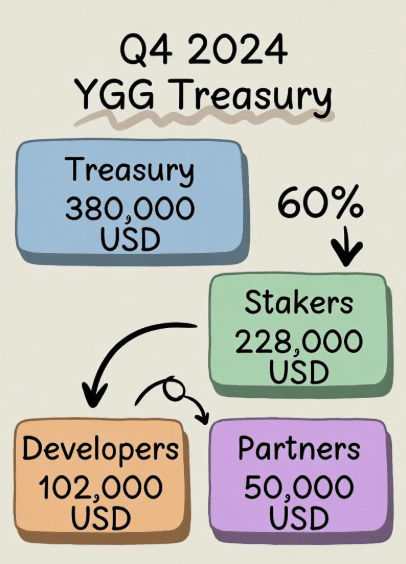
In the fourth quarter of 2024, the total revenue of the YGG treasury was about $380,000, of which 60% was allocated to stakers. If you staked 10,000 YGG at that time (about 0.5% of the total staking amount calculated at a YGG price of $0.7, with an annualized return rate of about 11%. It may not seem high, but please note: this money is 'net cash flow,' not an illusion of returns obtained by issuing new tokens.
More importantly, staking also comes with enhanced governance weight. Under the veYGG model, users who lock their tokens for 1 year have voting power that is twice that of non-locked users, and it can reach 4 times for those who lock for 4 years. This means you can exert a greater influence on the treasury—such as pushing investments into games you are familiar with, thereby indirectly enhancing your future returns.
Of course, reality has a harsh side:
If GameFi as a whole is sluggish and treasury income decreases, your dividends will naturally shrink;
Game token rewards may depreciate (for example, a certain chain game token dropped by 90% in six months);
YGG itself has significant price fluctuations. Even if you earn a 10% dividend, if the token drops by 30%, you still end up with a loss.
Therefore, whether staking $YGG is 'profitable' depends on how you define 'profit':
If you are pursuing short-term high profits, it indeed lacks sex appeal;
But if you believe that YGG can become the infrastructure-level DAO for Web3 games in the next three years, then staking is a low-cost way to acquire its 'equity + governance rights.'
It's like staking ETH in 2016—there were no returns at that time, only faith. Looking back now, the true returns are not in the APY numbers, but in the long-term value reassessment brought by the rise of the ecosystem.
The YGG flywheel turns slowly, but every step is grounded.
Those who stake it are not betting on tomorrow's APY, but on three years later, when millions of players enter the virtual world through the YGG Portal, how much that economy governed by them will be worth.
@Yield Guild Games #YGGPlay $YGG
