
In 2023, a Filipino player received a bank notice: his account was frozen due to "frequent receipt of cryptocurrency exchange funds." He was just playing a few hours a day (Axie Infinity), converting SLP to pesos to support his household. For him, this was a livelihood; for regulators, it could be an undeclared cross-border compensation activity.
YGG never imagined it would be caught in the whirlpool of labor law, foreign exchange control, and securities identification. But when it leases NFTs to players in 100 countries and takes a cut from their gaming revenues, it has effectively built a decentralized employment network on a global scale—yet this world is still governed by centralized legal systems.
Labor relationship? Or asset leasing?
The core controversy lies in: what is the relationship between Scholar and YGG?
If it is 'leasing,' then it is just a temporary transfer of NFT usage rights, legal and simple;
But if a Scholar is required to complete specific tasks, adhere to scheduling, and accept performance evaluations, regulators may determine that this constitutes a factual employment relationship.
In the EU, some countries have begun to regard P2E income as 'self-employment income,' which must be declared for tax; in Indonesia, the central bank has explicitly warned that 'earning foreign currency through games may violate foreign exchange laws'; while in the US, the SEC has hinted that if DAO tokens are used to distribute 'profits from the efforts of others,' it may constitute securities.
YGG's response strategy is very pragmatic: decentralized responsibility, localized compliance.
The main DAO does not directly contract with individuals, but handles local operations through SubDAOs or third-party platforms (such as Yield Guild Games SEA Pte Ltd). This way, legal risks are isolated within the jurisdiction. For example:
Register an entity in Singapore to handle Asian treasury settlements;
Collaborate with local payment gateways in Latin America to exchange USDC for local currencies;
In Japan, only collaborate with licensed virtual asset service providers to distribute NFTs.
But this is just a stopgap measure. The real challenge lies in the borderless nature of Web3, which fundamentally conflicts with the sovereign boundaries of nation-states.
Compliance is not a cost, but an admission ticket.
Interestingly, YGG is turning regulatory pressure into a competitive advantage.
In 2024, it collaborates with a licensed fintech company in the Philippines to launch the 'YGG Earn' wallet—automatically withholding income tax, generating annual income reports, and supporting direct withdrawals in pesos. The result? Local banks no longer freeze user accounts and even proactively offer low-interest loans to active Scholars.
This sends a signal: compliance is not a restraint, but a bridge that allows the Web3 economy to truly integrate into the real financial system. In the future, DAOs that can pass KYC/AML reviews in various countries will gain more stable user growth and institutional cooperation opportunities.
Of course, the cost is a compromise on decentralization. The completely anonymous Scholar model is waning, replaced by a hybrid solution of 'verifiable identity + privacy protection'—for example, proving you are over 18 and reside in a certain country using zero-knowledge proofs, without revealing your real name.
YGG's ultimate test may be: can it learn to coexist with the old world without betraying the spirit of the DAO?
It does not have to be friends with the government, but must avoid becoming its enemy. After all, no matter how powerful the code is, it cannot withstand a decree.
And those still fantasizing about 'completely breaking free from regulation' in GameFi projects might want to take a look at YGG's roadmap—true freedom is not about evading rules, but about forging new paths within the gaps of the rules.
@Yield Guild Games #YGGPlay $YGG
Illustration explanation: YGG's global compliance status
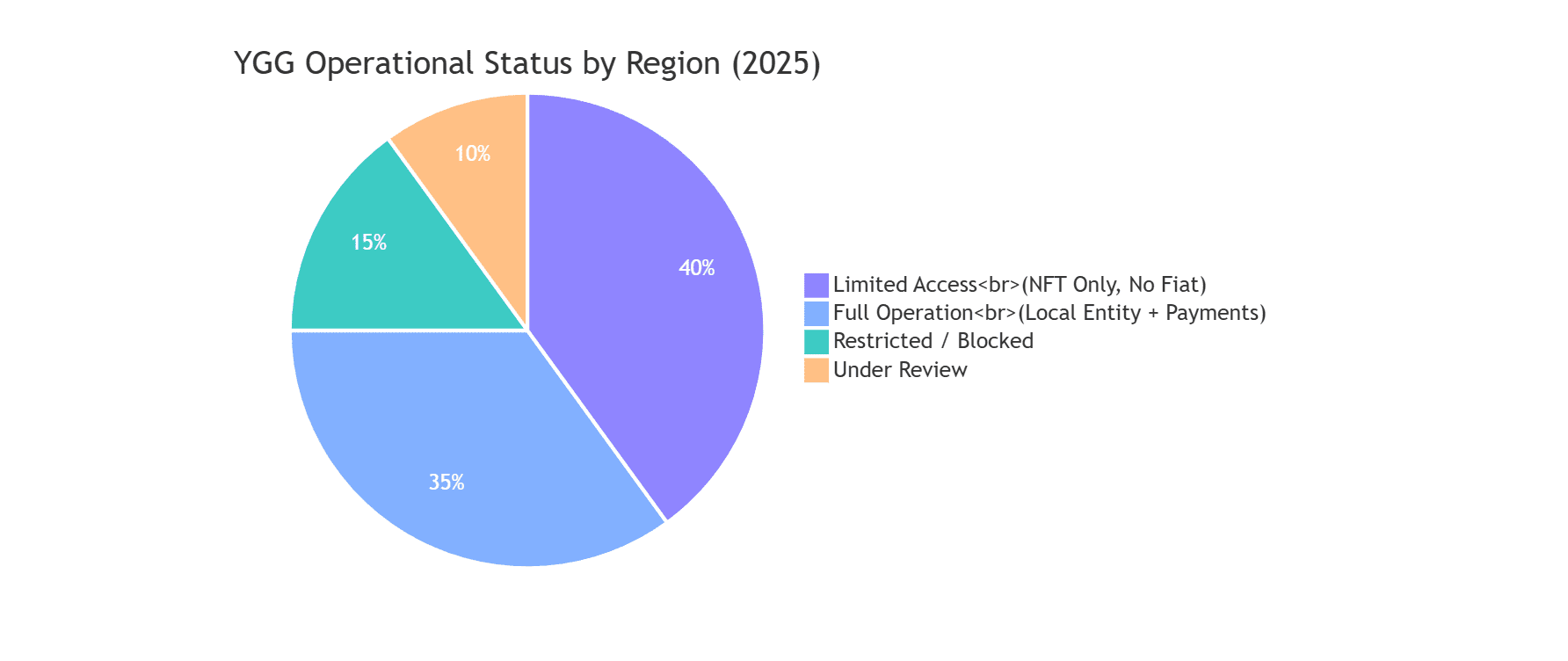
Full Operation: Southeast Asia (Philippines, Vietnam, Thailand), some Latin American countries, with local compliant entities;
Limited Access: Europe, America, Middle East, only supporting the circulation of crypto assets, unable to transact in fiat currency;
Restricted: China, some African countries, unable to operate due to policy prohibitions;
Under Review: India, Brazil, etc., in communication with regulatory agencies for pilot projects.


