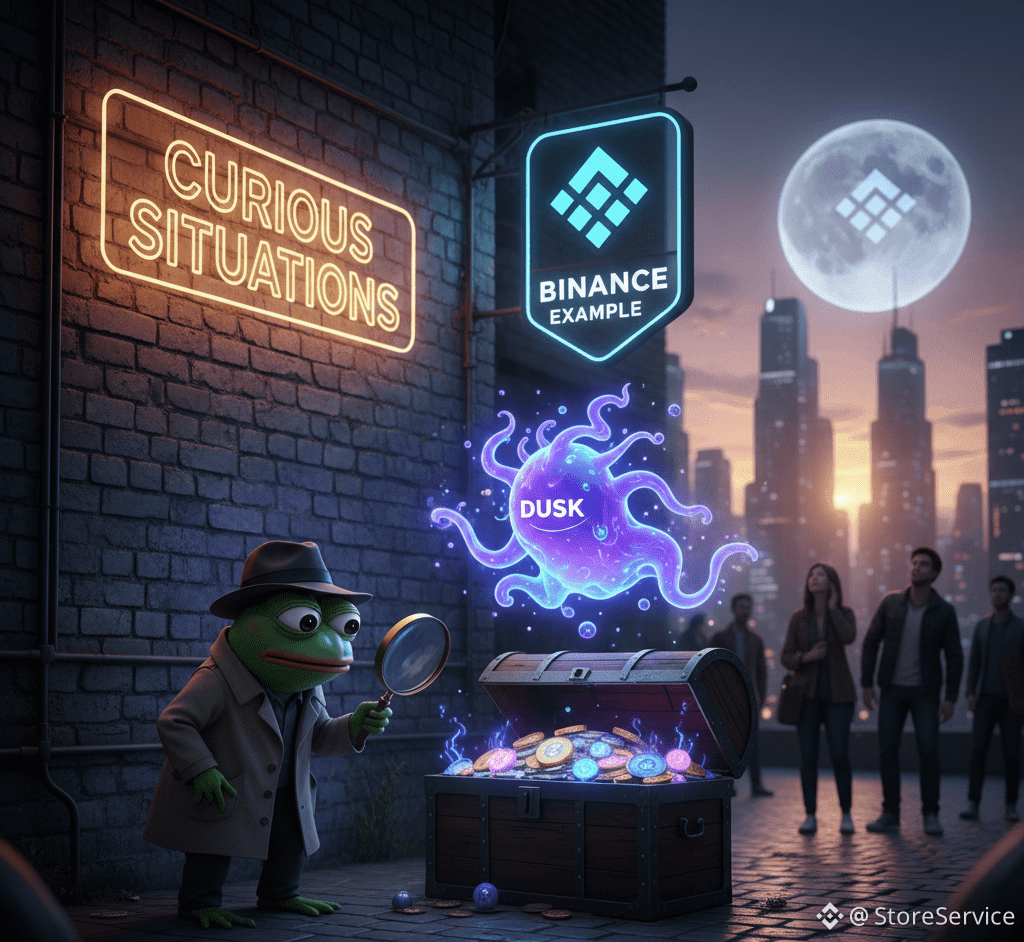
@Dusk is the native token of Dusk Network, a blockchain focused on privacy-preserving, regulated financial infrastructure and real-world asset (RWA) tokenization, using zero-knowledge proofs and EVM compatibility.
It aims to combine compliance with privacy — something few projects seriously attempt.
🔹 DUSK trades as an ERC-20 / BEP-20 token, with a circulating supply of ~486 million and a maximum supply of 1 billion.
🔹 The token is listed on several major exchanges, including Binance, where the DUSK/USDT pair is actively traded.
Despite having serious technical ambitions, the information space around $DUSK has produced some genuinely curious and ironic situations, showing how crypto projects often live very different lives in the minds of traders, users, and meme communities.

🧧 Curious Story — “Free crypto is the best crypto”
In October 2025, many users noticed that Binance distributed #dusk via Red Packets (Binance Pay) — meaning people could receive free tokens simply by joining a giveaway.
This quickly sparked jokes like:
🧧 “Free crypto is the best crypto — except when it disappears the moment you start thinking where to transfer it.” 😅
Posts and comments highlighted how a simple giveaway pushed users to:
generate QR codes,
share links in chats,
and compete to “catch” the biggest Red Packet.
It wasn’t a major financial event — but the mass participation effect and the memes around who got the ‘best’ packet turned into a recurring joke across crypto chats.
A classic airdrop-style irony - not about token value, but about attention, speed, and luck.
🧠 Even Serious Projects Can’t Escape Sarcasm
Another recurring ironic reaction appeared around DUSK’s Binance listing itself.
Some comments from the community included:
“What the f** is Dusk? Are you serious, Binance?”*
“DUSK? That’s a shitcoin.”
“Dusk = Dust 😂”
These reactions perfectly illustrate a familiar crypto paradox:
even a technically sophisticated project can be treated like a meme simply because most people don’t understand what it does.
In crypto, perception often has little to do with fundamentals.
🔁 A Similar Case from #Binance : When $PEPE Turns Irony into Momentum

A perfect comparison comes from #PEPE , a token traded on Binance that became a full-blown meme phenomenon.
PEPE was never built on deep technical utility. It is, by definition, a meme coin.
Yet it was precisely the community jokes, memes, irony, and “we know this is stupid” attitude that drove enormous trading volume and attention.
This led to several curious situations:
🚩 Examples of meme-driven absurdity:
sarcastic tweets instantly moving price;
traders buying PEPE simply because it was “the funniest meme”;
jokes about the price pumping “because the frog decided so.”
This is the curious power of narrative: people buying and selling not because of fundamentals, but because of humor, virality, and shared internet culture.
@Pepecoin
🧩 What Does This Tell Us?
🔸 DUSK is a technically serious project with real infrastructure goals, yet in the public info-space it is often reduced to sarcasm, jokes, or wordplay on its name.
🔹 Binance Red Packet giveaways created a wave of humor around “free crypto,” where users competed over speed rather than long-term value.
🔸 PEPE proves that in crypto, curious situations often arise not from the product itself, but from community behavior and collective psychology.
🧠 Final Takeaway
In the crypto information space, even projects with real technology and long-term vision can become the subject of irony, memes, and curious social reactions — from free token giveaways to name-based jokes like “Dust.”
Sometimes it’s not the fundamentals that make a token interesting — it’s how people react to it.