

Market sentiment is tough right now, but sticking to solid protocols helps keep perspective clear. With the market rate at -6.55%, technical utility remains the best metric during drawdowns.
As decentralized infrastructure faces growing security challenges, evaluating a network based on its native execution constraints is essential. This technical overview examines how the Newton Mainnet Beta introduces an architecture designed for deterministic safety and built in policy validation.
The Foundational Vision
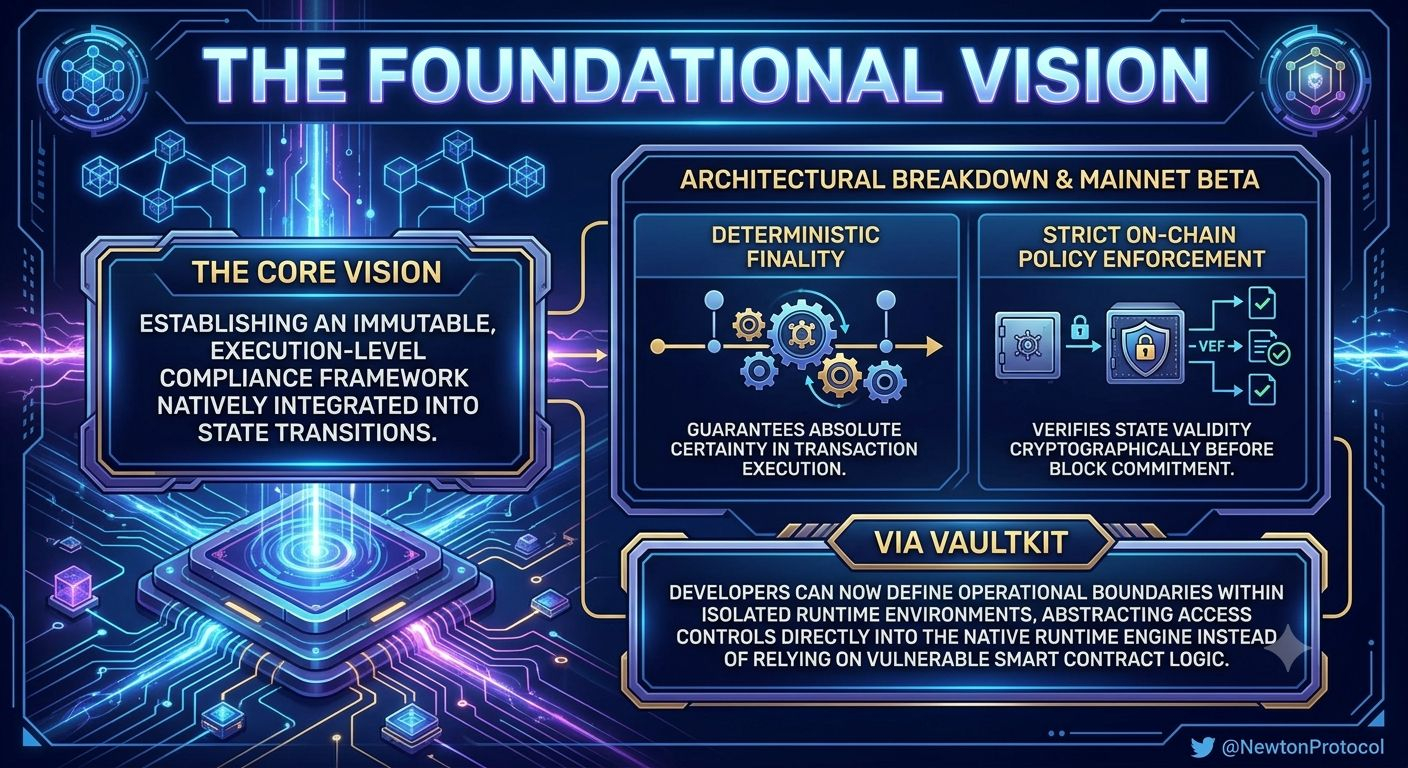
The core vision of @NewtonProtocol l centers on establishing an immutable execution level compliance framework natively integrated into state transitions.
Architectural Breakdown and Mainnet Beta
Architecturally the Newton Mainnet Beta achieves its security baseline by combining two pillars:
Deterministic Finality: Guarantees absolute certainty in transaction execution.
Strict On Chain Policy Enforcement: Verifies state validity cryptographically before block commitment.
Via VaultKit, developers can now define operational boundaries within isolated runtime environments abstracting access controls directly into the native runtime engine instead of relying on vulnerable smart contract logic.
Resolving Legacy Blockchain Limitations
This architecture directly resolves the core limitations of legacy infrastructure:
Legacy Layers: Depend on retroactive auditing or post-execution slashing executing state changes before validation and leaving them exposed to exploits.
The $NEWT Solution:
Blocks anomalous transactions at the pre settlement phase by making compliance an absolute constraint of consensus.
Forward-Looking Impact
Looking forward embedding policy validation directly into the network layer provides the deterministic zero-trust framework necessary for hosting institutional-grade decentralized applications (dApps).

Technical Discussion:
How does the computational overhead of pre execution policy enforcement impact cross shard synchronization latencies when scaling horizontally?