
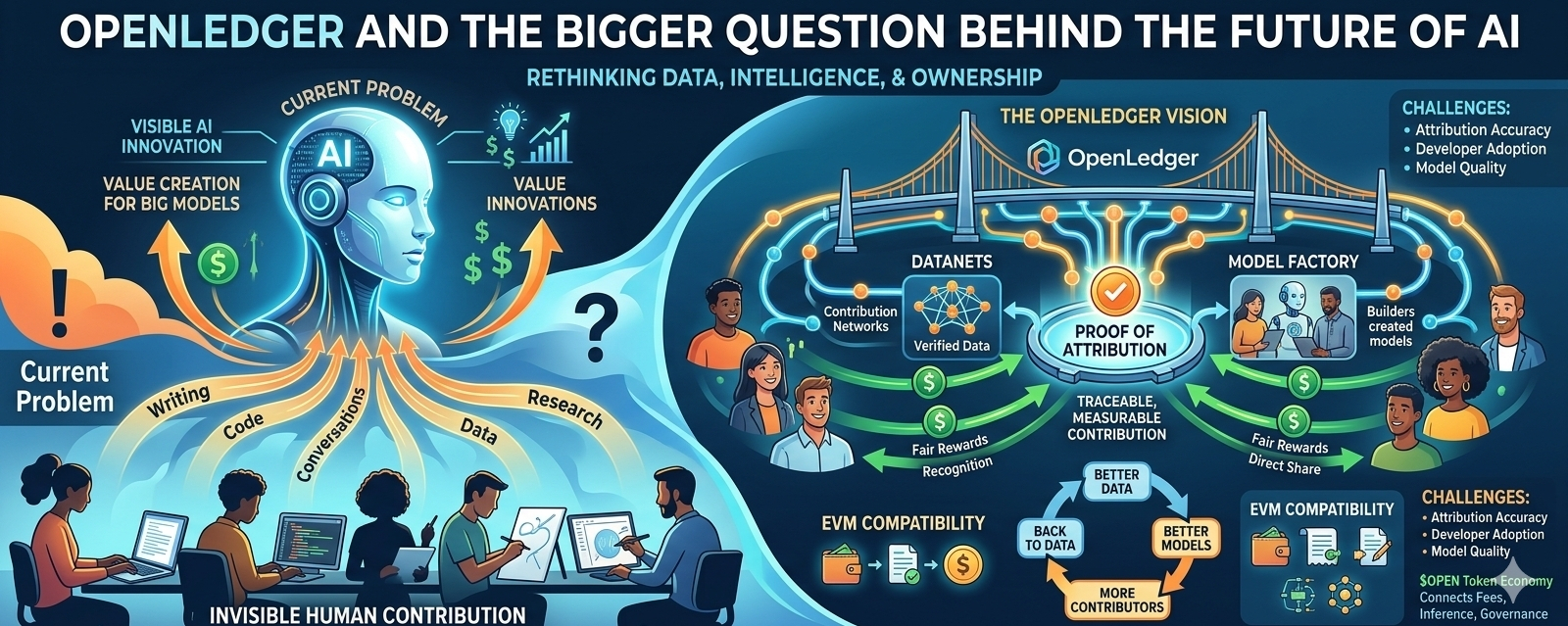
Sometimes I feel the real problem with AI is not only about the models. Everyone is talking about bigger systems, faster inference, better reasoning, stronger benchmarks and more advanced performance. And honestly, all of that is improving very fast. But somewhere inside this race, one very simple question keeps getting pushed to the side: who is actually creating the value that AI is using?
Because AI does not become powerful on its own. Behind every model, there is a massive layer of human-created data. People’s writing, conversations, research, images, code, opinions, mistakes, corrections, feedback and ideas all become part of the system in one way or another. This is the real foundation of artificial intelligence. But when AI turns that data into value, most of the benefit usually goes to the companies and model owners. The people who helped create the original value often remain invisible. No clear credit. No direct recognition. No fair share. And that is where the whole discussion becomes much deeper.
This is the reason OpenLedger caught my attention. At first glance, it can look like another AI and blockchain project, and honestly, there are already many projects in this space that only use AI as a trend. But when you look deeper, OpenLedger seems to be asking a more important question. It is not only focused on building a better AI model. It is trying to explore whether an AI economy can be built where contribution is traceable, measurable and rewarded.
That idea changes the direction of the whole conversation. Because data is not just something to be collected and used silently. It is a contribution. It has value. And if AI systems are becoming more powerful because of that data, then the people and communities behind it should not always stay outside the reward loop. This is where OpenLedger’s Datanets become interesting. They create a way for people to contribute, verify and share data for specific AI use cases. It may sound simple, but the meaning behind it is strong. Data starts becoming part of a living contribution network instead of just raw material for someone else’s model.
The Model Factory side also matters a lot. Many builders have ideas for AI tools, products and applications, but the technical barrier is still high. Not everyone can easily build, fine-tune or deploy AI models. If OpenLedger can make this process easier, then AI innovation does not have to remain only in the hands of big labs and large companies. Smaller builders, communities and developers can also create useful models around the data and problems they understand best.
But the most important part for me is Proof of Attribution. This is where the idea becomes more serious. Today, when AI gives an answer, it is very hard to know which data source helped create that output and how much it contributed. Everything gets mixed together. OpenLedger is trying to bring clarity to that hidden layer. If an AI inference is made, the system aims to identify the contribution behind it, so rewards can be distributed more fairly. If this works properly at scale, it can become a major shift. AI would not only create value, it would also make the source of that value more visible.
EVM compatibility also gives the project a practical edge. Developers do not want to learn a completely new environment every time a new ecosystem appears. If they can use familiar Ethereum tools, wallets and smart contracts, adoption becomes easier. This kind of accessibility can make a big difference because even the best idea needs real builders, real usage and real applications. The $OPEN token also fits into this structure as more than just a trading asset. It connects with fees, inference, rewards and governance, making it part of the working economy of the ecosystem.
Still, this is not an easy path. The biggest challenge is attribution accuracy. If the system cannot fairly measure who contributed what, then trust becomes weak. Developer adoption is another major test because infrastructure only matters when people actually use it. Model quality is also important because users will not care about contribution tracking if the AI output itself is not useful. In the end, performance and fairness both have to work together.
What makes OpenLedger interesting is the loop it is trying to create. Better data can improve models. Better models can attract more contributors. More contributors can improve the data layer again. If this cycle becomes strong, OpenLedger is not just another blockchain project. It becomes an attempt to rethink the connection between data, intelligence and ownership.
Of course, it is still too early to say how successful this idea will be. Building a fair AI economy is not simple. It is much harder in reality than it looks on paper. But the direction is meaningful. As AI becomes more powerful, the important questions will not only be about speed, size or benchmarks. The bigger questions will be about who contributed, who gets rewarded and whether the value created by AI can be shared in a more transparent way.
That is why OpenLedger feels important. It is touching one of the most ignored parts of AI: the invisible human contribution behind intelligence. And maybe in the future, this question of contribution and value distribution will become just as important as the models themselves.