i was watching an AI agent demo a few nights ago, and the weird thing is, the demo worked.
that should have been the impressive part.
the agent pulled information, made decisions, executed tasks, explained itself with confidence. everyone in the chat was reacting to the same surface-level stuff: speed, autonomy, UX, automation, “this is where crypto meets AI,” all the usual lines.
but i kept thinking about something else.
it felt like watching a trader place perfect orders with someone else’s notebook, someone else’s research, someone else’s market data, and then pretending the final trade was the whole story.
that is where AI feels incomplete to me right now.
we keep celebrating the output, but the input trail is blurry.
the real question isn’t whether AI is intelligent. it’s whether AI is accountable.
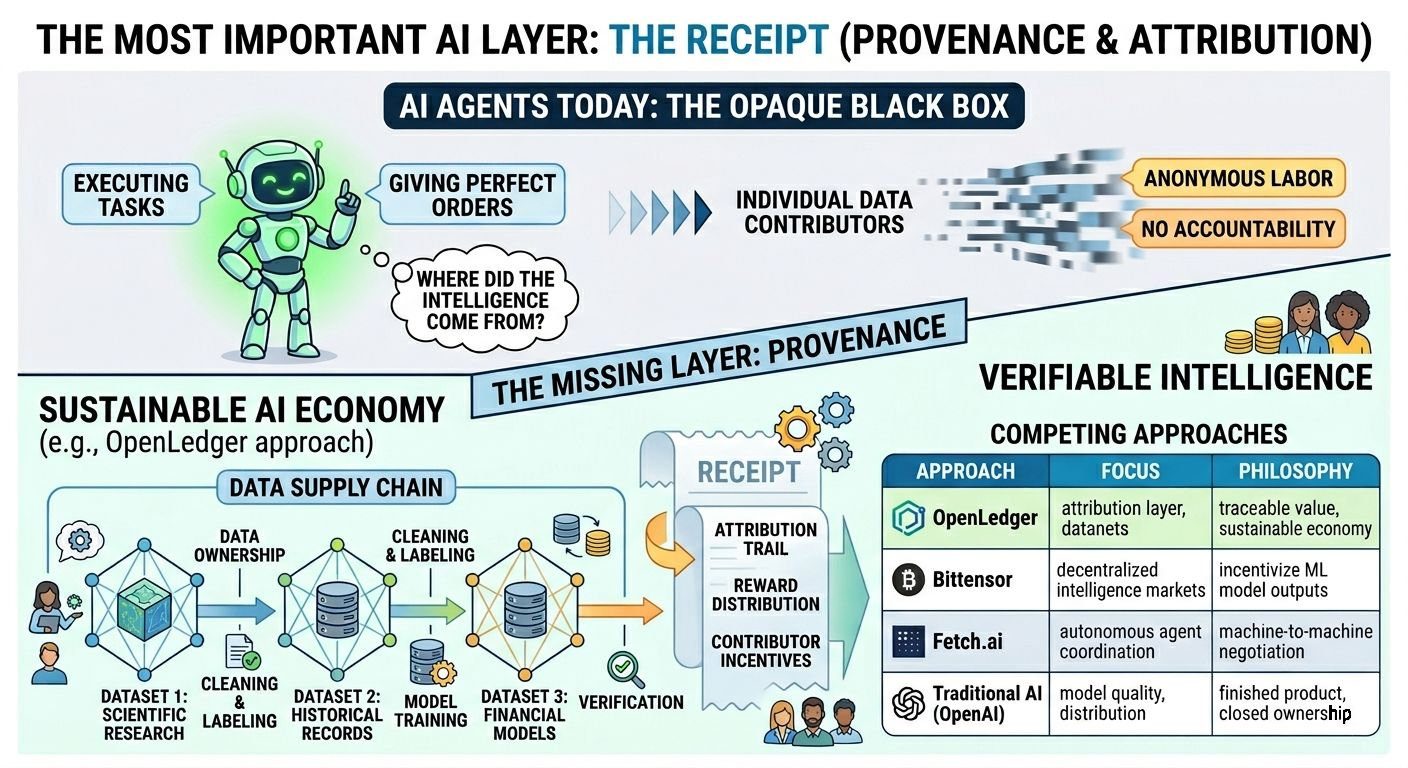
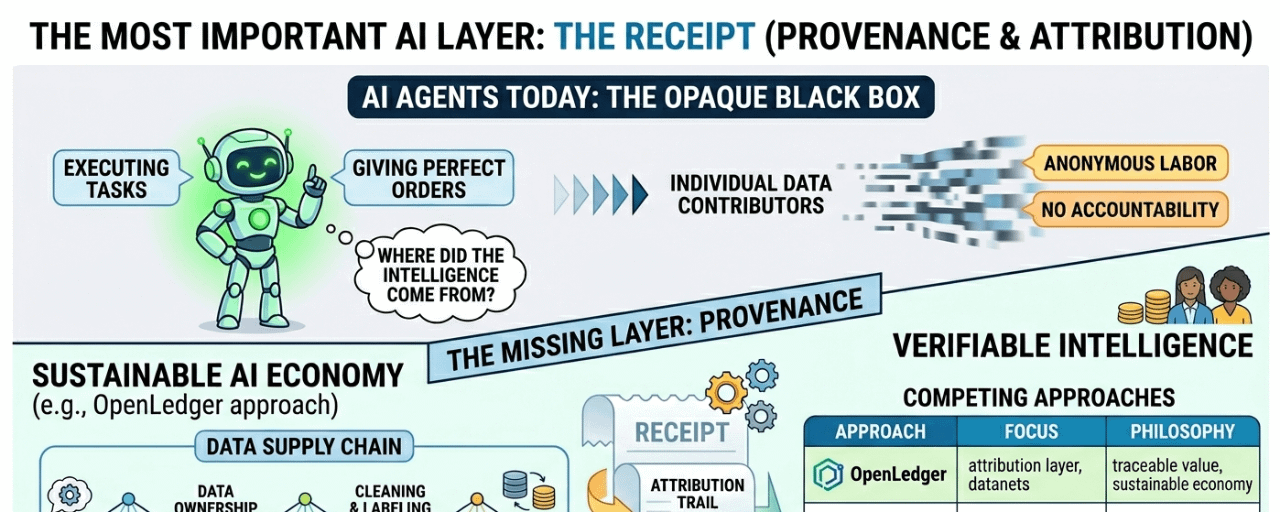
where did the intelligence come from? who contributed the data? who cleaned it, labeled it, improved it, verified it? who gave the agent permission to act? who gets paid when that intelligence becomes valuable?
without attribution, intelligence becomes anonymous labor.
and this is the lens where OpenLedger becomes worth examining. not because it has solved everything. honestly, i get uncomfortable when any AI crypto project acts like it has already figured out ownership, incentives, and verification at scale. those are not small problems. they are the problems.
but OpenLedger seems to be circling the right missing layer.
Proof of Attribution, data ownership, contributor incentives, datanets, specialized AI models, verifiable intelligence — these are not as loud as agent demos or model benchmarks. they do not make for the cleanest marketing clip. but they are closer to the boring infrastructure that actually matters.
the metaphor i keep coming back to is a supply chain.
AI today has a beautiful storefront. polished apps, smart agents, smooth answers, fast execution. but behind the storefront, the warehouse is chaotic. data moves around, models absorb it, outputs get monetized, and most contributors disappear from the economic map.
OpenLedger is trying to make that warehouse auditable.
not just “here is an AI answer,” but “here is where the value came from, here is who contributed, here is what should be rewarded.”
compare that to OpenAI or traditional AI platforms. they are excellent at distribution, model quality, product polish, and making AI usable for normal people. that matters. but the ownership and provenance layer is mostly closed. users see intelligence as a finished product, not as a chain of contributors.
Fetch.ai focuses more on autonomous agents and machine-to-machine coordination. useful layer, especially if agents are going to negotiate, transact, and operate across digital markets. but an agent still needs a trust boundary. what is it allowed to do? what shaped its decisions? who audits the action after it happens?
Virtuals Protocol understands the social and economic side of agents better than most. it makes agents visible, community-owned, and market-facing. but visibility of the agent is not the same as visibility of the intelligence behind the agent.
Bittensor is closer to the decentralized intelligence conversation. it creates markets around machine learning outputs and useful model contribution. but OpenLedger feels more focused on the attribution layer beneath that: the datasets, the contributors, the specialized data networks, and the question of value distribution before intelligence reaches the user.
an AI model without provenance is a black box with a confident tone.
and in crypto, we already know what happens when confident black boxes manage value. eventually someone asks for proof.
still, i am not pretending this is easy.
attribution can be gamed. contributor rewards can turn into farming. low-quality data can flood the system. governance can drift. specialized models need real demand, not just token incentives. and “transparent AI economy” only matters if people actually use the transparency.
so no, i do not look at OpenLedger and assume it wins.
i look at it as a serious question being asked in a market that usually prefers louder answers.
the industry keeps optimizing intelligence while neglecting responsibility.
OpenLedger seems less interested in making AI louder and more interested in making AI traceable.
maybe the next major AI infrastructure layer is not the smartest model, fastest chain, or most autonomous agent.
maybe it is the system that finally answers:
where did this intelligence come from, and who should be rewarded for creating it?