
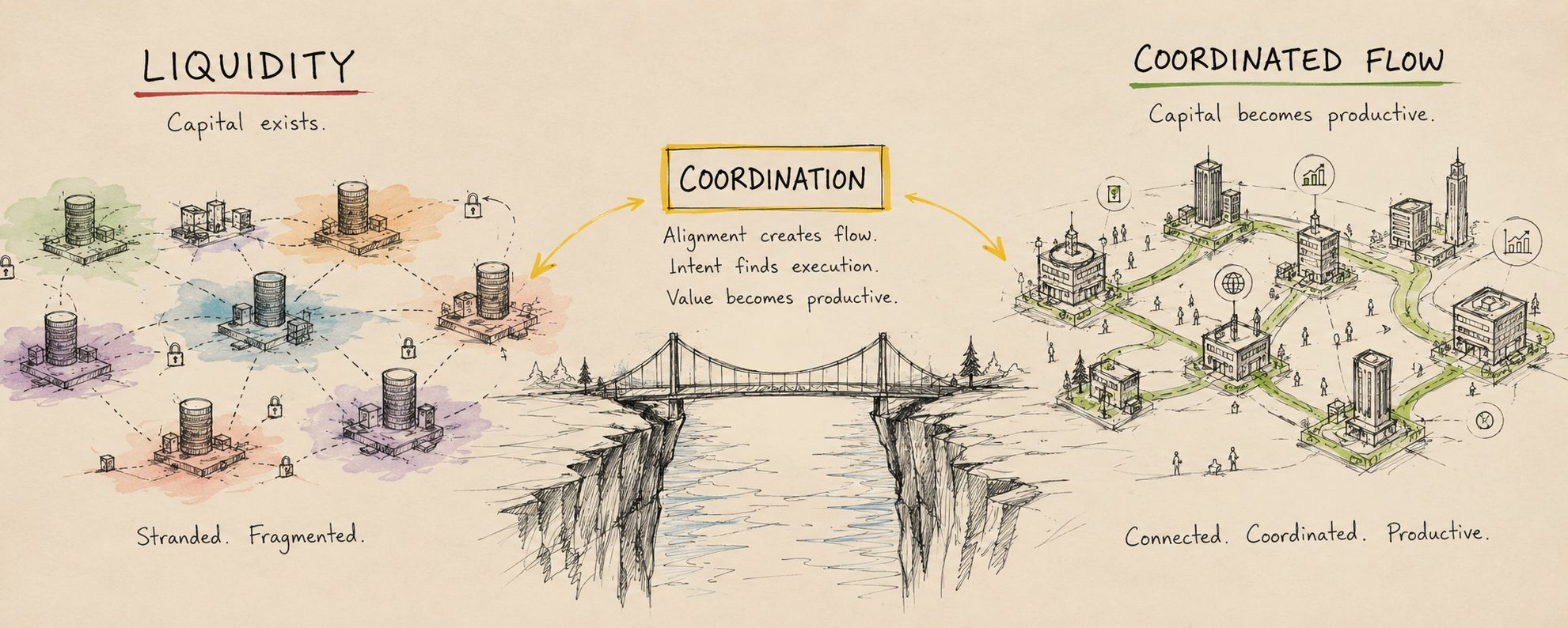
For most of crypto's history, liquidity was treated as the ultimate measure of success. If capital was flowing, the industry assumed progress was happening.
More liquidity meant deeper markets.
Deeper markets attracted more users.
More users attracted more builders.
More builders created more applications.
And more applications attracted even more liquidity.
It was a cycle that made intuitive sense.
For years, it was also largely correct.
But lately I've started wondering whether the industry is still solving the same problem it was solving during its earlier growth phases.
Because when I look across crypto today, I don't see an ecosystem suffering from a shortage of capital.
I see an ecosystem struggling to coordinate the capital it already has.
That sounds like a subtle distinction.
I don't think it is.
In fact, it may become one of the defining challenges of the next stage of crypto's evolution.
One of the most overlooked realities in today's market is that liquidity isn't necessarily scarce.
A surprising amount of it is simply stranded. Not because it cannot move, but because coordinating its movement remains harder than most people realize.
Stranded across chains.
Stranded across ecosystems.
Stranded behind incompatible standards, isolated data environments, fragmented user experiences, and disconnected incentives.
The industry spent years building places where value could exist.
Now it faces a different challenge.
Helping value move intelligently between those places.
That's a very different problem.
And it requires a very different type of infrastructure.
Sometimes crypto feels less like a unified financial system and more like a collection of cities connected by roads that were built by different teams using different maps.
Technically connected.
Practically disconnected.
And what's fascinating is that this fragmentation rarely shows up in the metrics people spend the most time discussing.
TPS doesn't capture it.
Transaction fees don't capture it.
Market capitalization doesn't capture it.
But user behavior does.
I've noticed it in my own experience.
A few years ago, I spent far more time exploring new ecosystems.
Today, despite having more options than ever, I often find myself using fewer pathways.
That realization felt strange.
The ecosystem kept expanding, yet my own behavior was becoming narrower.
More possibilities didn't automatically translate into more participation.
Not because innovation disappeared.
But because every new ecosystem demanded something from me before it delivered something back.
A new mental model.
A new interface.
A new workflow.
A new set of assumptions.
Eventually familiarity became more valuable than optionality.
And I don't think that's unique to me.
Most users eventually narrow their activity into predictable routes.
Known chains.
Known protocols.
Known communities.
Known workflows.
The ecosystem expands, but actual movement contracts.
That is not a liquidity problem.
It is a coordination problem.
And the difference matters.
Because access is no longer the biggest challenge.
Movement is.
Not movement of transactions.
Movement of intent.
Helping users, capital, information, and opportunities find each other without unnecessary friction.
This is also why I think many people misunderstand the next infrastructure cycle.
The conversation still revolves around speed.
Faster chains.
Cheaper transactions.
Higher throughput.
Those improvements matter.
But a system can become incredibly fast while remaining deeply fragmented.
A transaction settling in one second doesn't automatically create a seamless experience if the user still has to navigate multiple disconnected environments to achieve a simple outcome.
The friction hasn't disappeared.
It has simply moved.
And that becomes even more important as AI enters the picture.
Because AI agents don't interact with ecosystems the way humans do.
Humans compensate for fragmentation through experience.
Machines don't.
Humans develop intuition.
Machines depend on structure.
Humans tolerate inconsistency.
Machines expose it.
An AI agent attempting to coordinate activity across multiple ecosystems immediately encounters every incompatibility that human users quietly learn to ignore.
Different data formats.
Different standards.
Different assumptions.
Different execution environments.
What humans adapt to, machines reveal.
In some ways, AI acts like a stress test for infrastructure.
It exposes the hidden assumptions, inconsistencies, and coordination failures that experienced users have simply learned to work around.
And that's why I increasingly believe the next infrastructure race isn't a race for liquidity.
It's a race for coordination.
Because in a world increasingly shaped by automation, coordination becomes a competitive advantage in its own right.
This is where Open Coin becomes particularly interesting to me.
Not because it exists within another market narrative.
And not because it promises some dramatic reinvention of finance.
What stands out is that it appears to be focused on a challenge that becomes more important as ecosystems become larger, more automated, and more interconnected.
Coordination.
Crypto already has liquidity.
It already has data.
It already has users.
Increasingly, the question is whether those pieces can interact in a way that creates something larger than the sum of their parts.
In fragmented environments, information often arrives disconnected from action.
Incentives become localized.
Useful data becomes trapped inside separate systems.
Communities grow, but rarely move together.
The projects that matter over the next decade may not be the ones that create the most resources.
They may be the ones that help existing resources find each other more efficiently.
That's why coordination feels less like a feature and more like a foundational layer.
Liquidity by itself doesn't create value.
Coordinated liquidity does.
Data by itself doesn't create intelligence.
Coordinated data does.
Communities by themselves don't create network effects.
Coordinated communities do.
History repeatedly shows that the most important technologies are often not the ones that create entirely new resources.
They're the ones that organize existing resources more effectively.
The internet didn't create information.
It improved access to information.
Search engines didn't create knowledge.
They improved discovery.
Payment networks didn't create money.
They improved movement.
Again and again, the breakthrough wasn't creation.
It was coordination.
And I suspect crypto may be approaching a similar moment.
A moment where expansion becomes less important than organization.
Not creating more liquidity.
But helping liquidity find where it's needed.
Not creating more ecosystems.
But helping ecosystems work together.
Not generating more activity.
But coordinating existing activity more intelligently.
Of course, none of this guarantees success for any specific project.
Infrastructure transitions are rarely linear.
Standards compete.
Incentives conflict.
Timing matters.
Many technically strong ideas fail.
Many imperfect ideas succeed.
Markets are messy.
History rarely moves in straight lines.
But the direction still feels important.
Because when I look across crypto today, I don't see an industry running out of capital.
I see an industry trying to figure out how to organize the capital, information, users, and intelligence it already possesses.
And that feels like a much deeper challenge.
For years, crypto treated liquidity as the ultimate resource.
But mature systems rarely fail because resources are missing.
They fail because resources cannot find where they are needed.
That is a coordination problem.
And coordination problems are often harder to solve than liquidity problems.
Because capital can be created.
Liquidity can move.
New protocols can launch.
But getting thousands of participants, applications, data systems, and increasingly AI agents to operate as part of a coherent network is an entirely different challenge.
Maybe that's the shift many people are still missing.
The next era of crypto may not be defined by who owns the most liquidity.
It may be defined by who helps liquidity, intelligence, data, and users coordinate most effectively across increasingly complex networks.
Because mature digital economies don't become powerful simply because resources exist.
They become powerful when resources can find where they're needed with minimal friction.
In the early years of crypto, scarcity was the challenge.
In the years ahead, coordination may be the challenge.
Liquidity determines where capital exists.
Coordination determines whether that capital can actually become productive.
And if digital economies continue becoming larger, more automated, and more interconnected, the most durable advantage may not come from owning more resources.
It may come from making existing resources work together.
Because in mature networks, value rarely comes from what exists.
It comes from what connects.
And increasingly, what connects may matter more than what accumulates.
