I didn’t take it seriously at first…
not because OpenLedger sounded empty. more because I’ve watched too many infrastructure ideas arrive with clean language and slowly turn into incentive puzzles nobody wants to admit they helped create.
crypto does that. it takes a real problem, gives it rails, gives it markets, gives it a token-shaped gravity, and then acts surprised when people start optimizing around whatever the system measures.
Maybe that’s too harsh.
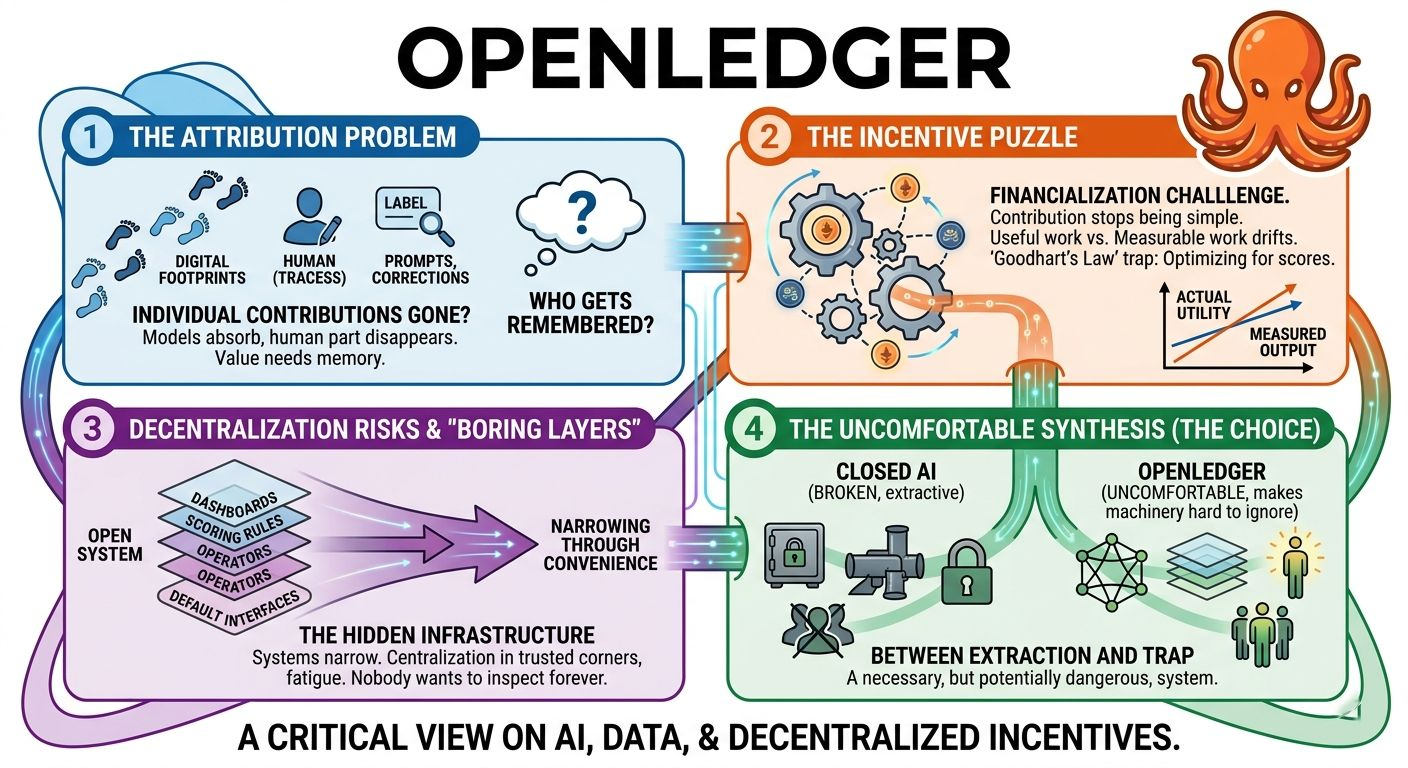
but AI-data feels especially fragile here. models are being shaped by human traces everywhere. labels, prompts, corrections, examples, preference signals, domain knowledge, little bits of judgment. the work looks small until it gets absorbed. then the model improves, and suddenly the human part disappears into a word like “data.”
I keep coming back to attribution.
there is something necessary in it. if intelligence has a supply chain, maybe that supply chain should not stay hidden inside private pipelines. maybe contribution should have memory. maybe people should not vanish the second their input becomes useful.
OpenLedger seems to sit near that discomfort.
not as a clean answer. I don’t trust clean answers here. more like a system trying to make the invisible layer harder to ignore.
but attribution changes once it becomes valuable.
That’s where things start to feel uncomfortable.
once data becomes financialized, contribution stops being simple. people study the scoring layer. they learn what the verifier rewards. they produce toward what can be measured. and slowly, useful work and measurable work begin drifting apart.
It works in theory. Most things do.
The problem isn’t really the technology… or not only the technology. human contribution is soft around the edges. a signature is clean. a transaction has boundaries. but context doesn’t. judgment doesn’t. usefulness can appear late. originality can be shared, copied, blurred.
so who gets remembered?
the person who helped, or the person who fit the system’s measurement best?
That part keeps bothering me more than it should.
and then there is the old pattern. open systems rarely recentralize loudly. they narrow through convenience, fatigue, trusted dashboards, default interfaces, scoring rules, operators, and all the boring layers nobody wants to inspect forever.
AI infrastructure feels exposed there because the boring layers are the real layers.
still, I can’t dismiss OpenLedger.
centralized AI has not earned that comfort either. closed datasets, vague ownership, invisible labor, extraction hidden behind smooth products. that version already feels broken, just easier to ignore.
maybe OpenLedger makes the machinery harder to hide.
or maybe once incentives get sharp enough, it remembers only the parts of human contribution that are easiest to price, and lets the rest fade again.