

The trade that stays with me the most was not the one I lost.
It was the one I got right.
The setup was there. The opportunity was obvious. The analysis was correct. Yet by the time assets moved across chains, approvals cleared, and transactions confirmed, the market had already moved on.
The profit never disappeared because I misunderstood the trade.
It disappeared because execution could not keep up with conviction.
That memory comes back to me whenever I hear people talk about AI in crypto.

Most projects seem obsessed with helping us look at markets. Better dashboards. Smarter chatbots. Faster summaries. Endless streams of information packaged as innovation. But after a while, it all starts to feel strangely superficial. The industry keeps building tools that observe reality while ignoring the harder problem of acting within it.
That is why #OctoClaw caught my attention.
Not because it promises another way to watch the market.
Because it asks what happens when AI starts participating in it.
Anyone who trades across multiple chains understands the friction. Arbitrage spreads vanish while funds are still crossing bridges. Gas costs suddenly explode and erase expected returns. Opportunities measured in minutes disappear while confirmations take longer than expected. Every approval, every wallet interaction, every chain switch introduces another point of delay.
Markets move at machine speed.
Humans do not.
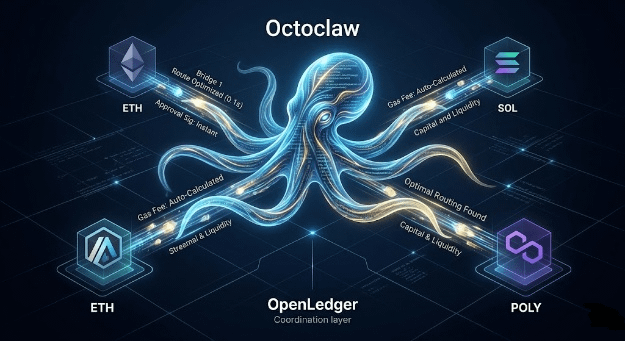
The idea behind OpenLedger feels interesting because it focuses on that gap. An autonomous AI agent coordinating swaps, bridges, routing, approvals, fee calculations, and execution across networks is not simply a convenience feature. It is an attempt to remove one of the largest inefficiencies in modern crypto: the human bottleneck.
For years, this vision felt premature.
Today, it feels possible.
Modular chains are maturing. Account abstraction is reducing complexity. Cross-chain infrastructure is becoming more reliable. Liquidity is increasingly connected rather than isolated. For the first time, the foundation exists for autonomous systems to coordinate activity across ecosystems without requiring constant human intervention.
But experience has taught me that every technological breakthrough arrives carrying its own risks.
Trusting an agent with capital means trusting smart contracts, data feeds, wallet permissions, and security assumptions. A flawed oracle can create costly decisions. A vulnerability can turn automation into exposure. The same systems designed to save time can amplify mistakes at a scale humans never could.
That skepticism matters.
Because blind optimism is rarely rewarded in crypto.
There is another question I cannot stop thinking about.
What happens when everyone has access to the same intelligence?
If AI agents become faster, more efficient, and more capable than human operators, then speed eventually stops being an advantage. Execution becomes a commodity. The edge shifts elsewhere. Strategy design becomes more important than reaction time. The winners will not necessarily have the fastest agents. They will have the best systems directing them.
That is why I see $OPEN less as a short-term narrative and more as a long-term infrastructure thesis.
The real question is not whether AI agents will become part of Web3.
They will.
The question is whether #OpenLedger becomes the coordination layer they depend on, or whether it becomes another replaceable piece of software in an increasingly crowded stack.
The market will answer that over time.
For now, I remain curious enough to pay attention and skeptical enough to ask difficult questions.
Because the most valuable infrastructure rarely looks revolutionary once it succeeds.
It becomes invisible.
Nobody thinks about the protocols routing internet traffic. Nobody thinks about the systems moving electricity through a city. The infrastructure that wins is the infrastructure people stop noticing.
Maybe that is the destination #OpenLedger is chasing.
Not a future where everyone talks about it.
A future where nobody has to.
Because the highest form of infrastructure is not the technology that demands attention.
It is the technology that quietly becomes impossible to live without.
