
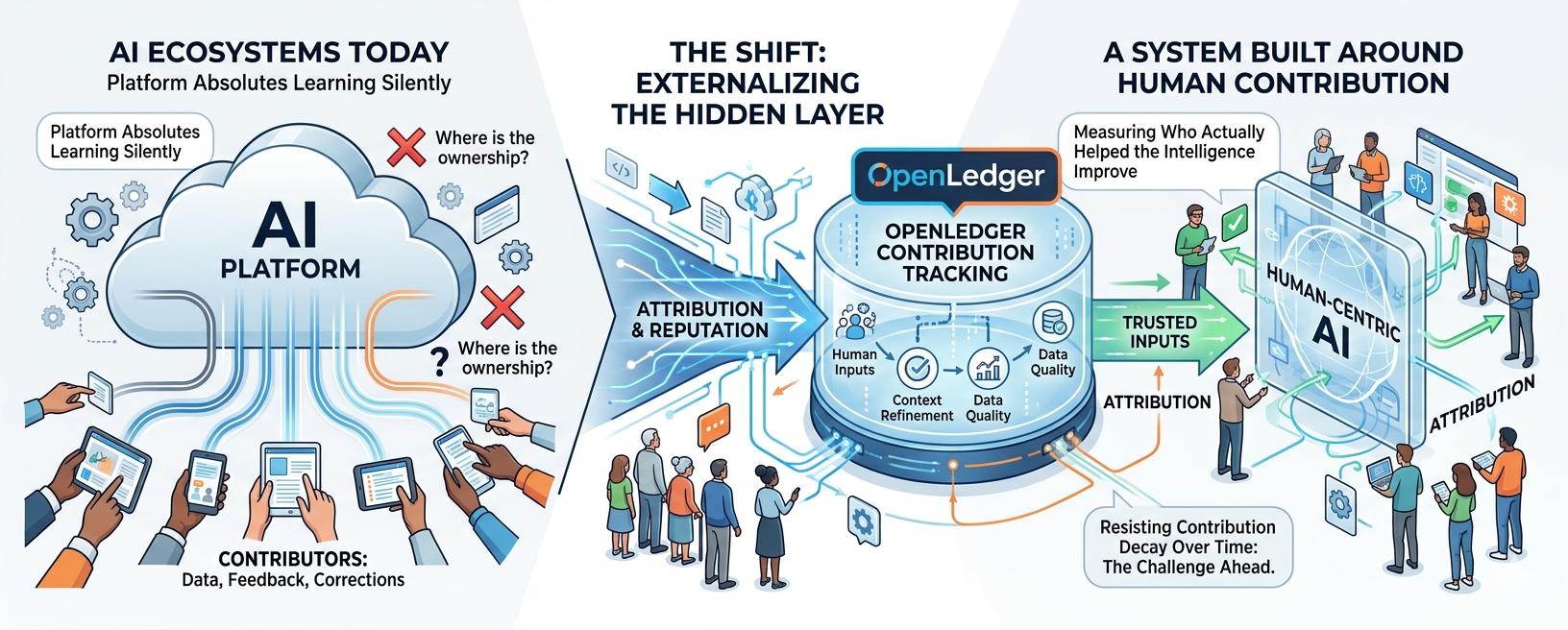
The More I Watch OpenLedger, The More It Feels Like a System Built Around Human Contribution Instead of Just AI
Something about OpenLedger has been sitting in my head lately.
Not the AI part. Not the token either.
It’s the way the whole system seems centered around contribution tracking.
That sounds boring at first. Almost administrative. But after spending time looking at how most AI ecosystems actually operate, I think this is where a lot of the real battle will happen later.
Most people still look at AI like it magically appears from models.
But models are downstream from everything else.
Data. Feedback. Corrections. Human interaction patterns. Context refinement.
Without those layers, even powerful models become stale surprisingly fast.
OpenLedger seems to understand that better than most crypto AI projects right now.
Instead of only asking “how do we build AI,” the system keeps circling around another question: how do we measure who actually helped the intelligence improve?
That changes the structure completely.
Normally contribution inside AI systems disappears into the platform itself. Millions of people interact, correct outputs, generate data, and shape behavior every day without seeing any ownership around that process.
The platform absorbs the learning silently.
OpenLedger is trying to externalize that hidden layer.
At least that’s how it looks from the outside.
And honestly I think that’s why the design feels different compared to the usual AI narrative floating around crypto.
Most AI chains still focus heavily on compute power or agent hype because those are easy stories to sell quickly.
Contribution systems are harder.
They force uncomfortable questions.
What counts as useful input? Who decides quality? Can contribution be measured fairly at scale? What happens when users optimize for rewards instead of genuine usefulness?
I keep coming back to that last part.
Because every incentive system eventually collides with human behavior.
You reward activity, people spam activity. You reward engagement, people manufacture engagement. You reward datasets, suddenly synthetic garbage floods the network.
Crypto has already lived through this cycle multiple times.
Liquidity mining. Play-to-earn. SocialFi.
The pattern repeats constantly.
That’s why I think OpenLedger’s biggest challenge isn’t attracting contributors.
It’s resisting contribution decay over time.
And honestly I’m not sure any fully open system has solved that problem cleanly yet.
What does feel solid though is the direction they’re choosing.
Lately the ecosystem seems less focused on broad AI promises and more focused on traceability, attribution, and reputation around data flows. That shift feels intentional.
Almost like the team realized raw scale means nothing if nobody trusts the inputs anymore.
That’s probably the most mature thing happening in AI right now honestly.
Everyone keeps chasing bigger outputs while quietly ignoring where the intelligence actually comes from.
OpenLedger at least appears to be building around the origin layer itself.
Still, there’s another side to this that keeps bothering me.
The more detailed contribution tracking becomes, the harder the system gets to keep decentralized.
Eventually somebody has to validate quality. Somebody defines standards. Somebody resolves disputes.
That’s where idealism usually starts colliding with operational reality.
And AI contribution systems are even messier because usefulness is subjective half the time.
One dataset improves one model while damaging another. One user correction helps in one context but creates bias somewhere else.
How does an open system evaluate that fairly?
I don’t think the industry has a good answer yet.
Another thing I’ve noticed is how OpenLedger’s structure quietly creates dependency between participants instead of isolated usage.
Contributors need builders. Builders need data. Applications need reliable outputs. Agents depend on all three.
That interconnected setup feels healthier than ecosystems where every participant is just farming temporary incentives independently.
But interconnected systems also carry systemic risk.
One broken layer spreads problems everywhere else.
I remember watching early DeFi protocols years ago and realizing the dangerous part wasn’t individual failure. It was composability without strong foundations underneath.
AI ecosystems could run into something similar.
Bad attribution logic. Weak reputation systems. Low quality datasets.
Those issues compound over time quietly before anyone notices.
That’s why I’m more interested in how OpenLedger behaves during slower periods than during hype cycles.
Do contributors stay active without aggressive rewards? Does the quality of participation improve or decline? Do developers build because the system actually helps them or because emissions temporarily hide friction?
Those are probably the only signals that matter long term.
Everything else is noise for now.
And honestly I still can’t tell whether contribution-based AI economies become the future or just another crypto experiment that sounds smarter than it works in practice.
But I do think OpenLedger is asking more realistic questions than most projects in this sector right now.
That alone keeps me watching it.
