
I’ve been watching AI and blockchain evolve for a while now, and lately I keep noticing something shift beneath the surface. The conversation doesn’t feel centered on intelligence alone anymore. It feels more focused on ownership — who benefits, who earns, and who quietly becomes infrastructure for systems growing larger than any individual.
I keep wondering if we’re moving toward a world where data has a clearer price, models become economic assets, and autonomous agents don’t just perform tasks but participate in value creation themselves.
That’s where OpenLedger (OPEN) started feeling interesting to me.
Not because it claims to solve everything. More because it seems built around a difficult question people rarely sit with long enough: if AI continuously creates value, should the people, data, and systems behind it be rewarded differently?
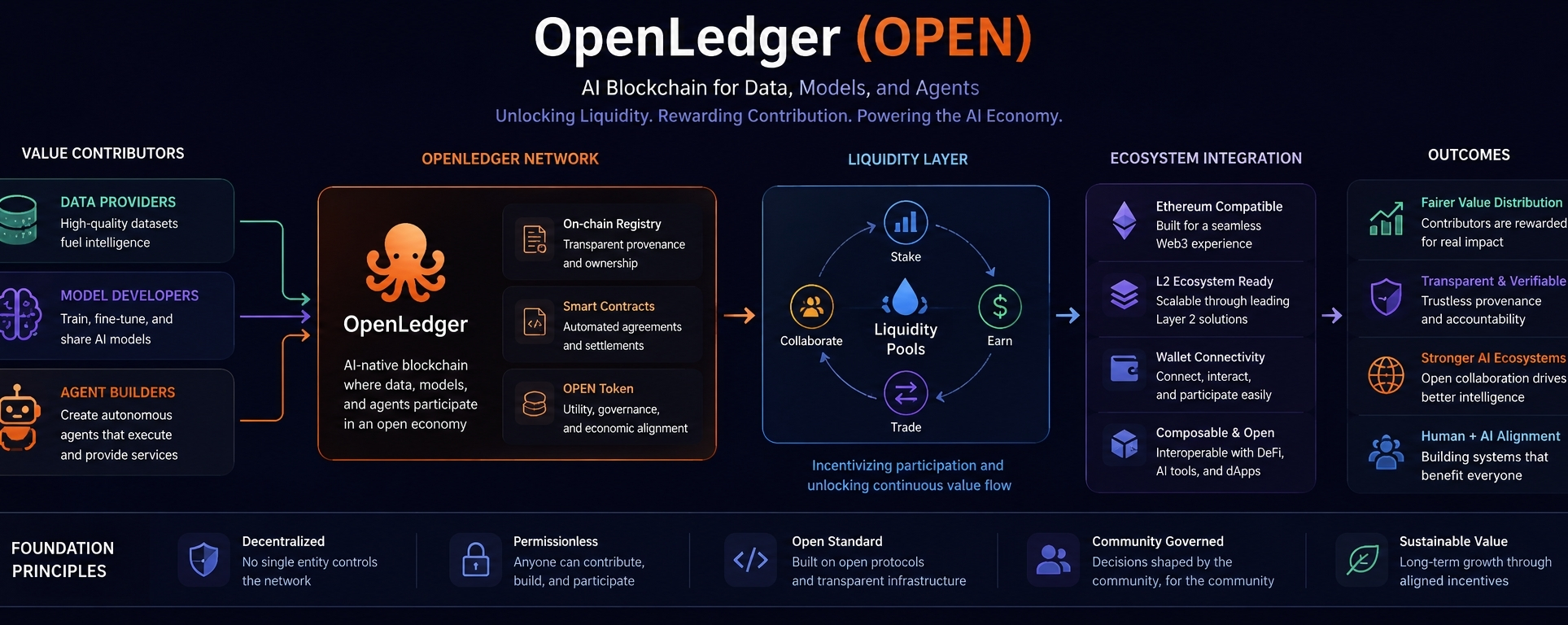
OpenLedger appears to imagine AI as something that operates inside an economic layer rather than above it. Data contribution, model deployment, and autonomous agents become part of an on-chain environment where participation can potentially be tracked and monetized.
At first glance, the idea sounds reasonable.
Its Ethereum-compatible architecture, wallet connectivity, smart contracts, and integration with L2 ecosystems suggest it isn’t trying to reinvent everything from scratch. It feels more like an attempt to fit into existing blockchain behavior while extending it toward AI participation.
But the longer I think about it, the more uncertain I become.
Because making something liquid changes it.
Once data carries direct economic value, contribution changes. Incentives change. The meaning of ownership changes. If autonomous agents eventually create measurable output, then questions around who controls them — or profits from them — become harder to ignore.
There’s also an uncomfortable tension between decentralization and automation.
Blockchain often promises distributed ownership. AI often pushes toward efficiency and abstraction. Those ideas sound compatible until they aren’t. A system can be open while influence quietly concentrates elsewhere. It can increase participation while reducing human relevance over time.
I’m not saying OpenLedger leads there.
I’m saying projects like this make those possibilities harder to dismiss.
Maybe creating liquidity around models, data, and agents strengthens AI ecosystems and rewards contributors more fairly.
Or maybe it builds new dependencies that simply feel more transparent.
I honestly don’t know yet.
What keeps my attention isn’t certainty. It’s the possibility that the next AI race won’t be about who builds the smartest systems, but who owns the infrastructure where intelligence creates value.
And somewhere inside that uncertainty, OpenLedger seems to be placing a bet.
Whether that bet becomes empowerment or another layer of dependency still feels unresolved. I think that’s the part worth watching most.