
Look, I understand why projects like OpenLedger are suddenly attracting attention. The timing is perfect. Artificial intelligence is consuming capital at a pace we haven’t seen since the early cloud computing boom, and crypto desperately needs a new story after years of collapsed exchanges, dead metaverse projects, and token ecosystems that promised revolutions but mostly produced bag holders.
So now the pitch has changed.
AI is the future. Blockchain is the coordination layer. Tokens will somehow connect data, models, and autonomous agents into a giant economic machine where everyone gets paid fairly.
It sounds tidy. On paper, at least.
But I’ve seen this movie before.
Every few years, Silicon Valley and crypto circles discover a real problem hiding inside a growing industry. Then a swarm of startups appears claiming not only to solve the issue, but to redesign the entire economic structure around it. Usually with a token attached. Usually with venture capital waiting near the exit door.
OpenLedger is operating inside exactly that pattern.
The core problem they claim to fix is real enough. AI systems depend on enormous amounts of data, and the people producing that data rarely see meaningful financial upside. Meanwhile, a small number of companies control most of the AI infrastructure. They own the compute. They own the cloud platforms. They increasingly own the distribution layer too.
That concentration is hard to ignore.
A handful of firms like OpenAI, Google, and Meta are effectively becoming industrial powers in the AI economy. They have access to the best chips, the deepest capital reserves, and the largest training pipelines. Smaller developers are left renting access to someone else’s infrastructure while trying to survive inside ecosystems they do not control.
OpenLedger steps into this imbalance and says: what if AI systems could coordinate through decentralized infrastructure instead?
What if datasets could be tracked transparently? What if AI agents could pay each other automatically? What if contributors could receive rewards directly through blockchain-based attribution systems?
That’s the sales pitch.
And to be fair, there is a legitimate idea buried underneath the crypto vocabulary. AI systems probably will require more sophisticated coordination mechanisms over time. Once autonomous agents begin interacting with each other economically, traditional financial rails start looking clumsy. Machines do not want banking hours. They do not want manual compliance forms. They do not want human settlement delays.
So the theory behind OpenLedger is not entirely ridiculous.
The problem is what happens when theory collides with operational reality.
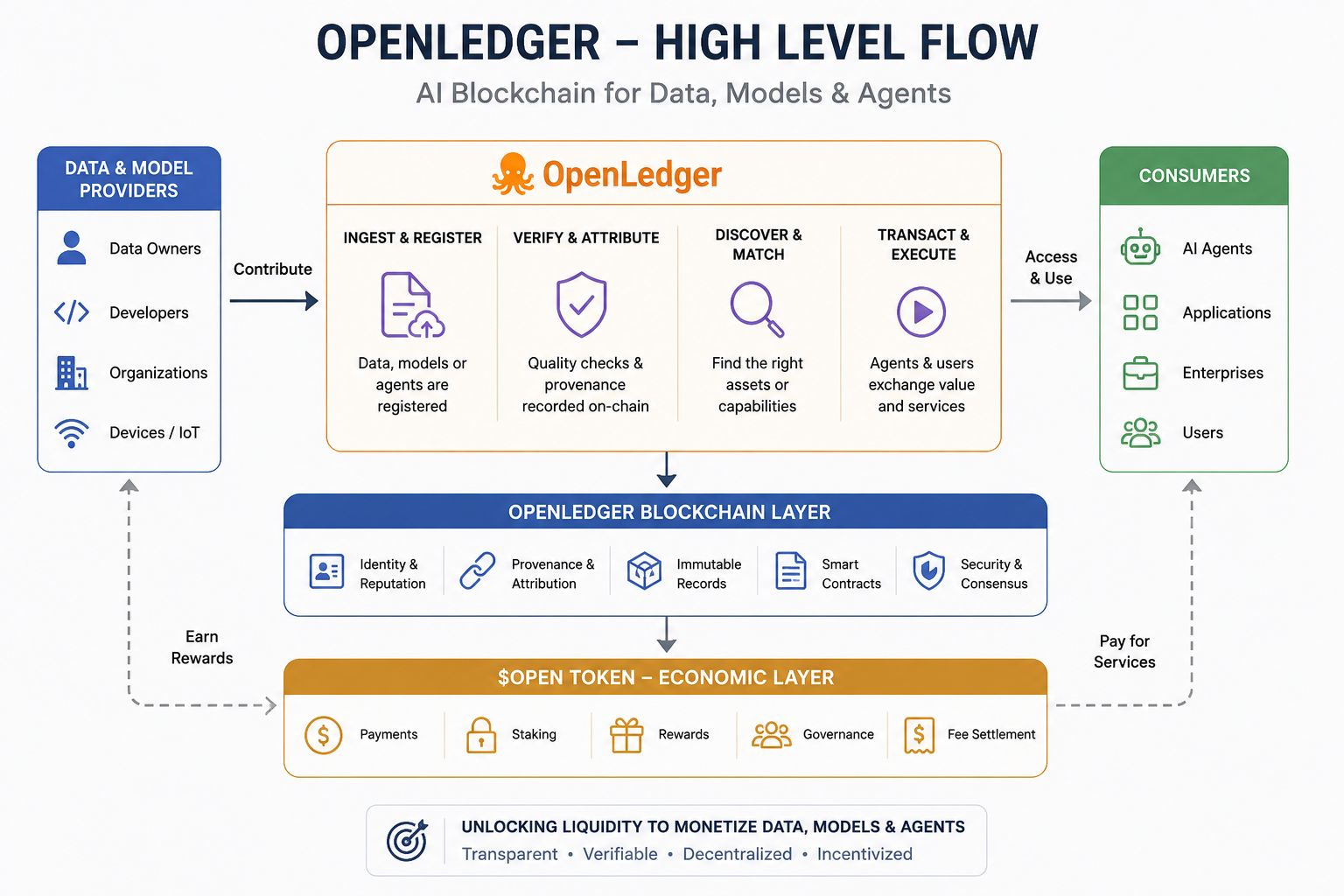
Because when you strip away the marketing language, OpenLedger is essentially trying to build a decentralized economic network where machines, datasets, and developers continuously exchange value using token incentives.
Now ask yourself the uncomfortable question.
What usually happens when token incentives become the center of a system?
People optimize for the token. Not for quality. Not for reliability. Not for long-term sustainability.
Crypto history is filled with systems that looked elegant until money entered the feedback loop. Play-to-earn games became digital labor farms. Decentralized social platforms filled with spam and engagement bait because rewards distorted human behavior. Yield farming protocols attracted liquidity that vanished the moment incentives weakened.
OpenLedger risks walking directly into the same trap.
Imagine a network where contributors receive rewards for uploading useful AI datasets. Sounds reasonable. Until participants realize they can flood the system with low-quality, synthetic, duplicated, or manipulated data designed primarily to farm token payouts.
And here’s the ugly part.
AI systems are extremely vulnerable to poisoned data. Garbage spreads fast. Once economic incentives reward quantity, the network begins fighting itself. Verification becomes expensive. Trust deteriorates. Moderation layers grow increasingly centralized because someone eventually has to decide what counts as “useful.”
That brings us to the decentralization question.
Because this is where many AI blockchain projects quietly become awkward.
OpenLedger presents itself as decentralized infrastructure for AI coordination. Fine. But decentralized relative to what?
The actual AI economy remains heavily centralized at the hardware level. Advanced AI models depend on gigantic computing clusters, specialized semiconductors, and hyperscale cloud infrastructure controlled by a very small number of corporations. You can put transaction records on-chain all day long, but you are still dependent on companies like NVIDIA, Amazon Web Services, and Microsoft to keep the entire machine running.
That is the catch the marketing teams rarely emphasize.
The blockchain may be decentralized. The economic gravity is not.
AI infrastructure is becoming more centralized over time because scale matters. Training frontier models now costs enormous sums of money. Energy consumption matters. Chip access matters. Supply chains matter. The winners are increasingly those with industrial-scale resources, not ideological commitments to decentralization.
So what exactly becomes decentralized here?
Usually the answer is governance theater wrapped around infrastructure that still depends on centralized choke points.
And then there’s the human reality. This part always gets ignored during the hype cycle.
What happens when these systems fail?
Not theoretically. Operationally.
Suppose an AI agent makes a harmful decision using flawed training data purchased through a decentralized marketplace. Who carries liability? The dataset provider? The model developer? The network validators? The token holders voting on governance proposals?
Good luck explaining decentralized accountability structures to regulators after real financial damage occurs.
Because regulators are not going to care about elegant token mechanics once autonomous systems start making costly mistakes. Governments tolerate speculative crypto experiments during bull markets because the fallout remains mostly contained inside trading communities. But AI systems touch healthcare, finance, legal workflows, defense contracting, and critical infrastructure.
That changes the political equation fast.
And let’s be honest about another uncomfortable detail. A lot of these projects are not really designed for mainstream users right now. They are designed for investors searching for the next narrative cycle.
The crypto market runs on storytelling momentum. DeFi had its moment. NFTs had theirs. AI is the current magnet for speculative capital. Combining blockchain with artificial intelligence creates a powerful fundraising narrative because it merges two industries that already attract oversized expectations independently.
That does not mean the infrastructure itself is useless. It means incentives become distorted very early.
Once token price appreciation becomes central to community identity, every technical roadmap risks turning into investor relations material. The network stops asking, “Does this solve a meaningful coordination problem?” and starts asking, “Will this increase market demand for the token?”
Those are very different priorities.
I keep coming back to one broader issue with OpenLedger and projects like it. They assume future AI ecosystems will naturally evolve into open, interoperable machine economies where autonomous agents transact across decentralized networks.
Maybe.
But large technology companies have a different vision entirely. They are building vertically integrated ecosystems where the models, infrastructure, payment systems, cloud services, and enterprise relationships all stay under one roof. Closed systems are often simpler, faster, and easier to monetize.
History shows consumers usually choose convenience over ideological purity.
That matters because infrastructure projects only succeed when enough participants adopt shared standards simultaneously. Otherwise you end up with technically sophisticated systems sitting mostly unused while centralized alternatives quietly dominate the market through operational simplicity.
I’ve watched this happen repeatedly over the last twenty years. Peer-to-peer networks. Decentralized storage systems. Distributed computing platforms. Most failed not because the technology was impossible, but because ordinary users do not wake up asking for more infrastructure complexity in their lives.
They want products that work.
And that is the lingering problem with OpenLedger.
The project may be solving a future coordination issue before the market actually needs the solution. Or worse, it may be building elaborate decentralized machinery around problems that large AI firms eventually solve internally through centralized infrastructure.
Because underneath all the futuristic language about autonomous economies and machine coordination sits a much colder reality.
Somebody still owns the servers.
