
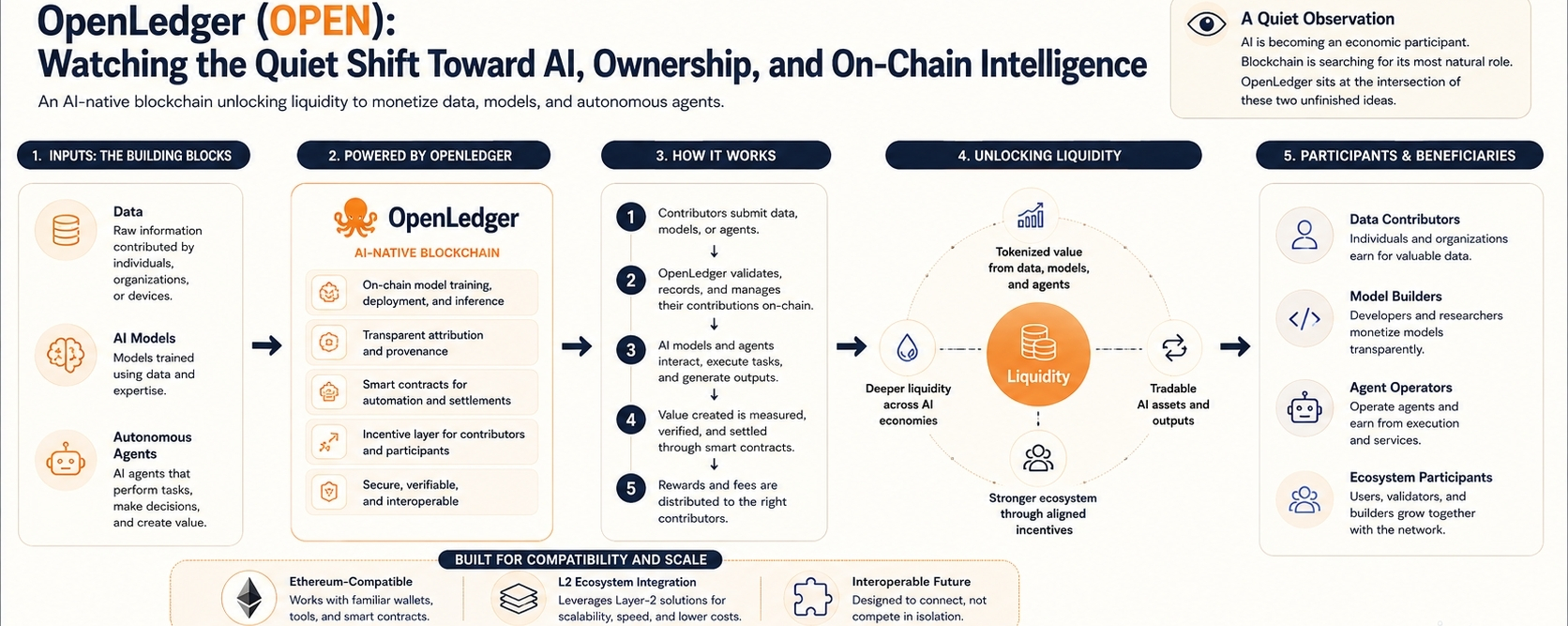
I’ve been watching the way people talk about AI lately, and something feels different. Not louder exactly—just heavier. More certain. As if we’ve quietly moved past asking what AI can do and started assuming it will become part of everything: work, money, decisions, creativity, even systems that run without much human involvement.
I keep wondering when that shift happened.
At the same time, blockchain seems to be going through its own identity search. After years of promises around decentralization and ownership, there’s this feeling that the technology is still looking for its most natural role. Not disappearing, just changing shape.
Maybe that’s why projects like OpenLedger caught my attention.
Not because it feels revolutionary at first glance, but because it sits where two unfinished ideas meet: artificial intelligence and decentralized networks. And whenever unfinished ideas collide, the results are unpredictable.
OpenLedger is built around the belief that data, AI models, and autonomous agents shouldn’t just exist in the background powering systems. They should have economic value attached to them. They should be able to participate, contribute, and potentially generate rewards inside an on-chain environment.
That sounds straightforward when explained quickly.
The longer I think about it, the stranger it becomes.
Because for years, most digital economies were designed around people. People earning, spending, creating, trading. OpenLedger seems to imagine infrastructure where AI itself becomes part of that activity—where models are deployed on-chain, where autonomous agents interact, where contributions from data or intelligence can be monetized rather than absorbed quietly into larger platforms.
There’s something fascinating about that.
And something slightly unsettling too.
The project’s Ethereum-compatible structure makes practical sense. Existing wallets, smart contracts, and familiar developer tools remain useful instead of forcing everything into an isolated environment. Integration with Layer-2 ecosystems feels like another acknowledgement that new networks rarely survive completely alone anymore.
None of that sounds dramatic.
But infrastructure usually isn’t dramatic. The systems that matter most often arrive quietly, hidden beneath bigger narratives.
What keeps pulling me back isn’t the technical side though. It’s the question underneath all of it.
What happens when intelligence becomes something people try to price?
Not human intelligence in the broad sense, but datasets, AI outputs, models, autonomous agents—pieces of machine-driven activity turned into economic assets.
There’s an argument that this creates fairness. If data helps train systems, perhaps contributors deserve value. If models generate utility, maybe ownership should be distributed differently.
I understand the appeal.
Still, I’m not fully convinced that monetization automatically leads to healthier ecosystems.
Sometimes adding financial incentives strengthens participation.
Sometimes it changes behavior entirely.
People begin optimizing for rewards instead of meaning. Quantity overtakes quality. Contribution becomes performance.
Technology has a habit of promising empowerment while quietly introducing new dependencies.
That thought lingers with me when I read about AI-native blockchain infrastructure.
OpenLedger appears to imagine a future where autonomous agents can operate continuously—interacting, executing tasks, participating in economies with less direct human involvement. Efficient systems. Faster coordination.
Efficiency is attractive.
It’s also worth questioning.
Because every time friction disappears, dependence often grows in ways we don’t notice immediately.
I think that’s the tension sitting at the center of projects like this.
Decentralization suggests openness, distribution of power, fewer gatekeepers.
Automation often moves toward optimization, consolidation, and systems that become harder for ordinary people to understand.
Those directions don’t always conflict.
But they don’t always align either.
I’m not sure where OpenLedger eventually lands between them.
Maybe it becomes meaningful infrastructure for a future where AI participation is transparent and economically fairer than today’s models. Maybe monetizing data and intelligence creates entirely new kinds of ecosystems.
Or maybe it recreates older patterns with different language around them.
New layers.
New intermediaries.
New forms of reliance disguised as openness.
I don’t say that cynically.
Mostly with curiosity.
Because technologies often reveal their real purpose years after people stop debating them. By then, they’ve already blended into everyday life.
For now, OpenLedger feels less like a conclusion and more like an observation in progress—a sign that the relationship between AI, value, and ownership is still being negotiated.
I keep watching these projects for that reason.
Not looking for certainty.
Just trying to understand what kind of world starts forming when intelligence itself becomes something networks can measure, reward, and trade.