

I’ve spent enough years in crypto to know that most narratives sound revolutionary right before they become irrelevant.
We’ve seen it happen with metaverse tokens, play-to-earn economies, “Ethereum killers,” and every version of “the future of finance” imaginable. The market gets excited first, asks questions later, and eventually realizes half the infrastructure was built for users that never arrived.
That’s partly why I became skeptical of anything carrying the AI label this cycle.
Every project suddenly claims to be building “decentralized intelligence.” Every roadmap mentions agents, data layers, autonomous coordination, or some variation of machine economies. Most of it feels forced. Like teams discovered AI was getting attention and adjusted the branding overnight.
But underneath the noise, something real is actually changing.
You can feel it if you spend enough time around traders, builders, or even small research teams.
The workflows are different now.
A single person with the right AI stack can process market information faster than entire desks could a few years ago. Funding rate changes, liquidity movement, governance activity, wallet clustering, sentiment shifts — all of it can now be filtered, interpreted, and acted on almost instantly.
That changes markets more than people realize.
The edge used to come from having access to information. Now information is everywhere. The real edge is becoming speed of interpretation and execution.
And honestly, that’s where OpenLedger started making sense to me.
Not as another “AI coin,” but as infrastructure trying to solve a problem that’s becoming increasingly obvious: AI systems are generating enormous value, but the ownership layer around them is still incredibly centralized.
The people creating data rarely monetize it properly.
The people training models usually depend on closed ecosystems.
The people building AI agents often don’t own the rails those agents operate on.
Everything eventually funnels back into a handful of dominant platforms.
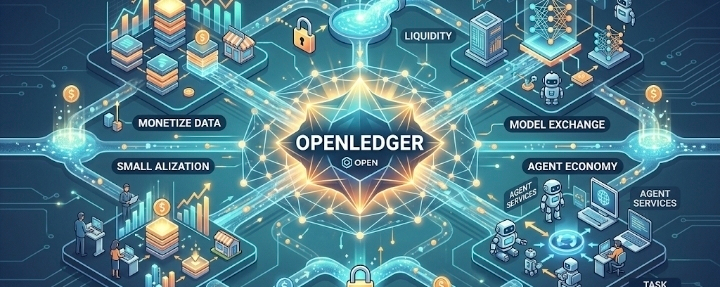
OpenLedger seems to be approaching that from a different angle. The idea of turning data, models, and AI agents into assets that can move through an open blockchain economy is actually a pretty important concept if this industry keeps evolving the way it has been.
Because once AI agents start interacting directly with markets, liquidity, and onchain systems, the infrastructure beneath them matters a lot more.
And I don’t mean in the abstract “future of AI” way people post about on timelines.
I mean practically.
Imagine agents competing for data access in real time.
Models improving themselves based on live market conditions.
Builders monetizing niche intelligence layers without needing approval from centralized platforms.
Execution systems interacting across chains automatically while humans mostly supervise risk.
That sounds futuristic until you realize pieces of it already exist.
The market structure is slowly adapting around machine participation whether people notice it or not.
What crypto adds to this is economic coordination.
Blockchains allow these systems to transact, verify, incentivize, and operate in environments where ownership can actually be transparent. That’s the interesting part to me. Not the AI itself — the incentive layer beneath it.
Still, I think people are underestimating how difficult this becomes in reality.
Data quality is messy.
Most “decentralized AI” still depends heavily on centralized compute infrastructure.
Incentives can be manipulated.
And token models often struggle to capture actual network value once speculation fades.
That last point matters more than communities want to admit.
A useful product doesn’t automatically create a valuable token.
Crypto history already proved that multiple times.
So when I look at OPEN, I’m less interested in short-term price action and more interested in whether the network can create real economic dependency over time. If builders genuinely need the infrastructure, if agents transact through it consistently, if valuable datasets become native to the ecosystem — then maybe value eventually compounds at the protocol layer instead of just the application layer.
But that’s a difficult path.
Infrastructure trades on patience, and markets rarely reward patience anymore.
Still, I can’t ignore the direction things are moving.
This cycle feels different from previous ones because the technology is no longer isolated. AI is affecting how people trade, research, build, and compete right now. Not hypothetically. Right now.
And crypto, for the first time in a while, might actually have a meaningful role beyond speculation if it becomes the coordination layer for these machine-driven economies.
Maybe OpenLedger succeeds in that vision.
Maybe it doesn’t.
But I think the bigger shift is already happening underneath the surface.
The market is slowly transitioning from tokenizing assets to tokenizing intelligence itself.
That’s a much bigger change than most people currently understand.
