
I almost ignored OpenLedger the first time it crossed my timeline.
Not because it looked bad. Honestly, it was the opposite. It looked too familiar.
Crypto has gone through so many “future of AI” narratives recently that my brain almost filters them automatically now. Every few weeks another project appears promising decentralized intelligence, autonomous economies, agent infrastructure, or some new system where data somehow becomes infinitely valuable because it’s on-chain.
I’ve been around long enough to know how these cycles usually play out.
The story gets ahead of the structure.
Attention arrives before sustainability does.
And eventually the economy underneath starts breaking in quiet ways long before people admit it publicly.
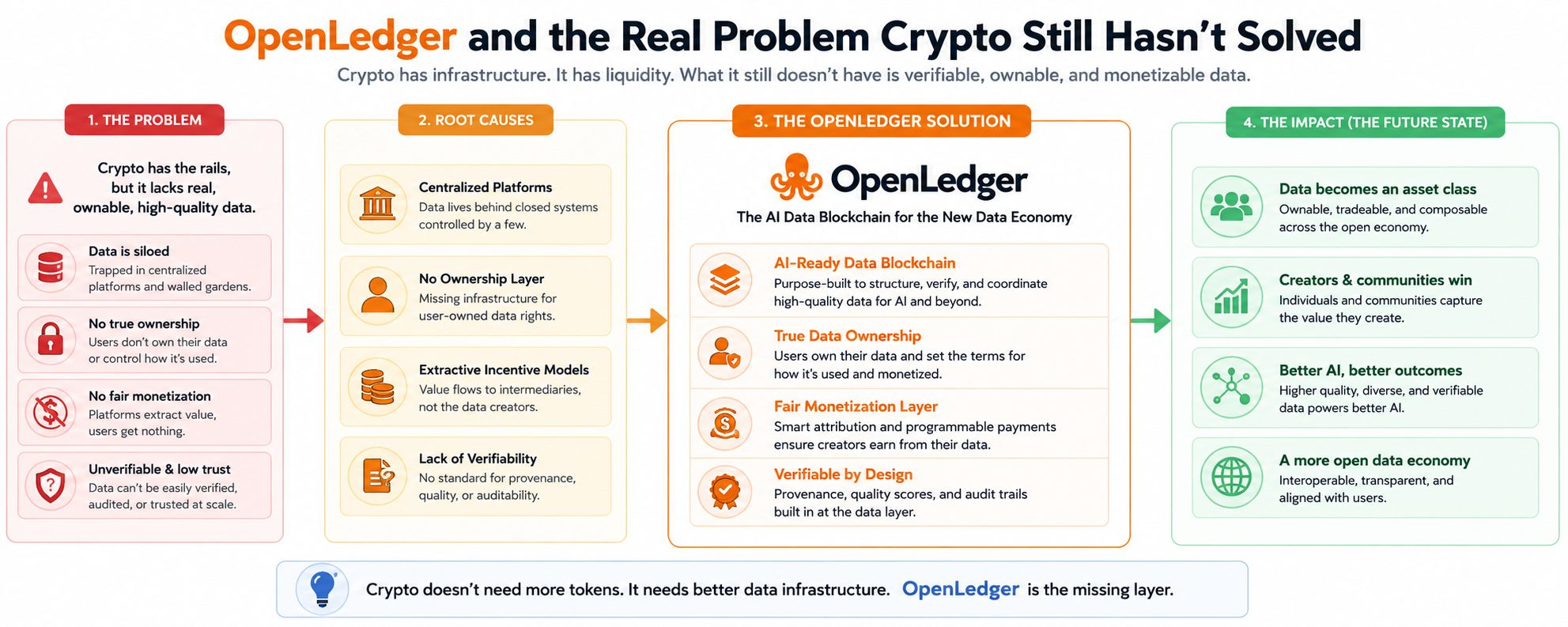
That’s probably why OpenLedger stayed in the back of my mind longer than most AI projects instead of disappearing after a few hours. The more I looked into it, the more it felt less obsessed with “AI hype” itself and more focused on something crypto still hasn’t solved properly: how value actually moves between contributors, users, models, and platforms without the entire system becoming extractive.
That sounds simple when written out like that, but it’s honestly one of the hardest problems in Web3.
Because crypto users are not emotional participants first.
They’re economic participants first.
That changes everything.
Most projects pretend users will stay because they believe in the vision. Reality usually looks very different. People stay where incentives make sense. They stay where friction prevents abuse. They stay where there’s something meaningful to lose by leaving.
Without that, ecosystems become temporary campsites.
You see it constantly in GameFi especially. Massive onboarding. Huge activity spikes. Everyone celebrates “growth.” Wallet numbers explode. Daily active users look incredible for a few months.
Then rewards slow down.
And suddenly the entire economy feels empty.
Not because the people were evil, but because the system quietly trained them to extract instead of participate.
That distinction matters more than most tokenomics spreadsheets ever will.
While reading deeper into OpenLedger, I kept coming back to the same thought: the project at least seems aware of this problem. Their whole direction around attribution, contributor ownership, and payable AI feels less like pure marketing and more like an attempt to solve incentive imbalance before it becomes fatal.
Whether they actually succeed is another story entirely.
But awareness alone already separates them from a lot of projects I’ve watched collapse.
The idea behind OpenLedger isn’t really difficult to understand conceptually. AI models consume data, contributions, prompts, and interactions constantly, yet most of the people feeding value into these systems never see compensation once scale arrives. OpenLedger is trying to build infrastructure where those contributions can actually be tracked and rewarded through on-chain attribution.
And honestly, that feels more grounded than a lot of AI narratives floating around crypto right now.
Because at least the problem is real.
A huge amount of Web3 still builds economies around artificial activity. Incentives create motion, but not necessarily value. You can pay people to click buttons forever if you want. That doesn’t mean you’ve built something sustainable.
Eventually emissions become pressure.
Pressure becomes extraction.
Extraction becomes collapse.
It happens slowly at first, then all at once.
That’s why I pay more attention to behavioral design now than flashy announcements. Mechanics tell you more than marketing ever will. A project can have beautiful branding, massive engagement, and endless partnerships, but if users are economically encouraged to leave, they eventually will.
That’s the uncomfortable truth behind most crypto ecosystems.
OpenLedger caught my attention because it seems to be trying to align participation with contribution instead of just rewarding raw activity. The Proof of Attribution structure, the idea of routing value back toward datasets and contributors, the way OPEN exists inside transaction flow itself instead of sitting completely disconnected from usage — those things matter more to me than short-term price action.
Not because they guarantee success.
Nothing guarantees success in this market.
But because they at least acknowledge how fragile digital economies really are.
And honestly, fragility is something crypto rarely talks about openly.
Everyone talks about scaling.
Very few talk about retention.
Everyone talks about adoption.
Very few talk about sustainability under pressure.
Those are different conversations.
I think that’s also why I’m careful not to romanticize user numbers anymore. Crypto became obsessed with metrics that often hide more than they reveal. Wallets can be farmed. Activity can be incentivized artificially. Volume can be recycled. Communities can look alive while slowly hollowing out underneath.
Sometimes the strongest signal is not explosive growth.
Sometimes it’s whether people remain after incentives weaken.
That’s the real test.
And I don’t think OpenLedger has fully reached that stage yet.
Right now the AI sector still has enormous attention flowing into it, which helps projects like this gain visibility faster. But attention is dangerous when economies are immature. The more capital enters early, the more extractive behavior appears alongside it.
Farmers arrive before builders.
Speculators arrive before long-term users.
Liquidity becomes emotional instead of structural.
I’ve seen ecosystems die from too much attention before they even had time to mature properly.
That’s something I still think about while watching OpenLedger develop.
Because the project sits in a strange position. On one hand, AI infrastructure is becoming increasingly important globally. Attribution, ownership, data rights, and transparent contribution systems are probably going to matter more over time, not less. OpenLedger positioning itself around those layers could give it relevance beyond temporary market cycles.
But relevance alone doesn’t protect token economies.
What matters is whether the system creates internal circulation strong enough to survive extraction pressure later.
That’s always the question.
Can value keep moving inside the ecosystem naturally?
Or does everything eventually leak outward?
I’ve noticed OpenLedger trying to strengthen that internal structure through staking mechanics, contributor incentives, ecosystem utility, and payment routing tied directly to network activity. That’s healthier than systems where tokens exist purely for speculation detached from actual usage.
Still, these systems only prove themselves during difficult conditions.
Bull markets hide weaknesses.
Bear markets expose behavior.
That’s why I’m less interested in how a project performs during excitement and more interested in how people behave once the easy money disappears. Do contributors still care? Do developers continue building? Do users remain engaged when extraction becomes less profitable?
Most don’t.
That’s just reality.
And honestly, I don’t even think that’s entirely negative. Markets reveal human nature more honestly than people admit. If a system doesn’t guide behavior correctly, people will optimize against it eventually. Crypto users are incredibly efficient at finding loopholes, draining incentives, and maximizing short-term gain.
Good systems understand this.
Bad systems rely on hope.
That’s why friction matters too.
Crypto spent years treating friction like the enemy because everyone wanted infinite onboarding and zero barriers. But some friction is healthy. Some friction protects ecosystems from becoming disposable. Reputation systems, delayed rewards, staking requirements, contribution history, internal utility loops — these things slow extraction down.
And slowing extraction down is sometimes the only thing standing between sustainability and collapse.
The older I get in crypto, the less impressed I become by speed alone.
Fast growth can actually be terrifying when the economy underneath is weak.
I’ve watched projects go from “future of Web3” to abandoned ghost towns in less than a year because nobody stopped to ask whether users had any reason to stay once emissions slowed down.
That’s why I keep watching OpenLedger quietly instead of loudly.
Not because I think it’s guaranteed to succeed.
Not because I think AI narratives automatically create durable value.
And definitely not because crypto suddenly became rational overnight.
I’m watching because the project seems to understand that behavior matters more than promises. That economies break when extraction becomes easier than participation. That attention without retention eventually turns destructive.
Maybe OpenLedger figures out how to balance those pressures properly.
Maybe it doesn’t.
But the real answer probably won’t appear during hype phases anyway.
It’ll appear later, when market conditions become heavier, liquidity becomes tighter, and users start behaving differently under pressure.
That’s when projects stop feeling like narratives and start revealing what they actually are.
And honestly, I think that moment is still ahead of us.
Maybe that’s why I still keep OpenLedger on my screen instead of forgetting it like hundreds of other projects that passed through this market already.
Not because the charts look exciting.
Not because AI became the fashionable narrative again.
But because underneath all the noise, I keep wondering what happens when the easy liquidity disappears and only real behavior remains.
That’s the part crypto can never fake forever.
Sooner or later, every ecosystem reaches the moment where rewards stop carrying the entire structure. Where attention becomes unstable. Where users start revealing whether they came to build something… or simply extract from it.
And honestly, that moment feels closer for the entire market now.
If OpenLedger survives that pressure, it probably won’t be because of hype.
It’ll be because the system quietly learned how to make people stay before teaching them how to earn.