
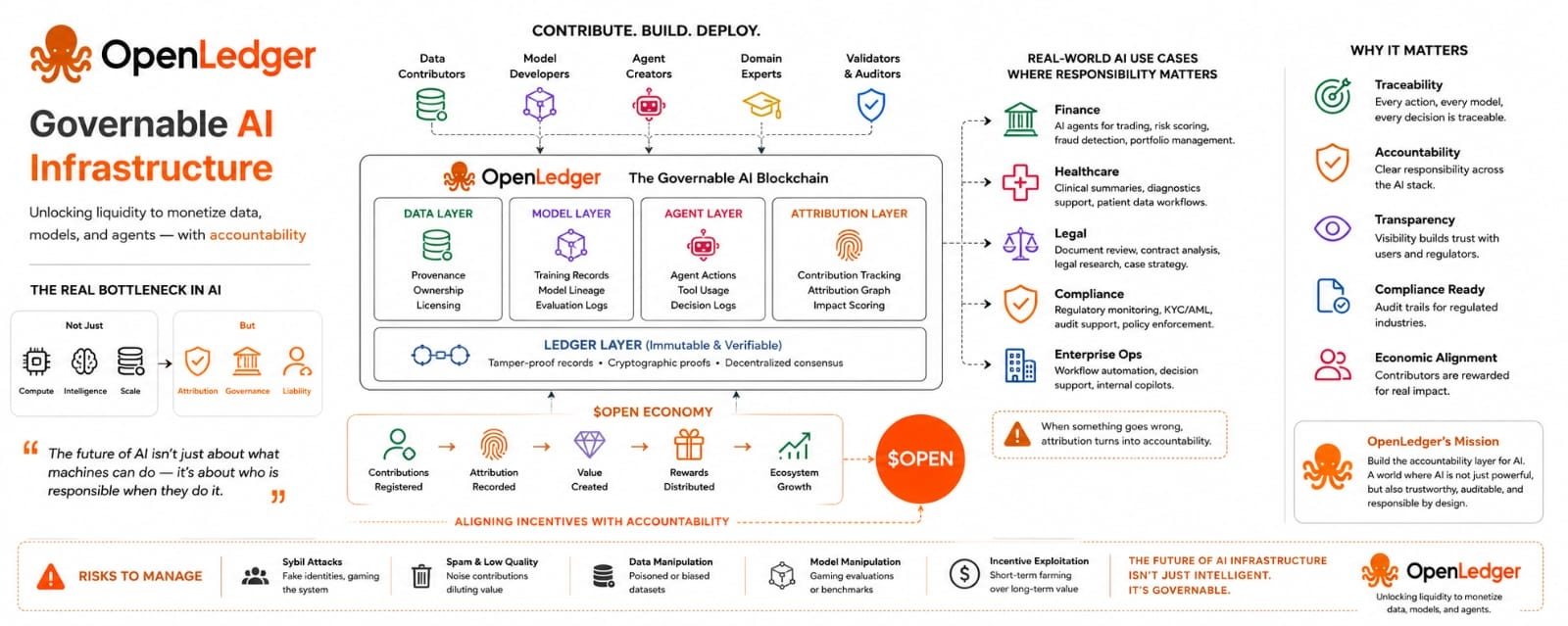
A few years ago, infrastructure w$OPEN as one of those words people used without thinking much about it. Roads, bridges, ports, cloud servers if the conversation got technical enough. Infrastructure was the quiet layer underneath everything else. Necessary, expensive, but not particularly interesting.
AI changed that completely.
Now infrastructure feels like a market narrative. GPUs move entire sectors. Data centers suddenly matter to geopolitics. Compute has become a speculative asset. Everyone wants exposure to “AI infrastructure,” and honestly, I understand why. Intelligence is becoming economic power in real time.
But lately I’ve been thinking that maybe the biggest bottleneck in AI isn’t intelligence itself.
Maybe it’s accountability.
That sounds less exciting, which is probably why people avoid the conversation. It’s easier to talk about model performance than responsibility. Easier to talk about scale than consequences. But the more AI moves into real-world systems, the harder that becomes to ignore.
Because once AI starts making decisions that affect money, healthcare, law, compliance, or operations, somebody eventually has to answer a simple question:
Who’s responsible if the machine gets it wrong?
That question changes everything.
And honestly, it’s one of the reasons OpenLedger caught my attention in the first place.
At first I looked at OpenLedger the same way most people probably do. AI blockchain. Monetized data. Agents. Models. Contributors getting rewarded. Standard AI-crypto overlap narrative. Interesting, but familiar.
Then I started thinking about attribution differently.
Most people frame attribution as a rewards mechanism. Who contributed data? Who trained the model? Who deserves compensation? That’s the obvious interpretation because crypto naturally gravitates toward incentives.
But I think attribution may end up mattering for a completely different reason.
Liability.
Or maybe more accurately: traceability.
Because once AI systems start operating inside serious industries, attribution stops being a nice feature and starts becoming infrastructure. Not because companies suddenly care about fairness out of nowhere, but because institutions hate uncertainty.
And AI introduces a massive amount of uncertainty.
Think about where this is all heading. AI agents are beginning to handle workflows, financial operations, customer interactions, research, compliance reviews, healthcare summaries, coding assistance, even decision support inside businesses. Some of these systems already operate semi-autonomously.
That sounds efficient until something breaks.
What happens if an AI agent approves a fraudulent transaction? Or summarizes medical information incorrectly? Or makes a recommendation based on manipulated data? Or executes a workflow that creates legal exposure months later?
The technology part is easy to imagine.
The accountability part is not.
And that’s where I think the broader AI conversation still feels incomplete. Everyone talks about what AI can do. Very few people talk about how institutions actually adopt systems that can create real liability.
Because enterprises don’t think like retail markets do.
Retail usually prices upside first. Institutions price downside first.
A bank doesn’t just ask whether an AI model is smart. It asks whether the system can survive audits, regulators, lawsuits, compliance reviews, and operational failures. A hospital doesn’t only care about efficiency. It cares about whether decisions can be traced after the fact. Large organizations don’t simply buy capability.
They buy defensibility.
That’s why provenance, audit trails, and attribution suddenly matter much more than people expected.
And honestly, that’s why OpenLedger started looking more interesting to me over time.
If AI infrastructure can track where data came from, which contributors influenced a model, which agent performed an action, and how outputs were generated, then attribution becomes something much bigger than rewards.
It becomes a map of responsibility.
That changes the entire framing.
Because maybe the next phase of AI infrastructure isn’t only about compute power. Maybe it’s about governability. Maybe the systems that matter most won’t just be the most intelligent ones. They’ll be the ones organizations can actually trust enough to deploy at scale.
And trust in AI probably doesn’t come from intelligence alone.
It comes from visibility.
That’s especially true once you start thinking about agentic AI.
Right now most people still interact with AI through prompts and responses. But over time, agents will probably handle increasingly complex tasks independently. They’ll coordinate workflows, interact with software systems, move information across platforms, maybe even make limited economic decisions on behalf of users or businesses.
That creates incredible efficiency.
It also creates a completely new layer of operational risk.
Because once machines start acting instead of simply responding, organizations need to understand what happened after the action takes place. They need logs. Provenance. Accountability layers. Behavioral tracking. Decision histories.
Not because it sounds futuristic.
Because regulators, auditors, and legal teams will demand it.
And maybe that’s the part of the AI economy markets still underestimate. The hidden cost of intelligence isn’t compute alone. It’s governance.
The smarter systems become, the more expensive ambiguity becomes.
Of course, there’s another side to this story too.
Crypto incentive systems are messy.
That’s important to acknowledge honestly because every decentralized attribution network eventually faces the same problems: spam, sybil attacks, fake engagement, manipulated contributions, low-quality participation optimized for rewards. Incentives attract coordination, but they also attract exploitation.
So OpenLedger’s challenge probably isn’t just scaling activity.
It’s maintaining credibility.
Because attribution only matters if the underlying signals remain trustworthy. And in an internet increasingly flooded with synthetic AI-generated content, trustworthy provenance may become one of the rarest assets online.
That sounds dramatic, but maybe it’s true.
We’re entering a world where machines can generate infinite text, images, code, research, interactions, even other agents. Information abundance is no longer the problem. Verifiable lineage might be.
Where did this come from? Who influenced it? Can it be audited? Can responsibility be traced?
Those questions are becoming economic questions now.
And honestly, I don’t think markets are fully pricing that shift yet.
Most AI tokens are still being valued through the lens of compute, scale, or model access. But OpenLedger feels slightly different when viewed through the lens of uncertainty reduction.
Because that may ultimately be the real infrastructure layer AI needs.
Not just intelligence.
Governable intelligence.
Infrastructure capable of making machine decisions more traceable, more auditable, and maybe a little less opaque.
That’s a serious thesis if it works.
And maybe that’s why I think $OPEN is more interesting than a simple AI narrative token. It potentially represents something deeper: a market bet that accountability itself becomes valuable infrastructure in the AI era.
Not glamorous infrastructure.
But historically, the most important infrastructure rarely looks glamorous at first.
People notice intelligence immediately.
It takes longer to notice the systems quietly reducing uncertainty underneath it.
I think that shift is starting now.