The more I look at this, the less simple it feels.
People often reduce projects like OpenLedger into a familiar crypto narrative: “AI + blockchain.” But that framing may actually miss the core argument entirely.
The more important question is whether AI itself needs a native economic layer one capable of tracking contribution, distributing value, and coordinating incentives across datasets, models, validators, developers, and agents.Because right now, most AI systems operate with a strange imbalance.
The infrastructure depends on millions of invisible contributors, yet the economic rewards remain heavily centralized. Data providers rarely know how their information is used. Model improvements are difficult to trace. Human feedback becomes part of training loops without meaningful ownership. And once a model succeeds commercially, almost all value accumulates at the platform level.OpenLedger’s thesis appears to target that imbalance directly.
Instead of treating blockchain as an add-on for AI, the project positions blockchain as the accounting and coordination layer for the AI lifecycle itself. That distinction matters more than it initially sounds.At the center of the architecture is Proof of Attribution.
The idea is relatively straightforward in theory but difficult in practice: measure how specific datasets or contributors influence model outputs, then distribute rewards proportionally. If successful, that creates something crypto has discussed for years but rarely implemented effectively — programmable ownership around digital intelligence.
In OpenLedger’s model, contributions are not just uploaded and forgotten. They become part of an on-chain attribution system tied to future usage and inference revenue.That changes the economic structure significantly.
Under the current AI landscape, most contributors are effectively unpaid infrastructure. OpenLedger is attempting to transform them into participants within an active economic network.
The project extends this logic through Datanets, which function as specialized data ecosystems rather than generic scraping repositories. That distinction is important because the AI industry itself is already shifting away from the assumption that bigger models automatically win.Increasingly, the demand is moving toward specialized intelligence.
Healthcare systems require domain-specific reasoning. Financial models need compliance-aware outputs. Cybersecurity tools require constantly updated threat intelligence. Legal applications demand traceable logic and explainability.General-purpose models can assist with these tasks, but specialized fine-tuning is where practical commercial value often emerges.
That is where OpenLedger’s infrastructure stack becomes more interesting.ModelFactory attempts to simplify the process of fine-tuning domain-specific models through a more accessible workflow. OpenLoRA focuses on serving multiple fine-tuned models efficiently through shared GPU infrastructure, lowering inference costs and improving scalability.
Individually, these components are not entirely unique. The stronger argument is how they connect economically.A specialized model can theoretically move through a complete lifecycle inside the ecosystem:
• contributors provide expert datasets,
• the model gets fine-tuned,
• governance approves progression,
• users pay for inference,
• revenue flows back through attribution and staking mechanisms.
That creates a feedback loop where AI usage directly connects to contributor incentives.From a crypto perspective, this may be the project’s most important angle.
Many AI discussions still focus primarily on model capability. OpenLedger appears more focused on coordination, ownership, and economic alignment. In some ways, the project resembles infrastructure for a future AI marketplace rather than simply another AI protocol.
The OPEN token sits at the center of OpenLedger’s coordination model.What makes it interesting is that the utility goes beyond simple speculation.The token is tied to:
• governance decisions,
• staking mechanisms,
• model proposal approvals,
• inference payments,
• contributor rewards,
• and broader ecosystem incentives.
At least in theory, that creates a circular AI economy where network activity continuously feeds value back into the people helping improve the system.
A practical example probably explains the idea better.Imagine a specialized medical AI model trained using datasets contributed by healthcare researchers, doctors, and institutions. As the model becomes useful, hospitals and applications begin paying for inference access.
Instead of all the value flowing to a single platform, part of the revenue can move back toward contributors whose data actually improved the model’s performance.That changes the structure of AI economics quite a bit.
The difficult part, though, is whether this works cleanly at scale once real demand, incentives, and competition enter the system.Over time, the model becomes commercially useful for diagnostics or workflow automation.Hospitals and enterprises begin paying for inference access.
Instead of all revenue flowing exclusively to a centralized AI company, parts of the economic value are distributed across validators, infrastructure providers, model developers, and data contributors whose information materially improved the model’s performance.That concept is powerful because it introduces ownership structures around AI production itself.But this is also where skepticism becomes necessary.
The difficult part is not designing token flows or attribution frameworks on paper. The difficult part is proving that attribution can remain accurate, scalable, and economically meaningful under real usage conditions.
As networks scale, complexity increases quickly:
• contribution measurement becomes harder,
• governance quality can deteriorate,
• incentives may centralize,
• low-quality data can overwhelm systems,
• token economics can distort participation.
And unlike traditional DeFi systems, AI introduces additional uncertainty because model quality itself is subjective and continuously evolving.OpenLedger’s success therefore depends less on theoretical architecture and more on actual adoption metrics.
What I’m personally watching is fairly specific:
• whether developers genuinely build specialized models inside the ecosystem,
• whether contributors consistently receive meaningful rewards,
• whether enterprises use the infrastructure for real inference demand,
• and whether governance remains functional once economic incentives intensify.
Because ultimately, infrastructure only matters if real economic activity forms around it.The broader opportunity, however, is difficult to ignore.If AI becomes the next foundational internet economy, then systems capable of coordinating trust, attribution, payments, and ownership could become increasingly important. OpenLedger is positioning itself around exactly that possibility.
So the real question is not whether OpenLedger can combine AI and blockchain.It is whether it can become a durable coordination layer for AI value creation without slowly recreating the same concentration dynamics that decentralized systems originally aimed to escape.$OPEN #OpenLedger @undefined @OpenLedger 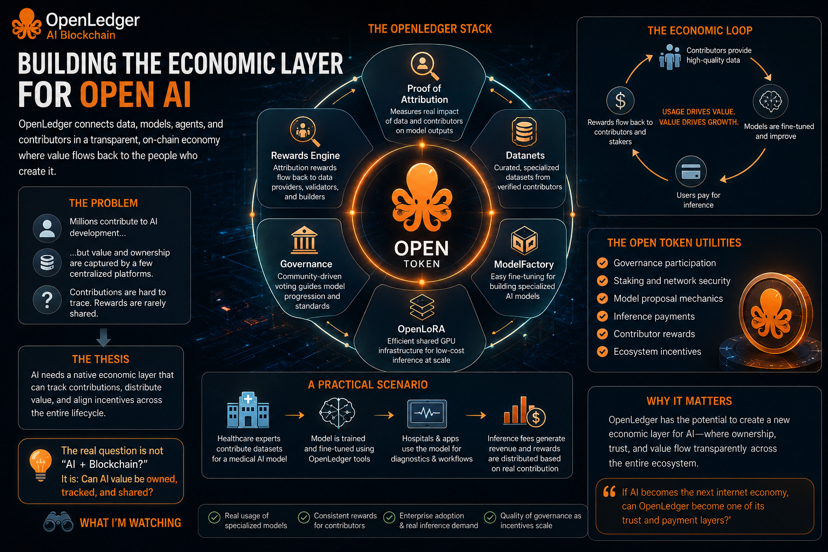

Artikel
Can OpenLedger Become AI’s Trust and Incentive Layer?
--
Haftungsausschluss: Enthält Meinungen von Drittanbietern. Keine Beratung. Binance Ai wird ohne Gewähr bereitgestellt. Siehe AGB.