
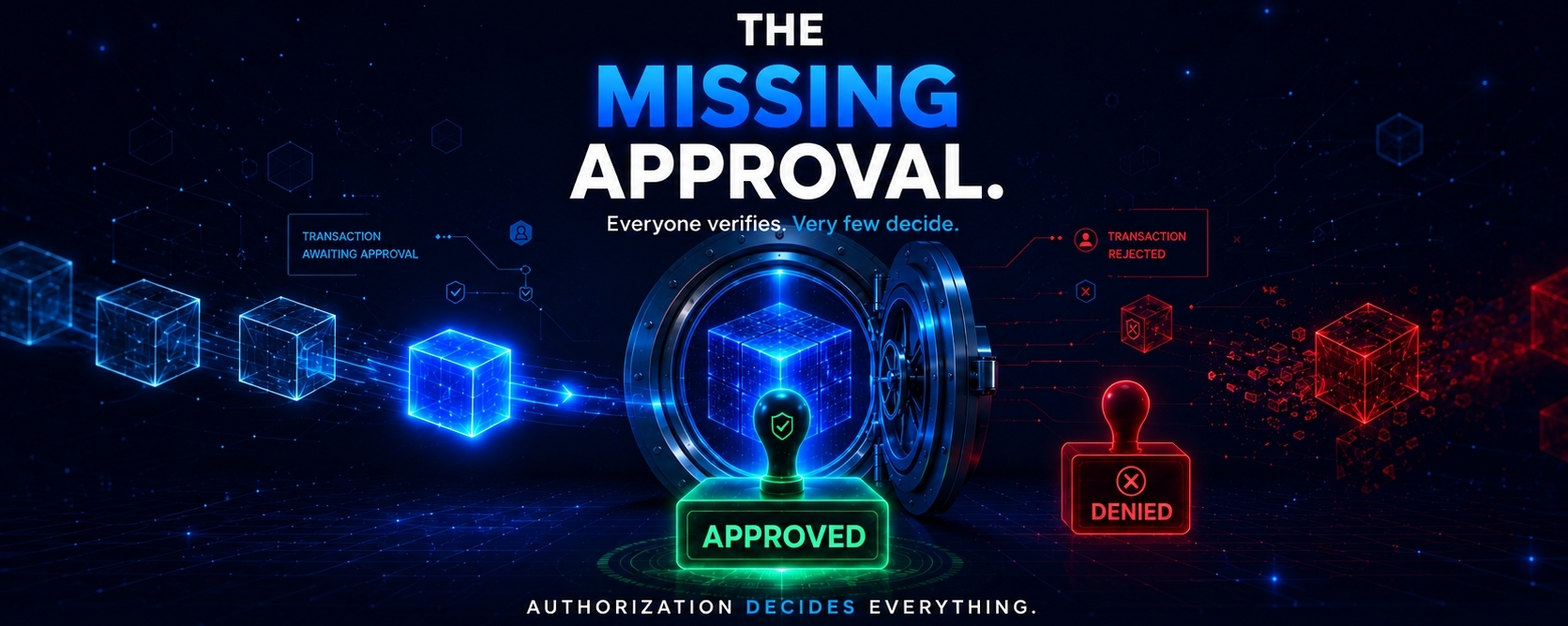
Most people think blockchain already solved trust.
The more I explored Newton Mainnet Beta, the more I realized something surprising.
Maybe blockchain never solved trust.
Maybe it only solved verification.
There's a difference.
A transaction can be perfectly signed.
It can be cryptographically valid.
It can execute exactly as designed.
And it can still be the wrong decision.
That was the moment I stopped thinking about speed, throughput, and transaction costs.
Instead, I started thinking about approval.
Not the kind we click on every day.
The kind that determines whether something should happen at all.
Newton describes institutional-scale authorization backed by real-world data.
At first, that sounded like another technical feature.
But the more I connected the pieces, they more it felt like a completely different philosophy.
Verification answers one question.
"Is this authentic?"
Authorization asks another.
"Should this be allowed?"
Those two questions sound similar.
They're not.
As blockchain expands into identity, finance, AI, and real-world assets, that second question may become the more important one.
For me, that's what Newton Mainnet Beta represents.
Not another race to execute transactions faster.
A step toward making every decision before execution more intelligent.
Maybe the future of Web3 won't be remembered for moving assets faster.
Maybe it'll be remembered for knowing when not to move them.
That's the part I think deserves far more attention.
What do you think will become more valuable over the next few years:
Faster execution…
or better authorization?