
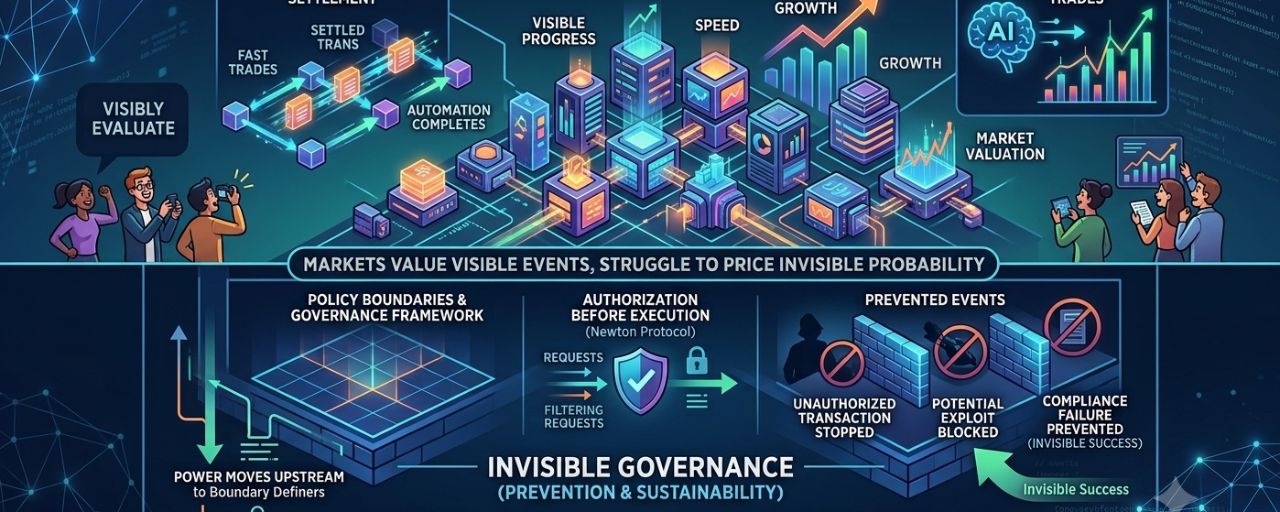

"The AI executed the trade."
"The transaction settled."
"The automation completed the task."
Those are the moments we remember.
Something happened.
A problem was solved.
A new capability appeared.
Progress feels visible because it creates an event we can point to.
The more I think about it, the more I wonder whether that instinct quietly shapes how we evaluate technology itself.
We naturally admire systems for what they accomplish.
Much less often do we admire them for what they quietly prevent.
At first, that sounded like nothing more than a difference in language.
Now I'm beginning to think it's one of the reasons some of the most important infrastructure is consistently undervalued until the moment it fails.
Most technological progress is easy to demonstrate.
A faster processor finishes work sooner.
A better model solves more complex problems.
A blockchain processes more transactions.
The improvement is visible.
People can benchmark it, compare it, and talk about it.
Prevention works differently.
When it succeeds, the outcome is often the absence of an event.
The exploit never reaches production.
The unauthorized transaction never settles.
The security incident never becomes tomorrow's headline.
Success leaves remarkably little evidence behind.
That creates an unusual challenge.
How do people learn to value something whose greatest achievement is making sure there is nothing dramatic to notice?
Once I started looking for that pattern, I saw it far beyond software.
Airlines invest enormous effort in procedures passengers hope they'll never think about.
Hospitals depend on protocols that are only discussed when they fail.
Financial institutions spend billions on controls that rarely appear in product demonstrations.
The most mature organizations don't simply become better at acting.
They become better at deciding which actions should never be allowed to happen in the first place.
That distinction seems small.
I don't think it is.
Capability expands what a system can do.
Governance defines which of those capabilities society is willing to trust.
Capability creates progress.
Governance determines whether that progress remains sustainable.
I also wonder whether our own psychology makes this harder to appreciate.
Human attention is naturally drawn toward events.
We remember launches.
Failures.
Breakthroughs.
Crises.
Stories require something to happen.
Prevention removes the story before it can exist.
Perhaps that's why visible capability feels exciting while invisible protection often feels like overhead.
Not because one creates more value than the other.
Because one produces evidence of its own importance, while the other quietly erases it.
If capability creates visible success...
prevention creates invisible success.
And invisible success is one of the hardest things for people—and markets—to value consistently.
That perspective stayed with me while reading about Newton Protocol.
I expected to find another architecture focused primarily on making autonomous systems more capable.
Instead, what caught my attention was something much simpler.
The protocol emphasizes authorization before execution.
Before an action proceeds, it is evaluated against predefined policy.
Only then can execution continue.
Technically, that's an architectural decision.
Conceptually, it feels like something larger.
Instead of asking only how autonomous systems can do more, it also asks whether certain actions should happen at all.
That inversion struck me because it mirrors the way mature institutions evolve.
The organizations that survive for decades rarely succeed by maximizing capability alone.
They also invest in defining boundaries that scale alongside capability.
Capability creates growth.
Governance determines whether growth survives.
The more I thought about that, the more it changed how I think about markets.
Markets naturally reward what they can observe.
Higher throughput.
Lower costs.
Better benchmarks.
Those improvements are measurable.
Invisible prevention is much harder to value before failure occurs.
How do you measure the worth of a fraud that never happened?
Or a transaction that was never allowed to become unauthorized?
Or a compliance failure that quietly never reached production?
Those outcomes create real value.
They're simply difficult to price because success removes the evidence that would have made the value obvious.
Markets are remarkably good at pricing visible evidence.
They struggle to price invisible probability.
Perhaps that is why infrastructure built around prevention often appears less exciting than infrastructure built around capability—even when both become equally essential over time.
That observation also changes where I think power lives.
We often assume the most influential part of a system is the component taking action today.
But every permission has an author.
Every boundary reflects a decision someone made long before today's request arrived.
That means every autonomous system also carries an invisible history.
Long before software performs today's action, someone already decided where today's boundaries would be.
As autonomous systems become more capable, influence may increasingly belong to the people and institutions defining those boundaries rather than the systems executing them.
Power doesn't disappear.
It quietly moves upstream.
For years, the central question around AI has been how capable these systems might become.
That remains an important question.
I'm starting to think another one deserves equal attention.
How quickly can our institutions evolve the governance needed to match that capability?
History is full of technologies that advanced faster than the frameworks surrounding them.
Capability is often the visible race.
Governance is usually the quieter one.
The challenge is that societies rarely notice governance succeeding.
When it works, nothing dramatic happens.
The boundaries simply hold.
Maybe that's why the technologies that matter most in the long run aren't always the ones attracting the most attention.
Some create visible progress.
Others make that progress sustainable.
Newton didn't change my mind because it promised more capable autonomous systems.
It made me think more carefully about something we celebrate far less often.
The infrastructure that quietly decides which capabilities should never become actions in the first place.
We often imagine the future belonging to the systems capable of doing the most.
I'm beginning to suspect it may belong just as much to the institutions capable of deciding what those systems should never be allowed to do.