
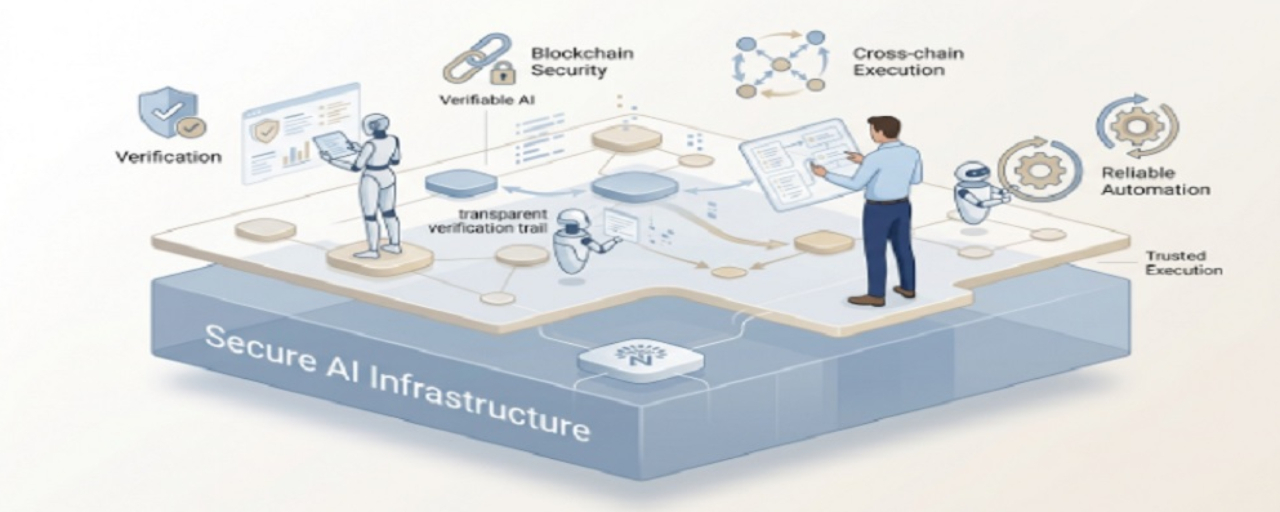

Over the past year, AI has become part of everyday conversations in crypto. New tools appear almost weekly, each promising faster automation or smarter decision-making. What I've started paying more attention to, though, isn't what AI can do. It's whether the systems supporting it are ready for the responsibility.
That question naturally leads to infrastructure.
It's easy to be impressed by an AI agent that can complete a task in seconds. It's much harder to think about how those actions are verified, recorded, and trusted once they begin interacting with decentralized applications. Without that foundation, speed alone doesn't solve much.
This is where @NewtonProtocol stands out in an interesting way.
Instead of treating AI as a feature layered onto blockchain, Newton appears focused on the environment where AI can operate with stronger accountability. That shift changes the conversation from capability to reliability.
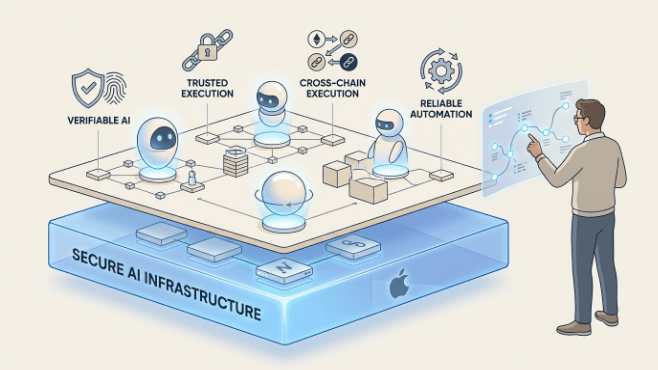
Imagine asking an AI agent to coordinate several blockchain actions across different networks.
The result might be technically correct, but users still need confidence that every step happened as intended. If something goes wrong, they should have a way to understand what occurred instead of relying entirely on blind trust.
That idea becomes even more important as automation grows.
The more responsibilities we hand to software, the less practical it becomes to manually verify every action ourselves. Good infrastructure doesn't remove trust from the equation. It provides tools that make trust easier to evaluate.
One concept that caught my attention is Verifiable AI.
Rather than expecting users to simply accept an AI-generated result, verification creates an opportunity to inspect and confirm important actions. It reminds me of the difference between receiving an answer and seeing the reasoning behind it. The second option usually inspires much more confidence.
Developers could benefit from this approach as well.
Building AI-powered applications often means balancing convenience with transparency. If users can verify how key operations were handled, developers may spend less time addressing concerns about hidden processes and more time improving functionality.
Another reason secure infrastructure matters is interoperability.
AI services are unlikely to exist within a single blockchain ecosystem forever. As decentralized networks become increasingly connected, automated systems will need to communicate across multiple environments while maintaining consistent standards for security and verification.
That isn't a simple technical challenge.
Different chains have different architectures, execution models, and assumptions. Infrastructure that helps coordinate those interactions could quietly become one of the most valuable layers of the AI ecosystem, even if most users rarely notice it.
I also think discussions around AI sometimes overlook an important reality.
Not every improvement is visible on the surface. Better interfaces often receive immediate attention, while backend improvements remain almost invisible despite making everything more dependable. In technology, some of the most meaningful progress happens where users never have to think about it.
That's one reason I appreciate projects investing in infrastructure before chasing attention.
It isn't the fastest path to recognition, but durable systems usually outlast temporary trends. Crypto has seen many moments where excitement arrived well before practical utility. Building the opposite way around feels more sustainable.
Of course, no infrastructure is perfect from day one.
Real adoption often reveals challenges that aren't obvious during development. That's why gradual refinement, testing, and community feedback remain essential parts of building trustworthy systems instead of obstacles to overcome quickly.
Looking ahead, I think the conversation around AI will gradually become less about impressive demonstrations and more about dependable execution.
People will likely care less about whether an AI agent can perform a task and more about whether that task can be verified, secured, and repeated consistently under real-world conditions.
For me, that's what makes infrastructure such an interesting topic.
It may never generate the loudest headlines, yet it influences nearly everything built above it. As the broader AI ecosystem evolves, projects exploring verification, security, and reliable automation could shape the user experience in ways that aren't immediately obvious but become increasingly valuable over time.
That perspective is why I find $NEWT worth following as a technology initiative rather than a source of hype. If trustworthy AI becomes a long-term expectation instead of an optional feature, the infrastructure supporting it may ultimately matter just as much as the intelligence itself.
