
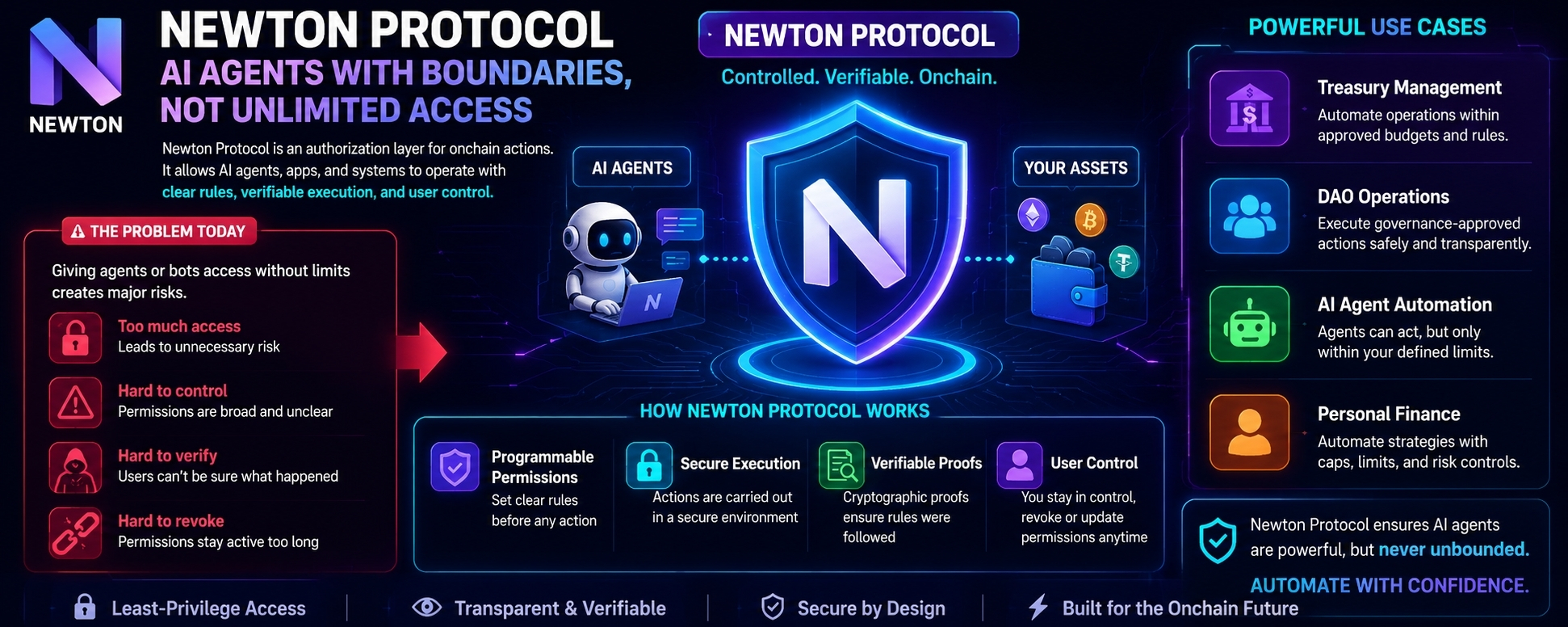

I’ve been spending time looking at Newton Protocol, and what stands out to me is that it is not really trying to push the usual idea that AI can do everything on its own. The project seems more focused on a harder and more practical question: how can AI agents act onchain without being given too much freedom?
That matters because once an AI agent is connected to assets or digital permissions, it is no longer just giving suggestions. It can potentially move funds, trigger actions, and follow instructions faster than a person can react. That can be useful, but it also creates a serious trust issue. Nobody wants to give an automated system unlimited access and simply hope that it behaves correctly.
Newton Protocol is trying to approach this through controlled permissions. Instead of letting an agent act freely, the user can decide what the agent is allowed to do before it starts operating. The idea is that the agent should work inside clear limits rather than having open access to everything.
I think that is the part of the project that deserves more attention. A lot of people talk about AI agents as if the main challenge is making them smarter. But intelligence is only one part of it. The bigger challenge is making sure that a smart agent cannot make a damaging decision just because it has too much access.
For example, someone might want an AI agent to manage a set amount of digital assets. In a risky setup, the agent could be free to move funds anywhere it thinks is best or take actions the user never expected. With Newton Protocol’s kind of model, the user could create limits around that activity. The agent might be allowed to work with only approved assets, stay below a certain amount, avoid risky actions, or stop operating when certain conditions are met.
That makes the agent feel less like something with full control and more like a tool following a clear set of instructions.
I keep coming back to this because crypto has always had a permission problem. Many people approve actions without fully understanding what they are allowing. Some permissions can remain active longer than expected. Automation can be helpful, but it often asks users to trust systems with more access than they are comfortable giving.
Newton Protocol appears to be trying to make that process more structured. The project is built around the idea that permissions should be programmable, meaning users can decide in advance what kinds of actions are allowed. That could be useful for individuals, teams, communities, and organizations that want automation without handing over full control.
A group managing shared funds, for example, could allow an agent to handle regular payments within a fixed budget. A business could use automation for certain routine tasks without giving the system unlimited authority over all of its assets. A regular user could automate repeated onchain actions while still keeping strict boundaries around what the agent is able to do.
The interesting part is that Newton Protocol is not only about automation. It is also about proving that automation followed the rules.
In simple terms, the project is trying to create a system where users can have more confidence that an agent acted within the permissions it was given. The goal is not just to say, “Trust this AI agent.” The goal is to make it possible to check whether the agent stayed inside the limits that were set.
Of course, that does not solve everything.
An agent can follow the rules perfectly and still make a poor decision if the rules were badly designed. It can also act on weak information or respond to conditions that later turn out to be risky. Technology can reduce certain mistakes, but it cannot completely replace human judgment.
That is why I do not see Newton Protocol as something that removes risk. I see it more as an attempt to make risk easier to control.
The project will also need to prove that its permission system is simple enough for ordinary users. Security tools are only useful when people can understand them. If creating rules becomes too complicated, many users may choose broad permissions because it feels easier. That would weaken the whole idea.
I’m also watching how the project develops over time. The important questions will be how the rules are enforced, how actions are verified, how much control users really have, and whether the system remains understandable as it grows.
For me, the real value of Newton Protocol is not about short-term excitement around AI or the NEWT token. It is about whether the project can help create a safer way for AI agents to operate in crypto.
AI agents may become more common in digital finance, asset management, payments, and online systems. But that future only makes sense if users can give those agents limited authority without feeling like they are giving up control completely.
Newton Protocol is trying to build around that idea. It is asking whether automation can become useful without becoming dangerous, and whether AI agents can act onchain while still being restricted by rules that users understand.
That is the bigger picture I will be watching. Not whether AI agents become popular overnight, but whether projects like Newton Protocol can make them safe enough for people to trust over the long term.