The most dangerous price in an automated vault may be the one that is correct on one venue and misleading everywhere else.
That is the data reliability problem I would watch around Newton Mainnet Beta.
In automated finance, a policy often needs a number before it can make a decision.
Price.
Liquidity.
Volatility.
Spread.
Risk score.
Deviation.
If the number is fresh and comes from a recognized source, it can feel reliable enough for pre-settlement evaluation. The vault checks the rule, the action fits the limit, and the system moves forward.
But market data is not always a single truth.
Sometimes the real signal is not the price itself.
It is the disagreement around the price.
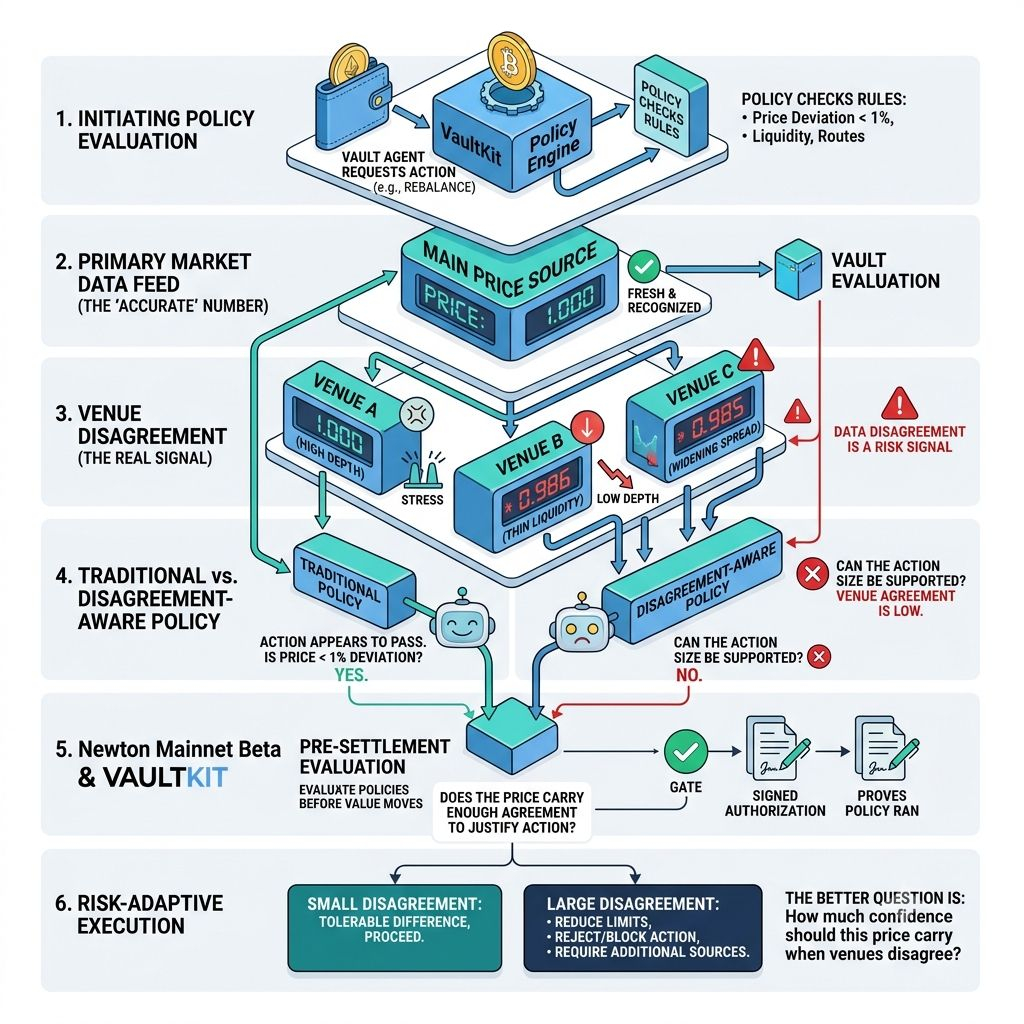
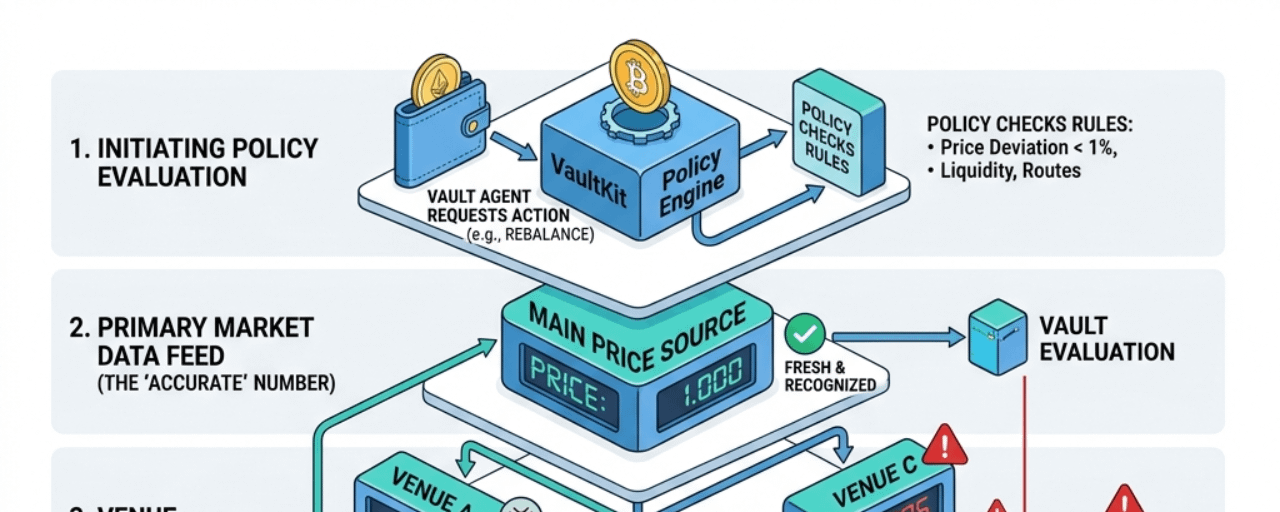
Imagine an automated vault using VaultKit to evaluate a rebalance before settlement. The policy allows the agent to move into an asset only if the price deviation is below 1%, liquidity is acceptable, and the route stays inside approved execution paths.
Venue A reports the asset at 1.000.
Venue B reports it at 0.986.
Venue C shows thin liquidity and a widening spread.
The primary feed still reports a fresh price close to 1.000.
The requested action appears to pass.
The destination is approved.
The amount is inside the asset limit.
The policy is enforced correctly before settlement.
Nothing looks broken.
But the data disagreement is itself a risk signal.
If one venue says the asset is stable while another venue shows stress, the policy should not treat the clean price as if the whole market agrees. The number may be accurate where it was measured. It may still be unreliable as a decision input for a vault that must execute across real liquidity.
That distinction matters for Yasir’s lane.
A valid number is not always a reliable number.
A fresh price is not always a complete market signal.
A policy can evaluate the available input correctly and still miss the fact that the input is disputed by the market.
This is where @NewtonProtocol becomes interesting from a data-quality perspective.
Through VaultKit, applications can place policy evaluation before settlement. Actions can be checked against asset limits, routes, approved destinations, and policy conditions before value moves. Signed authorization records can help show that a request was evaluated under a policy context.
That is meaningful.
But a signed result can prove that the policy ran.
It does not automatically prove that the market data behind the policy was uncontested.
For serious automated vaults, venue disagrement should not be treated as background noise. It should be part of the risk context.
If the policy uses only one clean price during a fragmented market, the agent may receive a false sense of safety. It may move capital into a position that looks acceptable under one venue and dangerous under another.
The issue is not always manipulation.
It can be latency.
It can be thin liquidity.
It can be fragmented order books.
It can be regional venue stress.
It can be a temporary imbalance during volatility.
It can be a stable asset beginning to trade differently across markets before the primary feed fully reflects the stress.
The data point is not necessarily fake.
It is incomplete because it hides disagreement.
Consider a vault reducing exposure during a volatile period.
The agent wants to move into a stable asset.
The main price source shows 0.999.
Another venue shows 0.985 with low depth.
A third venue still shows 0.998, but only for small size.
If the policy only asks whether the reported price is within range, the action may pass.
If the policy asks whether venues agree enough to support the action size, the result may be different.
That is the real standard.
The question is not only:
“What is the price?”
The better question is:
“How much confidence should this price carry when venues disagree?”
This becomes even more important when the action size is large.
A small transfer may tolerate some venue disagreement.
A large rebalance may not.
A low-risk maintenance action may proceed with a wider tolerance.
A new exposure increase during fragmented liquidity should demand stronger confirmation.
A risk-reducing exit may need a different standard from a yield-seeking entry.
The policy should not treat every disagreement the same.
It should scale its caution with action type, size, route senstivity, and market stress.
There is a trade-off.
If every venue mismatch blocks automation, the vault becomes fragile. Markets are never perfectly synchronized. Small differences are normal. Overreacting to every spread can slow down useful execution and create unnecessary failed authorizations.
But if venue disagreement is ignored completely, the vault may act on a clean-looking number while the broader market is already warning that execution risk has changed.
The better standard is disagreement-aware evaluation.
Small differences can be tolerated.
Large gaps can reduce limits.
Persistent disagreement can require additional sources.
Disagreement during stress can allow only risk-reducing actions.
Disagreement across venues with thin liquidity can trigger stronger review before settlement.
That kind of policy does not need to claim perfect market truth.
It only needs to admit that a single number may not deserve full trust when the market around it is fractured.
This is the Yasir-style test I would apply to Newton Mainet Beta.
Can a VaultKit-powered application distinguish a clean price from a contested market?
Can policy evaluation account for venue disagreement before settlement?
Can signed records show whether an action passed under normal data confidence or disputed data conditions?
Can agents avoid treating one venue’s accurate number as universal truth?
Can risk limits adapt when the market stops speaking with one voice?
Automated vaults do not only need data that updates.
They need data that carries enough agreement to justify action.
Because the danger is not always a stale feed or a false price.
Sometimes the price is accurate.
The mistake is believing it represents the market.
$NEWT @NewtonProtocol #Newt $LAB $VANRY #Velvet #xau #VANRY #Labs