
I have noticed something over the last few years.
Whenever people talk about AI, the conversation usually stays around how smart a model has become. It can solve harder problems, answer faster, write better, reason longer.
Those things matter, of course.
But I keep coming back to a different question.
What happens after intelligence stops working alone?
That part feels strangely underexplored to me.
One capable system is interesting.
Thousands of capable systems interacting with each other every second is something else entirely.
I think the difficult part begins there, not because the individual systems suddenly become worse, but because the environment around them becomes crowded.
Traffic is probably the easiest comparison.
A single car making a sharp turn is rarely a disaster.
Put that same decision into a city where everyone is reacting to everyone else at almost the same time, and very small delays start multiplying.
Nobody intends to create a traffic jam.
It simply appears because every driver is adjusting to someone else's adjustment.
Markets often remind me of that.
The more automated they become, the less important isolated decisions seem.
What matters instead is timing, coordination, and whether different systems understand the same situation in compatible ways.
Two correct decisions arriving a fraction of a second apart can produce completely different outcomes.
I think people sometimes underestimate how much of reliability depends on synchronization rather than intelligence.
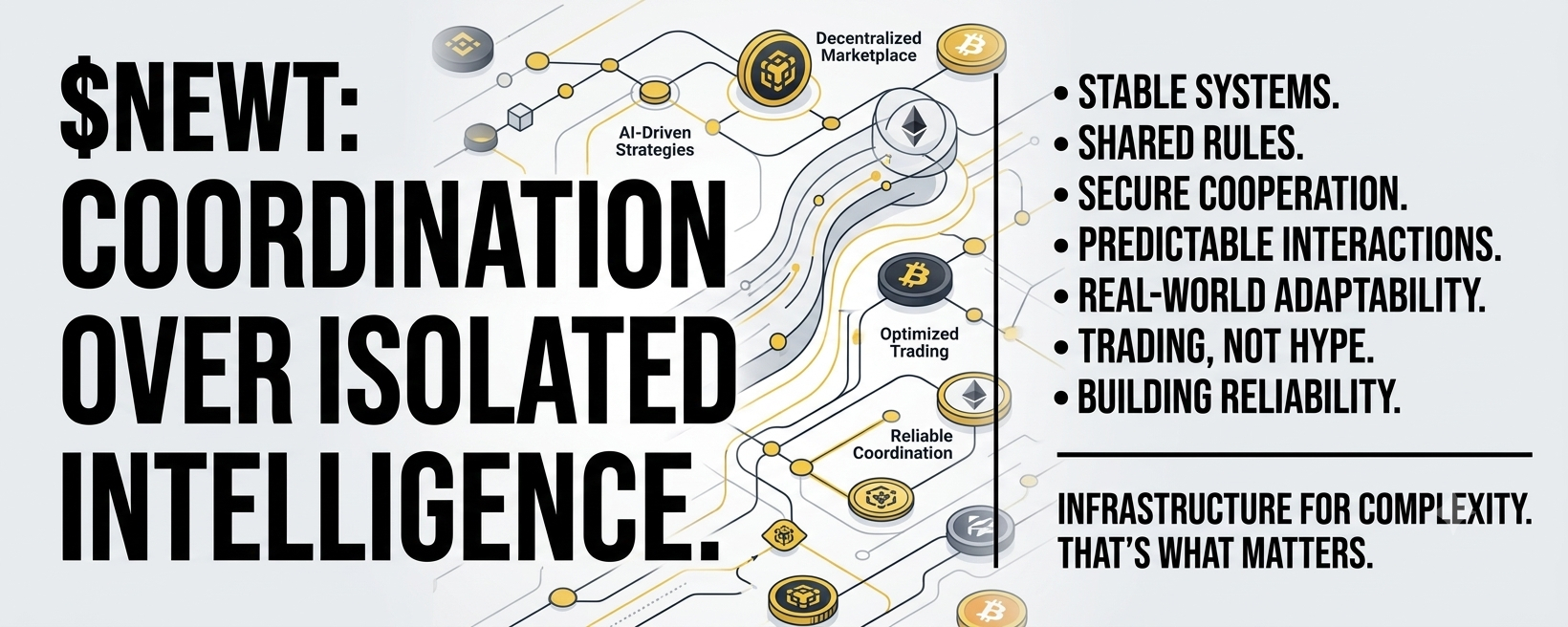
That is partly why Newton Protocol caught my attention.
As I understand it, the project is trying to build a secure rollup for AI-driven strategies, automated trading, and a marketplace where AI developers can contribute.
I do not immediately see it as a magic solution.
Actually, I become skeptical whenever any infrastructure claims it can solve everything.
Real systems never behave that politely.
Still, I think the direction is interesting because it shifts attention toward the environment where AI operates instead of only improving the AI itself.
Maybe I am influenced by watching operational systems over the years.
The biggest failures I have seen were rarely caused by one dramatic mistake.
They usually came from many ordinary actions lining up in unfortunate ways.
One service slowed down slightly.
Another retried too aggressively.
Monitoring reacted late.
Humans interpreted the alerts differently.
None of those events looked catastrophic by themselves.
Together they became one.
That pattern seems to repeat almost everywhere.
Cities experience it.
Supply chains experience it.
Electrical grids experience it.
Even organizations with experienced teams experience it.
Communication delays often matter more than technical capability.
A highly skilled team working with incomplete information can perform worse than an average team that shares information consistently.
I think protocols face a similar challenge.
People often describe infrastructure as if it quietly sits underneath everything without affecting behavior.
I do not think that is true.
Roads influence how cities grow.
Water pipes influence where neighborhoods develop.
Railways change entire economies over time.
Infrastructure shapes decisions because people naturally adapt to whatever constraints exist.
Digital infrastructure probably behaves the same way.
If AI systems eventually begin negotiating, executing financial strategies, managing resources, or coordinating across different organizations, then the reliability of those interactions becomes just as important as the quality of the underlying models.
Maybe even more important.
Of course, coordination has costs.
Adding security checks increases confidence but also introduces delay.
More verification usually means more processing.
Faster communication sometimes reduces careful validation.
Every improvement seems to create another trade-off somewhere else.
I have never seen a system escape that reality.
That is why I hesitate whenever discussions become too optimistic.
Faster is not always better.
More automation is not automatically safer.
More intelligence does not necessarily produce better collective behavior.
Actually, I remember a conversation from years ago with someone responsible for maintaining industrial equipment.
He said the hardest part was never replacing broken components.
The difficult part was understanding why several perfectly healthy components suddenly stopped cooperating after one small environmental change.
That stayed with me.
Complex systems rarely announce where the real weakness exists.
They simply become less predictable.
Maybe that is where something like Newton Protocol has an opportunity.
Not because it can eliminate uncertainty, but because it recognizes that coordination deserves infrastructure of its own.
Secure execution, predictable interaction, and shared operational rules sound less exciting than talking about increasingly powerful AI models, yet I suspect those quieter pieces determine whether ambitious ideas survive real conditions.
I also think incentives deserve more attention than they usually receive.
Technology often assumes participants will naturally behave in ways that strengthen the overall network.
Reality feels messier.
Developers optimize for different objectives.
Organizations protect their own interests.
Automated strategies compete rather than cooperate.
Humans remain humans regardless of how advanced the surrounding technology becomes.
Infrastructure cannot erase those differences.
It can only create conditions where disagreement becomes manageable instead of destructive.
That distinction matters to me.
Sometimes I wonder whether we spend too much time imagining ideal operating conditions.
Systems rarely experience ideal conditions for very long.
Markets become volatile.
Hardware fails.
Connections slow down.
Unexpected participants join.
Regulations change.
Human priorities shift.
Eventually something operates outside its original assumptions.
That moment tells us much more than successful demonstrations.
I have learned to trust boring reliability more than impressive performance numbers.
A bridge becomes valuable because it continues functioning during heavy rain, not because it looks beautiful on a sunny afternoon.
Nobody celebrates plumbing until water stops flowing.
Infrastructure earns appreciation mostly when stress appears.
Perhaps protocols are similar.
I do not know exactly how AI-driven markets will evolve over the next decade.
Maybe adoption will happen faster than expected.
Maybe it will move slowly because organizations remain cautious.
Both outcomes seem plausible to me.
What feels less uncertain is that coordination problems will grow alongside capability.
Smarter participants create more interactions.
More interactions create more opportunities for misunderstanding, delay, and unintended consequences.
That sounds almost obvious when I write it down.
Yet discussions still tend to focus elsewhere.
I suppose intelligence attracts attention because it is easy to observe.
Coordination is quieter.
It hides inside timing, sequencing, trust, incentives, communication, and recovery after something goes wrong.
Those qualities rarely produce dramatic headlines.
But they quietly decide whether large systems remain dependable.
Maybe that is the lens through which I now look at projects like Newton Protocol.
I am less interested in promises and more interested in the problems they choose to acknowledge.
Recognizing that infrastructure is about balancing competing needs instead of chasing perfection feels like a healthier starting point.
Nothing guarantees success.
No protocol can eliminate uncertainty or remove every operational risk.
That would be unrealistic.
But I think systems improve when their designers accept that complexity is permanent rather than temporary.
Once that idea becomes part of the design itself, the conversation changes.
Instead of asking how to build something flawless, we begin asking how to build something that keeps functioning after reality refuses to follow the plan.
Oddly enough, I trust that question much more than any confident answer.
@NewtonProtocol #Newt $NEWT #SKHynixSetsADRGuidancePriceAt$149 #Binance

