

Newton Protocol is one of those projects I would normally scroll past if I only saw the surface pitch.
AI agents. Automated trading. Onchain permissions. Strategy vaults. Another token. Another clean deck. Another promise that crypto is about to become smarter, safer, and more efficient if everyone just installs the next layer.
I have seen this movie too many times.
Most projects in this corner of the market end up recycling the same language until the words stop meaning anything. AI becomes a sticker. Automation becomes a sales pitch. Security becomes a paragraph near the bottom of the website. The token launches, attention spikes, liquidity thins out, and then everyone quietly moves on to the next thing with a different logo and the same bones underneath.
So I do not want to pretend Newton Protocol deserves trust just because it is talking about a real problem.
But it is talking about a real problem.
The problem is not whether crypto can automate finance. It already can. Bots have been front-running, rebalancing, farming, routing, liquidating, and exploiting for years. The market does not need another reminder that software can move faster than humans. We learned that the hard way. The harder question is what happens when that software is given permission to touch capital on behalf of users, funds, vaults, or agents that may not fully understand what they are signing away.
That is where Newton becomes worth looking at.
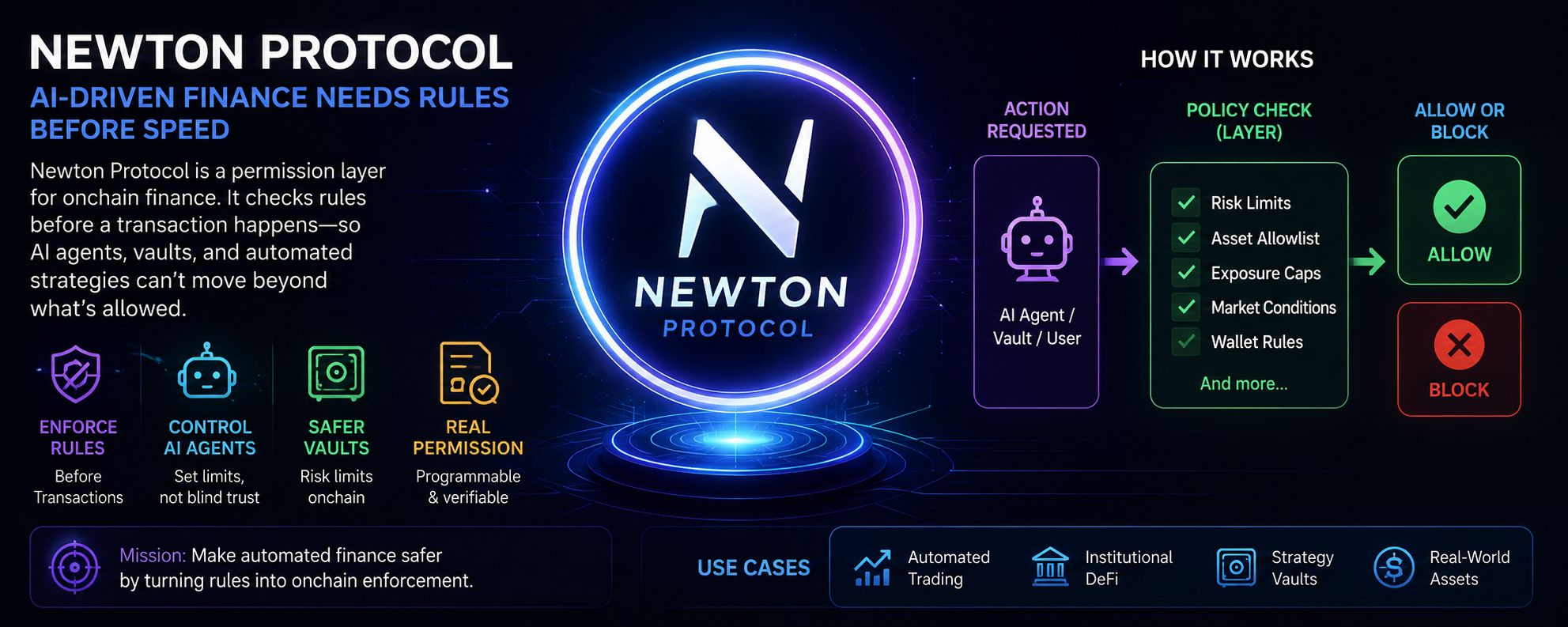
The project is trying to build a permission layer for onchain activity. Not a prettier dashboard. Not another place to watch risk after the fact. A layer that asks whether an action should be allowed before the transaction goes through.
That sounds boring until you have watched enough wallets get drained, vaults get mismanaged, strategies break under pressure, and “risk controls” turn out to be a Google Doc nobody followed when the market started moving.
Crypto is full of systems that execute perfectly and think badly. Smart contracts do what they are told. That is the beauty and the horror of it. If an AI agent is given too much freedom, it will not pause and wonder whether the user really meant to allow that trade. If a vault strategy crosses a risk limit, the chain will not feel shame. If a bot follows bad inputs into a bad market, the transaction still settles.
Newton’s idea is to put friction in the right place.
Not the annoying kind of friction where users are forced through endless screens and approvals. The useful kind. The kind that says: this agent can only trade these assets, this vault cannot exceed this exposure, this wallet cannot move more than this amount, this strategy stops if conditions get ugly. Rules before damage. Permission before execution.
That is the part I like.
I do not like it enough to ignore the rest.
Because every infrastructure project sounds clean when it is still young. The hard part is not writing the policy logic. The hard part is getting real people to use it when the market is tired, liquidity is selective, builders are distracted, and most users only care about safety after something goes wrong. Security infrastructure has always had this problem in crypto. Everyone respects it. Few want to pay for it until the floor is already on fire.
Newton Protocol is also trying to sit inside a messy future: AI agents managing money, automated vaults making decisions, users delegating control, and smart contracts needing to understand more than balances and signatures. That future is probably coming in some form. I do not think it arrives as smoothly as the marketing people suggest. It will arrive through mistakes. Bad agent permissions. Broken automations. Mispriced risk. Overconfident vault managers. Users clicking through approvals because they are tired.
That is the grind Newton is stepping into.
In plain terms, Newton wants to make permissions programmable. A user should not have to give an agent full control just to let it perform one job. A vault should not rely only on the reputation of the person managing it. A strategy should not be able to drift far outside its stated limits without something stopping it before capital moves.
This matters most when humans are no longer watching every action.
Say someone gives an AI agent permission to manage a small portfolio. Without strong limits, that agent might trade too aggressively, interact with risky contracts, move funds into the wrong place, or keep operating during market conditions where it should probably sit still. With a system like Newton, the user could narrow the agent’s freedom. Only certain assets. Only certain amounts. Only certain conditions. No movement outside the approved zone.
That is not exciting in the way crypto usually wants things to be exciting.
It is more like installing brakes.
And after enough cycles, brakes start to look underrated.
The vault angle is probably where Newton makes the most sense early on. Vaults are convenient because they hide complexity. Users deposit funds and let someone else, or something else, manage the strategy. But that convenience comes with a trust gap big enough to lose money in. The user does not really see every decision. They see the result after the decision has already happened.
Newton is trying to make vault rules harder to ignore. If a vault says it will not take too much exposure to one asset, that rule should not just sit in a description. If a strategy says it avoids certain markets, the contract flow should help enforce that. If risk conditions change, there should be some way to stop the system before it calmly walks into the mess.
I keep coming back to that word: enforce.
Crypto has enough promises. It has enough dashboards. It has enough post-mortems written in that strangely calm language everyone uses after millions of dollars disappear. The useful question is whether a rule can actually stop a transaction when it matters.
That is what Newton has to prove.
The NEWT token sits behind all of this as the economic piece. It is meant to support staking, fees, access to protocol infrastructure, and governance. Fine. That is the standard shape. I am not dismissing it, but I am not impressed by token utility written on paper either. I have read too many versions of that section. Staking, fees, governance, ecosystem access. The words are familiar. Too familiar.
The token only becomes interesting if the network becomes necessary.
That means real usage. Not just announcements. Not just integrations written like trophies. Not just a short burst of volume after listings. I want to see builders using the permission layer because they need it, vaults relying on it because allocators demand it, and users understanding that giving an AI agent limited authority is safer than handing it the keys and hoping for the best.
Until then, NEWT is still a young token in a tired market.
That matters. Young tokens are fragile. Supply can become a problem. Liquidity can vanish faster than confidence. The chart can look alive while the underlying usage is still thin. I have seen good ideas trade badly and bad ideas pump violently. Price is not proof. Not early.
There is also the complexity problem. Newton is not building something simple. It has to connect user intent, rules, smart contracts, external data, automated systems, operators, and whatever messy edge cases appear when real capital starts pushing against the design. That is where pretty architecture diagrams usually start sweating.
I’m looking for the moment this actually breaks.
Not because I want it to fail. Because that is when infrastructure shows what it is. Everything works in a clean example. The real test is a volatile market, a half-broken data feed, a strategy trying to execute at the edge of its mandate, a user who set bad permissions, a vault manager under pressure, and a system that has to decide whether to allow or block the transaction in time.
That is the job.
Newton Protocol is at least aiming at something useful. I will give it that. It is not only dressing up a token with AI language. It is looking at one of the more uncomfortable questions in crypto’s next phase: if agents and automated strategies are going to move money, who keeps them inside the lines?
Maybe the market is not ready to care yet. Usually it is not. Usually people care about permission after they have already given too much of it away.
But if onchain finance keeps moving toward automation, this kind of control layer stops feeling optional.
The question is whether Newton becomes the layer people actually use, or just another serious idea buried under the noise.