For years, blockchain integrations have mostly been about visibility.
A protocol connects to an oracle, compliance provider, or analytics platform, receives useful information, and leaves the final decision to developers or operators. The data improves awareness, but the smart contract itself rarely changes its behavior because of that information.
That is the assumption Newton Protocol challenges.
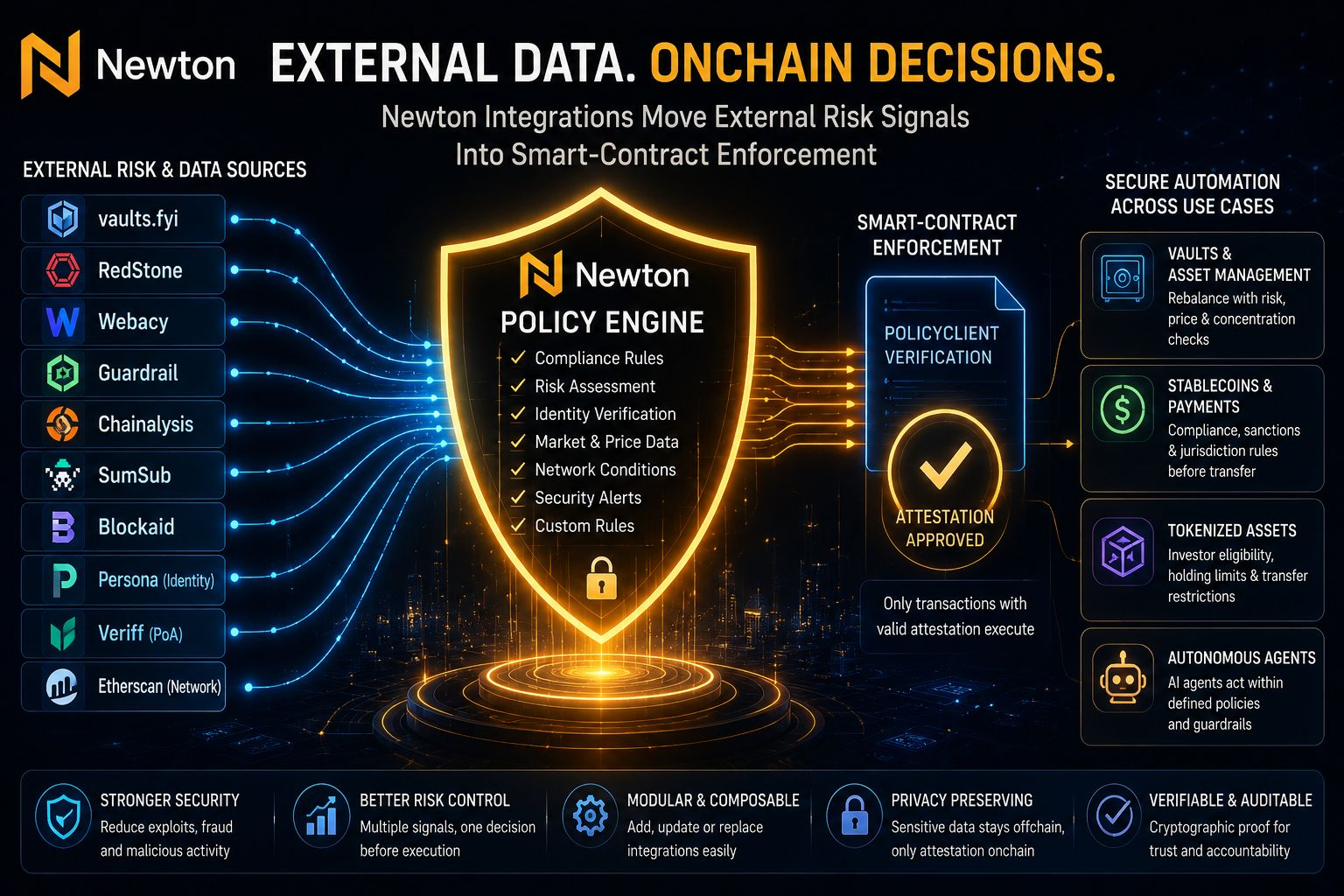
Instead of treating external services as dashboards that generate alerts after an event, Newton places their signals inside the authorization process before a transaction reaches execution.
The difference sounds subtle, but it changes how applications respond to risk.
Imagine an AI agent preparing a vault rebalance. The strategy may be profitable, the destination contract may be trusted, and the transaction may be technically valid. Yet the market price could suddenly diverge, gas fees could spike, or a connected address could trigger a compliance warning.
Traditionally, those events are detected after the transaction has already been submitted or settled.
Newton's policy model aims to evaluate those conditions first.
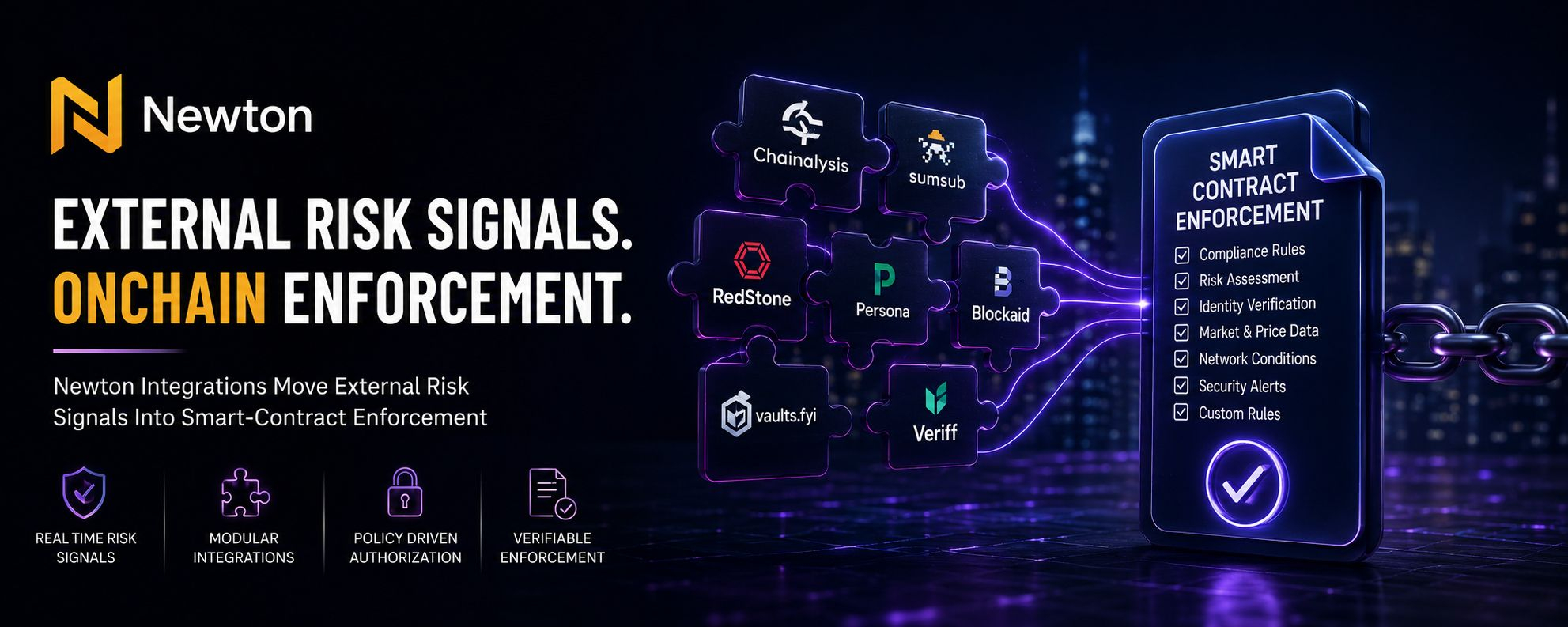
Rather than giving every external provider direct control over execution, each service contributes evidence. Risk engines, identity providers, compliance tools, market data, and security platforms become independent inputs that a programmable policy evaluates together.
Only when the complete policy is satisfied does execution continue.
That separation is important because information and authority are not the same thing.
A sanctions provider identifies exposure.
A pricing oracle reports market conditions.
An identity platform verifies user attributes.
A security engine detects suspicious activity.
None of them independently approve a transaction. Their signals become part of a broader authorization decision.
This approach allows multiple conditions to influence the same action.
A wallet might successfully pass identity verification but still fail sanctions screening.
A vault allocation may remain within portfolio limits while relying on stale market data.
An autonomous trading agent could identify the correct opportunity, yet execution might be delayed because network conditions no longer meet predefined requirements.
Looking at authorization through this lens makes integrations feel less like optional features and more like infrastructure.
Applications no longer consume external information only to display it on a dashboard. They use that information to determine what is actually permitted onchain.
That could become increasingly valuable as tokenized assets, autonomous agents, and institutional finance require stronger operational controls without sacrificing automation.
Of course, this model is not without trade-offs.
More integrations also mean more dependencies.
Data providers can experience outages, deliver delayed information, or apply different scoring methodologies. Even a perfectly enforced policy can produce poor outcomes if its inputs are inaccurate or its thresholds are poorly designed.
Cryptographic verification confirms that a defined process was followed.
It does not guarantee that every external signal was correct.
Privacy also remains a critical consideration.
Identity and compliance data should influence authorization without exposing unnecessary personal information onchain. Keeping sensitive evaluation offchain while anchoring only verifiable approvals can reduce disclosure, but developers must still decide which attributes deserve influence over execution.
Ultimately, the long-term value of this model will not depend on how many integrations Newton announces.
It will depend on whether developers consistently build applications where external context changes authorization before capital moves.
If that becomes common practice, integrations may evolve from passive information sources into active components of the execution layer itself.
The data describes the environment.
The policy evaluates the context.
The smart contract enforces the outcome.
@NewtonProtocol #Newt $NEWT $EVAA