

Main Takeaways
Binance invests around $300 million a year in compliance – exceeding what most major banks spend – with nearly 1 in 4 employees dedicated to keeping users safe.
In just over a year, our systems intercepted $10.53B in fraud and helped recover over $8.2B in user assets since 2021.
To date, Binance has supported global authorities across 313,653 law-enforcement requests, helping strengthen trust and accountability throughout the digital asset ecosystem.
As digital assets become increasingly mainstream, one question continues to surface: can crypto platforms operate with the same level of security, oversight, and compliance expected from traditional financial institutions?
At Binance, the answer isn't something we ask users to take on faith. Compliance is one of the largest investments across the company – underpinning everything from fraud prevention and user protection to law-enforcement collaboration and asset recovery. Here's what our commitment looks like in practice.
Investing in Compliance at Scale
While innovation may attract users, trust allows an ecosystem to scale sustainably. Compliance is one of the ways that trust is built – through fraud prevention, asset recovery, law-enforcement collaboration, and ongoing investment in user protection.
At Binance, that investment amounts to approximately $300 million annually, supporting the technology, investigations, operations, programs, and people that help safeguard users across the platform. Relative to assets held, Binance allocates an estimated 0.22% toward compliance versus roughly 0.14% across the broader financial industry – about 57% more, per Binance Research estimates based on data from AscentAI and BCG.
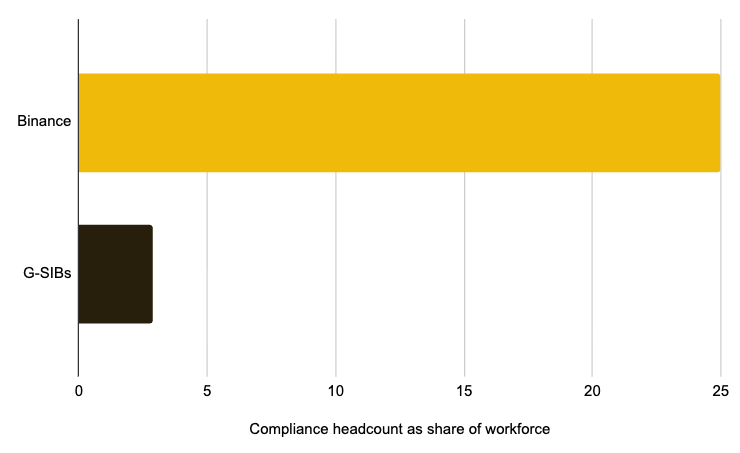
Our investment extends beyond direct financial investment alone. Nearly 1,500 professionals – around one in four Binance employees – work in compliance-related functions. Binance invests approximately $50,000 per employee annually in compliance – several times the level typical of large financial institutions
To put this into perspective, BCG estimates that even the largest global systemically important banks (G-SIBs) typically dedicate around 1% to 3% of total employees to compliance functions. Binance's allocation is approximately 8.6 times higher than G-SIBs, a reflection of how seriously we take user protection.
Results: Binance's Share of Activity Tied to Sanctioned Flows is Well Below the Industry Average
The clearest test of any compliance program is its effect on illicit activity – and by that measure, the results speak for themselves. As of June last year, only about 0.018-0.023% of total Binance transaction volume was linked to illicit addresses. This means Binance operates with a low concentration of illicit activity, reducing user-level risk and reflecting the impact of sustained compliance investment.
Measurable Outcomes: Recovering and Protecting User Assets
Cybercrime remains one of the most significant threats facing the digital asset industry. In 2025, Binance assisted in the recovery of approximately $114 million linked to external hacks and security incidents. In 2026 to date, we've already helped recover an additional $60.2 million year-to-date – bringing the total to more than $174 million returned in the face of external attacks.
Furthermore, in 2025 we helped recover $8.2 billion in missent assets across 1.28 million user appeals – funds that, on most platforms, would have been lost.
AI-Powered Protection for Users
As threats grow more sophisticated, so do our defenses. In the first five months of 2026 alone, Binance spent more than $3 million in compute on compliance-focused AI – systems built to detect suspicious behavior, surface emerging threats, and improve the speed and accuracy of investigations. And the results speak to their reach: between 2025 and Q1 2026, these systems intercepted approximately $10.53 billion in potential fraud, scams, and anomalous activity before harm could occur.
Supporting Global Law Enforcement
We believe that protecting users extends to working with authorities working to hold bad actors accountable.
In 2025 alone, Binance handled 72,632 law-enforcement requests from authorities worldwide. As of June 2026, that figure has already reached 36,235 requests, bringing the all-time total to 313,653, while maintaining the safeguards and legal processes that protect users' rights. This collaboration draws on blockchain analysis, cross-platform coordination, and rapid incident response – designed to help victims recover assets and limit criminal activity – and has contributed to successful enforcement actions and asset-recovery efforts across the globe.
Final Thoughts
The question we began with – can crypto platforms operate with the same rigor as traditional finance? – has a clear answer at Binance. We've gone beyond the standard on every front – in what we invest per employee, in the size of the team we dedicate to it, and pairing it with AI advanced enough to match the pace of modern threats. The proof is in the outcome: billions intercepted, billions recovered, and countless users protected.
As the digital asset landscape evolves, Binance remains committed to building one of the industry's most robust compliance and safety operations – not as an end in itself, but as the bedrock of a safer, more trusted ecosystem, and ultimately, the financial super app for all.
Further Reading
AI Versus AI – How Binance Is Defending Users in the Age of Intelligent Fraud
The New Front Line of Compliance: How Binance Uses AI to Stay Ahead of Financial Crime
Cut the Costs, Open the Gates – Here’s How Binance Lowers the Friction on Investing
Disclaimer: Digital asset prices can be volatile. The value of your investment may go down or up and you may not get back the amount invested. You are solely responsible for your investment decisions and Binance is not liable for any losses you may incur. Not financial advice. For more information, see our Terms of Use, Binance Pay Terms of Use and Risk Warning.