
We don’t just need smarter robots. We need better rules for them.
I’ll be honest: a lot of robotics talk sounds cool for five minutes and then falls apart the second you ask one basic question who controls this stuff, and how do we know it’s acting safely?
That’s why Fabric Foundation stands out to me.
From my point of view, the big idea behind Fabric Protocol isn’t just “let’s build robots.” That part alone isn’t new. What actually matters is the deeper layer: how robots are built, governed, verified, and improved together in public, instead of behind closed doors. And yeah, I think that matters a lot more than people realize.
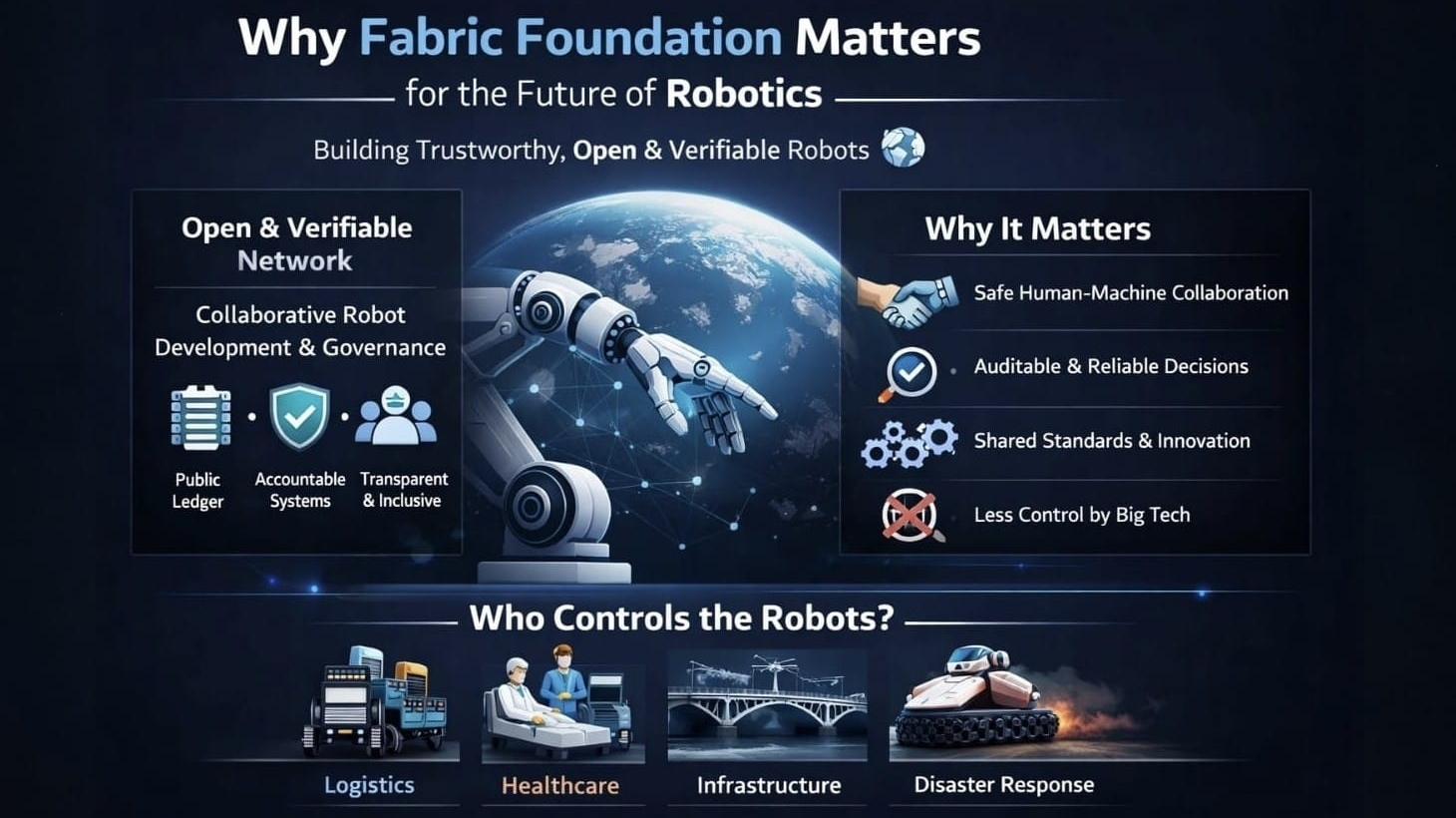
Fabric Protocol, as described, is a global open network backed by the non-profit Fabric Foundation. It’s designed to support the construction, governance, and collaborative evolution of general-purpose robots using verifiable computing and agent-native infrastructure. That may sound a bit technical at first, but the core point is pretty simple: robots shouldn’t just be powerful — they should be accountable.
And honestly, it’s about time.
Why this idea actually matters
We’re moving into a world where machines won’t just do repetitive factory work. They’ll assist in homes, warehouses, hospitals, public infrastructure, and probably places we haven’t even thought through properly yet.
That creates a real problem.
If a robot is making decisions, handling tasks, collecting data, or interacting with humans, then people need answers to basic questions:
Who trained it?
What data shaped its behavior?
Who gets to update it?
What happens if it fails?
Who checks whether it followed the rules?
A public, verifiable system for coordinating data, computation, and regulation makes a ton of sense here. Without that, we’re basically trusting black boxes with physical power. That’s not futuristic. That’s reckless.
The part I like most: it’s not just about innovation, it’s about coordination
This is where I think Fabric Foundation has a genuinely strong angle.
A lot of tech projects obsess over performance first and governance later. That usually ends badly. You get rapid scaling, vague accountability, and then everyone starts acting surprised when safety, ethics, or control become a mess.
Fabric seems to be trying the opposite route: build a framework where infrastructure, governance, and verification are part of the system from day one.
I like that. A lot.Because robotics is not just a hardware problem. It’s also a coordination problem.
If thousands of developers, researchers, manufacturers, operators, and regulators are all contributing to robot behavior, then there has to be a shared system for trust. Otherwise it turns into fragmented chaos different standards, unclear responsibility, and way too much room for abuse or sloppy deployment.
What “verifiable computing” means in real life
This part sounds technical, but it has very human consequences.If a system uses verifiable computing, the basic promise is that actions, computations, or decisions can be checked rather than blindly trusted. That’s huge.
Say a robot is used in elder care. Or in a warehouse moving heavy goods near human workers. Or in disaster response where bad decisions can seriously hurt people. In those settings, “trust us, the model works” is not good enough.
You need proof trails. You need logs. You need clear governance. You need ways to audit what happened and why.
That’s where Fabric’s model gets interesting. A public ledger coordinating data, computation, and regulation could help create a clearer chain of responsibility. Not perfect, obviously. Nothing is. But way better than opaque systems where no one really knows what the machine did until after something breaks.
Open networks usually bring one big advantage: fewer gatekeepers
This is another reason I’m positive on the idea.
When a protocol is open and supported by a non-profit foundation, there’s at least a stronger chance that development won’t be dominated entirely by one private company chasing its own incentives. That doesn’t magically solve everything, but it changes the tone.
It opens the door to broader participation: developers can build, researchers can test, communities can contribute, and governance can, at least in theory, become more transparent.
That matters because general-purpose robots shouldn’t become the property of a tiny handful of players who decide how machines behave for everyone else. That’s a bad setup, full stop.
An open network gives us a shot at shared standards instead of isolated control towers.
Still, let’s not act like “open” automatically means “safe”
My hot take: open systems are powerful, but they’re not automatically responsible.
People sometimes hear “open network” and assume it means fair, democratic, and safe by default. Nah. It just means the door is open. You still need serious governance, clear incentives, abuse prevention, and practical rules that work in the real world.
That’s why the Foundation part matters just as much as the Protocol part.
A non-profit structure can help keep the mission focused on long-term public value instead of short-term hype. But it also has to stay credible. That means being transparent, technically serious, and willing to handle messy questions around safety, misuse, incentives, and power.
Because once robots become general-purpose and collaborative, the stakes go way up. A bug in software is annoying. A failure in a physical robotic system can be dangerous fast.
Where this could become genuinely useful
I think Fabric Protocol becomes most compelling when you stop thinking about abstract “robot futures” and start looking at everyday use cases.
1. Warehouses and logistics
Robots already work around humans in fulfillment environments. A shared protocol for verified updates, coordination, and accountability could reduce risk and improve trust between operators, companies, and workers.
2. Healthcare and assisted living
If robots help with support tasks, mobility, monitoring, or delivery inside care environments, there needs to be a strong system behind how they behave. Not just “AI vibes.” Actual structure.
3. Public infrastructure
Cleaning robots, inspection bots, maintenance systems these don’t sound glamorous, but they matter. Public-facing robotics needs more transparency than most private software tools.
4. Disaster and hazardous environments
In dangerous zones, robots can do work humans shouldn’t have to do. But the more critical the job, the more important it is that the system behind the machine can be audited and trusted.
That’s the practical case. This isn’t just cool tech for demos. If it works, it could shape how real human machine collaboration happens at scale.
My honest opinion: this is the kind of robotics project worth paying attention to 👀
I’m way more interested in infrastructure that makes robotics trustworthy than flashy robot videos on social media. Anybody can post a slick demo. That’s easy. The hard part is building systems that can scale responsibly.
Fabric Foundation seems aimed at that harder problem.And that’s why I think it matters.
Not because it promises some sci-fi robot utopia. Not because “decentralized” sounds trendy. And not because every open protocol deserves blind praise. It matters because it appears to focus on the one issue robotics can’t dodge forever: how humans stay meaningfully in the loop while machines become more capable.
That’s the real fight.If Fabric can help make robot development more verifiable, more collaborative, and less dependent on opaque control, then it’s not just another protocol. It could become part of the basic trust layer for future robotics.
Takeaway
The future of robotics will be decided less by who builds the fanciest machine, and more by who builds the most trustworthy system around it.
That’s why Fabric Foundation feels relevant.
It’s trying to connect robotics with public accountability, shared governance, and verifiable infrastructure. And in a space where too many people still act like speed matters more than responsibility, that feels like a smart move.
Not perfect. Not guaranteed. But definitely worth watching.
And honestly? I’d rather see the future of robotics shaped by open, checkable systems than by secretive black boxes with good marketing. That’s just common sense. 🤝🤖